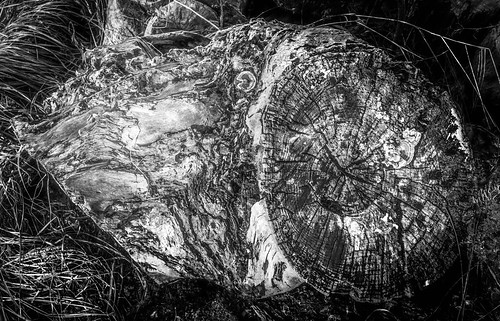
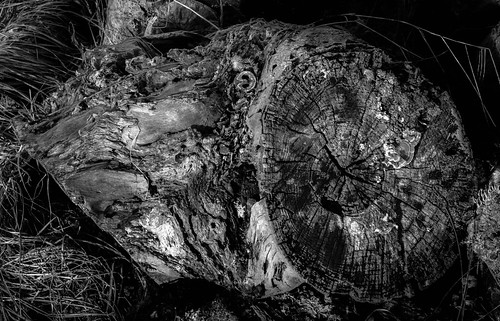
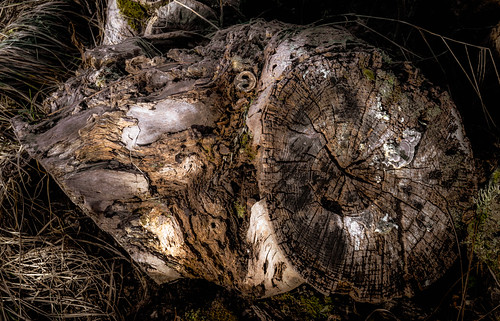
Category Archives: photography

two Newfoundland gravestones

As I work on a project (photographic or otherwise) I’m continuously wondering why—seeking for reasons, bits of insight, overarching whithers. What is it about gravestones that keeps me returning to cemeteries? It turns out that the answers are many, and not simple, forever unfolding into new revelations of the depths and varieties of Form. For me, so much of the pleasure is in reading (that is, imagining, chasing, constructing) the Story contained in any instance of the Form.


Querpon02

This stone is from Querpon, at the northern tip of the western shore of Newfoundland. ‘Killed by dogs’ is not a phrase found on many gravestones, but we surmise that Murray Roberts might have been teasing tied-up sled dogs (there were not many snowmobiles in Querpon in 1967) who got loose and took revenge. I had a chance to find out, but muffed it: also visiting the tiny graveyard the day I was there was a man of more or less my age who was “visiting the parents” and told me he’d left Querpon in 1962 to join the Canadian Forces and only returned to Querpon when he retired… but he’d have been a teenager at the time, and would surely have remembered the incident. And it’s not unlikely that Murray was a shirt-tail cousin, Querpon being about 20 households.

This double stone, from Isle aux Morts at the southwestern tip of Newfoundland, sketches a tale that it turns out we can fill in details on. We begin with two brothers, a disaster to a named boat, a precise date, even some detail on their marital status:
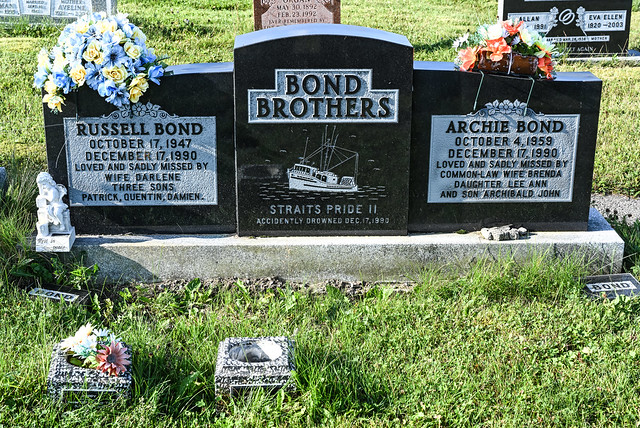

Margaree24viii1902

Straits Pride II went down in a storm 29 years ago, and the incident was thoroughly investigated by the Transportation Safety Board:

On 17 December 1990, the F.V. “STRAITS PRIDE II”, inbound to St. John’s, Newfoundland, from
the fishing grounds with a two-third load of round (ungutted) codfish stowed in the fish hold,
encountered adverse weather, capsized and sank throwing the six-person crew into the ice-cold waters. Three crew members who managed to board the inflatable liferaft were subsequently rescued, but the remaining three lost their lives.

The Transportation Safety Board of Canada determined that the vessel continued to fish after learning of a forecasted storm warning and that the combined effects of the weather, shipped seas, stowage of the catch, free surface effect of liquids, loss of the port paravane, and downflooding caused the vessel to capsize and sink by the stern. The suddenness of the capsizing precluded efforts by three of the crew to successfully abandon the vessel, displacing them into the sea. As they were wearing only normal winter clothing with approved lifejackets, their survival time was limited. The other three crew members boarded the liferaft from the sea and were rescued some eight hours later in a mildly hypothermic condition. (see the detailed report of the incident)

and there’s more, in the form of a song:


I also learned (via Google) that Russell Bond’s wife Darlene died in February 2019, and that Russell had found a life-ring from the Ocean Ranger in 1982:

Officials at the Search and Rescue Center said Friday that a life-ring found on Newfoundland’s south coast was not from the Ocean Ranger oil rig that sank in February but from a Greek vessel bearing the same name. The ring was discovered on the beach at Burnt Islands, near Newfoundland’s southwest corner, last week by Russell Bond, a local fisherman. Bond turned the life-ring over to the RCMP and told local reporters he was certain it had come from the giant oil rig that sank Feb.15 on the Grand Banks, killing all 84 crew aboard.

Small things, bits of drama from lives lived quietly, of no great significance, but fascinating for their essential humanity.

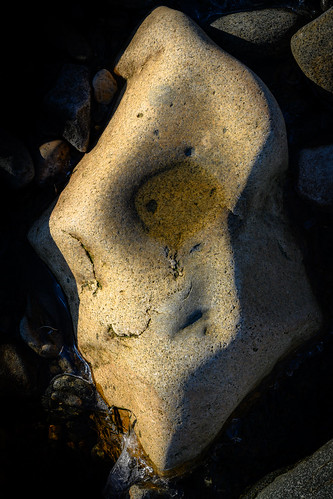
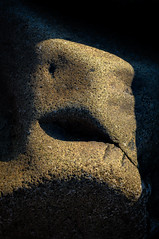
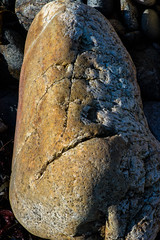
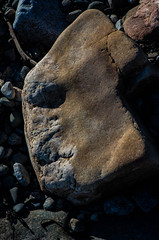
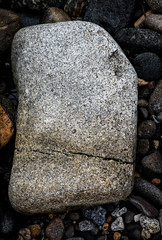
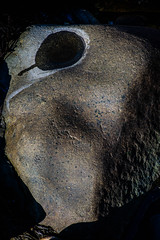
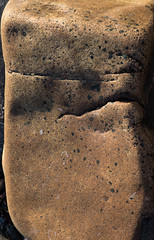
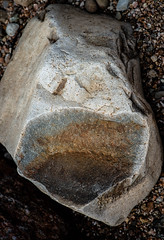
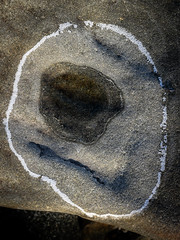
Rocks from whom one learns


NFLDrock1

NFLDrock4

NFLDrock3

Last night I took this specimen along on a visit and our hostess said “oooh is this a gift?” and I was immediately protective. “Certainly not!” I said, and immediately regretted my vehemence in defense of my rock, as I hadn’t even photographed it yet. I did make its portrait today, and thus recognized a Lesson in Attachment—one I might have learned (but had clearly forgotten) with the Bodhidharma example cited at the end of the Morphic Resonance post. In what wise is this rock my rock? Why should I wish to hold on to it? Wouldn’t it be better to appreciate it and pass it on so that others could enjoy its verisimilitude? Isn’t it enough to have discovered its several personalities and felt its agency? Yes, yes, 10,000 times yes.

of Morphic Resonance

It’s been months since the last post here, almost 3 quite busy months since our return home from this year’s cross-continent trip. The last six weeks included a very successful gallery show for Broot and a one-day pop-up show for me, and we’re now in Nova Scotia, just finishing another 3-week trip, this one a 55th anniversary circumtransit of the Gulf of Saint Lawrence (four nights by freight boat from Rimouski to Blanc Sablon PQ; ferry from Labrador to St. Barbe, Newfoundland; north to L’Anse aux Meadows, then down the west coast to Gros Morne National Park, then ferry to North Sydney NS, and finally to Horton Landing; home to Maine by the weekend).

StLawrencesatellite

The usual welter of thoughts and reading and explorations of this’n’that accompanied, of course, so there’s much to get caught up.

The Flickr photostream tells many tales but also leaves out happenings that didn’t happen to get photographed. I’m just uploading the bountiful harvest of our week in Newfoundland, and thinking through What It All Means. And wondering what’s next. There are Flickr Albums of faces, surfaces and abstracts, and landscapes as a first stab at sorting the hundreds of images.

The perennial puzzlement of how to think about and what to do with the vast array of anthropo- and zoomorphic images of rocks and wood and water seems to be heading toward a resolution, but the complexities and leaps of association that underlie will take some explication. The cut-to-the-chase of the moment is an evolving scheme for a multimedia gallery presentation next summer, the provisional title for which is

Morphic Resonance:
Portraits in Stone, Wood, and Water

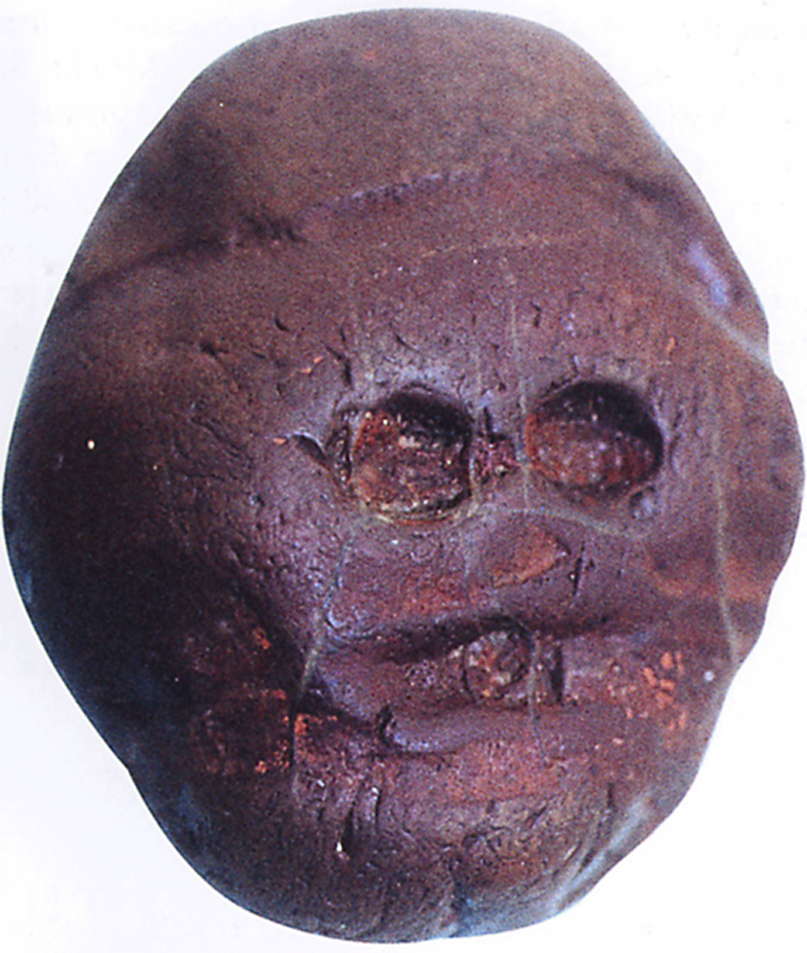
but the emergence of that title takes us back more than 3 million years, to the Makapansgat Pebble, which is surely an anthropomorphic form.:


The hominin ancestor who picked up and carried the pebble some 20 miles from its geological origin seems to me to represent an early (I’m tempted to claim the earliest) instance of aesthetic Consciousness in our own evolutionary branch [“possibly the earliest example of symbolic thinking or aesthetic sense in the human heritage”]). My own pursuit of wholly imaginary faces in various materials seems a direct descendant. I’ve been chewing over the deeper significance of this for the last year or so (since I learned of the Makapansgat Pebble). A couple of weeks ago the phrase “morphic resonance” drifted through my mind, and seemed somehow portentious (though I can’t remember when/where I first encountered it). It turned out to be a coinage of Rupert Sheldrake:

Morphic resonance is a process whereby self-organising systems inherit a memory from previous similar systems. In its most general formulation, morphic resonance means that the so-called laws of nature are more like habits. The hypothesis of morphic resonance also leads to a radically new interpretation of memory storage in the brain and of biological inheritance. Memory need not be stored in material traces inside brains, which are more like TV receivers than video recorders, tuning into influences from the past. And biological inheritance need not all be coded in the genes, or in epigenetic modifications of the genes; much of it depends on morphic resonance from previous members of the species. Thus each individual inherits a collective memory from past members of the species, and also contributes to the collective memory, affecting other members of the species in the future.

This seems akin to notions of ‘distributed consciousness’ with which I’ve been toying in the last year or so, and surely skates on the rim of mystical hoo-hah. I direct your attention to the Bodhidharma posts of February 2018 for earlier instances, and of course to the Just a Rock: a lithic menagerie book; see also Form Finds Form and Just Another Rock and Allegories and Agglomerations for more kindred threads.

department of co-incidence

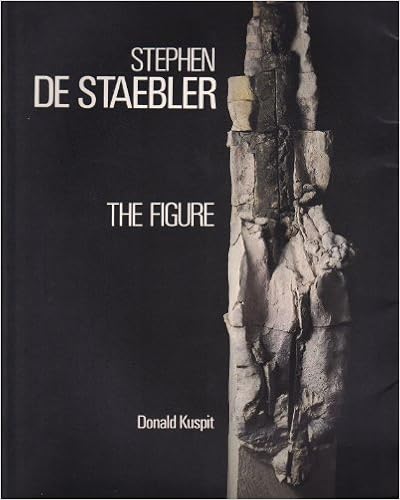
During a visit to Vashon Island, a series of unplanned conjunctions took me to the Vashon Bookshop for a half hour of browsing before our reservation at the marvelous May Kitchen and Bar. This book leapt into my arms:


Stephen De Staebler was my 9th grade history teacher (1957-58), and offered a high-energy version of World History to a class of 15 or so engaged and eager students. He also taught a class in stained glass for 5 of us, with lead and solder and glass cutters, the real deal. He was only at the school for a year, but was unforgettable for his contagious enthusiasm. He went on to become a well-known sculptor and teacher at San Francisco State, and died in 2011. His website (stephendestaebler.com) represents his work quite well. I was something between delighted and gobsmacked to discover a gallery of masks that presage my recent work with lithic personalities. At the very least, we draw upon the same mysterious vein of mimetic imagery (“a term used in literary criticism and philosophy that carries a wide range of meanings which include imitatio, imitation, nonsensuous similarity, receptivity, representation, mimicry, the act of expression, the act of resembling, and the presentation of the self” in its Wikipedia rendering). There’s also this quote to consider:

Much of art is play in the serious sense,
like magic, trying to restructure reality
so that we can live with the suffering.

-Stephen De Staebler, 1984

I’m not quite sure what to do with “the suffering” but I’m pleased to consider what he might mean. It’s the sort of responsibility one has toward one’s well-remembered teachers. Alas, there are only a couple of 9th grade classmates left who remember Steve De Staebler, and I wish I’d been able to convey my thanks to him for what he taught and what he Taught.

Spring, finally


29iii1902

Just about to depart for a 6-week cross-country driving trip, anticipating many opportunities to photograph novel things in unfamiliar territories. I’m sure that thoughts about photography will arise as we go, and perhaps when we return I’ll have the requisite inspiration to plunge into the Blurb books that have been gathering a head of steam during the winter.

One that seems somehow inevitable is tentatively titled Elevenses, being the eleventh:

‘Elevenses’ (‘elevensies’ if you are a Hobbit, or a non-Hobbit with a penchant for puerile language) refers, as the word itself suggests, to food taken at eleven in the morning. Actually, the word applies not to the mere snack itself, but to the whole concept of a brief, healing pause in the crisis of the day. It is peculiarly British, and is rather more significant than its common definition of “a light informal snack” would suggest. It is, in fact, an institution, an inviolable right, a routine without which the British could not (would refuse to) continue with their working day. (Note to any country considering invading Britain: do it at eleven a.m. when everyone’s attention is focused elsewhere.)
(from theoldfoodie.com)

Perhaps Elevenses wants to be free-standing, and thus able to include occasional images that have appeared in other books. Perhaps it’s about what I think about photography, and about my own practise in the medium. Sometimes it’s a bit difficult to know which are my own ideas, which are my distillations of others’ ideas, and which are basically purloined words of other writers. I imagine Elevenses as an effort to sort those various strains out.

As I have read about photography I have transcribed especially trenchant passages, in which authors seemed to be speaking directly to my concerns and sensibilities of the moment. It’s difficult to know how useful such extracts might be to others, unless I am able to use them to illustrate or exemplify some particular point or issue in my own photographic work.

One more ears-of-hippopotamus that I’ve been contemplating: Landscapes of the Imagination.

And why not give Ansel Adams the last word?

Ansel Adams to Dick Miller, 1973:
My concept of photography is nothing tangible. I want my images to vibrate in vacuum, giving vent to the intangible tangibles of the immediate tangent. My prints reflect my deep non-concern with the concernable. When I am out with my camera I am in with my libido.

If photography is silence, then I am a sonic boom. If photography is a sonic boom then I am extinguished. One must make a decision: is photography an art or is it a rural funicular railway, descending into levels of non-comprehension, ornamented with the pangs of perverse euphoria?

My photographs reflect just that and nothing (more). My reflections reflect my photographs; a spiritual, Zen-like reflection of the reflectivity of the reflective spirit.

I stand supine at the realization of my semi-experience. May my prints cause a re-supinization of my spectators. Let us PRAY!

clarity


salt1x4

All the world is taken in through the eye,
to reach the soul,
where it becomes more,
representative of a realm deeper than appearances:
a realm ideal and sublime,
the deep stillness that is,
whose whole proclamation is
the silence and the lack of material instance
in which,
patiently and radiantly,
the universe exists.
(Mary Oliver, “Emerson”)

Allegories and Agglomerations


vent Allegory

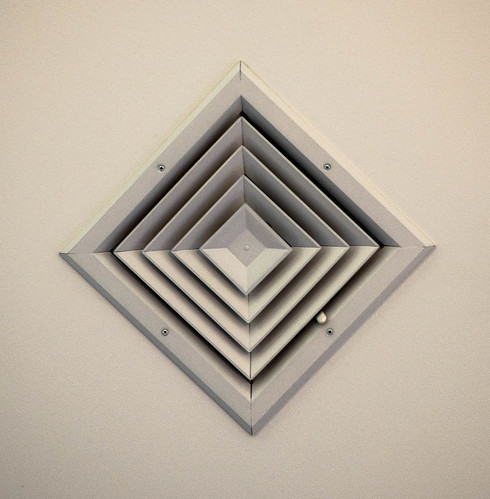
I’ve been thinking about this image ever since I captured it back in August, and wondering how to explain what I saw, what it means, and how it fits into my evolving sense of personal engagement with photography.

The train of thought came about during a yoga nidra session, as I lay immobile for 40 minutes or so with no other visual stimulus than a ho-hum quotidian ventilation duct on the ceiling 15 feet above me. The suggestion was that I close my eyes, but they decided to remain open. The eyes seem often to have minds of their own. The wider context included about a year of deep and deeper immersion in photography, including lots of reading and writing and thousands of photographs studied and taken.

Contemplation of the metal duct provoked the insight that narratives unfold —the case with most tessellations, and also with the presentation of groupings of images, exemplified by my galleries of faces on rocks and other materials. As one looks and studies and ponders, unexpected visions and associations arise, and underlying realities emerge, or (as it might be) are imagined.

The duct itself is pretty simple: a utilitarian presence with little or no artistic intent, a piece of unpretentious industrial design, one of many thousands of ducts, formed of sheet metal in a way that is sensitive to function and to market pricing, and surely not imagined by designers and manufacturers as the inspiration for anything. Geometrically it’s just a triangle, mirrored and then mirrored orthogonally into a symmetrical diamond shape. But upon contemplation it’s clear that there’s more to it: a something else that might be a Creature manifests, equipped with eyes and even a tongue. And suddenly the duct is not so simple, and inspires the viewer to consider Unfolding, and Creaturehood, and Allegory.

Namaste, tout le monde.

The next morning I returned with a camera and found that the Creature was still in residence, and was as provocative as it had been the day before.

The Full-frontal Spiritual Manifestations: gods, godlets, daemons and other beings project seems a direct outcome of the adventure with the duct.

Addendum: the wee hours found me considering that Agglomerations consist of Agglomera, and that the singular would thus be Agglomerum; Agglomeratio would be the act of gathering up Agglomera. By itself,

30xii1832
is just an oddly-shaped rock, but in company (Agglomerated) with others of its ilk, other possibilities emerge:

30xii1832 30xii1833 DriftInn1i1817

DI6ii077 DI7ii059 DI25i18072

DI2i1876 Wass29vii18079 28xii1816

Christmas ephemeral

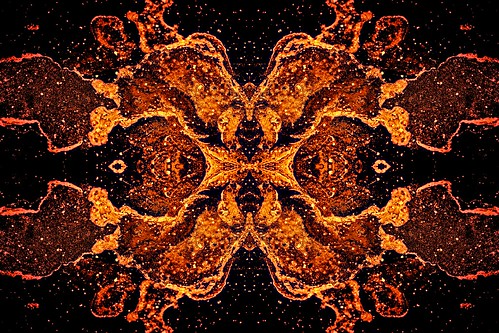
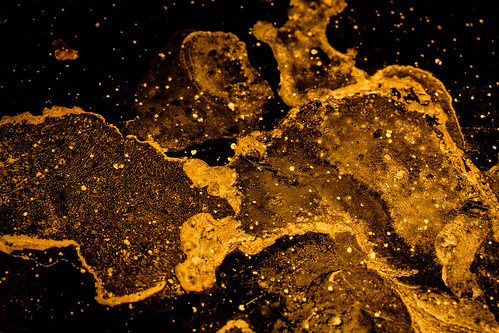
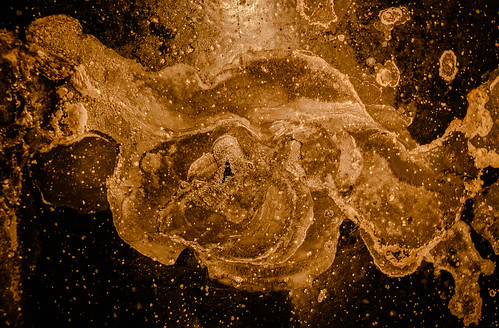
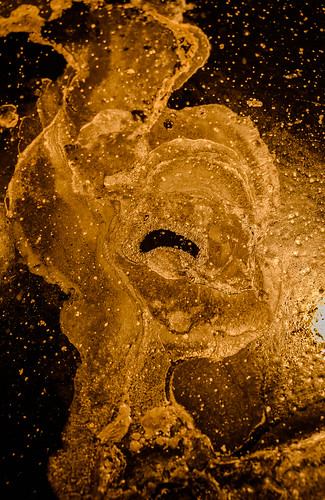
It began with a dozen very local oysters (Ice House Cove, thanks to Toni and John who presided over their growing). The very local trick for opening them is to put them in the oven for a few minutes, just until the shells open. Absolutely delicious. A byproduct is some of the salty oyster liquor leaking into the pan and crystallizing with the residual heat. Instant abstract, sort of galactic in flavor:

oyster pan

Of course I couldn’t let that be the final act…


salt1x4

And there were a couple of other captures from the same pan:


oyster pan

oyster pan

enigmata

I like me a good enigma, and I’ve used that word in all sorts of connections over the years, but never thought to inquire into its etymology and various senses. Dictionaries seem to agree that the Greek ainos, ‘fable’, is the original progenitor, but others cited are Greek ainisessthai, ‘to speak allusively’, and Latin aenigma, ‘riddle’. The modern senses favor

  • mysterious
  • puzzling
  • hard to explain
  • inexplicable
  • hidden meaning or known thing concealed under obscure words or forms
  • dark saying
  • baffles understanding

Looking over my own past uses, I seem often to invoke enigma in describing something non-obvious that interests me or piques curiosity or captures my attention. An artful story is what’s required to dispel murk (or mirk). See Narrativium for the how and why.

Most dictionary senses seem to favor the textual enigma, but I’m especially drawn to visual instances, in which there’s something unresolved


Orrs Island mystery

or ???huh???
children at play

or flat-out puzzling

This morning in the Back 40

or ambiguous and suggestive of multiple possible readings

the morning after the night before

or just plain weird

31x18068

Edward Gorey on writing:

…the way I write, since I do leave out most of the connections, and very little is pinned down, I feel that I am doing a minimum of damage to other possibilities that might arise in a reader’s mind. (New Yorker Dec 12 2018)

Photographers who traffic in enigma and abstractions of various kinds, and/or explore Buddhist and Taoist notions of the contemplative owe a lot to Minor White. Herewith some of my thoughts from more than a year ago: Major Minor.

just a stump

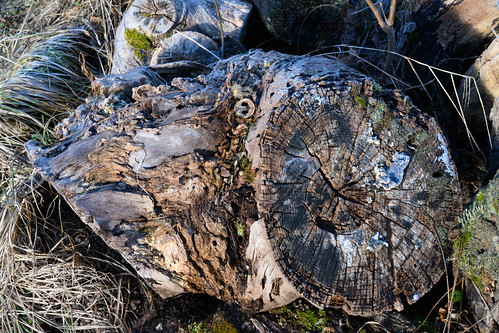
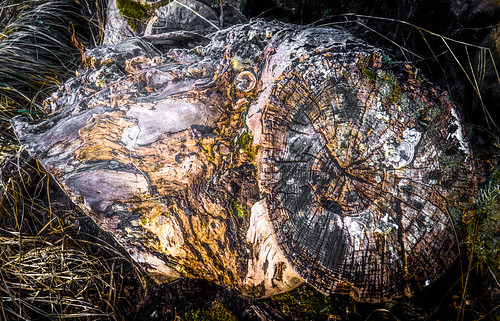
Digital processing is really a marvel, especially in the ease with which one can tweak an image to express different flavors, moods, attitudes. The danger is that it’s easy to take the tweakage too far, but that’s really subjective. Here’s one from yesterday in which various changes are rung (as Bill Skinner was wont to say). It’s worthwhile to contemplate why one might prefer one or another version.

the unedited original:
stump as shot

cropped and adjusted, subjectively pleasing:
stump1

monochrome, with green filter:
stump b+w green filter

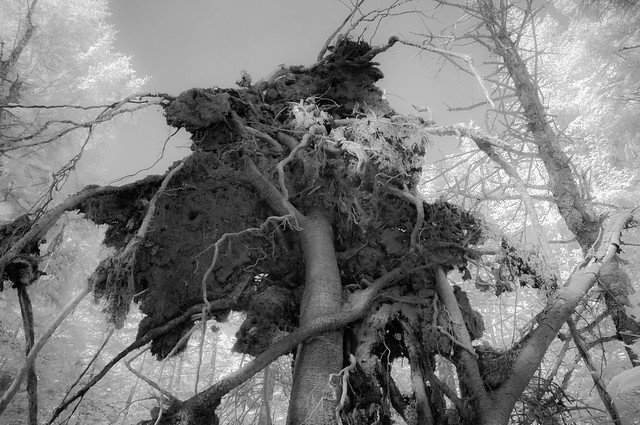
using Lightroom’s “Infrared” preset:
stump "IR"

using Lightroom’s “aged photo” preset:
stump "aged"


Of course I see a creature, probably a large-mouthed fishy person (a staring eye in the upper center)