all what you do it come back to you
you got to bear the consequence
(an extended rumination, knitting several trains of thought)
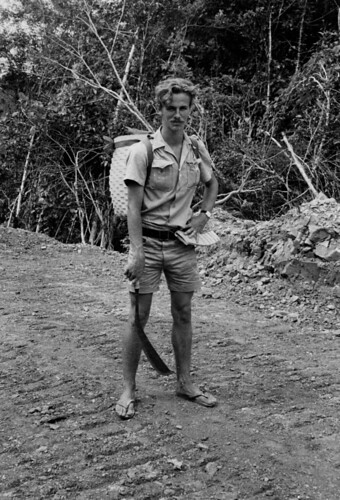

53 years ago we were in Sarawak, helping to build a new village into which people from 15 Iban longhouse communities would be resettled. This Land Development Scheme (its formal designation) involved the planting of high-yield rubber trees which the Scheme participants would (eventually) tap, thus trading a semi-self-sufficient life on the fringes of the cash economy for full-fledged peasant status, living on the proceeds of their labor in the sort-of-cooperative rubber plantation. They would “own” their rubber plots, but pay mortgages on the land and on the single-family houses in the new village. What could possibly go wrong?
The premise that government-sponsored Development would make a better life for all (schools for children, health care clinics, “Progress”) was almost completely unquestioned. The assumption that demand for natural rubber would increase was unstated, because self-evident to the minds of mid1960s government planners. But that’s not how it turned out.
The new village was built next to the single trunk road that connected to the state capital (some 80 miles away) and continued on to link a series of (basically Chinese) towns, all situated on rivers that had formerly been the primary transportation corridors. Quite suddenly the accessibility of rural hinterlands changed—buses were available to nearby towns, a vastly expanded range of goods and services became available, and participation in a national and international cash economy was ubiquitous.
That process of infrastructural development and contingent change was what I thought I would return to Sarawak to study, but that’s not how it all worked out. I went to Nova Scotia instead, and only occasionally checked in with what was happening in Sarawak. The last 50 years has brought devastation of forests, the building of large dams on several rivers, rural dislocations and resettlements, and the advent of palm oil plantations to take the place of rubber as the principal primary export commodity. The Sarawak we knew is all but unrecognizable.
The new village of 50 years ago was on the edge of a vast and largely impenetrable peat swamp, covered in 100+ foot hardwood trees. Nobody envisioned any possible use for that land, since it would have to be drained and cleared. Nobody thought of palm oil as a possible crop for Southeast Asia until about 1980. That’s when Malaysia (and Indonesia) started to ramp up palm oil planting. Beyond swamp-draining and planting of oil palm, I don’t know any of the details of the development in the area we worked in, but in general the development process in Sarawak involves government and large corporations, and the public face of the operations emphasizes the benefits to one and all of the glorious implementation. The only sure thing is that the little people get squeezed and screwed, while somebody else reaps the benefits.
My attention to this bit of backstory comes about today because of a New York Times Magazine article on the tragedies of palm oil, which mostly focuses on Indonesia, and which raises some wider issues that I’m inclined to discuss under a new rubric: What Kittens?. The reference is to a passage in Don Marquis’s Archy and Mehitabel, written 90 or so years ago but absolutely on the money today. Still more backstory is needed.
well boss
mehitabel the cat
has reappeared in her old
haunts with a
flock of kittens
three of them this time
When I began to read about agriculture, in the early 1970s and before I went to Nova Scotia to do research in what I was pleased to label as “agricultural transformation”, a central concept for my explorations was the importance of exotic energy, by which I meant petroleum fuels and such petroleum derivatives as fertilizers and pesticides. In the 20th century, exotic energy was brought to bear on agricultural production, underwriting its intensification and midwifeing the increasing scale and concentration of agricultural enterprises. It was the inexorability of the transformation process, together with its malign effects upon families and communities, that led me to abjure that line of research as soon as the ink was dry on my dissertation.
I continued to track the significance of exotic energies in human affairs throughout my teaching career, especially in about 15 iterations of a course I called Human Geography. I was never as systematic as I should have been, but I did continue keep eyes peeled throughout the years as a librarian. Some years ago I read a number of news stories about far-sighted experimenters who were using discarded vegetable oil (mostly from fast food fryers) to power their diesel cars. A win-win, one might have thought: recycling a disposable, replacing a petroleum product, carving out an efficiency. Soon after that rash of stories I heard about “biodiesel” as an alternative Green fuel source, and made the assumption that the feedstock must be recycled plant oils… Ah, assumptions. Little did I know that the Southeast Asian palm oil plantations were more and more the primary source of biodiesel, and (hand in hand with deforestation) responsible for much misery along with obscene profits for the perpetrators of ever-larger projects. None of this should have been in the least surprising.
archy she says to me
yesterday
the life of a female
artist is continually
hampered what in hell
have i done to deserve
all these kittens
i look back on my life
and it seems to me to be
just one damned kitten
after another
i am a dancer archy
and my only prayer
is to be allowed
to give my best to my art
but just as i feel
that i am succeeding
in my life work
along comes another batch
of these damned kittens
The world of academic thought and action seems at any point in time to be mappable into distinct Disciplines, though the edges of any Discipline are ragged and permeable. But over time, in decades or generations, the boundaries shift and shimmer, and local heresies morph into schismatic reorganizations; intellectual fashions and leitmotifs come and go, and the focus of the Important peregrinates. I’ve been on the edges of a succession of disciplinary kerfuffles, almost entirely as a bemused observer.
In the 1960s the concept of Development was a leitmotif in many social science disciplines, not least in Economics, Political Science, and Anthropology. After a brief vogue for Ecology, Cybernetics, and a whiff of Sociobiology, in the 1970s and 1980s the leading edge lurched toward Postmodernism and Diversities (thankfully, I missed those morasses). The 1990s found those same fields riveted by Globalization. And the 21st century has seen Global Warming and Inequality come to the fore as the reigning integrative challenges. Each of these seems like an era, and the succession leaves a trail of supposed focal Problems behind, their dilemmas unresolved and their protagonists ageing gracelessly.
but it isn t fair archy
it isn t fair
these damned tom cats have all
the fun and freedom
if i was like some of these
green eyed feline vamps i know
i would simply walk out on the
bunch of them and
let them shift for themselves
but i am not that kind
archy i am full of mother love
my kindness has always
been my curse
a tender heart is the cross i bear
self sacrifice always and forever
is my motto damn them
i will make a home
for the sweet innocent
little things
unless of course providence
in his wisdom should remove them
So I escaped the Wheel in the 1990s, into the aether of Library and Information Science, and enjoyed more than a decade of adventures completely outside of disciplinary argy-bargy, learning and building and following my nose. They paid me to know stuff and find out about more stuff and help others find what they were seeking. I had audience and agency, and an infinitude of things to explore. The 13+ years of retirement continues to present that infinitude, in which I revel. I sometimes miss the audience and the agency, though photography offers both.
these terrible
conflicts are always
presenting themselves
to the artist
the eternal struggle
between art and life archy
is something fierce
my what a dramatic life i have lived
one moment up the next
moment down again
but always gay archy always gay
and always the lady too
But every so often I encounter some subject matter that reopens old files and nudges me toward trying to make better sense of one or another of problems left behind. It was palm oil this time, but who knows what next?
one day she was talking to me
of the kittens
and the next day when i asked
her about them
she said innocently
what kittens
interrogation point
and that was all
i could ever get out
of her on the subject