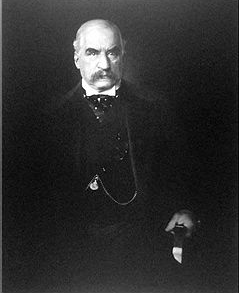
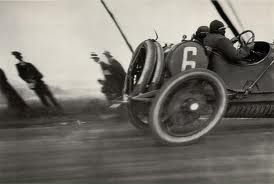
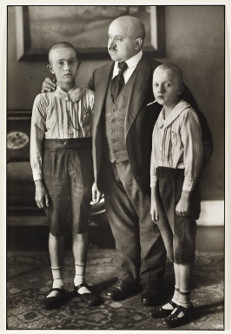
I’ve been reading Will Gompertz What Are You Looking At? The surprising, shocking, and sometimes strange story of 150 years of modern art, and this morning woke from a dream in which I was conducting a seminar in looking at photographs, and presenting an exercise for the participants. I showed them three photographs and asked that they write a response to the question “What are you looking at?” for the three. The idea was that some would know the photographs and/or their makers already, and might write on the place of each in the photographer’s oeuvre; some would be seeing the images for the first time, and might respond more subjectively; some might respond from a technical perspective, discussing how the images were captured and processed; and some might come up with other entirely novel responses to the three pictures. These were the three that came clearly to mind in the dream:
In case they’re not familiar to you, the first is Edward Steichen’s 1903 portrait of financier J.P. Morgan (see discussion), the second is by the 18-year old Jacques-Henri Lartigue in 1912 (see discussion), and the third is from August Sander’s People of the 20th Century, taken in 1914 (see discussion).
I was just imaging the discussion that would result from everyone’s reading of each other’s responses when I woke up. What surprises me is how clear the whole thing was, the images and the process and some of the outcome.
What I love about Gompertz’ title is the various emphases one might give: WHAT are you looking at? What are you looking at? What are you LOOKING at? What are you looking at? All deliciously valid questions, of course, and applicable to any appreciation of visual material (which is just Gompertz’ point, natch). And pursuing this set of questions seems a worthwhile objective for the New Year.
98 cent words are always a pleasure: one can hug oneself over the fine distinctions and definitional nuances they facilitate, or revel in arcana accessible only to the cognoscenti… but sometimes they may serve a constructive purpose by staking out underexplored semantic territory. Chronotope is one such term, handy in helping me clarify an ongoing struggle with images in time. Its origins are more or less in literature:
The concept of chronotope, from Mikhail Bakhtin, provides a useful tool … Chronotope is the coordination of a system of time and space, a form-giving ideology. Bakhtin uses the term to name the set of distinctive temporal and spatial features within a work, the phenomenal « feel » of the world produced by the work, which is, it should be emphasized, quite different from the world in which the work is produced. In the chronotope, “time, as it were, thickens, takes on flesh, becomes artistically visible; likewise, space becomes charged and responsive to the movements of time, plot, and history. The intersection of axes and fusion of indicators characterizes the artistic chronotope.” The chronotope determines, if it does not displace, the more familiar notion of genre… (K.Michael Hays)
‘Chronotope’ has found its way into film discourse, but is rarely used in writing about photography. One exception is a remarkable book of photographs of Afghanistan by Simon Norfolk, Chronotopia: Landscapes of the Destruction of Afghanistan.
I owe my awareness of the term ‘chronotope’ to my friend Ron Nigh, with whom I taught a couple of courses a decade ago (see here and here). About 30 years before that, we had limned related territory in a reading course with G. William Skinner in the general realm of anthropologies of time-and-space (we called it ‘4-space’ at the time), but Bakhtin was unknown to us then.
I want to appropriate (in a Dumptean sense) ‘chronotope’ to talk about the subjective experience of multifaceted time-and-space, a territory I seem to inhabit more and more with each passing year, a continuing tumble through the chronosynclastic infundibulum of now-and-then, here-and-there that passes for Reality.
And I’m caught in time myself, in multiple ways. I belong to a cohort that’s been marching toward oblivion since 1943, sharing experiences and outlooks (more or less) and seeing the Zeitgeist differently from adjacent cohorts (George WS Trow was one of the ablestchroniclers of the cohort). I pick and choose among incoming innovations (Facebook no, iPhone yes), and betimes must deal with the perceptions/capabilities of much younger individuals and cohorts. Occasionally I’ve been blindsided, most recently by the 9-second gif (Mike Johnston offers an interesting take on photographic aspects of the technological present …and don’t miss his followup post on the changing culture of photography).
I spend a lot of time exploring bits of the past, trying to construct coherent narratives for myself. Lately I’ve been revisiting photographic territories of the past, looking through books I’ve had on the shelves for years and buying new ones as I encounter titles that enlarge some aspect of my interests. Each book (for that matter, each photograph) has multiple coordinates in time and space. These include the basic publication metadata (where and when), the facts of when I encountered and purchased, the contexts (spatio-temporal, intellectual, relational) in which I read and re-read them, their place in the land- and timescapes of commentary and criticism. Thus, Steichen’s Family of Man came into my ken sometime in the mid-1950s, before I had even begun to think of myself as a photographer; re-entered my life in the early 1960s when I was self-consciously developing my own visual aesthetic; dropped in and out of nowness multiple times over the years as I revisited it in various contexts; and most recently I found it juxtaposed in contrast to Robert Frank’s The Americans.
…a look at the overall plan of the book [The Americans] reveals it to be more like a perverse parody of Edward Steichen’s 1955 catalogue for the exhibition, “The Family of Man.” It covers the same range of topics but from an altered viewpoint that reverses the implicit argument that the political system proceeds from the individual. And there are clear parallels — the introduction by Jack Kerouac, for example, which mocks Carl Sandburg’s introduction to The Family of Man… (Jno Cook)
And it’s really The Americans that I’m leading up to writing about. It seems to be widely agreed that Frank’s book, first published in the late 1950s (by Grove Press), was a watershed in [modern/American/documentary] photography. I can’t remember when or even if I encountered it as a book in the early 1960s, but I should have. I certainly knew a number of its images very well, but I wasn’t aware of the controversies the book unleashed, and until quite recently I didn’t reckon with its influence on my own perceptions of photography. A couple of years ago I almost bought Looking In: Robert Frank’s The Americans, and now it’s indefinitely backordered (gotta have it: 600 pages of analysis of the original, 50 years after its first publication –see
You can see many of the images from the book via Google images, but not of course in the carefully architected order in which Frank assembled them.
In one sense, Frank’s photographs are a record of a specific time (1955-56) and a sequence
of locations which he visited during a transit of the US, funded by a Guggenheim grant. Across half a century there has been a rainbow of responses to The Americans, beginning with plentiful umbrage at the presumption of a Swiss beatnik’s dark vision of the Beloved Land, but within a decade there was a dawning recognition that the book had in fact changed American photography, or anyway changed how American photographers saw their surroundings. Nathan Lyon’s Vision and Expression: An International Survey of Contemporary Photography (from the Eastman House show of 1969) makes no explicit reference to Robert Frank, but most of the photographs in the exhibit are almost unimaginable without Frank’s example.
Here’s John Szarkowski’s reminiscence of the initial response to The Americans:
It was something in the very bones of the photographs themselves – something about the look of the pictures that suggested that, whereas what was being described had to be described because it was there, it didn’t have to be described according to the rules and formulations that were thought of as being good photography… We all knew those things existed… but the way in which they were depicted made them seem more difficult to accept, more pessimistic. There was something approaching a sharp edge of bitterness in the look of the pictures. And of course what was eventually learned from that it was not necessarily the sensibility that gave the pictures their bitter taste, but rather the knowledge that the medium itself was much more plastic, and was open to a wider range of invention that we ever realized.
and see also Leaving Home, Coming Home: A Portrait of Robert Frank
James May’s Robert Frank’s “The American’s”: A Dawning of Self Loathing and Political Correctness (2010) and Jno Cook’s Robert Frank:Dissecting the American Image (1986) can be read as opposite arguments, but I’m tempted to see them as two sides of the same Chronotopic Coin, and thus to see The Americans as a text that encourages (hell, maybe even provokes) multiple and even divergent readings, especially over 25 years of cultural vicissitudes. Is The Americans a parody of Family of Man or is it not? I’m happy to answer “yes” (to both questions) and to trade those two perspectives back and forth, according to the time-and-space which I occupy as I read the two documents.
Cook’s 1986 essay is a profound take on Frank, worth reading even if one initially disagrees, and one might be persuaded to look again and then again again at the book, trying to see it with Cook’s eyes. I am mightily impressed by the sheer work Jno Cook has done in producing The Robert Frank Coloring Book and his 1982 Afterimage essay. Netflix has Philippe Seclier’s documentary American Journey: Revisiting Robert Frank’s The Americans (2009),
which has a short segment with Jno Cook, in which he shows pages from The Robert Frank Coloring Book. I quote at length from Cook 1986 because I’m still chewing on it:
…recognizable even in the 1950s as a tone of disapproving sadness which had never before been allowed in photojournalism… it took years to recognize that the book went far beyond diary and document, that in rejecting the mannered and predictable style of photojournalism of the period Frank produced a radical critique of photography itself. Radical, because it returned photography to the vernacular of vision: in The Americans the everyday is recognized as it is seen and this recognition makes the book amazingly undated even after twenty-five years. And a critique because any return to the vernacular implicates the established style of photography in a falsification of the real world. “You can photograph anything now,” Robert Frank said in 1961…
…a look at the overall plan of the book reveals it to be more like a perverse parody of Edward Steichen’s 1955 catalogue for the exhibition, “The Family of Man.” It covers the same range of topics but from an altered viewpoint that reverses the implicit argument that the political system proceeds from the individual. And there are clear parallels — the introduction by Jack Kerouac, for example, which mocks Carl Sandburg’s introduction to The Family of Man…
…The Americans became a prophetic symbol for the rethinking of America — something which would become a universal consciousness and critical awareness of a younger generation within ten years of its publication. Unified in intent — as an experience, as a disdainful gesture, as a critique of photography, and superimposed on a critique of America — the combined power of these images voiced that something was wrong, that changes had to be made. Often more felt than rationally understood, the message became a radical point of departure for the work among a generation of photographers…
…What first struck me about The Americans was the refusal of any of the images to adhere to recognizable stereotypes. None of them had a look of familiarity about them. This was a genuine hindrance, for the readability of photographs is always a matter of recognition, of familiarity. What we see in each new photograph is what we recognize as having been seen before in all other photographs. But the images of The Americans were not familiar, and at the same time they were all too familiar. For most readers they presented a surrealists’s view on life: absurd, ambiguous, and inconclusive. In 1958, it was totally unexpected, and totally new. Frank, however was not pretending to art through ambiguity, as if subtlety might be suggested with vagueness, for the images of The Americans are anchored in a bedrock of specificity and careful intent. Each meant something, each was taken for a reason, and each was purposefully included in the book. Many of the reasons are as simple as the experience of things wholly American by a stranger from a foreign land; outside his ken, and overlooked by us, it was a new look at America seen through European eyes and taking Europe as the standard of judgment…
…Seen as a miniature exhibition the book presents the photographs as evidence in an argument about America, but an inconclusive argument, for nothing seems to be proven. The pervasive display of malaise, however is powerful and frightening just the same. The effect is totally different from the thematic illustrative use of photographs in Steichen’s book. Frank’s ability to build a series of single unrelated images to a crescendo of unnerving feelings is perhaps the most masterful aspect of the book…
…Spend enough time with the book and you will learn that there is nothing random about the order of the photographs — that each has been selected for a specific place in the series, that groups reiterate specific themes like carefully chosen words in a poem, and that each photograph is usually a direct response to its predecessor, at least to the point of maintaining visual links between subsequent photos, at times as many as four or five simultaneously. Look at the titles too, for as often as visual connections can be found there exist verbal relationships — in English, in French, in German. The specifics of the infrastructure of The Americans can get in the way: you get lost among the multiple cross references, the allusions to the work of others, pointed references to The Family of Man, punning irreverent art-historical allusions, and the just-plain-fun things the series of bottles, or stripes, or trees, or prints (fabric print, fine print, newsprint, photographic print — the “nothing- scape”). This Varronian monologue of the book — which mixes wit, black humour, and pathos in a series of rhymes, asides, contradictions, and seemingly irrelevant interludes — will intrigue and confound the minds of all but the most casual readers. The whole enterprise makes little sense unless you understand it as an element in an established mode of expression — established, that is, in literature and art, but unheard of in photography…
…In 1957 Frank voiced his disagreement with the proposition that photography was assumed to be understood by all, “even children.” It becomes obvious then that the hidden argument of The Americans is that photographs are in fact generally misread and misunderstood. Ample proof lies in the concordance of organized disharmony of the book, a fabric of intricate connections woven into a jubilant display of intellectualism which almost displaces the grim subject matter at the surface…
…The Americans uses a form completely different from the narrative, the illustrative, even from the diaristic and album type of photographic literature, and certainly from the “photo essay.”…
The experience of visiting this retrospective is pretty stirring: first, the line to get in could be an hour or more (but when we went it was only about 15 minutes), and once in you’re part of a slow-moving crocodile that moves chronologically (more or less) through Cartier-Bresson’s life as an artist. The prints are beautifully lit, and even with the crowds it’s possible to really see the images. Photography is allowed, so I was able to grab quick reminders of images that I found especially affecting or surprising (lots that I’d never seen before, as well as the most famous/iconic of his images). Here they are as a Flickr set of 20, the wee-waw perspective of which was quite intentional on my part.
A lot of engagement with photography lately, including several new books as well as hours of processing of pictures from our trip to France. Too many different threads to knit into a single coherent posting, so there may be a succession as I continue to unpack the resources. Here’s a quote from an interesting Guardian story:
It is what it is and, in a way, photography is flourishing even if some photographers are not. I read somewhere recently that the average person in the west sees more images before lunch than someone living in 1890 would see in their whole life. It’s hard to make sense of what that means. Everyone can make a picture look fantastic now just by using an app, so that is not the point anymore. Ideas are the key. Ideas are the future.
I’ve often had the experience that the first thing I read of a morning colors the day, setting in train what turns out to be a series of interlinked thoughts and explorations. Occasionally I’ve managed to catch the wave of that sequence and capture it to paper (or computer text), but more often stuff happens and I lose the train of associations. Or something shinier heaves into view and I’m diverted down some other path. This morning’s first read was a longish passage from Richard Powers’ Three Farmers On Their Way To A Dance (1985/1987), which I’m rereading in the wake of Powers’ marvelous Orfeo.
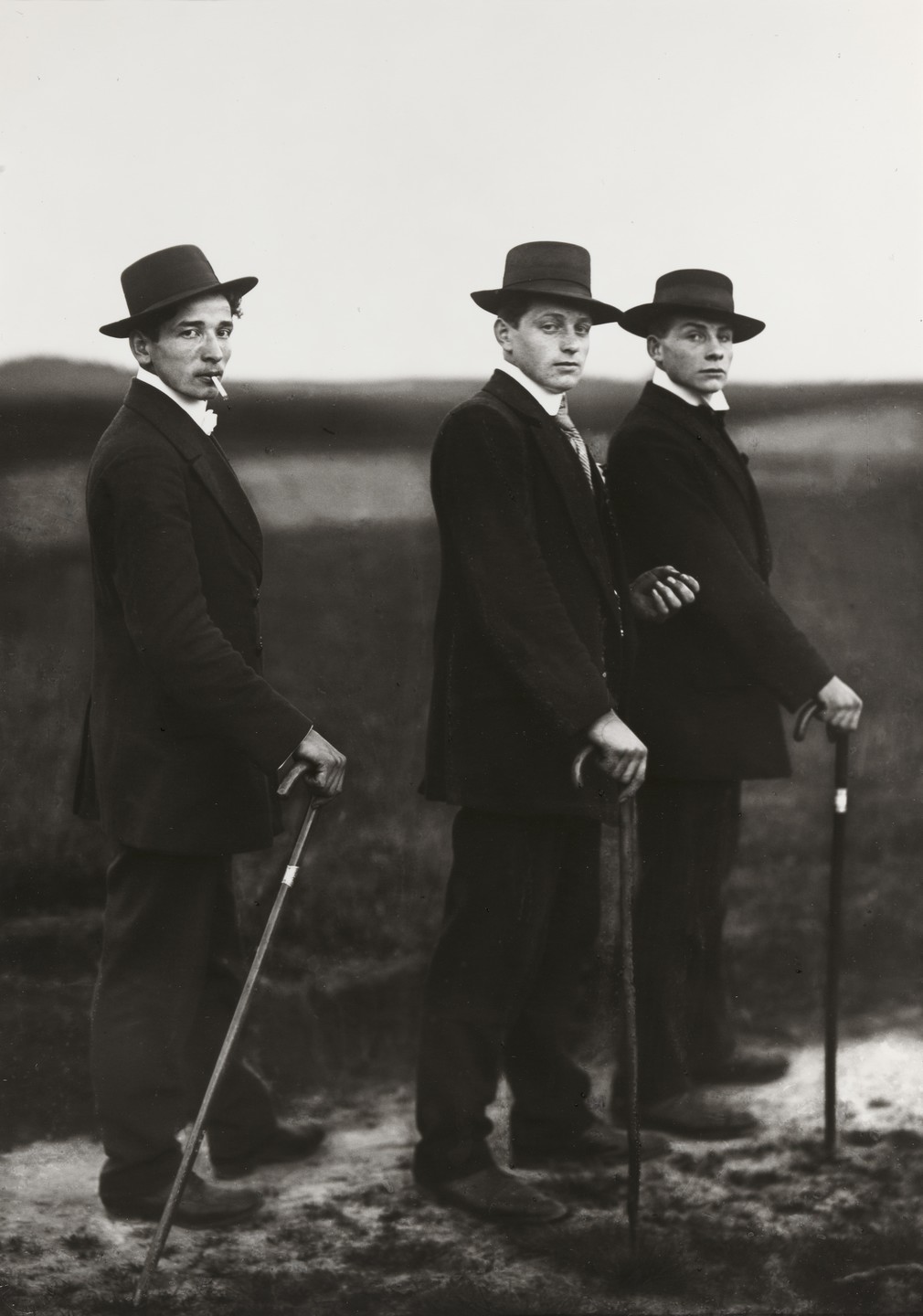
First a bit of background. I’m sure that I first noticed Three Farmers (which I bought and first read in 1987) because of its cover illustration
–a photograph I’ve known and been influenced (or is it haunted?) by for 50-odd years. It’s by the German photographer August Sander, one of a dozen or so most influential in my own history of photographic aesthetic development (others: Paul Strand, Walker Evans, Edward Weston, Paul Caponigro, Lartigue, Cartier-Bresson, Brassaï… another whole clutch of possible posts). Here’s the image in more or less its original form:
Sander’s photograph has the added poignancy of being taken in 1914, so it’s easy to see (obvious to our modern sensibilities) that the “dance” they’re on the way to is WW I. And that’s how the novel begins, with the narrator discovering the photograph in a Detroit museum. And here’s how Powers himself describes how the novel began for him, at the Boston Museum of Fine Arts:
In the early eighties, I was living in the Fens in Boston right behind the Museum of Fine Arts. If you got there before noon on Saturdays, you could get into the museum for nothing. One weekend, they were having this exhibition of a German photographer I’d never heard of, who was August Sander. It was the first American retrospective of his work. I have a visceral memory of coming in the doorway, banking to the left, turning up, and seeing the first picture there. It was called Young Westerwald Farmers on Their Way to a Dance, 1914. I had this palpable sense of recognition, this feeling that I was walking into their gaze, and they’d been waiting seventy years for someone to return the gaze. I went up to the photograph and read the caption and had this instant realization that not only were they not on the way to the dance, but that somehow I had been reading about this moment for the last year and a half. Everything I read seemed to converge onto this act of looking, this birth of the twentieth century–the age of total war, the age of the apotheosis of the machine, the age of mechanical reproduction. That was a Saturday. On Monday I went in to my job and gave two weeks notice and started working on Three Farmers. (from Paris Review interview)
…and for a real shot of versimilitude, you can hear Powers tell the story himself via a Language Log post.
Anyway, what I read (and then re-read several times) this morning was seven extraordinarily densely-packed pages (pp 260-267), in the middle of a novel that follows at least three braiding strands of narrative, includes biographical excursions (Henry Ford, Sarah Bernhardt) and WW I detalia, visits multiple landscapes (Detroit, Boston, Maastricht…), and still finds room to include a chapter on the philosophy of photography and Sander’s glorious photographic quest/project, Man of the Twentieth Century.
The challenge before me now is to somehow extract just what it was that electrified me about those pages, and it’s almost as if I need to invent a new way to write, so as to represent the kaleidoscope of neuronal firings that ensued as I read. A series of extracts might do to begin, but they won’t hold still on the virtual page –each calls for a pop-up or callout (or more likely several) linking outward to other material. And Powers’ prose does that quite a lot, making it a bit difficult to read in straight lines. So I transcribe parts of the text that seem especially portentious, in the hope that I’ll eventually be able to assimilate their message/s:
Biographies ask the question “How do the details of this particular life demonstrate the spirit of its times?” Making the life conform to the times sometimes involves editing the first, sometimes reinterpreting the second. In both cases, biography always involves much footwork to keep the biographer’s footwork hidden… (pg 260)
—
All lives are messy aggregates: [Henry] Ford the farmer, Ford the illiterate, Ford the mechanical genius, the progressive, the reactionary, the anti-Semite, the philanthropist. Modern times are, by definition, a few billion times messier. Linking one aggregate to the other requires a good dose of editing, and thereby temperament. (pg 261)
—
The paradox of the self-attacking observer is this century’s hallmark. Psychologists now know there is no test so subtle that it won’t alter the tested behavior. Economic tracts suggest that Model A would be inviolably true if enough people realized its inviolability. Political polls create the outcome they predict. Even in the objective sciences, physicists, in describing the very small, have had to conclude that they can’t talk about a closed box, but that opening the box invariably disturbs its contents.
These are the recognizable bywords and clichées of our times. Casual talk abounds with the knowledge that there is no understanding a system without interfering with it… “All observations are a product of their own times. Even this one.” [cf Gartner Hype Cycle, for an über-current example]
This recursion is critical, not because it places a limit on knowing, but because it shows the impossibility of knowing where knowledge leaves off and involvement begins… (pp 261-262)
—
With every action, we write our own biographies. I make each decision not just for its own sake but also to suggest to myself and others just what choices a fellow like me is likely to make. And when I look back on all my past decisions and experiences, I constantly attempt to form them into some biographical whole, inventing for myself a theme and a continuity. The continuity I invent in turn influences my new decisions, and each new action rearranges the old continuity. Creating oneself and explaining oneself proceed side by side, inseparably. Temperament is the act of commenting on itself. (pp 262-263)
—
Each discrete life examines and explains everything it touches in a constant exchange of mutual defining and reshaping. By living, we become our times’ biographer. (pg. 263)
—
Although we cannot hope to pin down a view of our subject undisturbed by our observation, we can test if we have reached an optimal fit between the two.
One such test is unsponsored recognition. Each day as I sift through my many new experiences, I find a few that I recognize without having any memory or experience of them. I do not mean mystical déja vu; I mean the practical moment artists call epiphany and scientists call the instant of aha.
At this moment of recognition I temporarily stop taking part in the thing at hand and jump a level in the hierarchy of awareness, no longer looking at the object from my vantage point, but at myself from the vantage point of the object. This shift of awareness away from the looked-at to the act of looking creates the illusion of familiarity, since this moment of standing outside the observed system is common to all other such moments.
…What I am experiencing is neither precognition nor submersion in mystical vision. It is a by-product of the way consciousness is structured, the consequence of our unusual ability to make one level of our terraced awareness double back and appraise another. At the moment when the stuff holding our attention dissolves and gives way to an awareness of awareness itself we recognize a community with all the other similar moments we have gone through –a concord, or close fit, between hypothesis and measured result.
…By slightly changing our angle of observation, a copse of seemingly random trees reveals itself as an orchard. This specific angle of observation, then, has an independent validity, revealing an order not of the viewer’s making. Such a surprise visit of the orchard effect is always pleasurable –filled with the delight of recognition, a sense of the community of all explorers who also touch base at this common spot.
I continually write my own biography by my actions, mixing involvement with knowledge, accountable to those moments when both drop away to reveal the act of mixing –something a priori recognizable. This process does not differ measurably from the way I come to understand others, my time, or past times. Memory, then, is not only a backward retrieval of a vanished event, but also a posting forward, at the remembered instant, to all future moments of corresponding circumstance.
We remember forward; we telegraph ourselves to our future selves and to others: “Rescue this; recognize this, or not this, but the recognizing.” If we constantly reform the continuity of our past with each new experience, then each message posted out of an obscure or as yet unexperienced past represents a challenge to re-form the future. No action unchanged by observation. No observation without incriminating action. Every moment of unsponsored recognition calls me to return to the uninspired world, to continue the daily routine of invention and observation, to dirty my hands in whatever work my hands can do. (pp 264-266)
—
To compound the instant of aha, I rounded the corner smack into the three farmers, more familiar to me than my own parents, though I knew beyond doubt that I had never seen them or their photo before. For the next several months I would be obsessed with finding the exact message the image meant to send me, mistakenly looking for it in names, dates, and places.
I had to learn that that none of that had any real importance, did not in fact exist without active interference from me. The black-and-white print was less a document for archiving than it was a call to action… (pp 266-267)
…each of the three story lines cycles in a predictable order: Chapters One, Four, Seven, etc. follow the story of the extradiegetic narrator; chapters Two, Five, Eight, etc., the three farmers, and so on. Selectively reading every third chapter produces a coherent narrative that largely stands on its own. The relationship between the three threads in the novel is a tension that holds the narratives in position. Each is completely explicable on its own, yet the additional meaning provided by the parallel threads at once enriches and problematises the meaning of the threads. None of the threads in the novel can be considered as more important than any other, whether contemporary or historical, extradiegetic or essayistic, and while the events in the contemporary thread are subsequent to those in the historical thread, their importance belies the subordination implied by the term ‘subsequent.’ It is this idea that I call temporal flattening. While the fabula of one thread is located some seventy years in the past, its sjuzet is indistinguishable from the contemporary threads, in either style or diction…
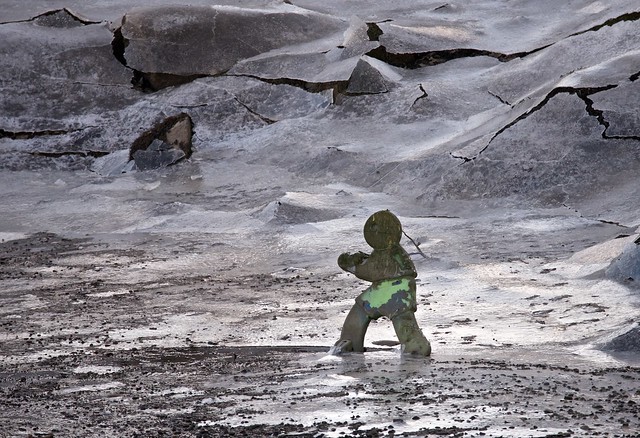
I’m particularly fond of photographs that propose some sort of enigma, whose full narrative potential is only realized with the addition of something that’s not manifest in the image alone. ‘Whimsical misdirection’ seems like another earmark of this genre. I’ve done two such puzzle pictures in the last couple of days:
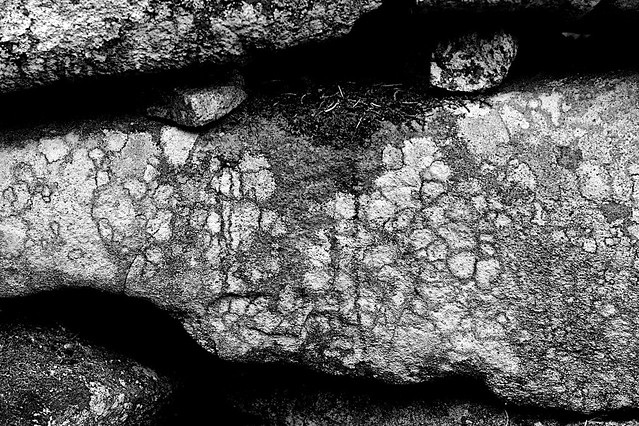
Another, taken a few weeks ago, is a rock creature whose rheumy eye seems to peer warily:
And here’s one that’s almost a portrait of a blond-bearded skull:
I’ve been in thrall to the Bay of Fundy ever since I decided (in about 1970) to do my dissertation research in Nova Scotia. In 1972 we moved into a house at Horton Landing, right on the very shore of an arm of the Bay, where the tides were 35+ feet and the low-tide mud was a distinctive red-brown. The energy of Fundy truly boggles any mind that considers it, and people have been scheming schemes to capture that energy since, well, pretty much forever. The First Nations folks who were the first inhabitants of the landscapes around the Bay told stories about the Beavers who tried to dam Fundy, and the culture hero Glooscap who smashed their dams; and so it is with any later folk who have tried to steal Fundy’s energy: turbines are crumpled, silt is deposited in unpredicted places, and sadder and wiser Beavers retreat to scheme again. Will those tides ever be “harnessed” or will Glooscap return to sort things out?
On the latest trip to Nova Scotia we stopped at the Clarence Gosse Bridge over the Shubenacadie River, a structure with its own tales of Beaver hubris. Built in 1979 and an early example of its type (a pre-stressed concrete box girder bridge, the two sections meeting in the middle, said by some to be “the world’s first cantilever bridge”), by the early 1980s its smooth curve was disrupted by subsidence at the center join –the engineers hadn’t reckoned with the sheer power of the tides and/or the depth of the mud. There’s a thump from every wheel that crosses.
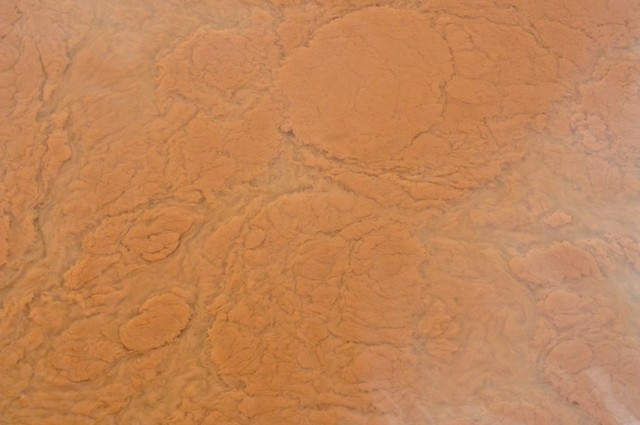
From the observation point on the river bank one sees the power of Fundy in several ways. There’s a tidal bore that attracts rafters and kayakers (though I’ve never seen it there myself), and the old piers of the (now-vanished) railroad bridge are impressively eroded. At low tide you see almost nothing but red mud with a trickle of the Shubenacadie at the very bottom; just before high tide the incoming river is impressively wide. This trip I looked down and saw the swirling of mixed silty and clearer waters, and tried to capture it with the camera:
This view doesn’t do justice to the energies involved, being static and pretty muddy too, so I did a bunch of fiddling with the image, changing it to monochrome, upping the contrast and definition, generally trying to tease out the patterns I saw. This version is a bit more eloquent in revealing the profundity of the flux of energy:
…and incidentally vindicates any amount of post-processing. It’s still a photograph, still tells a story and roils the mind.
This last week in Turkey I learned a lot, I mean really a lot. In the area of ostensible purposes of the trip (Turkish cooking, photographing food) I’m just beginning to …erm… digest the learning, but this morning’s feedings are a good place to begin to try to articulate a few of my discoveries. There may be many more posts along these lines, as I process more photos from the trip and begin to construct narratives out of their constituents.
Nobody will be surprised that our first stop, even before going home, was Home Kitchen Cafe (it being 10ish, and we having driven 3+ hours from the park’n’fly hotel we’d flopped in after a day of flying Istanbul-Paris and then Paris-Boston). And Home Kitchen never disappoints:
(The photographer may be forgiven the softness of focus cum camera movement… it was the iPhone, I hadn’t had tea yet, the iPhone is a barely adequate image-maker, etc.). Of course I ordered the lobster migas, I mean who wouldn’t? And when it arrived I did my usual iPhone grab shot:
Now, that’s not too bad, even straight out of the phone and up to Flickr with no processing. Not ineptly framed, even some parts (cilantro, mostly) in pretty crisp focus, but not carefully thought out. Quotidian might be a good way to summarize the image. That’s what I ate, and very happy I was to eat it.
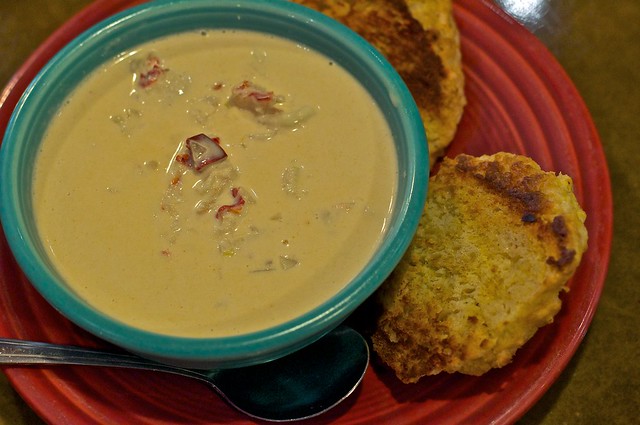
I did have the real camera with me, so I did a couple of shots with that and they provide food (so to speak) for thought. First I did Betsy’s lobster stew:
…and I’m reasonably pleased with the result in that the (notably shallow) plane of focus is about where I’d intended it to be, though the overall composition is less than carefully considered, and that reflection in the upper right hand corner is a distraction. A lot sharper than the iPhone effort. And so on to my migas:
Now here the plane of focus is just too shallow –should have stopped down a couple of notches, but that would have meant I couldn’t hand-hold the camera without movement. Or I could have changed the ISO (or fetched the tripod), but I was in too much of a hurry to, well, eat. I did try a top shot:
but that was even less competently executed, focus-wise. Of course it wasn’t until I saw these in Aperture that I found things of which to be critical, or (perhaps more hopefully) to think about constructively. Which is to say that readers of this blog will be hearing more along these lines as I unpack the experiences and the imagery of the week.
While considering the matter of just what I want to get out of the Turkish Adventure, and especially out of the photographic part, I started thinking about which photographers I especially admire, and/or which I think of as particularly important influences. My immediate shortlist, without consulting any of the many books in the house, began with Henri Cartier Bresson, Paul Strand, Walker Evans, August Sander and Paul Caponigro. Trying to identify just what common thread is found in those 5 led to the (obvious) observation that they worked in monochrome –in black and white, as we used to say (though greys might deserve mention too). And of course my own photographic aesthetic developed in that medium.
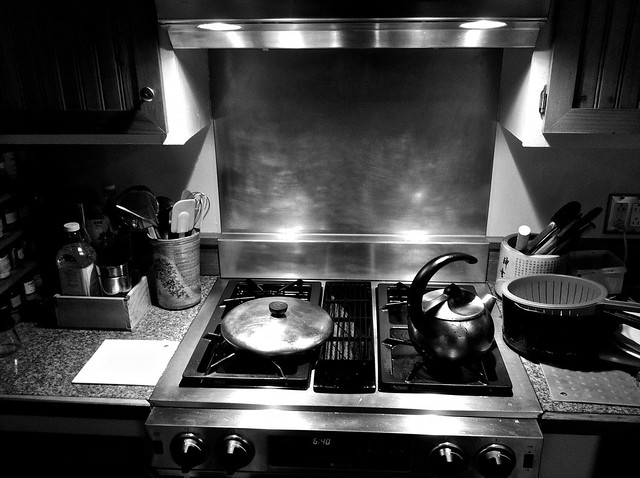
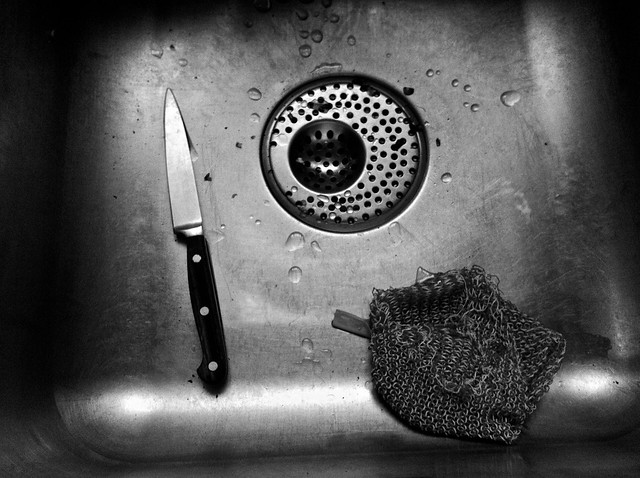
Thinking further, I realized that I’ve never had an intuitive sense for light, and especially for light in color. That’s what I’d like to work on, and it occurred to me that I could shift one of my iPhone camera apps over to B&W, and also set the Coolpix in that mode, and use those resources to explore some of what I encounter in Turkey.
Now, obviously one can post-process digital color as B&W, and I may well resort to that with some images, but I find it much easier to see the play of light in B&W. So I did these two images at home yesterday morning, just as a place to begin:
The day began at the Park’n’Fly hotel in Revere with a 5AM trip to Logan Airport to catch the flight to JFK. The images aren’t distinguished, but I’ll post them anyhow: