If you’ve never heard of Rousas John Rushdoony and William J. Federer, you need to read Jeff Sharlet’s piece just posted at Harpers.org: Through a Glass, Darkly: How the Christian right is reimagining U.S. history.
Category Archives: Uncategorized
McLuhan rocks
Boy, gotta love this bit from McLuhan’s Understanding Media, in re: iPhone and any other Object of Desire:
Man becomes, as it were, the sex organs of the machine world, as the bee of the plant world, enabling it to fecundate and to evolve ever new forms. The machine world reciprocates man’s love by expediting his wishes and desires.
(See more via John Holbo’s posting at Crooked Timber)
Trow, take 2
George W.S. Trow calls this passage “my personal favorite Mainstream American Cultural Artifact” (well, I’ve chosen out the part that I find most significant, and added some emphasis):
The man of today is a citizen of the world. He seems to be ubiquitous. It is as though he had a thousand eyes and ears and, alas, only one mind. Thought has two conditions. First, knowledge as food and stimulus, second, time for distributing and digesting that knowledge. But the first is so superabundantly fulfilled that it completely obliterates the second. Knowledge comes pouring in from all quarters so rapidly that the man can hardly receive, much less arrange and think out, the enormous mass of facts daily accumulating upon him. The boasted age of printing presses and newspapers, of penny magazines and penny encyclopedias is not necessarily the age of thought. There is a worldwide difference between knowledge and wisdom. The one consists of facts as they are, the other of facts as they may be. The one sees events, the other relations.
Seems pretty modern, doesn’t it? A nice summary of what we’re enmeshed in here in 2007, no? It was penned by one John A. French, and published in Continental Monthly in March 1864, and Trow cites it in My Pilgrim’s Progress, pp 174-175. His summary comment:
When I first read that, I was astounded. Was I involved in some multigenerational, genetic thing quite beyond my understanding? Well, I think, yes, and I think that in the next century, either people will have lost all memory and will start from scratch, or they will integrate with a multigenerational view of their experience. The failure of modernity means, among other things, that we will either start from scratch with nothing or we will find that we are necessarily connected with who we were before the process got rocking and rolling.
(My Pilgrim’s Progress, pg 175)
Something to chew upon as I contemplate the mountain of family photographs awaiting my attention…
On George W.S. Trow
I’ve just finished reading a couple of books by George W.S. Trow: Within the Context of No Context and My Pilgrim’s Progress: Media Studies, 1950-1998, and I’m sort of brimming over things I want to say about them, and about reading them, and about what-all else they connect to in my own life.
Is it that I want you to read them? Not really… I mean, who has the time to read stuff unless there’s a really good and clearly personal reason to read this instead of the many thats which compete for one’s eyeballs. Or is it that I want you to think good thoughts about me reading them? That’s probably closer to the mark (sez: I’ve just read a couple of books that were extremely meaningladen for me, amn’t I a good boy? and don’t you wish that you could feel the weight of the meaningladenness?). But really it’s that I want to try to sort out for myself why these books mean, why they reach me in unique ways, and just what those ways are.
That needs some background. George W.S. Trow [Wikipedia article] died this past November. Among the obits are three I’d like you to scan: Hendrik Hertzberg’s in the New Yorker:
From adolescence on, George William Swift Trow was a cult figure of sorts, whose fame, though for a time considerable, was a lagging indicator of his influence, which made itself felt through his personal and literary impact on other writers and on certain institutions, notably but not exclusively this magazine. He was an essayist, aphorist, journalist, satirist, and analyst (and annalist) of what he once labelled, with characteristically arch capitalization, Mainstream American Cultural Artifacts…
and Stephen Metcalf’s “Assessing the legacy…” from Slate:
Every generation or so, a disappointed preppy marvels at the demise of the Protestant ascendancy he took for granted in his childhood, and out of an embarrassed mix of pride and self-reproach, writes a masterpiece. A line can be drawn, in attenuated blue blood, from Henry Adams to Robert Lowell, then extended out to include George W. S. Trow…
And while you’re at it, also take a look at Mark Feeny’s take in The New York Observer:
..the Harvard class of 1965 was the one Eustace Tilly fell on. Its members included Trow, Hendrik Hertzberg, Jacob Brackman, Jonathan Schell and Wallace Shawn (who qualifies as a legacy, if not a hire)…
You might also take a look at Dennis Perrin’s blog reminiscence of an interview with Trow.
Now, George W.S. Trow is an exact contemporary of mine (born in September 1943), and I’m at a point in life where contemporaneity means a lot more than it used to, partly because there’s a noticeably diminishing stock of it, as contemporaries shuffle off, Stage Right. Furthermore, he’s a college classmate, though I certainly never knew him in those years. I knew of him (he was president of The Harvard Lampoon, and moved in circles more exalted than those I found comfortable), and I’ve followed his writing for a lot of years in the New Yorker, always marveling at his way with le mot juste. So it’s like I know him, but he didn’t know me.
Still, there are these overlappings. We share an abiding fascination with the Nacirema, one of the wilder and woolier of the world’s cultures. He studied them up close, mostly in the urban belly of the beast; my vantage points were Borneo and Nova Scotia. He’s a student of media, and of the clothing of emperors. Here’s an example of his observational acuity, in a context that’s especially meaningful for me:
New England is history. Step One. Step Two. Do this. Do that. This happened. That happened. It all adds up to New England. It doesn’t break down from something else. It is no share of anything larger. History takes a certain course, and it adds up to New England. Of course, once it does, you can work it in other ways. New England as a phrase means a certain thing, because certain things have added up to mean New England. But once a phrase means a certain thing, you can abuse the meaning and twist it: refer to the sense of what “New England” means to suit your purposes, which may not have correct reference to the history of New England –which may, in fact, directly oppose the essence of that history. SHOT OF FABULOUS OLD NEW ENGLAND INN. Look at the clapboards. So white. Look at the porch. Why, Mrs. Martin you’re pouring Silt-Whip over that old New England cherry cobbler. Of course it’s Silt-Whip; nothing else is good enough for Martin’s Inn.…
(Within the Context of No Context, pp 58-59)
Now, this is ethnography in a New Key, no doubt about it. It’s allusive and witty and telegraphic and committed, whereas the traditional pedestrian mode of ethnography is stodgy and ‘objective’ and inoffensive and, well, tired. And the passage is exemplary of Trow’s style: he’s forever picking out details that one wouldn’t have noticed particularly, and foregrounding them, making them the focus of the point he’s making. He’s a genius of juxtaposition, illuminating linkages which are invisible until he turns the light upon them.
He says in several places that he thinks and sees “demographically”, which is to say that he thinks of population phenomena, and is especially sensitive to the analytical frame of age cohorts (though he doesn’t use that term) –he does the mental calculation to ascertain when the actors in his stories were born, how old they were in [e.g.,] 1950, who their contemporaries were. I’ve been doing that same thing myself for as long as I can remember, being aware of age cohorts and the perspectives their inhabitants share with other members, and/or don’t share with members of other cohorts.
Each one of these social generations –from the ’50s, from the ’60s. from the ’70s, from the Reagan era, from now– thinks of its social aesthetic as definitive. In fact, they are all in a process: encouraged toward, and beyond, hubris, by demography.
(Within the Context of No Context, pg 12)
Both books are full of dates,most of them serving as place markers in people’s lives and tied to the vaudeville of Cultural Artifacts and to specific examples of the always-shifting Zeitgeist.
In 1958, the people I had moved next door to not only were universally considered to make up the ruling group of the country; they owned the rituals: the schools, the clubs, the ladders. Part of their style was to say, “But of course, we’re just ordinary Americans.” Five years later they were just ordinary Americans, and their rituals –including the dogs and the horses, maybe– were burdens, and were so perceived by their children.
(Within the Context of No Context, pg 23)
I dimly remember the original form of a big chunk of one week’s New Yorker in 1980, but I didn’t manage to read it then –it was in too new an expository form, and I just didn’t spend the time to get it, didn’t recognize its relevance to my own pursuits. A lot of Within the Context has to do with the powers of television, and I’ve spent most of my life with my back turned to television (though not to film, and not to serials originally made for television… but that’s another story).
Television is the force of no-history, and it holds the archives of the history of no-history. Television is a mystery. Certain of its properties are known, though. It has a scale. The scale does not vary. The trivial is raised up to the place where this scale has its home; the powerful is lowered there. In the place where this scale has its home, childish agreements can be arrived at and enforced effectively –childish agreements, and agreements wearing the mask of childhood.
Television has a scale. It has other properties, but what television has to a dominant degree is a certain scale and the power to enforce it…
The power behind it resembles the power of no-action, the powerful passive.
It is bewitching.
It interferes with growth, conflict, and destruction, and these forces are different in its presence.
“Entertainment” is an unsatisfactory word for what it encloses or projects or makes possible.
No good has come of it.
(Within the Context of No Context, pg 45)
It was back in October that I spied Within the Context of No Context [the 1997 reprinting, with an added introduction assessing the 17 intervening years] in one of the used bookstores I frequent, and I picked it up and leafed through it… and put it back on the shelf. A month later I read that George W.S. Trow was dead, and went back to the shelf and there it was, so I bought it, thinking that I really did finally have a reason to read it. I’m really glad I did.
links for 2007-01-08
-
a whole Education in one metadiagram. stunning!
-
by *spacecoyote on deviantART
-
oook’s very own early wonderments
An e-mail exchange of musical obscurities
So I sez, “…doubtless I SHOULD read the new book. I don’t seem much inclined to SHOULDs these days…”
and Carolyn replies, “Nor SHOULD you… except for whiskey. Whiskey you should do. (was listening to Hamza at lunchtime whence the synesthetic pun)”
For those who don’t catch the latter reference, here’s the bit she’s referring to, from Hamza el Din’s first record (on Vanguard, about 1964)
…and the only possible response is another favorite musical quote, from the old Folkways Music of Afghanistan (Mrs. Parwin and Chorus –the real title is “A rose is blooming”, but I’ve always heard it as “John Fonda, Whaddya Know?”).
Anybody have any others in this realm of lyrical bogosity? Perhaps cousins to the form called Mondegreen?
On Desmond McCarthy
Conversation was his art, and for him the tragedy was that he should have chosen so ephemeral a medium… he would turn up at Richmond for dinner, uninvited very probably, and probably committed to a dinner elsewhere, charm his way out of his social crimes on the telephone, talk enchantingly until the small hours, insist that he be called early so that he might attend to urgent business on the morrow, wake up a trifle late, dawdle somewhat over breakfast, find a passage in The Times to excite his ridicule, enter into a lively discussion of Ibsen, declare that he must be off, pick up a book which reminded him of something which, in short, would keep him talking until about 12.45, when he would have to ring up and charm the person who had been waiting in an office for him since 10, and at the same time deal with the complications arising from the fact that he had engaged himself to two different hostesses for lunch, and that it was now 1 o’clock and it would take forty minutes to get from Richmond to the West End. In all this Desmond had been practising his art –the art of conversation.
(Quentin Bell Virginia Woolf: a biography Vol 2, pg 82)
Virginia Woolf to Vanessa Bell
Did anyone ever suffer as I did? You might have seen my soul shriveling like a — I cannot remember the image exactly, but its something one does by rubbing a piece of sealing wax & then everything curls up –as if in agony. Not that there was any imagery about it in my case. But the immanent greatness of my soul formed, as it were, a cream upon the surface. I survived.
(18 June 1919, quoted in a footnote on pg. 66 of Vol 2 of Quentin Bell’s Virginia Woolf: a biography)
2006 bookkeeping
My friend Carolyn circulated a list of books she’d found especially enjoyable in 2006, saying “I was hoping for a reciprocal list from a like-minded biblio-omnivore…”, and it got me thinking about books and other stuff of 2006. Turns out to be quite a challenge to summarize, particularly when one strays from the printed page and tries to summarize engagement with the various media that brighten one’s days.
I read quite differently than I did when I was employed –no classes to prepare, nobody to please but myself– but the inspirations are as varied as ever. I don’t seem to have stopped buying books, though the rate has slowed considerably. I re-read a lot of stuff, especially Terry Pratchett (either you do or don’t understand WHY one would do that), and I’m in and out of lotsa books that I don’t read cover to cover. Here’s a list for the year of memorable ones that I did finish (or am surely working on as we speak).
I realized that my Netflix history would tell another facet of the media tale, so I extracted that. Anybody with a day job will be envious of the time I’ve clearly spent in viewing mode.
Web video has attracted a lot of my interest in the last year, mostly via YouTube, and I’ve grabbed a lot of Flash video files (but don’t feel the need to catalog them here… but see this one for all you need to know about WHY the medium Matters). I’m also a devoted follower of Ze Frank’s daily The Show .
A lot of hours during the year were spent walking or otherwise exercising, usually with MP3s in the ears, mostly talk. Radio Open Source is absolutely GOLDEN, viz: Bach’s Chaconne (24MB, about 50 minutes). This American Life‘s archives were open for a while, and are now being podcast one at a time. And then there’s WFMU, and especially Secret Museum of the Air with Citizen Kafka and Pat Conte. I download a LOT of mp3 stuff, NONE of it from the pay-by-the-drink sites.
Every day includes a couple of hours of blog reading, from a list of some 300-odd that I follow (some fall off, some fall on). Boing Boing, Language Log, Informed Comment, EatingAsia, several Google Earth blogs… those are the absolute essentials, and I’m still following IT Conversations and Stephen Downes’ Edu_RSS, but getting further from the IT and pedagogical interests that used to be pretty central.
I’ve bought CDs during the year, probably more than I’d like to admit. Making a list would be ummmmmm dangerous… and I also acquired my late brother David’s vinyl holdings, many hundreds of records across quite a few genres and including a couple of hundred Bach, and hundreds of hours of cassette tapes of Bach, Vivaldi, etc. I’m gradually thinking through what to DO with that trove (satrting with cataloging, a daunting prospect).
Narrativium
I’m thinking that an appropriate Goal for the year is to work at gaining more control over the many threads of my own personal Narrative. This means sorting out and interconnecting a lot of stuff in many formats and disparate media (images, papers, html documents, sound files, vinyl records, CDs, videos, books, realia… more, and more varied, than you can imagine…), partly so that I can navigate it better myself, and partly because somewhere in there is legacy (though it’s not clear to whom, or for what). I made some pretty energetic beginnings in 2006, messing with timelines, quarrying Nova Scotia Faces, and starting on 45 years of negatives from my several lives as a photographer, but the coherence of it all is arguable, or at the very least, a subject for construction. I’m not really sure how to set about this Odyssey, other than casting off and seeing where the winds take me (and tracking waypoints via this blog), but a convenient organizing principle might be an exploration of narrativium, a Substance instantiated (as far as I know) in The Science of Discworld (Terry Pratchett, Ian Stewart and Jack Cohen [three volumes: 1999, 2002, 2006])
Our minds make stories, and stories make our minds. Each culture’s Make-a-Human kit is built from stories, and maintained by stories. A story can be a rule for living according to one’s culture, a useful survival trick, a clue to the grandeur of the universe, or a mental hypothesis about what might happen if we pursue a particular course. Stories map out the phase space of existence (II: 327).
The characteristic feature of narrativium is that it makes stories hang together. The human mind loves a good dose of narrativium. (I:64)
A little narrativium goes a long way: the simpler the story, the better you understand it. Storytelling is the opposite of reductionism: 26 letters and some rules of grammar are no story at all. (I: 93)
Narrativium is powerful stuff. We have always had a drive to paint stories on to the Universe. When humans first looked at the stars, which are great flaming suns an unimaginable distance away, they saw in amongst them giant bulls, dragons, and local heroes. This human trait doesn’t affect what the rules say — not much, anyway — but it does determine which rules we are willing to contemplate in the first place. Moreover, the rules of the universe have to be able to produce everything that we humans observe, which introduce a kind of narrative imperative into science, too. Humans think in stories…. (I: 11)
Humans add narrativium to their world. They insist on interpreting the universe as if it’s telling a story. This leads them to focus on facts that fit the story, while ignoring those that don’t. (I:233)
…humans seem to need to project a kind of interior decoration on to the universe, so that they spend much of the time in a world of their own making. We seem –at least at the moment– to need these things. Concepts like gods, truth and the soul appear to exist only in so far as humans consider them to do so… But they work some magic for us. They add narrativium to our culture. They bring pain, hope despair, and comfort. They wind up our elastic. Good or bad, they’ve made us into people. (I: 166)
Our children have been hearing stories since they recognized any words at all, and by three years old they are making up their own stories about what is happening around them. We are all impressed by their vocabulary skills, and by their acquisition of syntax and semantics; but we should also note how good they are at making narratives out of events. From about five years old, they get their parents to do things for them by placing those things in narrative context. And most of their games with peers have a context, within which stories are played out. The context they create is just like that of the animal and fairy stories we tell them. The parents don’t instruct the child how to do this, nor do the children have to elicit the ‘right’ storytelling behaviours from their parents. This is an evolutionary complicity. It seems very natural –after all, we are Pan narrans— that we tell stories to children, and that children and parents enjoy the activity. We learn about ‘narrativium’ very early in our development, and we use it and promote it for the whole of our lives. (II: 152)
Narrativium is not an element in the accepted sense. It is an attribute of every other element, thus turning them into, in an occult sense, molecules. Iron contains not just iron, but also the story of iron, the history of iron, the part of iron that ensures that it will continue to be iron and has an iron-like job to do, and is not for example, cheese. Without narrativium, the cosmos has no story, no purpose, no destination. (III: 1-2)
It looks like Ian Stewart and Jack Cohen are the source of the coinage Pan narrans, of which they say
We are not Homo sapiens, Wise Man. We are the third chimpanzee. What distinguishes us from the ordinary chimpanzee Pan troglodytes and the bonobo chimpanzee Pan paniscus, is something far more subtle than our enormous brain, three times as large as theirs in proportion to body weight. It is what that brain makes possible. And the most significant contribution that our large brain made to our approach to the universe was to endow us with the power of story. We are Pan narrans, the storytelling ape. (II: 325)
…if you understand the power of story, and learn to detect abuses of it, you might actually deserve the appelation Homo sapiens. (II: 330)
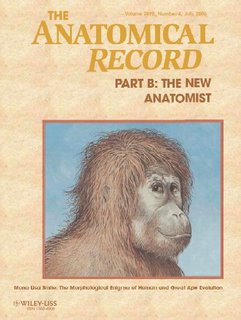 …and while we’re on the subject of close relatives, take note of the Orangutan Connection, via a blog posting that references Mona Lisa Smile: The Morphological Enigma of Human and Great Ape Evolution, The Anatomical Record (Part B: New Anatomist) 289B: 139-157