…we can recapture that sense of having just tumbled out to life on a new world by looking at our own world in unfamiliar ways.
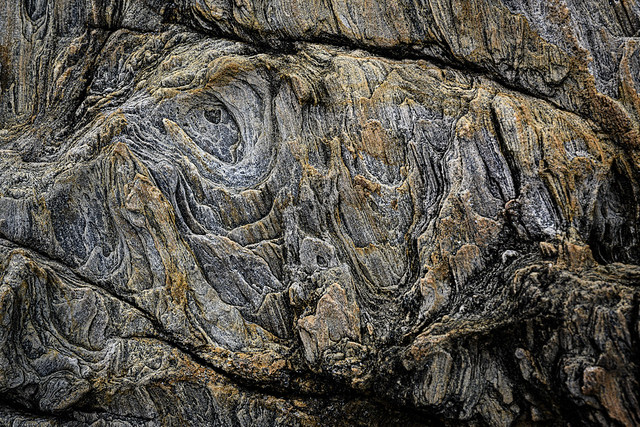
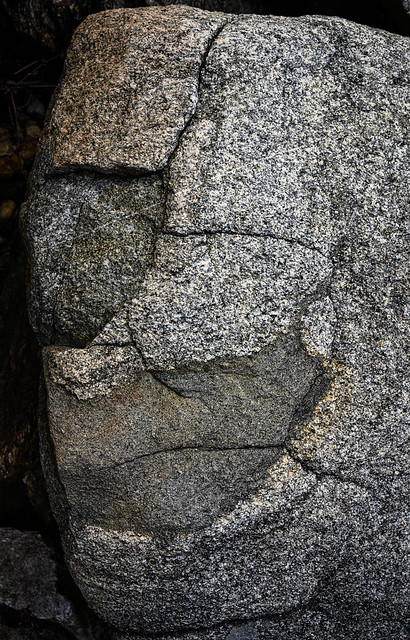
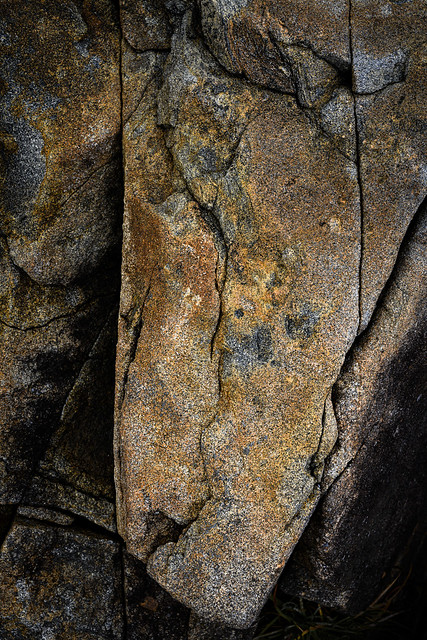
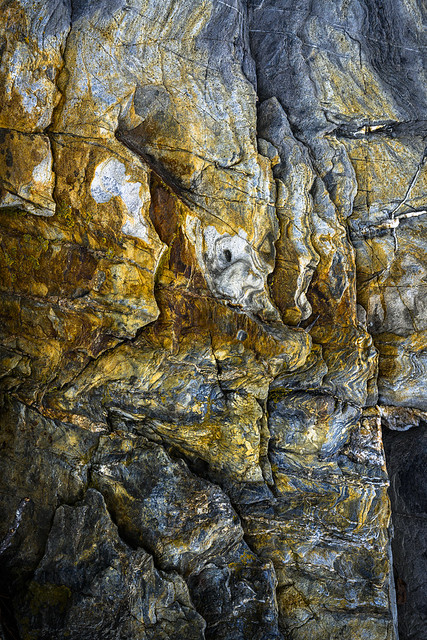
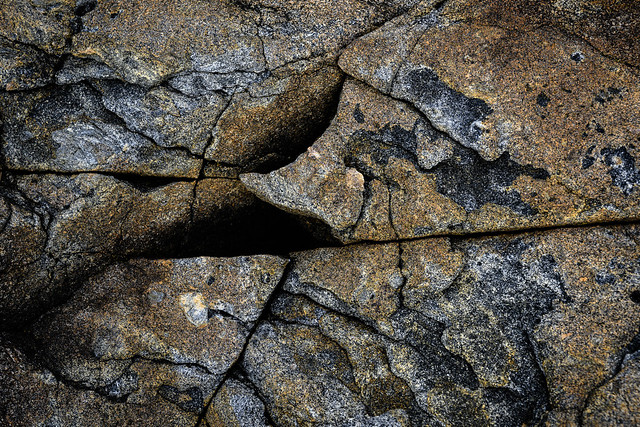
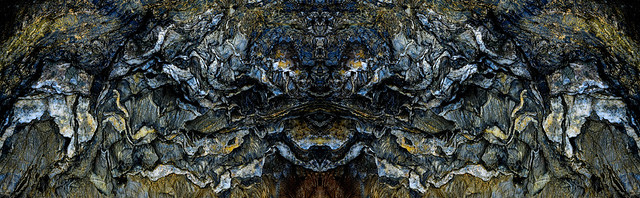
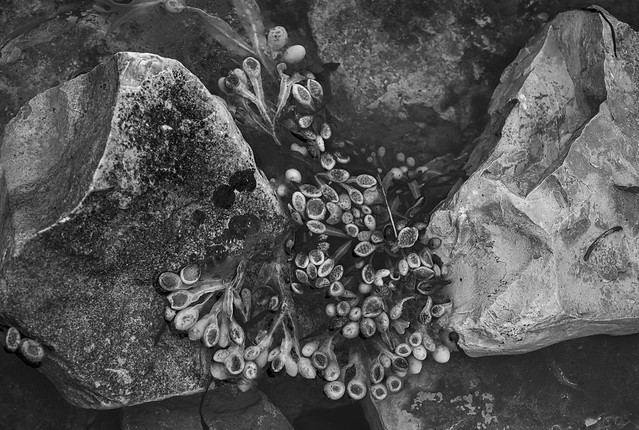
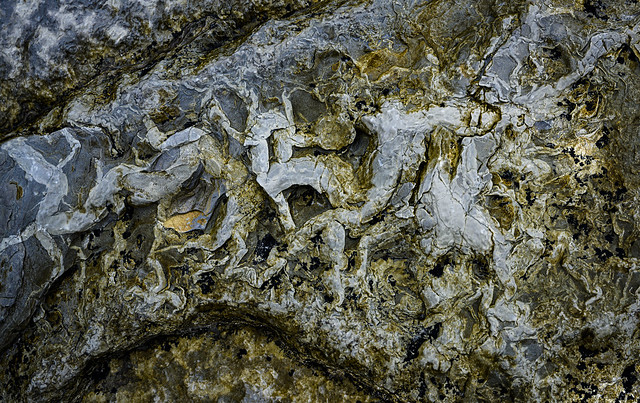
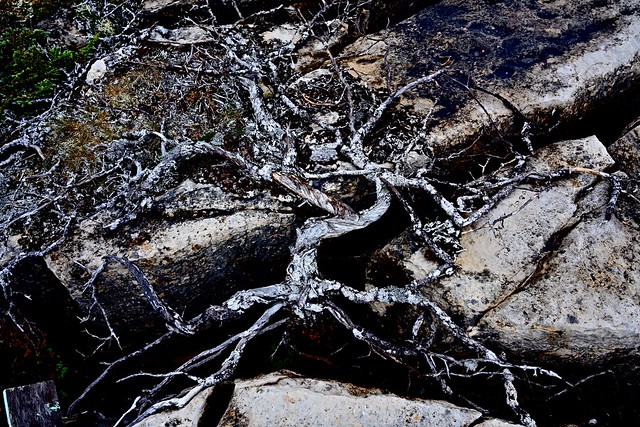
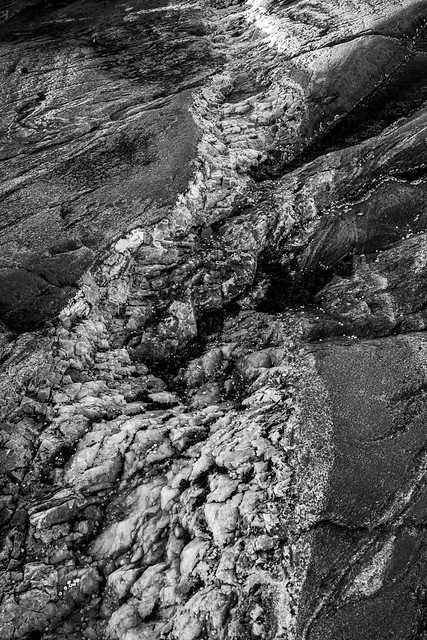
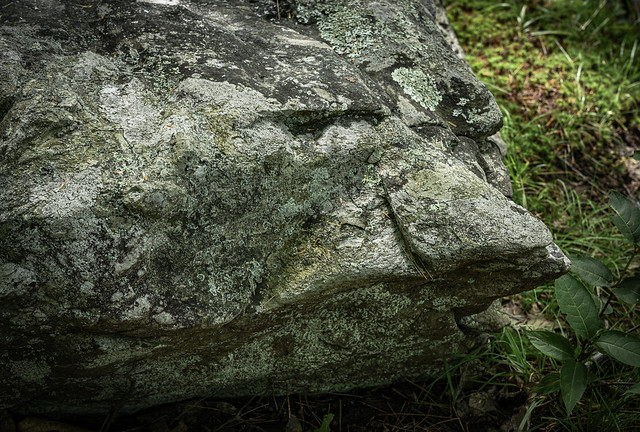
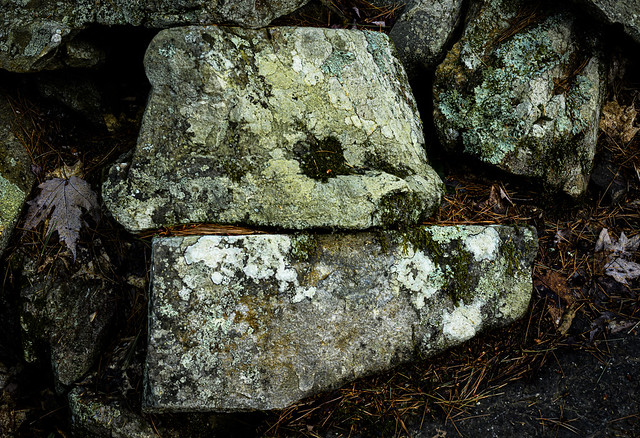
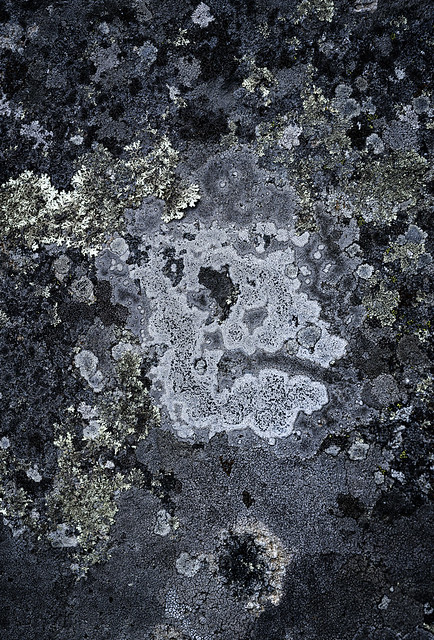
This is just what I’ve been trying to do in being attentive to faces that manifest as I prowl, looking down and looking around. And they are everywhere:
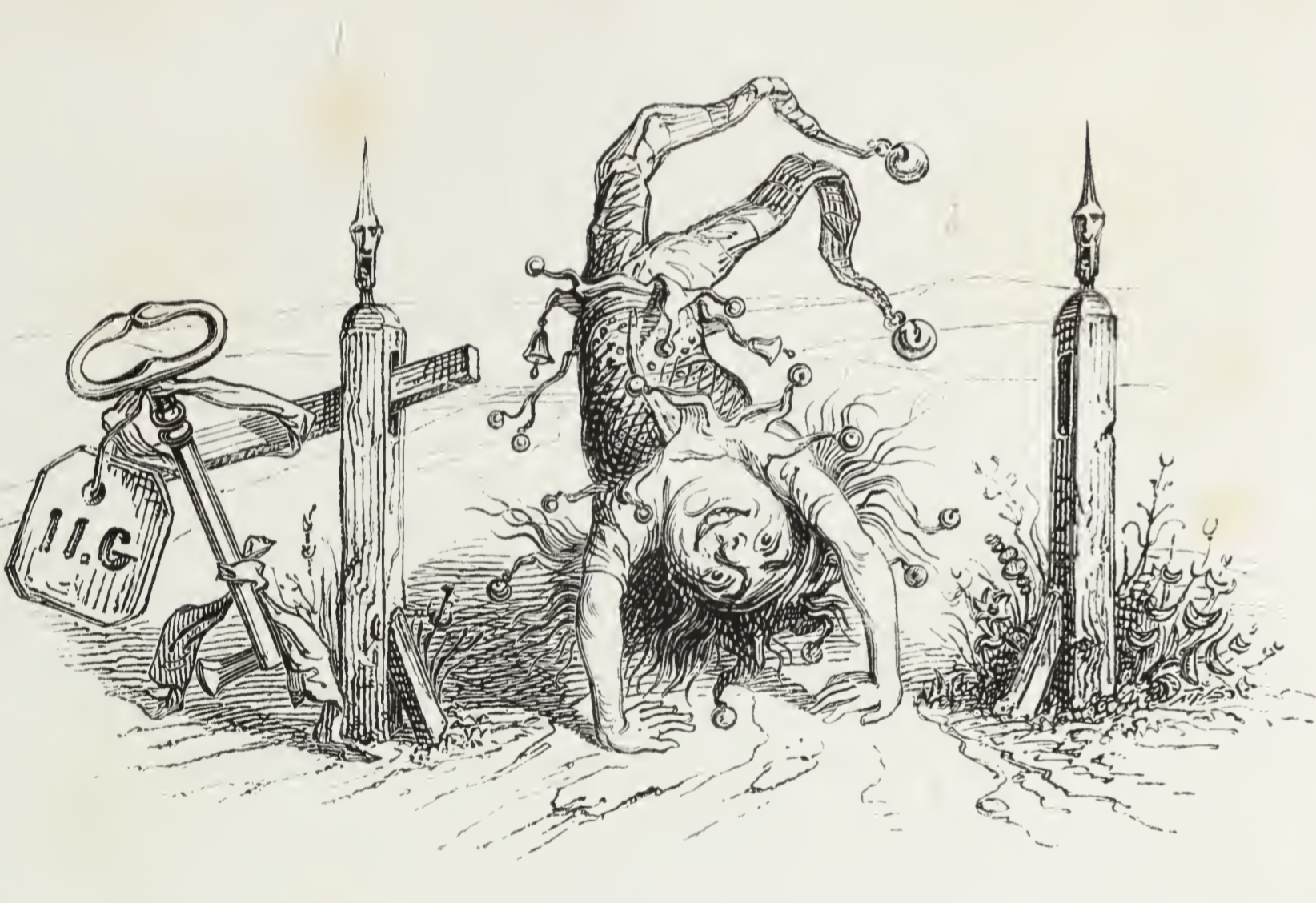
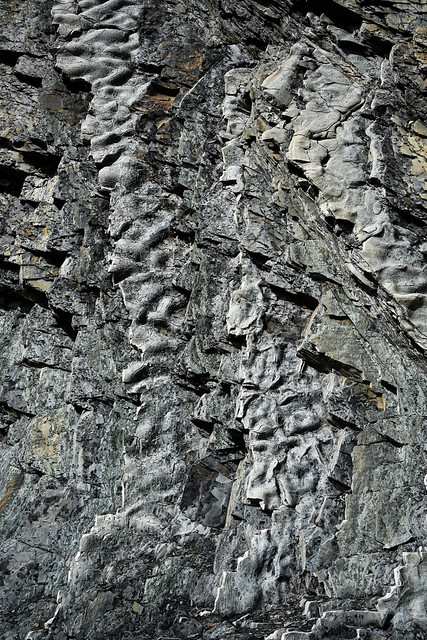
And there are dancers:
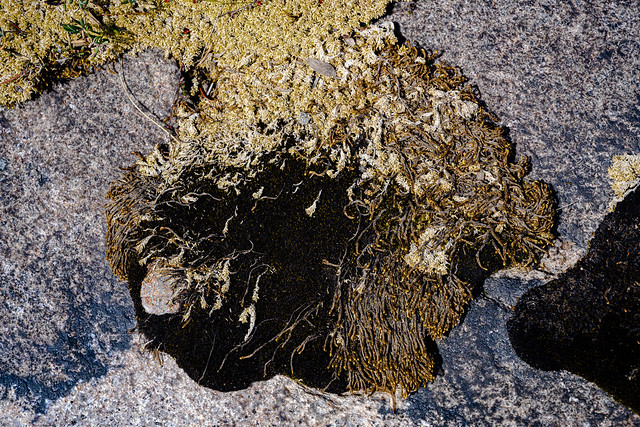
And magical geographies:
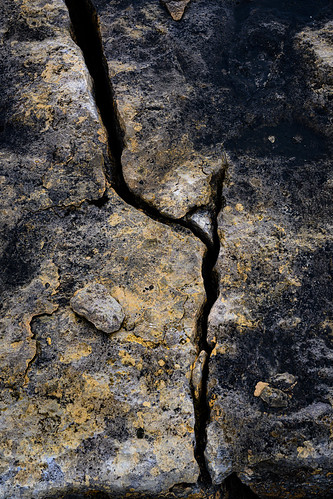
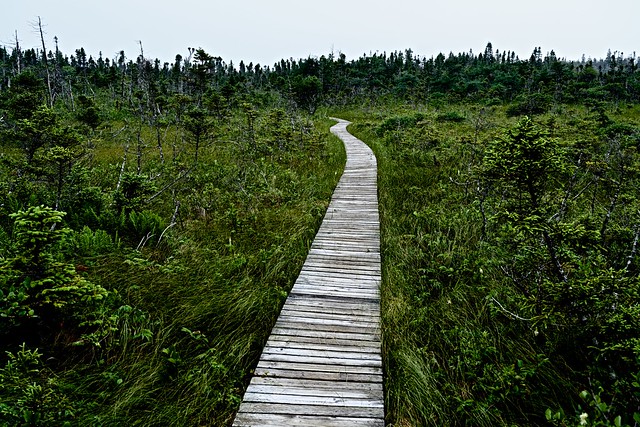
And (with a grateful nod to Tolkien) roads winding ever on and on:
As we were climbing Mount Megunticook last weekend, this thought wafted through my mind:
Am I seeing what I think I’m seeing, or is my imagination working overtime? How would I know?
Finding faces in beach or mountain rock is an exercise in imagination, perception, analogy, metaphor. But always: the more, the more, and definitely the merrier, as I’m pulled along by the joys of discovery. As Broot observed: Rock faces are on rock faces.
If you look at any walls spotted with various stains or with a mixture of different kinds of stones, if you are about to invent some scene you will be able to see in it a resemblance to various different landscapes adorned with mountains, rivers, rocks, trees, plains, wide valleys, and various groups of hills. You will also be able to see divers combats and figures in quick movement, and strange expressions of faces, and outlandish costumes, and an infinite number of things which you can then reduce into separate and well conceived forms.
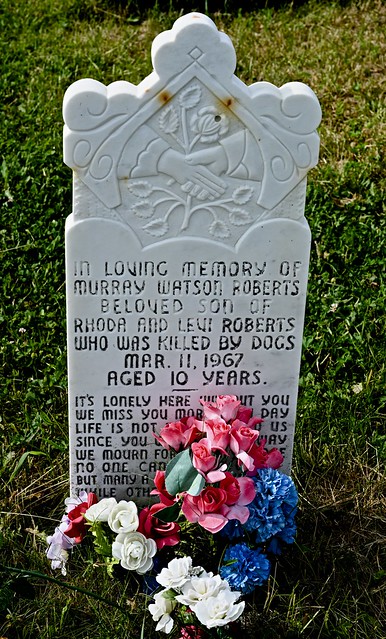
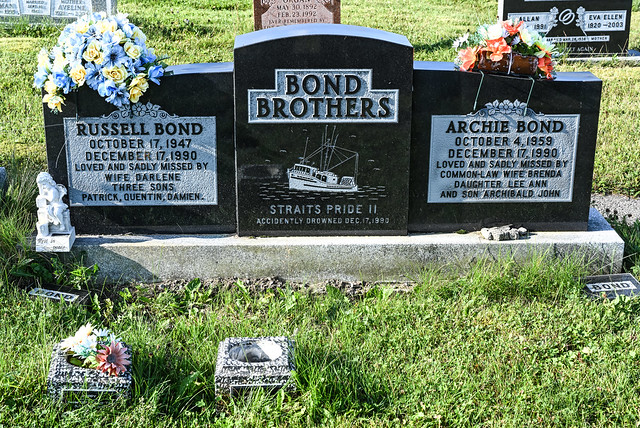
As I work on a project (photographic or otherwise) I’m continuously wondering why—seeking for reasons, bits of insight, overarching whithers. What is it about gravestones that keeps me returning to cemeteries? It turns out that the answers are many, and not simple, forever unfolding into new revelations of the depths and varieties of Form. For me, so much of the pleasure is in reading (that is, imagining, chasing, constructing) the Story contained in any instance of the Form.
This stone is from Querpon, at the northern tip of the western shore of Newfoundland. ‘Killed by dogs’ is not a phrase found on many gravestones, but we surmise that Murray Roberts might have been teasing tied-up sled dogs (there were not many snowmobiles in Querpon in 1967) who got loose and took revenge. I had a chance to find out, but muffed it: also visiting the tiny graveyard the day I was there was a man of more or less my age who was “visiting the parents” and told me he’d left Querpon in 1962 to join the Canadian Forces and only returned to Querpon when he retired… but he’d have been a teenager at the time, and would surely have remembered the incident. And it’s not unlikely that Murray was a shirt-tail cousin, Querpon being about 20 households.
This double stone, from Isle aux Morts at the southwestern tip of Newfoundland, sketches a tale that it turns out we can fill in details on. We begin with two brothers, a disaster to a named boat, a precise date, even some detail on their marital status:
Straits Pride II went down in a storm 29 years ago, and the incident was thoroughly investigated by the Transportation Safety Board:
On 17 December 1990, the F.V. “STRAITS PRIDE II”, inbound to St. John’s, Newfoundland, from
the fishing grounds with a two-third load of round (ungutted) codfish stowed in the fish hold,
encountered adverse weather, capsized and sank throwing the six-person crew into the ice-cold waters. Three crew members who managed to board the inflatable liferaft were subsequently rescued, but the remaining three lost their lives.
The Transportation Safety Board of Canada determined that the vessel continued to fish after learning of a forecasted storm warning and that the combined effects of the weather, shipped seas, stowage of the catch, free surface effect of liquids, loss of the port paravane, and downflooding caused the vessel to capsize and sink by the stern. The suddenness of the capsizing precluded efforts by three of the crew to successfully abandon the vessel, displacing them into the sea. As they were wearing only normal winter clothing with approved lifejackets, their survival time was limited. The other three crew members boarded the liferaft from the sea and were rescued some eight hours later in a mildly hypothermic condition. (see the detailed report of the incident)
and there’s more, in the form of a song:
I also learned (via Google) that Russell Bond’s wife Darlene died in February 2019, and that Russell had found a life-ring from the Ocean Ranger in 1982:
Officials at the Search and Rescue Center said Friday that a life-ring found on Newfoundland’s south coast was not from the Ocean Ranger oil rig that sank in February but from a Greek vessel bearing the same name. The ring was discovered on the beach at Burnt Islands, near Newfoundland’s southwest corner, last week by Russell Bond, a local fisherman. Bond turned the life-ring over to the RCMP and told local reporters he was certain it had come from the giant oil rig that sank Feb.15 on the Grand Banks, killing all 84 crew aboard.
Small things, bits of drama from lives lived quietly, of no great significance, but fascinating for their essential humanity.
Last night I took this specimen along on a visit and our hostess said “oooh is this a gift?” and I was immediately protective. “Certainly not!” I said, and immediately regretted my vehemence in defense of my rock, as I hadn’t even photographed it yet. I did make its portrait today, and thus recognized a Lesson in Attachment—one I might have learned (but had clearly forgotten) with the Bodhidharma example cited at the end of the Morphic Resonance post. In what wise is this rock my rock? Why should I wish to hold on to it? Wouldn’t it be better to appreciate it and pass it on so that others could enjoy its verisimilitude? Isn’t it enough to have discovered its several personalities and felt its agency? Yes, yes, 10,000 times yes.
This morning’s online version of the New Yorker brought a short story by Louise Erdrich, The Stone, and the text of an interview of Erdrich by Deborah Treisman, from which this segment is harvested:
Sometimes I notice an odd, local type of stone and pick up a shard or a pebble… I’ve learned to put most of these stones back after looking. But stones ground me, quite literally, when I am in a new place. And they are mysterious and yet friendly inhabitants of my house. Every time I’ve moved, I’ve left behind a small pile of foreign stones in the garden. Have these stones used me to get from one place to the next? So I have a lot of stones around, I must admit, but this story isn’t based on a particular one among them. In the Ojibwe language, nouns are animate or inanimate; the word for stone, asin, is animate. One might think that stones have no actual power—after all, we throw them, build with them, pile them, crush them, slice them. But who is to say that the stones aren’t using us to assert themselves? To transform themselves? One day, the things we made out of stones may be all that’s left of our species. Of our complex history of chipping away at and arranging stones, what will be recorded or known?
The story itself is quite marvelous, and includes this resonant passage:
A stone is, in its own way, a living thing, not a biological being but one with a history far beyond our capacity to understand or even imagine. Basalt is a volcanic rock composed of augite and sometimes plagioclase and magnetite, which says nothing. The wave-worn piece of basalt that the woman [protagonist of the story] had slept with for more than a decade was thrown from a rift in the earth 1.1 billion years ago, which still says nothing. Before she broke it and dumped it at the bottom of a drawer, the stone had been broken time and again. It had been rolled smooth by water and the action of sand. Because of its strange shape, it had been picked up by several human beings in the course of the past ten thousand years. It had been buried with one until a tree had devoured the bones and pulled the stone back out of the ground. It had been kept by a woman who revered it as a household spirit and filled its eyes with sweetgrass. It had been shoved off a dock, lifted back up with a shovel, deposited in a heap. It had surfaced in a girl’s left hand. A stone is a thought that the earth develops over inhuman time. It is a living thing to some cultures and a dead thing to others. This one had been called nimishoomis, or “my grandfather,” and other names, too. The woman had not named the stone. She had thought that naming the stone would be an insult to its ineffable gravity.
My dealings with ineffable gravity are hereby declared entirely legitimate.
It’s been months since the last post here, almost 3 quite busy months since our return home from this year’s cross-continent trip. The last six weeks included a very successful gallery show for Broot and a one-day pop-up show for me, and we’re now in Nova Scotia, just finishing another 3-week trip, this one a 55th anniversary circumtransit of the Gulf of Saint Lawrence (four nights by freight boat from Rimouski to Blanc Sablon PQ; ferry from Labrador to St. Barbe, Newfoundland; north to L’Anse aux Meadows, then down the west coast to Gros Morne National Park, then ferry to North Sydney NS, and finally to Horton Landing; home to Maine by the weekend).
The usual welter of thoughts and reading and explorations of this’n’that accompanied, of course, so there’s much to get caught up.
The Flickr photostream tells many tales but also leaves out happenings that didn’t happen to get photographed. I’m just uploading the bountiful harvest of our week in Newfoundland, and thinking through What It All Means. And wondering what’s next. There are Flickr Albums of faces, surfaces and abstracts, and landscapes as a first stab at sorting the hundreds of images.
The perennial puzzlement of how to think about and what to do with the vast array of anthropo- and zoomorphic images of rocks and wood and water seems to be heading toward a resolution, but the complexities and leaps of association that underlie will take some explication. The cut-to-the-chase of the moment is an evolving scheme for a multimedia gallery presentation next summer, the provisional title for which is
Morphic Resonance: Portraits in Stone, Wood, and Water
but the emergence of that title takes us back more than 3 million years, to the Makapansgat Pebble, which is surely an anthropomorphic form.:
The hominin ancestor who picked up and carried the pebble some 20 miles from its geological origin seems to me to represent an early (I’m tempted to claim the earliest) instance of aesthetic Consciousness in our own evolutionary branch [“possibly the earliest example of symbolic thinking or aesthetic sense in the human heritage”]). My own pursuit of wholly imaginary faces in various materials seems a direct descendant. I’ve been chewing over the deeper significance of this for the last year or so (since I learned of the Makapansgat Pebble). A couple of weeks ago the phrase “morphic resonance” drifted through my mind, and seemed somehow portentious (though I can’t remember when/where I first encountered it). It turned out to be a coinage of Rupert Sheldrake:
Morphic resonance is a process whereby self-organising systems inherit a memory from previous similar systems. In its most general formulation, morphic resonance means that the so-called laws of nature are more like habits. The hypothesis of morphic resonance also leads to a radically new interpretation of memory storage in the brain and of biological inheritance. Memory need not be stored in material traces inside brains, which are more like TV receivers than video recorders, tuning into influences from the past. And biological inheritance need not all be coded in the genes, or in epigenetic modifications of the genes; much of it depends on morphic resonance from previous members of the species. Thus each individual inherits a collective memory from past members of the species, and also contributes to the collective memory, affecting other members of the species in the future.
A story in the New York Times (These Mole Rats Felt No Pain, Even From Wasabi’s Burn) suggested the game of making haiku and senryu from headlines. The challenge is to add a line to complete the text of the headline, or perhaps find another way to work the text into the canonical 5-7-5 pattern. Here’s the opening salvo, in keeping with the sardonic and the mordant tone of the last post:
mole rats felt no pain even from wasabi’s burn try capsaicin next
(this assumes that tout le monde knows that ‘capsaicin’ is the active ingredient in the hotness of peppers) (and marks the conceit that the torture of mole rats is Science) (and with thanks to Nick for the capsaicin, C18H27NO3)
I’m at an age where I pay more attention than formerly to texts on health and Thanatos. Among the authors I seem to be engaged with are Atul Gawande, Sherwin Nuland, Jerome Groopman, Jenny Diski, and most recently Colm Tóibín. I’m especially interested in the grace and wit these writers apply to the direst of subject matter. Thus Tóibín in a recent article in London Review of Books:
A week later the phone rang and I was told that I had a cancer of the testicles that had spread to a lymph node and to one lung. Instead of seeing the urologist, I would now need to see an oncologist. For a few days I comforted myself by pretending that, because of my abiding interest in the mysteries and niceties of Being, I had to see an ontologist… (18 April 2019, page 3)
The art of the grim jest, the sardonic and the mordant, is not to everyone’s taste. Once again, Amazon seems to be reading my mind: as I wrote the last sentence, email binged a come-on for Tony Moyle’s The End of the World is Nigh (“If you love books about con-men, conspiracies, Renaissance history, massive agitated boar, exploding beds, marmalade and historical satire then this is the book for you…”). Did I succumb? Of course.
During a visit to Vashon Island, a series of unplanned conjunctions took me to the Vashon Bookshop for a half hour of browsing before our reservation at the marvelous May Kitchen and Bar. This book leapt into my arms:
Stephen De Staebler was my 9th grade history teacher (1957-58), and offered a high-energy version of World History to a class of 15 or so engaged and eager students. He also taught a class in stained glass for 5 of us, with lead and solder and glass cutters, the real deal. He was only at the school for a year, but was unforgettable for his contagious enthusiasm. He went on to become a well-known sculptor and teacher at San Francisco State, and died in 2011. His website (stephendestaebler.com) represents his work quite well. I was something between delighted and gobsmacked to discover a gallery of masks that presage my recent work with lithic personalities. At the very least, we draw upon the same mysterious vein of mimetic imagery (“a term used in literary criticism and philosophy that carries a wide range of meanings which include imitatio, imitation, nonsensuous similarity, receptivity, representation, mimicry, the act of expression, the act of resembling, and the presentation of the self” in its Wikipedia rendering). There’s also this quote to consider:
Much of art is play in the serious sense, like magic, trying to restructure reality so that we can live with the suffering.
-Stephen De Staebler, 1984
I’m not quite sure what to do with “the suffering” but I’m pleased to consider what he might mean. It’s the sort of responsibility one has toward one’s well-remembered teachers. Alas, there are only a couple of 9th grade classmates left who remember Steve De Staebler, and I wish I’d been able to convey my thanks to him for what he taught and what he Taught.