Rana Dasgupta

Christopher Lydon’s perennially fascinating Radio Open Source is doing a series of programs on India, well worth your attention even [maybe especially] if the Indian Subcontinent isn’t your usual territory. This bit of comparative analysis by Rana Dasgupta is typical of the richness:

America is a society of systems: there should be nothing that eludes the state – with systems of policing, control, regulation. That is clearly not the case in India. Indians accept that things cannot be systematized, that there is inherent chaos, that you don’t have to understand your neighbor, that he may live an incredibly different life from yours, but that’s not a problem. The incredible ramshackle bric-a-brac nature of Indian cities, where slums are next to high rises, is not felt to be a great shock. The face that people hack into electricity systems to run their slums is treated with wry humor by middle class Indians…

I suspect these things will play out to Indians’ advantage, because Indians will be much more comfortable in the US than Americans will be in India. And at a time when the new major economic growth prospects are in countries that look more like India than they do like America, Indians will be an incredibly mobile and flexible work population… Even being very wealthy they are quite comfortable living in a house that runs out of water quite often, and runs out of electricity. They’re able to go into weird places in central Asia and Africa and feel quite okay, knowing how things operate… (30 minutes into the program)
links for 2009-12-09

Mark Rubin totally rocks

Here’s Part Two of the totally absorbing profile of Mark Rubin that I pointed to Part One of a couple of weeks ago. I’ve just bought Fat Man and Little Boy and just looooove it. As Mark says,

I have a feeling that in every town in America there’s ten or twenty dudes that would really like what we’re doing. And if I could just get my record to those guys and if I could just hit the road every once in a while and just play for those guys, I would be completely thrilled, that would be all that I require. I’m real proud of it, and I’m just so happy and edified to see that other people like it as much as I do.

A gander at the video below will tell you if you are or aren’t one of the ten or twenty dudes. I am for sure:

Some audio experiments

Thinking about what to do with audio, I remembered that I’d uploaded some stuff to The Internet Archive a couple of years ago. The items turn out to be pretty interesting to re-encounter, and suggest that I should do more along these lines:

A couple of experiments I did in 2005, using an MP3 recorder to capture what was on mind mind as I walked to work: 16 March 2005 (just under 4 minutes) and 25 March 2005 (just over 4 minutes)
…and On Musical Variety (17:50) constructed in late 2004 as a come-on for a course in World Music (taught at Washington & Lee in Winter 2005)
…and Charlie Skinner tells a story (1:17)

Cory on Paige M. Gutenborg

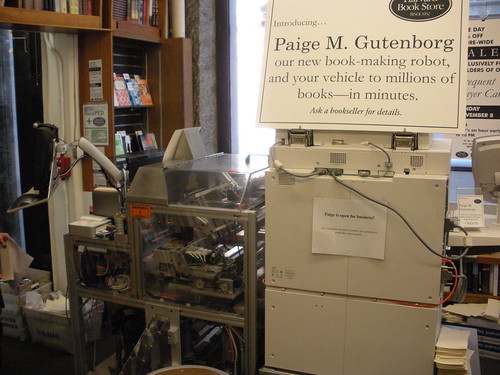
Cory Doctorow’s half-formed thoughts on one future for bookselling in this morning’s BoingBoing are worth a closer look if you’ve just clicked past the posting without reading it. He mentions the Harvard Bookstore’s Espresso book printer, which I visited and patronized myself a few weeks ago:
Paige M. Gutenborg
…but it’s what he says about its implementation that caught my eye:

At the Harvard Bookstore, they have someone who spends the day mousing around on Google Book Search, looking for weird and cool titles in the public domain to print and shelve around the store, as suggestions for the sort of thing you might have printed for yourself. This is a purely curatorial role, the classic thing that a great retailer does, and it’s one of the most exciting bookstore sections I’ve browsed in years. And even so, there’s lots of room for improvement: Google Books produces the blandest, most boring covers for its PD books, and there’s plenty of room for stores to add value with their own covers, with customer-supplied covers (the gift possibilities are bottomless), and so on. I can even imagine the profs across the street producing annotated versions — say, a treatise on Alice in Wonderland with reproductions of ten different editions’ illustrations and selling them through the store’s printer and shelf-space, restoring the ancient bookseller/book-publisher role.