If Tom Ze isn’t a household word out your way, give a listen to the four items linked at Captain’s Crate (“Rare, funky, and soulful music from the treasure trove of Captain Planet and Murphy’s Law”)
Category Archives: musics
Syllepsis for the masses
It’s always a comfort to learn a new bit of terminology, especially when a favorite bit of lyric is attached, and thus further clarified. Today’s case in point, from Language Log, invokes a song that’s been warming my little heart these 40 years, Michael Flanders’ and Donald Swann‘s Madeira M’Dear. If you don’t know it (and I can see by the look of you that some of you don’t, as Flanders was wont to say), a tiny fragment (but without the delicious syllepsis) is available via Amazon. Or you could watch a version, via Eric Storm and kwego:
Have Some Madeira M’Dear – kewego
Humorous song written by Flanders and Swann.
Humorous song written by Flanders and Swann.
While you’re at it, if you don’t already know The Gnu Song, here’s your opportunity, though once again not at the hands of the Original Authors.
Joshua Bell plays the Metro
I don’t know how long this Washington Post story will stay accessible, but MAKE time to read it, or at least skim through, before They pull it. Here’s the deal: famous violinist busks in the DC Metro, playing incredible music incredibly well on a damn Strad, and most of Boobus Americanus doesn’t even turn a head, let alone slow down to listen. Tsk.
There’s even a couple minutes of video, in 3 segments.
DON’T miss it. (via waxy.org)
On the epiphanic
I was walking briskly down toward Port Clyde, listening to Chris Lydon talking with Sonny Rollins, and reflecting on reflecting (we seem to be very reflexive today at #312; has to do with reading a few pages of Calvino with the first morning coffee), and the word ‘epiphanic’ slid into the foreground as I was listening to a bit of St. Thomas. Ah, I thought, that’s it, that’s the word that epitomises the frisson of Recognition, the instant of grokkage, one of the states of mind I love most. So first some delicious trivia:
From Greek epiphaneia, manifestation; and from epiphainesthai, to appear.
An epiphany is a sudden shift of perspective or flash of intuition that opens one to a greater or more subtle understanding. “Epiphanic” describes something or somewhere that is full of epiphany.
and from morewords.com:
epiphanic is a valid word in this word list. For a definition, see the external dictionary links below.The word “epiphanic” uses 9 letters: A C E H I I N P P.
No direct anagrams for epiphanic found in this word list.
Adding one letter to epiphanic does not form any other word in this word list.
Words formed when one letter is changed in epiphanic
No words found when changing letter 1 (E)
No words found when changing letter 2 (P)
No words found when changing letter 3 (I)
No words found when changing letter 4 (P)
No words found when changing letter 5 (H)
No words found when changing letter 6 (A)
No words found when changing letter 7 (N)
No words found when changing letter 8 (I)
No words found when changing letter 9 (C)
Sorry, no words at all (in this word list) can be found by changing one letter in epiphanic.So ‘epiphanic’ is a lexical dead end, sort of. But the Googly fun doesn’t stop there. I found this lovely wrang-wrang on the subject, at hypermedia joyce studies:
Joyce’s epiphanies and the accounts of the epiphany he stages in his work, lack claritas. They leave us wondering what exactly an epiphany is. While we may be able to separate the epiphany off from the conceptual void or plenitude, and appreciate it as a conceptual complex in itself, its final harmony or whatness eludes us. The set-piece presentations of the theory, in Stephen Hero and Portrait, signally fail to work as epiphanies of the epiphany, while taking their place no doubt in the relation of part to part, in reading as an exercise in consonantia.
Ouch. It goes on from there…
But back to Sonny Rollins, and Chris Lydon. Even when I find the guest(s) annoying (Camille Paglia, or the acolytes of Hannah Arendt for instance), it’s all so conversational and unrehearsed, and there’s a freshness to what Chris is doing. It’s good for me to find out something about stuff that I wasn’t paying attention to, and didn’t know I was interested in. Tubas, for instance.
Here are some especially succulent bits from the Sonny Rollins conversation. You have to slow yourself down a bit to get the full benefit of the wisdom in what Sonny is saying, and not-saying (some stuff is just hard to talk about in words…). The whole interview is really a gem, and these outtakes are just a few that especially grabbed me:
St. Thomas: origins and DRM (1:20)
playing with Bud Powell (1:29)
what do you think about when you solo? (1:11)
all of the above (1:14)
1958: how ironic (1:32)
listening to myself is an ordeal (1:16)
with Sonny Stitt, and about others he’s played with (3:06)
act on it (1:33)
On the Force being with one
In answer to Max’s query, Robert Force is HERE, complete with a digital version of In Search of the Wild Dulcimer and musical examples and oh jeez a whole lot of other stuff. Now it’s time to dust off that Mike Rugg rosewood CapriTaurus dulcimer that’s been sitting on the shelf: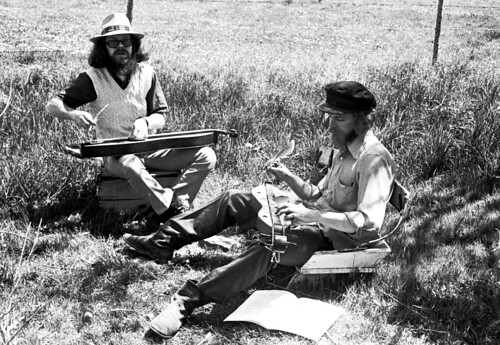
(it’s the one Kent is playing –and it’s really his, but lives with me until he comes to reclaim it. I’d love to see him, but… The one I’m playing is by Paul Reisler, and resides chez Ron Brunton. These bits of provenance might matter someday.)
Dulcimer stuff
Now and again a really resonant wave collapses on my desktop, and this morning it’s the video of Robert Force doing “On the Hard Drive Now” (12MB, about 3 minutes) linked at Old Blue Bus. Jeez, I’m gettin’ to be one of those Old Guys who remembers when… and gets out the old Richard and Mimi Fariña records for a bout of nostalgia. Suppose I’ll hafta reread Been Down So Long It Looks Like Up to Me. Yup, there it is on the top shelf…
A seriously wonderful CD
Ry Cooder’s brand new My Name is Buddy is surely not for just everybody, but it certainly has brightened the corner where I am for the last 24 hours (ever since the UPS dude delivered it, still warm from the anvil). Sidemen include Mike Seeger and Roland White (to cite two of my own musical heroes), and the artwork on the album is stunning too. Check out this story from last Sunday’s Observer for further details and inducements to purchase.
Ray’s song
ok, so the video is 14:33, but it’s an Important Cultural Document: Ray talks about the origins and consequences of his viral tune I’m about to whip somebody’s ass. The SportsRacer remixes are a whole other dimension or two.
Inspired nonsense
A few days ago I linked to a video of a ukulele number yclept “Monkey’s Brain” and was prompted to hunt down the perpetrators (The Hoppin’ Haole Brothers, who “mix the tropical-bopical sounds of paradise with the energy and rhythm of hot jazz and country swing”), with a CD at CD Baby… so I ordered it and it came. I don’t expect that just everybody will appreciate this sort of thing as I do, but you might try this 2:00 piece of Hosin’ Down the Devil to see if you’re Type A or Type B…
Cautionary Tales?
Things connect. Sometimes the linkages are obscure, or tolerably tendentious, or simply risible, or maybe they’re just co-incidental. And I suppose sometimes their Moment hasn’t come, and the nascent dots aren’t connected. The last few days have brought onto the stage several threads for which I’m seeking the Nexus. A prize to the reader who can construct it from these bits, each of which can be read as a sort of Cautionary Tale
Digression: Hillaire Belloc was not, perhaps, a very nice fellow, but his Bad Child’s Book of Beasts and Cautionary Tales for Children were staples of my own youth. Consider:
The Dromedary
The Dromedary is a cheerful bird:
I cannot say the same about the Kurd.The Frog
Be kind and tender to the Frog,
And do not call him names,
As “Slimy skin,” or “Polly-wog,”
Or likewise “Ugly James,”
Or “Gap-a-grin,” or “Toad-gone-wrong,”
Or “Bill Bandy-knees”:
The Frog is justly sensitive
To epithets like these.No animal will more repay
A treatment kind and fair;
At least so lonely people say
Who keep a frog (and, by the way,
They are extremely rare).(end Digression)
The candidates for interconnection: Amédé Ardoin, Thomas Midgely, and Harlan Ellison. Not exactly household words, but all have re-crossed my path lately, so I’m sporting with their possible interlinkage.
Amédé Ardoin came up this morning via Old Blue Bus, one of the music blogs I follow. The link to Two Step de Eunice will probably disappear in a few days, so listen while you can. The specific point of interest of the moment is the Tale of his death, which seems to have several variants:
Ardoin’s death remains shrouded in mystery. One report has him being brutally beaten after wiping his brow with a handkerchief handed to him by the daughter of a white farm owner. According to McGee, Ardoin was poisoned by a jealous fiddler. More recent studies have concluded that Ardoin died of venereal disease at the Pineville Mental Institution.
Craig Harris, All Music Guide)A cousin of renowned black Creole accordionist Alphonse “Bois Sec” Ardoin, he crossed racial boundaries by performing with noted Cajun fiddler Dennis McGee. However, he stepped too far when at a dance around 1941 he wiped away sweat with a handkerchief offered by a white female. Suffering a terrible beating after the dance, he eventually died of his wounds, emotional and physical, at Pineville on November 3, 1942.
(cajunculture.com)
Thomas Midgley, inventor of (1) tetraethyl lead AND (2) freon, came up in an answer to a friend’s email question about global warming. Both inventions transformed the technologies they were developed for (the internal combustion engine, and refrigeration) in the short run, and both of which turned out to be really really really BAD things in the long run. Bits of the story are available here and here and here and here. The story of Midgley’s death (strangled in a device of his own cleverness, contrived to solve the problem of his own physical limitations) makes the karmic point more obvious, if karmic points ever really work that way. But the other spin on Midgley’s work is that our civilization owes a very great deal to the efficiency of the gasoline engine (said efficiency absolutely based upon the high compression engine design that tetraethyl lead enabled) and to the possibility of cooling buildings and refrigerating food –indeed, our civilization is simply unthinkable without those two elements (the same story could be told with any number of other essential technologies). To be sure, our cleverness has found substitutes for both tetraethyl lead and freon, but not exactly “just in time”, and the substitutes themselves are iffy too (e.g., MTBE which succeeded tetraethyl lead as an antiknock compound, and is now being replaced by something else because of its toxicities).
And the third came up because I’ve been reading in Harlan Ellison’s anthologies Dangerous Visions (1967) and Again, Dangerous Visions (1972) and exploring who Harlan Ellison was/is and what he’s done. The two anthologies enjoy a reputation as ground-breaking collections –see James Schellenberg’s review as an example. The missing third anthology is the subject of a long-running soap opera which (among other things) provoked Christopher Priest’s The Book on the Edge of Forever –see Amazon reviewers’ comments for more on “a fascinating account of one of the most famous non-books ever not-published”, and note that “Ellison has been severely criticized for neither publishing the volume nor returning control of the stories to their authors, some of whom have since died.”
I’ve spent a lot of time in various corners of the realm of “speculative fiction” (see Wikipedia and a Wikipedia portal, and explore The Internet Speculative Fiction Database and ISFDB Wiki).