-
Teresa Nielsen, with MANY comments
-
Jamais Cascio asks for and gets suggestions
Category Archives: Uncategorized
links for 2006-01-28
-
clarity from the head lemur’s Blog
links for 2006-01-27
-
sheer bloody genius from Brian Lamb and Alan Levine, conference presentation reinvented
-
Photo Dictionary of Japanese Buddhist & Shinto Deities
On the Photobooth in Demotic Photography
Consider this spectacular image, from this morning’s Flickr Nation:
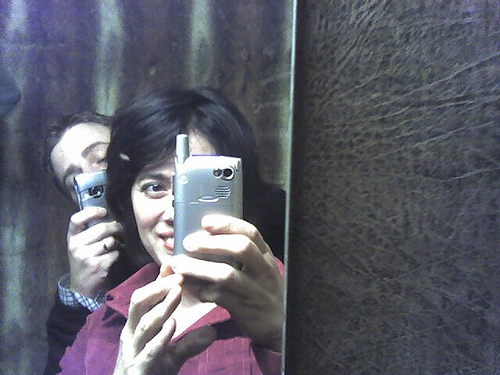
(I hope I’m doing this right, CC-wise: this one is by Caterina Fake herself (www.flickr.com/photos/caterina/91282844/).
I’m a latecomer to the notion that there’s something deeply significant in this medium, but I want to start a thread on the side to track it. Among others whose work precedes and informs this effort, I’m especially indebted to Photobooth, Babbette Hines’ glorious collection of “discarded images of men and women who crowded into photo booths to capture a moment on a little strip of film”. I have very few photobooth bits in my own collection, but there are two from the Joe Wilner trove:
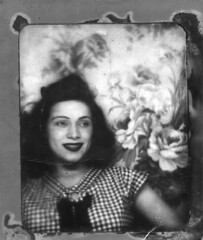 and
and 
It’s paradoxical that these share something with a few of the tintypes –a sort of artlessness in the pose that really conveys something about the essence of the person. Consider this one: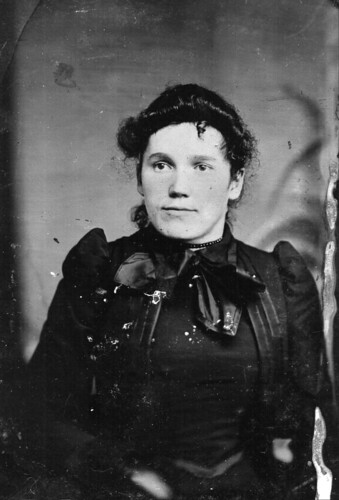
These are probably separated in time by something like 60 years, about as much time as separates the later ones from now.
I’m still hunting for whoever has analyzed the chronotope of the photobooth experience, the 1-2-3-4 exposures, with enough time between for the subjects to alter their pose/presentation, and about how people developed that temporal opportunity over the years. I have Babbette Hines’ book on order, and that may be just what I’m seeking.
It’s also necessary to explore what’s already out there on the Web, and a quick Google search nets a bunch: photobooth.net (“We aim to make this the most comprehensive photobooth resource on the internet…”), Wade’s Photobooth Gallery, the Flickr photobooth Group, Mr.Mixup’s Photobooth Archive (U.K.), just to start with…
Anyway, this is an open thread, to which I’ll add as I learn more.
links for 2006-01-26
-
Amalia Mesa-Bains
-
from Mark Dery’s Shovelware
links for 2006-01-25
-
Arctic ice mashup (“Developing Arctic Modelling and Observing Capabilities for Longterm Environmental Studies”)
Betsy’s comment on the Canadian election
“One nice thing about democracy is that you can have a change of scoundrels.”
UPS: been here and gone
Department of Co-Incidence
My friend Joan Larcom replied to a howyadoin message (which had included a pointer to Nova Scotia Faces) with this:
…The similarity I mentioned relates to your project on
Nova Scotia faces because I’ve only begun to think
about doing something similar with my family stuff.
This interest was piqued by an article in the NYT on
Dec 17th about Michael Lesy’s “Angel’s World” on
Angelo Rizzuto. Lesy is proposing “demotic”
photography or a closer look at family photos and
picture postcards. ‘UNpacking’ them sort of.
Here’s the Lesy quote:
In the past, Mr. Lesy has ruffled some academic feathers by arguing that what he calls “demotic photography,” like family snapshots or picture postcards, deserves the same level of scholarly study traditionally given only to art photography… “my whole intention is to subvert the [art photography] canon… There are possibilities that go beyond the safe definitions of what an artist is and what the camera is used for. …Academics… deal with photographs as aesthetic, intellectual constructs, or as integers in philosophical or linguistic argument. That’s not all they are. They’re slippery and deeply emotionally charged. A photograph is a thing which, to use an old scholarly word, needs to be ‘unpacked.’ There’s the manifest content, then half a dozen layered contents.”
(NYT 17 Dec 2005 sec B pg 9)
I like the flavor of “demotic”, which underscores the everyday, personal, hands-on qualities of family photographs. A Google search for “demotic photography” gets just 3 hits (“vernacular photography” nets 24,000).
One of those (besides the one pointing to the NYT Lesy quote) is a 1993 article from The Nation, which includes this provocative bit:
the Dada contribution to art was the photomontage, assemblages of photographic fragments that more or less assume an unlimited supply of images no more valuable than the paper on which they are printed, and that are readily understood by everyone, since they form the vernacular visual vocabulary of the culture.
One seeks to link to bits of story, of narrative or myth or expression. Consider the page of found images from In the Booth at squareamerica.com, each a scrap of the past, and more or less decodable, thanks to a common “vernacular visual vocabulary.” Each image serves as a momentary intersection with another person’s life-space,and the reader can gather the hologrammatic bits into the beginnings of an original narrative. Lesy’s Time Frames: the meaning of family photographs (1980) is, even 25 years later, an inspiring example of the exploration of photographs as ethnographic materials. I need to search for other books in the same vein… one such is Marianne Hirsch’s Family Frames : photography, narrative, and postmemory, but I’m sure there are others I should be thinking of.
I’ve often espoused the notion that you can start learning from anywhere/anything and construct interesting and worthwhile experiences. The starting point maps to other things and before you know it you’ve contextualized that starting point in some larger phenomenon. The challenge is to capture that process of linkage, and then to turn its telling into something distributable.
could it be better said?
When we stop seeing knowledge as an entity that is possessed within a person and start to cast it as a function of elements distributed across a system, we notice a dramatic impact on the education process: the educator becomes a supporter (not the center), the content is not as critical as the connections, learners find value in their aggregated perspectives, learners become content creators, and learning is continuous, exploratory and sustained (not controlled or filtered by only one agent).