Available as a pdf download

Available as a pdf download

and will evolve as the project progresses.

I’ve sent version 1.0 of my latest collection of photographs off to Blurb: Gone Tomorrow. It’s available for download via that link.
I woke up this morning with the first line of a haiku waggling in my mind:
and in the next few minutes the succeeding lines assembled themselves:
Each day’s reading and photography is pretty much guaranteed to present me with unexpected conjunctions and insights. This morning I read this in Ralph Eugene Meatyard (Steidl 2005), from a talk he gave to the Louisville Photographic Society in 1959:
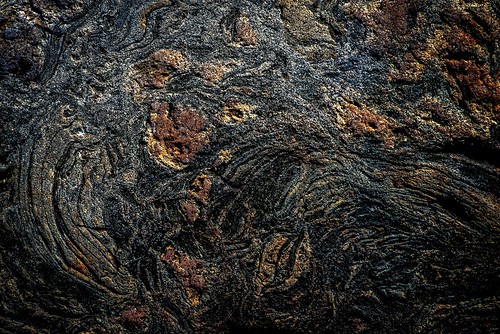
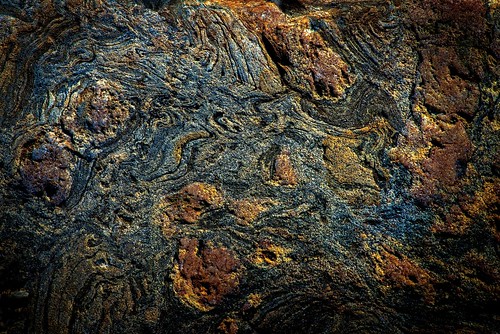
I have, at the present time, twelve methods, series, subjects that I am working on… They are: general photographs (that is, on any subject not otherwise covered), rock photographs; wall photographs; pictures of cemetery sculptures and sympathies; ice photographs; glass photographs; light photographs; painting in ice; uncanny photographs; emotionalist photographs; no-focus photographs; and the latest, photographs made through the influence of Zen. (pg 34)
I think of Meatyard and Clarence John Laughlin and Frederick Sommer as inhabiting many of the same quarters of the photographic landscape, where the ineffable reigns supreme and everything is more (and even spookier) than it seems to be at first glance. And I’m delighted to find that I have been, though unbeknownst, treading in his footsteps with about half of those “methods, series, subjects.”
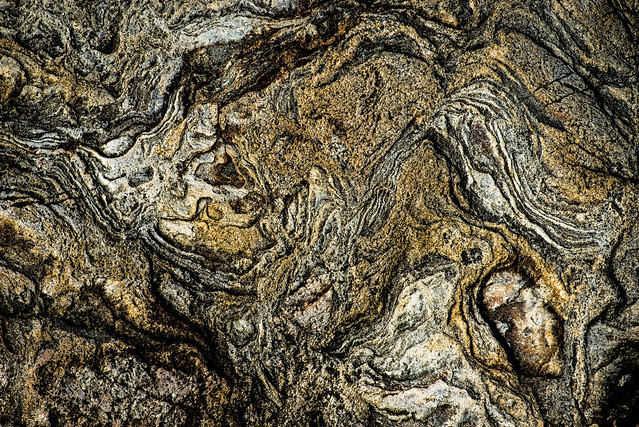
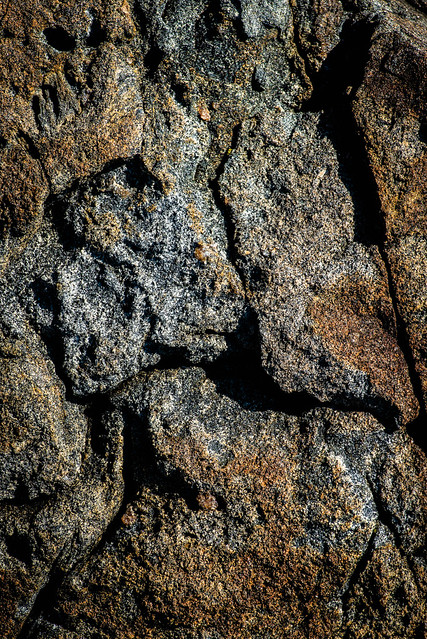
I’ve been exploring the possibilities afforded by a new lens, an 11mm ultrawide Irix. Three rock photographs from this morning’s visit to Marshall Point:


(note the enormous feline presence in the NW quarter)

(glacial scarring and a wonderful splash of intrusive lighter rock)

I’ve been reading Blake Stimson’s The Pivot of the World: Photography and Its Nation (MIT Press, 2006), which discusses three photographic Projects: Steichen’s The Family of Man, Frank’s The Americans, and the work of Bernd and Hilla Becher. Among the rumination-worthy bits I found this passage on aesthetic experience:
…The moment of feeling the pleasure of beauty or the fear of sublimity… [quoting Adorno] “the moment in which recipients forget themselves and disappear into the work; it is the moment of being shaken. The recipients lose their footing [and] the possibility of truth, embodied in the aesthetic image, becomes tangible.” (pp 25, 26)
I have occasionally felt that frisson, recently in coming upon a wall of Bernd and Hilla Becher’s images at Pier 24 in San Francisco, and also with a few of Paul Caponigro’s prints. One simply falls into the images and is vastated, never quite the same afterwards.
Critical mass seems to be approaching for a Blurb book of ice photographs, but the conceptual work remains to be done on text and sequence. Here’s a bunch of candidates for inclusion:
Each time I revisit Drift Inn beach I search for Bodhidharma (see the last post if this makes no sense whatever), but he continues to be Elsewhere. Yesterday I found and retrieved a faux-Bodhidharma whose manifestation taunted me:


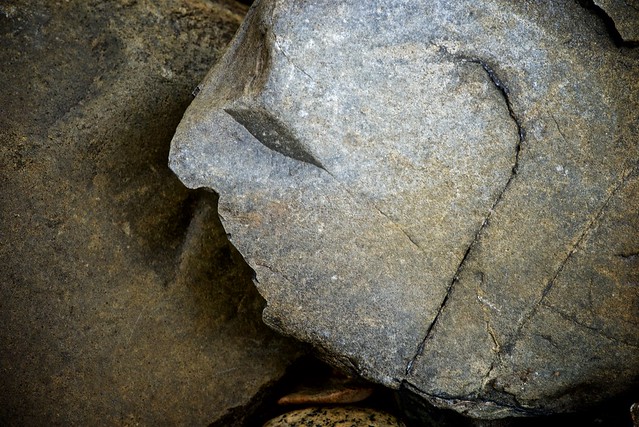
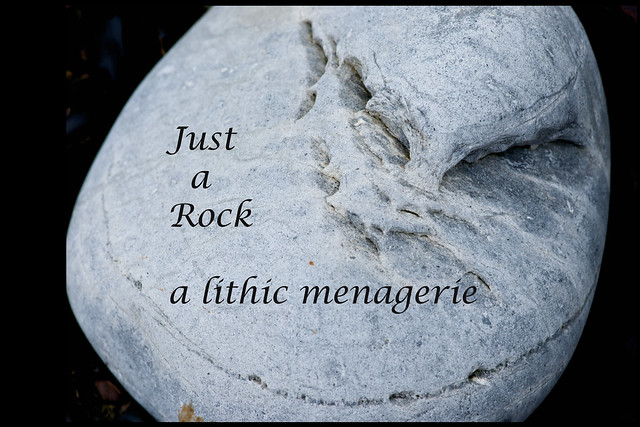
The Just A Rock book is beginning to come together, slowly, and is of course accompanied by discoveries and diversions of many flavors. I’ve been photographing at Drift Inn almost daily for the last 6 weeks or so, and each time I discover new rocks and often enough re-photograph ones I’ve already collected. A few days ago I was paying more attention to smaller rocks, those that fit in the hand and are rolled back and forth by the tide. One that I picked up seemed especially characterful, so I set it on a flat granite surface and photographed it:

It wasn’t until I was processing the image that I noticed that it was a portrait, and my first thought was “Zen Patriarch” since it reminded me of Japanese paintings I’d seen of those worthies. I wasn’t immediately sure which Patriarch, but put that question aside to explore later.
I’ve lately been reading The Gateless Gate: the classic book of Zen koans, and yesterday morning arrived at Number 4:

A haiku came to me, as haikus are wont to do:
Pictures of Bodhidharma are well known, and not only does he always have a beard but a very thick beard indeed! Wakuan was well aware of this. Why then does he say that Bodhidharma has no beard?
Everything has two aspects, phenomenal and essential. The phenomenal Bodhidharma has a beard, but the essential Bodhidharma has no beard. To realize this, you must grasp by experience the essential nature of Bodhidharma.
…
The essential nature [of anything] cannot be destroyed, even by karmic fire. If the whole universe were to be completely destroyed, the essential nature would continue to exist because it is empty. It is nonsubstantial. It cannot be seen with the eyes, heard with the ears, or touched with the hands. No one can identify the spot where it is.
So here’s what I was writing about rock before all the above happened:
The essence of rock is mineral, molecular, elemental, time-encapsulating, entropic [in the process of returning to its chemical origins], crystalline, cooled to a solid phase of a material derived from and still encapsulating its liquid phase.
The essence of a rock, such as one might hold or photograph, is revealed via the phenomenal engagement with a mind: the mind discerns (makes, constructs) form. The mind of a geologist attaches labels and associations and temporal structure; the mind of a wall builder sees mass and shape and fit; the mind of a sculptor may see the form that dwells within; the mind of an artist abstracts and transforms the visual appearance of the rock…
So you can see why the progress on Just A Rock is slow…
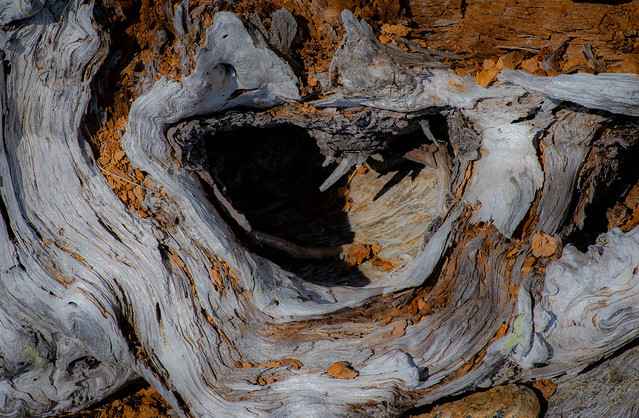
One of today’s rock creatures:

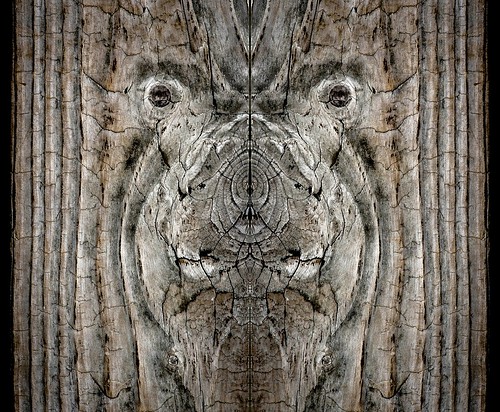
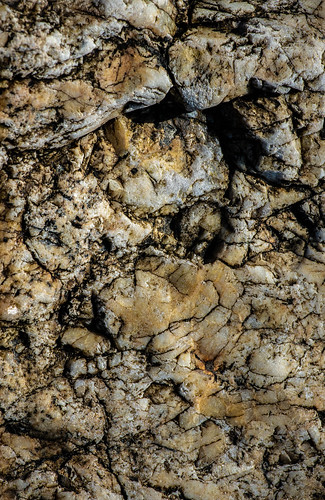
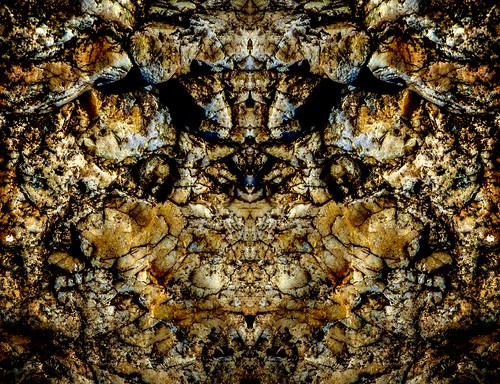
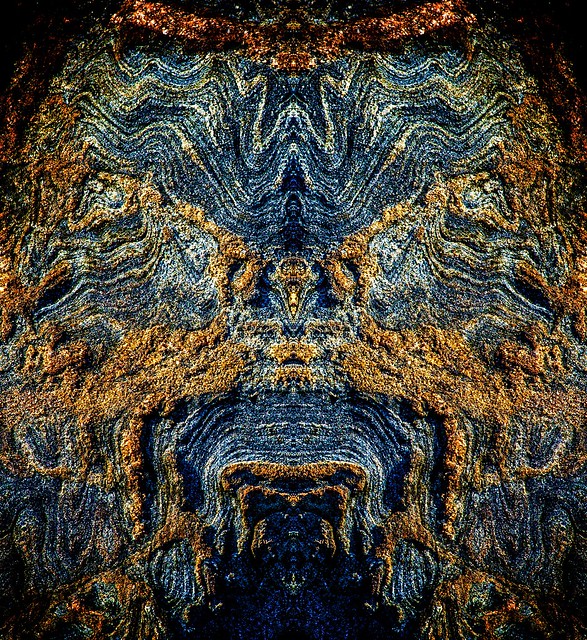
I continue to explore the mysteries of connotation that accompany the images in my Flickr photostream, wondering what inspires or provokes their composition and capture. Often it’s only during the processing phase that I recognize what a photograph contains, or means, or alludes to. This one is an example of an unsolved problem:

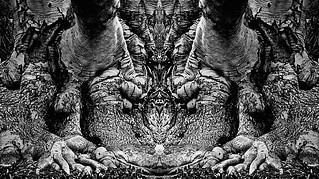
Does it help at all to mirror the image?