-
“an archive of videos that show politicians stumping for your vote. If a candidate or elected representative said it on TV… instead of just showing you the video, we invite you to do your own research and then tell the rest of us what you found.”
-
video interviews, from a 2008 Masters Thesis by Caleb J. Clark, New York University, Tisch ITP. Amazing.
-
from WFMU’s Beware of the Blog. 1929-1930 Brunswick Records. Wow.
-
of madness, in the British style: “On the District Line of the London Underground, Dagenham is three stops beyond the town of Barking”
Hoppin’ Hollanders
This fragment from 1956 conveys the sheer energy of Lionel Hampton’s performance:
(via Keep Swinging)
links for 2008-06-24
-
one or both? you choose (Shorpy of course)
-
I am speechless
-
and that man was a Comedian…
-
“…And here’s the curious thing, exactly these four giants “lost their concessions in Iraq” back in 1972 when that country’s oil was nationalized. Hmmm…”
Moleskine 9
I’ve been following Mattias Adolfsson for quite a while. Here’s his latest runthrough:
Don’t miss this one
Sooliman Rogie was just wonderful, and this page from True Panther Sounds links to five songs that will instantly become your favorites.
links for 2008-06-23
-
15 years of video virality
Charming
Life-affirming, even:
Matt Harding and his accompanying Google map
Mapping Afghan Ethnicities
I have a long-running fascination with spatial distribution of, well, pretty much anything and everything. One of the slipperiest things to map is ethnic identity, but that hasn’t deterred legions of cartographers (though in fact the cartographers are mostly hired help, assisting anthropologists, demographers, census-takers, colonial masters, the military…). One of my favorite examples of the pitfalls of ethnic mapping is George Peter Murdock’s effort to define the territories of peoples in Africa: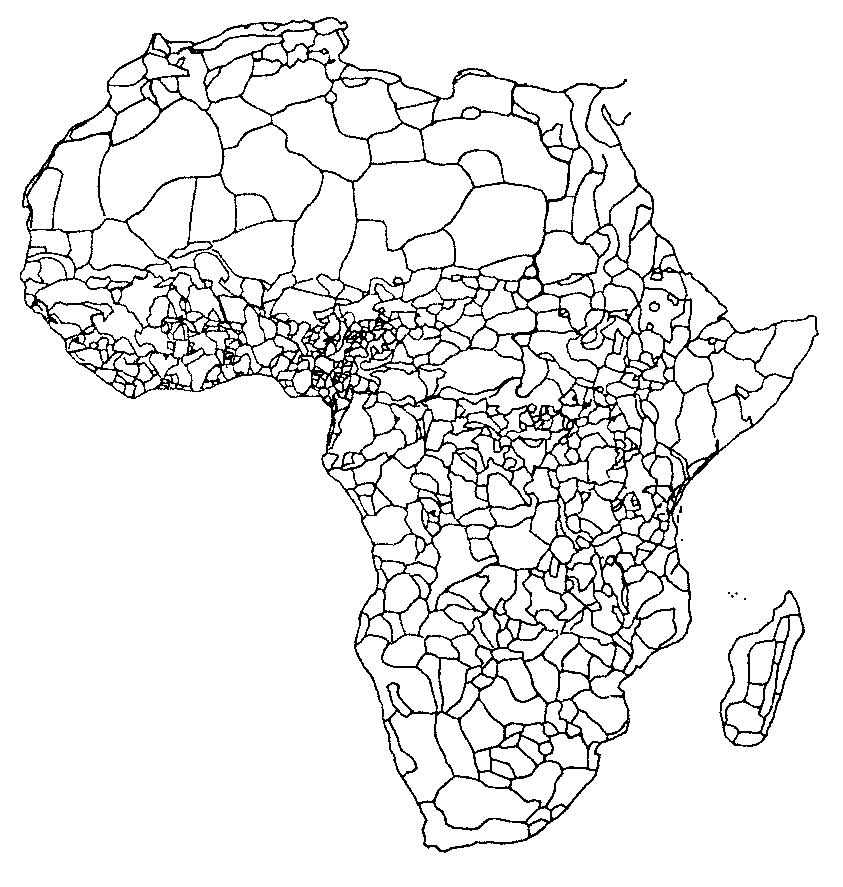
[adapted from Africa: Its Peoples and Their Culture History (1959)]
Pretty much everything is wrong with this map, starting with the very notion of a clear boundary (a line) to define where a “tribe” (ooooh, hateful word…) starts and stops (ethnic plurality and complex interdigitation is much more common than ethnic homogeneity, for all sorts of very good and highly location-specific reasons). At best, one might say that ethnicities have foci (perhaps hearths would be a better characterization) and force-fields that (seem to) emanate from a sort-of cultural identity centroid… but then there’s the problem of defining an ethnicity (does a person get only ONE?) and comprehending what its earmarks and contents might be (just what is “culture” anyway? –a problem that vexes anthropologists permanently). Sort of a long runup to a pointer to Ghost of Alexander’s “Fun with Ethnic Maps”, which showcases 7 versions of the ethnic territories of Afghanistan. The message here isn’t that one shouldn’t attempt to map slippery concepts, but rather that any map is a starting point for discussion and elaboration, and not an authority, and especially not a permanent authority. Pretty much any phenomenon worth mapping is likely to squirm around over time, and we’re just beginning to have the wherewithal to construct and distribute dynamic maps. Fascinating times, these.
Gary Burton and Makoto Ozone
I’m not in the habit of paying a lot of mind to piano or vibraphone, but this one sure got my attention:
What I should have been doing all these years
Dennis Havlena, via Make Magazine:
See also his Web page, shades of Bart Hopkin’s Experimental Musical Instruments. Just what is it that stands in the way of an Experimental Music outpost in Tenants Harbor ME?