Category Archives: reading

Conceptual pirouettes

Another piece from the May 2007 Harper’s: Gideon Lewis-Kraus “A World in Three Aisles: Browsing the post-digital library” has me thinking about collections, legacies, contextualizations, and the bugaboos I struggled with during my 15 years as a Librarian. With all that, this posting may take a while to unreel itself, and I’m thinking to break it up into money quotes from the article (which is eminently worth reading, even if you are not now nor have ever been a Librarian) and my own ruminations. So (with emphasis added here and there for bits I particularly like):

…why do they [Rick Prelinger and Megan Shaw Prelinger] truck across town to spend their afternoons painstakingly arranging and rearranging fifty thousand uncataloged and whimsically classified items, very few of which are overwhelmingly rare or commercially valuable… (pg 48)

…they want to help preserve a space for the physical, the limited, and the fussily hand-sorted alongside the digital pile. And they think there is a way that the small private library …can be reimagined to do just that. (pg 49)

The first rule [of the classification scheme] is that locality trumps all other considerations (pg 49)

Megan describes the library as fundamentally a physical organization of their own mental furniture. Their assortment maps out the range of future projects they have considered pursuing, and its varying granularity of organization provides insight into what they have worked through and what they haven’t quite gotten around to yet. (pp 50-51)

The charm of the Prelinger Library lies in the canny and pleasantly unexpected ways one subject blends into another [examples]…This latter transition is one of the conceptual pirouettes that Megan is proudest of, as it bridges the gap between the material and immaterial worlds. (pg 51)

The connections in Rick and Megan’s browsable narrative require varying degrees of imaginative exertion. (pg 52)

…the library is in a constant state of associative refinement, what Megan characteristically calls “brushing the teeth of the granularity” –that is, “work,” which also includes the transport of heavy cardboard boxes from one heap to another. (pg 52)

(Public libraries) are increasingly centered around computer terminals and stupidly grandiose atria that make them feel less like book repositories and more like shopping malls or free Internet cafés. The San Francisco Public Library… was constructed at enormous public expense in the nineties, and the result –a vacuous hotel-lobby sort of space, the actual books peripherized as a guilty afterthought— is unanimously considered a disaster… The reference librarians, reconciled to their new roles as customer-service technicians in the guise of advanced-degree “information scientists,” stand behind high oak-paneled counters and field questions about how to use these Internet resources, or more often how to get the printer to work… (pp 52, 54)

[the Prelinger Collection] is not about browsability per se but tailored and pointed browsability —browsability within a narrative structure and in service to some very particular ideas about the ownership of culture and the cultural frameworks of democracy (pg 55)

The promise of the Internet-as-Alexandria is more than the roiling plenitude of information. It’s the ability of individuals to choreograph that information in idiosyncratic ways… (pg 56)

…the Dewey decimal system is a helpful but ossified structure best suited to the bureaucratic centralization of thousands of different libraries (pg 56)

“We want to foment bursts of concentrated discovery across the spectrum,” Megan told one tour (pg 57)

As I read and re-read this article I found myself alternately cheering and tut-tutting, and here and there scribbling something in the margin, and when I add all that up I end up with the label “provocative” for the whole thing. There are some things that bother me, some scabs I continue to pick and itches that will be scratched.

The actual physical environment of the Prelinger collection centers on

haphazardly rigged shelves, eleven-foot stanchions, a gleaming gunmetal… [consisting of] about fifty thousand items… [including] twenty thousand pieces of what they call “ephemera,” maps and charts and brochures and errant scraps of apposite paper (pp 47, 48)

…so it’s different from my private library in being, well, bigger, but a lot of us preside over collections of a lifetime, which we tend and prune and augment and keep in idiosyncratic order (generally less apparent to outsiders than to ourselves), and which contain precisely what we “have worked through and what we haven’t quite gotten around to yet.” Managing such mathom houses, and turning them to productive use, is the greatest of pleasures for some of us. And now we have the means (via the Web) to put such ephemera into context and present some of their facets to a global audience.

The challenges of array and navigation are pretty profound, and I’m not convinced that the Prelinger approach to classification and order (“locality trumps all other considerations”) is of general utility –though I surely have myself bits of shelvage that are ordered by geographical considerations. Really the important point is one that I can’t find mentioned anywhere in the article: every item has more than one quality/characteristic that makes it worthy of membership in a collection, and a user needs to be able to use those earmarks to find associated items, and needs to be able to attach additional earmarks (OK, let’s call them TAGS) as new relationships emerge as a consequence of use.

A physical item pretty much has to reside in one location (its place on a shelf, or a labelled folder, or whatever), and serendipitous browsing is an important discovery method, but systematic frameworks and tools for managing such dynamic collections are essentially non-existent. The world of cataloging standards isn’t much help if the materials aren’t included in the standards (e.g., my collections of photographs, or of musical instruments, or coffin plaques, or extinct mass storage devices…). Thinking through all of this makes me realize the fairly obvious truth that what associates all these things is a narrative structure, the tales they are or can be woven into. Again, we have the medium for curation and distribution of those tales –the Web– but there aren’t a lot of examples or models out there. Perhaps more accurately, most of the existing examples and models are institutional, and based on grants and budgets and administrations. I need to keep a weather eye peeled for the work of others who are thinking along these lines, while continuing to pursue them myself. Expect to see more about this in this space…
State, dog and syntax

Here’s a book some of you will love and need to possess, one more from my MIT Press Bookstore haul of a few weeks ago: Virginia Tufte’s Artful Sentences: Syntax as Style

Savor (or, if outside the US, enjoy the extra opportunity and savour) the opening paragraphs, which follow an exemplary quotation:

And the words slide into slots ordained by syntax, and glitter as with atmospheric dust with those impurities which we call meaning.
Anthony Burgess, Enderby, 406

Anthony Burgess is right: it is the words that shine and sparkle and glitter, sometimes radiant with the author’s inspired choice. But it is syntax that gives words the power to relate to each other in a sequence, to create rhythms and emphasis, to carry meaning –of whatever kind– as well as glow individually in just the right place.

The basic unit of English syntax is the clause. Its “slots ordained by syntax” are a subject and a predicate. What traditional grammarians call a “simple” sentence consists of an independent clause, independent in that it makes sense without being attached to anything: Time flies. Without losing its nature as a basic sentence, however, a “simple” sentence may include optional added slots such as spaces for modifiers, complements, objects. (pg. 9)

I suppose one could read the book as didactic, but it never descends to the nagging prescriptive, and few would sit down to read it: the book invites random visitation, nibbling, pick-up-and-put-down. Ideal bathroom reading, for those so inclined. It is about syntax, so it’s stuffed with terminology that one has perhaps too tenuous a grasp upon: appositive, participial, nominative. But the commentary is focused on more than a thousand examples, lovingly chosen and clearly explicated. And the book is beyond elegant in design and typography (Monotype Dante), as befits something from Edward Tufte’s Graphics Press. VT is ET’s mom, professor emerita from USC, Miltonist and historian of English. And if you don’t know who Edward Tufte is, you need to remedy that deficiency forthwith.

On for whom to Stand Up

Walt Whitman 1855 Preface to Leaves of Grass:

All beauty comes from beautiful blood and a beautiful brain. If the greatnesses are in conjunction in a man or woman it is enough … the fact will prevail through the universe … but the gaggery and gilt of a million years will not prevail. Who troubles himself about his ornaments or fluency is lost. This is what you shall do: Love the earth and sun and the animals, despise riches, give alms to every one that asks, stand up for the stupid and crazy, devote your income and labor to others, hate tyrants, argue not concerning God, have patience and indulgence toward the people, take off your hat to nothing known or unknown or to any man or number of men, go freely with powerful uneducated persons and with the young and with the mothers of families, read these leaves in the open air every season of every year of your life, re-examine all you have been told at school or church or in any book, dismiss whatever insults your own soul; and your very flesh shall be a great poem and have the richest fluency not only in its words but in the silent lines of its lips and face and between the lashes of your eyes and in every motion and joint of your body…

I ran across this passage in John Leland’s Hip: the history (picked up remaindered at the MIT Press bookstore 10 days ago), and the above is one of the several bits that resonate at the moment, as I consider that which passes through the mind in an environment of yogic concentration. I came here after 8 months of involvement with yoga, sort of wondering whither this is headed. There’s lots that I have no wish to be involved with (the Spiritual trappings, mostly: “take off your hat to nothing known or unknown”). Having been NOT a student of English or American Literature (at least not since high school), though I’ve read a lot at my own speed, I’m forever finding lacunae in my experience. Leaves of Grass is one such Yawning (Yawping?) Gap in my Education, and I alternate between the pleasures of adult discovery and the regret that my adolescent self wasn’t Exposed to those specific Heresies in the passage. On sober reflection, it’s pretty clear WHY my long-ago teachers suppressed that side of Whitman (“dismiss whatever insults your own soul” ? I don’t think so…).

And as for “every motion and joint of your body”, well, that’s what I’m working on, and it’s turning out to be one of the best things I’ve ever done. The point of concentration for me personally is “have patience and indulgence toward the people”, working against what is for me the easy descent into Judgement of Others. I’m very interested to see what comes next…

The author, glimpsing himself in the mirror

I haven’t paid nearly enough attention to Italo Calvino, and it keeps coming back to bite me. My sister in law has an Inscription at the entry to her Library, from Calvino’s If on a winter’s night a traveler, and the sad fact that pretty much everybody but me was already familiar with it doesn’t diminish one bit my pleasure in having discovered it at last. Here it is, on the off chance that you don’t already know it:

In the shop window you have promptly identified the cover with the title you were looking for. Following this visual trail, you have forced your way through the shop past the thick barricade of Books You Haven’t Read, which were frowning at you from the tables and shelves, trying to cow you. But you know you must never allow yourself to be awed, that among them there extend for acres and acres the Books You Needn’t Read, the Books Made For Purposes Other Than Reading, Books Read Even Before You Open Them Since They Belong To The Category Of Books Read Before Being Written. And thus you pass the outer girdle of ramparts, but then you are attacked by the infantry of the Books That If You Had More Than One Life You Would Certainly Also Read But Unfortunately Your Days Are Numbered. With a rapid maneuver you bypass them and move into the phalanxes of the Books You Mean To Read But There Are Others You Must Read First, the Books Too Expensive Now And You’ll Wait Till They’re Remaindered, the Books ditto When They Come Out In Paperback, Books You Can Borrow From Somebody, Books That Everybody’s Read So It’s As If You Had Read Them, Too. Eluding these assaults, you come up beneath the towers of the fortress, where other troops are holding out:

the Books You’ve Been Planning Top Read For Ages,
the Books You’ve Been Hunting For Years Without Success,
the Books Dealing With Something You’re Working On At The Moment,
the Books You Want To Own So They’ll Be Handy Just In Case,
the Books You Could Put Aside Maybe To Read This Summer,
the Books You Need To Go With Other Books On Your Shelves,
the Books That Fill You With Sudden, Inexplicable Curiosity, Not Easily Justified,

Now you have been able to reduce the countless embattled troops to an array that is, to be sure, very large but still calculable in a finite number; but this relative relief is then undermined by the ambush of the Books Read Long Ago Which It’s Now Time To Reread and the Books You’ve Always Pretended To Have Read And Now It’s Time To Sit Down And Really Read Them.

With a zigzag dash you shake them off and leap straight into the citadel of the New Books Whose Author Or Subject Appeals To You. Even inside this stronghold you can make some breaches in the ranks of the defenders, dividing them into New Books by Authors Or On Subjects Not New (for you or in general) and New Books By Authors Or On Subjects Completely Unknown (at least to you), and defining the attraction they have for you on the basis of your desires and needs for the new and the not new (for the new you seek in the not new and for the not new you seek in the new).

All this simply means that, having rapidly glanced over the titles of the volumes displayed in the bookshop, you have turned toward a stack of If on a winter’s night a traveler fresh off the press, you have grasped a copy, and you have carried it to the cashier so that your right to own it can be established.

You cast another bewildered look at the books around you (or, rather: it was the books that looked at you, with the bewildered gaze of dogs who, from their cages in the city pound, see a former companion go off on the leash of his master, come to rescue him), and out you went.

(see more, nicely bracketed by bits of text on both sides, via Frank Pajares’ lovely site)

Calder’s Odds and Sods

Remaindered at the MIT Press bookstore when I visited a week ago was Angus Calder‘s Gods, Mongrels, and Demons : 101 Brief But Essential Lives. The single Amazon reviewer pretty much pans it, but I disagree after a week-long acquaintance with many of the Brief Lives, and find Dave Hallsworth’s review much more congenial (“Today’s academics, whose knights and emblems have all fallen in the gutter, are unable to differentiate between odds and sods..”). The dust cover offers this additional description:

A compendious assemblage of oddballs, tinks, heidbangers, saints, keelies, nutters, philosophers, freaks & other personages, whether real, imaginary, legendary or mythical from Billy the Kid & Hedy Lamarr to the Scottish Queen of Morocco & Ludwig Witgenstein

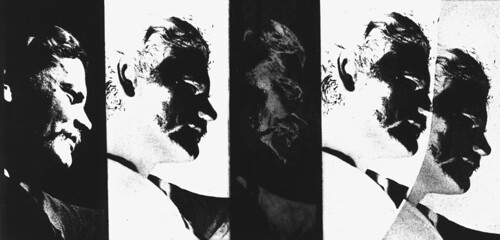
Biography is pretty voyeuristic anyhow, so it might as well be entertaining. Most of Calder’s miniatures are 4-6 pages, but some are longer and some shorter –i.e., they’re ideal Bathroom Reading (a genre which ought to be better appreciated). They’ll provoke you into unexpected excursions: the Tricky Sam Nanton profile rekindled my interest in the fine structure of Ellington Orchestra pieces of the late 1930s, and the entry for Lee Miller reminded me of her remarkable WWII photographs and her collaboration with Man Ray [they developed solarisation, aka The Sabattier effect, seen in the middle image below]:
Gary Miller
…and there are lots of people one had never heard of, but is glad to have made acquaintance at last. Racier than Wikipedia (no requirement for neutrality), more British than American in sensibility and vocabulary (trying to discover the meaning of “keelies” led me to WordNavigator.com [which didn’t help], but it took my Chambers Scots Dictionary to point me to “street arabs, pickpockets” and the Penguin Dictionary of Historical Slang to specify “an Edinburgh band of young blackguards, ca 1820”), and withal a lot of fun.

Cautionary Tales?

Things connect. Sometimes the linkages are obscure, or tolerably tendentious, or simply risible, or maybe they’re just co-incidental. And I suppose sometimes their Moment hasn’t come, and the nascent dots aren’t connected. The last few days have brought onto the stage several threads for which I’m seeking the Nexus. A prize to the reader who can construct it from these bits, each of which can be read as a sort of Cautionary Tale

Digression: Hillaire Belloc was not, perhaps, a very nice fellow, but his Bad Child’s Book of Beasts and Cautionary Tales for Children were staples of my own youth. Consider:

The Dromedary

The Dromedary is a cheerful bird:
I cannot say the same about the Kurd.

The Frog

Be kind and tender to the Frog,
And do not call him names,
As “Slimy skin,” or “Polly-wog,”
Or likewise “Ugly James,”
Or “Gap-a-grin,” or “Toad-gone-wrong,”
Or “Bill Bandy-knees”:
The Frog is justly sensitive
To epithets like these.

No animal will more repay
A treatment kind and fair;
At least so lonely people say
Who keep a frog (and, by the way,
They are extremely rare).

(end Digression)

The candidates for interconnection: Amédé Ardoin, Thomas Midgely, and Harlan Ellison. Not exactly household words, but all have re-crossed my path lately, so I’m sporting with their possible interlinkage.

Amédé Ardoin came up this morning via Old Blue Bus, one of the music blogs I follow. The link to Two Step de Eunice will probably disappear in a few days, so listen while you can. The specific point of interest of the moment is the Tale of his death, which seems to have several variants:

Ardoin’s death remains shrouded in mystery. One report has him being brutally beaten after wiping his brow with a handkerchief handed to him by the daughter of a white farm owner. According to McGee, Ardoin was poisoned by a jealous fiddler. More recent studies have concluded that Ardoin died of venereal disease at the Pineville Mental Institution.
Craig Harris, All Music Guide)

A cousin of renowned black Creole accordionist Alphonse “Bois Sec” Ardoin, he crossed racial boundaries by performing with noted Cajun fiddler Dennis McGee. However, he stepped too far when at a dance around 1941 he wiped away sweat with a handkerchief offered by a white female. Suffering a terrible beating after the dance, he eventually died of his wounds, emotional and physical, at Pineville on November 3, 1942.
(cajunculture.com)

Thomas Midgley, inventor of (1) tetraethyl lead AND (2) freon, came up in an answer to a friend’s email question about global warming. Both inventions transformed the technologies they were developed for (the internal combustion engine, and refrigeration) in the short run, and both of which turned out to be really really really BAD things in the long run. Bits of the story are available here and here and here and here. The story of Midgley’s death (strangled in a device of his own cleverness, contrived to solve the problem of his own physical limitations) makes the karmic point more obvious, if karmic points ever really work that way. But the other spin on Midgley’s work is that our civilization owes a very great deal to the efficiency of the gasoline engine (said efficiency absolutely based upon the high compression engine design that tetraethyl lead enabled) and to the possibility of cooling buildings and refrigerating food –indeed, our civilization is simply unthinkable without those two elements (the same story could be told with any number of other essential technologies). To be sure, our cleverness has found substitutes for both tetraethyl lead and freon, but not exactly “just in time”, and the substitutes themselves are iffy too (e.g., MTBE which succeeded tetraethyl lead as an antiknock compound, and is now being replaced by something else because of its toxicities).

And the third came up because I’ve been reading in Harlan Ellison’s anthologies Dangerous Visions (1967) and Again, Dangerous Visions (1972) and exploring who Harlan Ellison was/is and what he’s done. The two anthologies enjoy a reputation as ground-breaking collections –see James Schellenberg’s review as an example. The missing third anthology is the subject of a long-running soap opera which (among other things) provoked Christopher Priest’s The Book on the Edge of Forever –see Amazon reviewers’ comments for more on “a fascinating account of one of the most famous non-books ever not-published”, and note that “Ellison has been severely criticized for neither publishing the volume nor returning control of the stories to their authors, some of whom have since died.”

I’ve spent a lot of time in various corners of the realm of “speculative fiction” (see Wikipedia and a Wikipedia portal, and explore The Internet Speculative Fiction Database and ISFDB Wiki).

Obsession

I had to order the CD update for The Complete New Yorker in order to reread Jonathan Lethem’s Personal History essay “The Beards: An adolescence in disguise” (from the 28 Feb 2005 issue, pp 62-69), and found that I remembered bits of it clearly but that I’d missed a lot too. It’s a fine piece, especially if you’re trying to sort through your own history of interests and ummmm obsessions. A couple of especially juicy bits, in which I don’t exactly recognize myself but can see how one might extrapolate:

Attempting to burrow and disappear into the admiration of certain works of art, I tried to make such deep and pure identification that my integrity as a human self would become optional, a vestige of my relationship to the art. I wanted to submit and submerge, even to die a little. I developed a preference, among others, for art that required endurance, that mimicked a galactic endlessness and wore out the nonbelievers… By trying to export myself into a place that didn’t fully exist, I was asking works of art to bear my expectation that they could be better than life, that they could redeem life. I asked too much of them: I asked them to be both safer than life and fuller, a better family. That, they couldn’t be. At the depths I’d plumb them, so many perfectly sufficient works of art became thin, anemic. I sucked the juice out of what I loved until I found myself in a desert, sucking rocks for water. (pg. 67)

The work I’ve chosen bears a suspicious resemblance to the rooms themselves [ref: Every room I’ve lived in since I was given my own room at eleven, has been lined with books]. My prose is a magpie’s. Perhaps anyone’s writing is ultimately bricolage, a welter of borrowings. But, of the writers I know, I’ve been the most eager to point out my influences, to spoil the illusion of originality by elucidating my fiction’s resemblance to my book collection… My rooms might have been armor, a disguise or beard, but I wanted millions of admirers to peek inside and see me there, and when they did I wished for them to revere and pity me at once. The contradiction in this wish tormented me, so I ignored it. Then I became a writer and it began to sustain me. (pg. 69)

…this in the context of last night’s Radio Open Source program The Ecstasy of Influence and the Harper’s piece of the same name.

Jazz and ageing and sf

Co-incidentally, over at The New Yorker, Adam Gopnik’s Postscript for Whitney Balliett has this nice bit:

As the music he loved aged, he was often left without a subject, and those of us who revered his writing sometimes wished that he could have discovered in himself a more sympathetic ear for the sounds of newer jazz. But he was too honest to pretend to admire what he didn’t, and it was the great American music of the twenties through the eighties (the seventies, a jazz Indian summer in New York, were a high-water mark for him) that remained his subject… (12 Feb 2007, pg. 31)

In a related vein, my recent encounter with the video of Harlan Ellison reading Prince Myshkin (click on ‘Prince Myshkin’) led me to revisiting the Ellison-edited Again, Dangerous Visions “speculative fiction” anthology of 1972, and that, in turn, provoked this scribbled rumination:

1972 to 2007: 35 years, and still the stories seem fresh –or perhaps it’s that those issues still define what’s important for me, like Ursula LeGuin’s “The Word for World is Forest”, which is at base an examination of Ecology.
And it was Ecology that was the epicenter for my Generation, though my own take on it was more geospatial than energetic.
But the moniker “speculative fiction” (in Ellison’s Introduction to the collection, and elsewhere) is worth considering anew. I just have this feeling that the world would have gone another way if more people had read this stuff…

So here I am, drifting toward joining those “old guys” who remember and value what others have forgotten, or are so young as to never have known…

The Ecstasy of Repurposing

From Open Source, about an impending show:

We can’t stop talking about Jonathan Lethem’s essay in this month’s Harper’s. If you haven’t read it, you really should. Nothing that follows in this post will be nearly as interesting. Go ahead. And this post will still be here when you return. You know you want to.

Those of us fascinated by the cultural phenomenon (and the practical process) of mashups and the general subject of repurposing will be especially interested in both the essay and the forthcoming podcast.

Whitewash as Public Service

Benjamin DeMott in October’s Harper’s:

The 9/11 Commission Report, despite the vast quantity of labor behind it, is a cheat and a fraud. It stands as a series of evasive maneuvers that infantilize the audience, transform candor into iniquity, and conceal realities that demand immediate inspection and confrontation. Because it is continuously engaged in scotching all attempts to distinguish better from worse leadership responses, the Commission can’t discharge its duty to educate the audience about the habits of mind and temperament essential in those chosen to discharge command responsibility during crises.

(read the whole thing)