Category Archives: reading

Current reading

I’ve found Daniel Suarez’ Daemon pretty satisfying on several levels, not the least of which are the stoking of my schadenfreudian and conspiracy-detecting proclivities. Suarez (who has been taken seriously by a lot of smart people) seems to get a lot of things about the world as it seems-to-be-going right enough to raise the hairs on the back of the neck every few pages, and here and there he comes through with bits of insight that link domains in novel ways. One case in point mixes digital geekery with mythology and folklore:

The mythmakers… were the ones who invented rhyme and meter –the programming language for human memory in preliterary civilizations. It was a cultural checksum –a mnemonic device. You couldn’t fuck with the code or the rhymes didn’t work; and if the rhymes didn’t work, people noticed. And so the knowledge of a people was passed down intact. It was a shamanic code. If you fucked with the code, then society lost its collective mind. (pg 600)

And so, having finished Daemon, I’ve ordered its just-published sequel Freedom, and confidently expect it to be as gripping and prescient.

Did Gertrude Stein invent the Web?

I’ve been reading the Marcus and Sollors A New Literary History of America article by article, and this morning came athwart Daniel Albright’s on Gertrude Stein (“1903: Gertrude Stein moves to Paris, and neither is ever the same again”), in which is quoted this bit from Stein’s Three Lives:

…there was a constant recurring and beginning there was a marked direction in the direction of being in the present although naturally I had been accustomed to past present and future, and why, because the composition forming around me was a prolonged present… I created then a prolonged present naturally I knew nothing of a continuous present but it came naturally to me to make one.

Hmmm, I thought, how very like the Web in which we live more than a century later.

Albright ends his article with this food for thought, quoting an unknown-to-me

peculiar piece from Jonathan Swift called A Compleat Collection of Genteel and Ingenious Conversation (1738), full of passages such as this:

Neverout. Miss, what spells b double uzzard?
Miss. Buzzard in your teeth, Mr. Neverout.
Lady Smart. Now you are up, Mr. Neverout, will you do the the favour to do me the kindness to take off the tea-kettle?
Lord Sparkish. I wonder what makes these bells ring.

If Gertrude Stein had never been born, this would seem a freakish and incomprehensible text. It still seems freakish and incomprehensible, but as an anticipation of Stein it is made familiar, assimilated into a canon that she caused to exist.

Hmmm, I thought again, how very like the Web in which we live more than a century later…

Cory on Paige M. Gutenborg

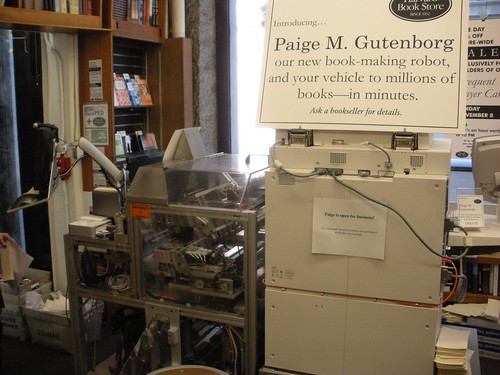
Cory Doctorow’s half-formed thoughts on one future for bookselling in this morning’s BoingBoing are worth a closer look if you’ve just clicked past the posting without reading it. He mentions the Harvard Bookstore’s Espresso book printer, which I visited and patronized myself a few weeks ago:
Paige M. Gutenborg
…but it’s what he says about its implementation that caught my eye:

At the Harvard Bookstore, they have someone who spends the day mousing around on Google Book Search, looking for weird and cool titles in the public domain to print and shelve around the store, as suggestions for the sort of thing you might have printed for yourself. This is a purely curatorial role, the classic thing that a great retailer does, and it’s one of the most exciting bookstore sections I’ve browsed in years. And even so, there’s lots of room for improvement: Google Books produces the blandest, most boring covers for its PD books, and there’s plenty of room for stores to add value with their own covers, with customer-supplied covers (the gift possibilities are bottomless), and so on. I can even imagine the profs across the street producing annotated versions — say, a treatise on Alice in Wonderland with reproductions of ten different editions’ illustrations and selling them through the store’s printer and shelf-space, restoring the ancient bookseller/book-publisher role.

Cantwell continued

I’m continuing to read Robert Cantwell’s When We Were Good: The Folk Revival, and still experiencing, in about equal measure, dissonance of the loathed and the admired: too-frequent overblown PostModernist claptrap, but mixed with really astute observation. Here’s a nice bit of analysis, replete with apposite coinage and illuminating simile:

Culturally, the banjo was an enigma, having been thrust out of a series of social niches through associations that had themselves become indefinable: abandoned by black culture, which reconstructed it from an African progenitor, forsaken by the Gilded Age parlor society in which it had a brief vogue, repudiated by jazz as jazz moved uptown –it was the instrument that history left behind. To take it up, as [Pete] Seeger had, was a gesture at once disarmingly candid and hauntingly emblematic, a fundamentally comic piece of cultural scavengery that like a clown’s broken umbrella solicits ordinary good will in conventional terms as it also legislates some independence of norms and conventions. (pg. 245)

T.S. Spivet

Intrigued by Christopher Lydon’s interview with author Reif Larsen (a 45-minute podcast), I asked the nice folks at Amazon to slip The Selected Works of T. S. Spivet onto a brown truck and hey presto it arrived yesterday. I’ll bet that you’ll do something similar once you’ve visited the book’s Web site, though some might be deterred by the last sentence of Philip Marchand’s review:

Like the Smithsonian, the novel is full of acquired curiosities whose significance and place in a larger order is very hard to figure out.

Yes, well, some of us think life’s a bit like that. And some of us (but not all of us) really relish the figuring. Probably the same people who relish Codex Seraphinianus (explore some images)

Cyberabad

Ian McDonald’s River of Gods has sat on the shelf for a couple of years, awaiting its turn as Book of the Moment. It’s too big for bathtub reading (nearly 600 pages) and too heavy to carry in my Wednesday evening bag (when I often read for an hour after a yoga class in Brunswick), but I’ve been reading the sequel Cyberabad Days lately, and when that’s done I expect I’ll take up River of Gods. Both are set in the India of 2047, so they’re speculative fiction, or maybe sci-fi. The world they inhabit is entirely believable, if one is into believing in future worlds: they are credible extrapolations from the present, alive with slang and bits of technology that just make sense even if they don’t really exist right now. And the Indian setting gives them a fascinating flavo[u]r of their own, easy to imagine that one understands kinda sorta, even if some of the details are a bit hazy –like, just what IS a djinn anyway? Are they imaginary beings, or might they just as well be seen as Real to those whose Imaginations are appropriately constructed? Here’s a bit to whet appetites:

Now there is a new race jostling for space in their city: the aeais [AIs, right?]. If the djinns are the creation of fire and men of clay, these are the creation of word. Fifty million of them swarm Delhi’s boulevards and chowks: routing traffic, trading shares, maintaining power and water, answering inquiries, telling fortunes, managing calendars and diaries, handling routine legal and medical matters, performing in soap operas, sifting the septillion pieces of information streaming through Delhi’s nervous system each second. the city is a great mantra. From routers and maintenance robots with little more than animal intelligence (each animal has intelligence enough: ask the eagle or the tiger) to the great Level 2.9s that are indistinguishable from a human being ninety-nine-point-nine-nine percent of the time: they are a young race, an energetic race, fresh to this world and enthusiastic, understanding little of their power… (pg 168)

Berrian addendum

About halfway through Berry’s essay one comes upon this perhaps-puzzling sentence:

The present scientific quest for odourless hog manure should give us sufficient proof that the specialist is no longer with us.

I reckon that this is an allusion to Chic Sale’s Lem Putt, introduced to the world in The Specialist (1929), a classic that should be better known. If it’s new to you, the whole text (including William Kermode’s illustrations) is available, and it won’t take you 10 minutes to read her. The first paragraph may convince you that you should:

YOU’VE heard a lot of pratin’ and prattlin’ about this bein’ the age of specialization. I’m a carpenter by trade. At one time I could of built a house, barn, church, or chicken coop. But I seen the need of a specialist in my line, so I studied her. I got her, she’s mine. Gentlemen, you are face to face with the champion privy builder of Sangamon County.

The book is full of Berryesque advice, grounded in good rural precedent and practice:

No, sir, I sez, put her in a straight line with the house and, if it’s all the same to you have her go past the woodpile. I’ll tell you why.

Take a woman, fer instance — out she goes. On the way she’ll gather five sticks of wood, and the average woman will make four or five trips a day. There’s twenty sticks in the wood box without any trouble. On the other hand, take a timid woman: if she sees any men folks around, she’s too bashful to go direct out so she’ll go to the woodpile, pick up the wood, go back to the house and watch her chance. The average timid woman — especially a new hired girl — I’ve knowed to make as many as ten trips to the woodpile before she goes in, regardless. On a good day you’ll have the wood box filled by noon, and right there is a savin’ of time.

“Now, about the diggin’ of her. You can’t be too careful about that,” I sez; “dig her deep and dig her wide. It’s a mighty sight better to have a little privy over a big hole than a big privy over a little hole. Another thing; when you dig her deep you’ve got ‘er dug; and you ain’t got that disconcertin’ thought stealin’ over you that sooner or later you’ll have to dig again.

“And when it comes to construction,” I sez, “I can give you joists or beams. Joists make a good job. Beams cost a bit more, but they’re worth it. Beams, you might say, will last forever. ‘Course I could give you joists, but take your Aunt Emmy: she ain’t gettin’ a mite lighter. Some day she might be out there when them joists give way and there she’d be — catched. Another thing you’ve go to figger on, Elmer,” I sez, “is that Odd Fellows picnic in the fall. Them boys is goin’ to get in there in four and sixes, singin’ and drinkin’ and the like, and I want to tell you there’s nothin’ breaks up an Odd Fellows picnic quicker than a diggin’ party. Beams, I say, every time, and rest secure.

See? Classic, like I said. And I’ll bet that Wendell Berry knows all about Lem Putt –see the Humanure page.

Today’s hortatory fanfare

Wendell Berry’s writing surely exemplifies the phrase “clarion call”, though I’ve often felt that it’s just not possible to live up to his level of ecological and economic rectitude. Still, there’s often a shiver of Right On! as I read his commentaries on what we’re missing through inattention. Today Tim O’Reilly links to Berry’s essay In Distrust of Movements (2000) and I’ll quote my favorite bits:

…I must declare my dissatisfaction with movements to promote soil conservation or clean water or clean air or wilderness preservation or sustainable agriculture or community health or the welfare of children. Worthy as these and other goals may be, they cannot be achieved alone. I am dissatisfied with such efforts because they are too specialized, they are not comprehensive enough, they are not radical enough, they virtually predict their own failure by implying that we can remedy or control effects while leaving causes in place. Ultimately, I think, they are insincere; they propose that the trouble is caused by other people; they would like to change policy but not behaviour

We are involved now in a profound failure of imagination. Most of us cannot imagine the wheat beyond the bread, or the farmer beyond the wheat, or the farm beyond the farmer, or the history beyond the farm. Most people cannot imagine the forest and the forest economy that produced their houses and furniture and paper; or the landscapes, the streams and the weather that fill their pitchers and bathtubs and swimming pools with water. Most people appear to assume that when they have paid their money for these things they have entirely met their obligations.

Revere on Dummett on Frege

Revere (be it one person or more than one, hardly matters) is always worth reading, and is pretty sure to please either because (1) my own sentiments are more clearly expressed than I could manage myself, and/or (2) some new vista of the world’s complexities is opened and eloquently articulated, and/or (3) something is brought to my attention that I’d otherwise never have given house room. And just because “Public Health” is such a broad and vital canvas… Anyhow, today’s On being inspired by the preface of a philosophy book quotes at some length from Michael Dummett’s Preface to his Frege: The Philosophy of Language (1973/1981) –a book I’d never have picked up, let alone read the Preface to. Revere’s posting sucked me right in, and occasioned a cascade of thoughts, memories, mental asides, and personal resolutions for the future (among them: always read the Preface…). Can’t ask much more of a blog posting, can you?

Extrapolatory and “plausible futures” fiction

Over at Jyri Zengestrom’s blog I happened upon this statement:

The most disruptive social objects articulate something masses of people urgently feel, but lack a way to express.

…and it fits nicely with a number of things I’ve been reading lately. Not everyone will share my enthusiasm for Warren Ellis’s Freak Angels (a serialized graphic novel, dark and violent), or for the near-future (and alternate-past) genres like Cyberpunk and Steampunk, but it’s obvious that authors in these realms are working with materials that are highly relevant to the present. And I’m reminded of the John Brunner masterpieces Stand on Zanzibar and The Sheep Look Up that I used in courses 30-some years ago, to get students thinking about possible futures and different views of the present…

I’ve been following Jim Kunstler’s blog for a while now, and his World Made By Hand arrived a couple of days ago and has been inhaled. The novel is interesting on several levels, but especially as an exercise in imagining the contingencies of an all-too-plausible future –that is, as a sort of projective anthropology. A visit to the World Made By Hand website will reward in a number of ways. It’s the first time I’ve seen a trailer for a novel:

and there’s an interview with Jim Kunstler in which he talks about how he wrote the book. Two bits that jumped out at me:

the footing underneath reality is not quite what we’ve been used to…

…when you’re composing a novel like this, you set certain elements in motion and they end up dictating how things will play out –it’s an emergent, self-organizing process

As I read World Made By Hand I found myself marking bits of text that serve as technological and sociological mise en scène, and I feel compelled to lay at least some of them out here. Why? Hmmmm. I suppose it’s an exercise in “projective anthropology” but it’s also part of my own continuing rumination on what-all underpins the lives we lead in the ethnographic present –the unexamined assumptions and contingencies that support our material lives. Anthropology is, after all, one of the means to wrestle with the question: where does structure come from for people’s lives? So here’s a passel of short extracts, with pages noted, each of them a potential jumping-off place for thought and discussion:

since we didn’t have news reporters anymore and you barely knew what was going on five miles away (3)

The turbines and metal parts had long since been sold for scrap and every other useful thing was scavenged out. We couldn’t replace them anymore. (4)

Now, in the new times, there were far fewer people, and many of the houses outside town were being taken down for their materials. Farming was back. That was the only way we got food. (5)

You could still find rubber tires here and there, but you couldn’t get patch kits or the kinds of adhesives that would stand up to a repair job anymore (5)

The strip mall stores were vacant. Spiky mulleins and sumacs erupted through the broken pavement of the parking lot. The plate glass was gone and the aluminum sashes, and everything else worth scavenging was stripped out. (11)

People are on the move again (12)

Being so few in numbers, children no longer enjoyed solidarity in rebellion, and our society was too fragile to indulge much symbolic misbehavior (13)

The various shifting factions worked hard at managing the news even as the TV, newspapers, and Internet were failing in one way or another from irregular electric service (15)

the federal government was little more than a figment of the collective memory. Everything was local now. (15)

We had trouble getting wheat latelybecause trade had fallen off, and we couldn’t grow it locally because of a persistent wheat rust in the soil that returned no matter how you rested a field. Mostly we had to rely on corn and buckwheat, with some barley, rye, and oats (16)

“It’s not all bad now,” I said.
“Weve lost our world.”
“Only the part that the machines lived in.” (18)

commercial entertainment as we knew it was no more, and its handmaiden, advertising, had gone with it (21)

milk was more difficult to keep in high summer because we lacked refrigeration (22)

…after the bomb went off in Los Angeles. That act of jihad was extraordinarily successful. The authorities finally had to start inspecting every shipping container that entered every harbor in the nation. Freighters anchored for weeks off Seattle, Norfolk, Baltimore, the Jersey terminals, Boston, and every other port of entry. Many of them eventually turned around and went home with their cargoes undelivered. (23)

…it was obvious there would be no return to “normality.” The economy wouldn’t be coming back. Globalism was over. (24)

We didn’t have coffee anymore, or any caffeinated substitutes for it (24)

…in the absence of complex polymers and advanced cements…(25)

When every last useful thing in town had been stripped from the Kmart and the United Auto, the CVS drugstore, and other trading establishments of the bygone national chain-store economy, daily life became a perpetual flea market centered on the old town dump, which had been capped over in the 1990s (28)

By then the justice system had ground to a halt like so many things that had once seemed woven into the fabric of regular life (29)

There were no distant markets to send it to because shipping anything was slow at best and often unreliable, and traveling was something you just didn’t do anymore (30)

with the population so far down, and many empty houses in town itself, and the oil gone, and no ability to drive heroic distances, these buildings had no value except for salvage (31)

Agriculture had changed completely without oil. We’d gone from a few people using machines to grow monoculture crops and process them for everybody else, to a society in which at least half the people used tools skillfully with human and animal muscle to feed the other half (35)

With the electricity off, you didn’t hear recorded music anymore. You had to make it yourself (36)

There were still plenty of guns around, but manufactured ammunition was nearly impossible to get (49)

No one years ago would have anticipated how much production moved back into the home when the machine age ended (57)

There were no official safety nets in our little society, no more social services, no life insurance, nothing but the goodwill of neighbors. (70)

A lot of what had been forsaken, leftover terrain in the old days, was coming back into cultivation (74)

“…all these individuals in the town trying to live like it’s still old times, each on its own, each family alone against the world. You can’t have that in these new times or things will fall apart…” (90)

As the world changed, we reverted to social divisions that we’d thought were obsolete. The egalitarian pretenses of the high-octane decades had dissolved and nobody even debated it anymore (101)

In a world without electric powered saws, you had to take care with hand tools (112)

You never knew the weather in advance anymore. You might be said to have a good weather eye but nobody knew anything for sure and some were just better guessers than others (115)

You couldn’t be too careful about infected wounds when there were no
more antibiotic medicines (134)

Less pollution of all kinds ran into the river, no more factory fertilizers and pest control poisons, no more detergents. So the fish had returned in numbers not seen in anyone’s memory (135)

“There’s grievances and vendettas all around at every level. Poor against what rich are left. Black against white. English-speaking against the Spanish. More than one bunch on the Jews. You name it, there’s a fight on. Groups in flight everywhere…” (149)

“This is just a time when nobody seems to know how to do anything, to get things done. A fellow makes a few things happen, and the world falls at his feet…” (162)

…a talented fellow whose fix-it shop was vital in a society that was forced to recycle virtually everything (199-200)

…going back to the old days, when television and all the other bygone diversions held people hostage in their homes after the sun went down, and you could hardly pry people out of their living rooms –as we used to call the place where the TVs lived (208)

“Even back in the old days, in the big hospitals, the docs lost patients,” I said. “What they gained in technological magic, they lost in bureaucracy and inattention and sloppiness.” (229)

“The car wrecked the southland. It wrecked Atlanta worse than Sherman ever did. It paved over my Virginia. they made themselves slaves to the car and everything connected with it, and it destroyed them in the end.” (305)

The immense overburden of skyscrapers in Manhattan had proven unuseable without electric service (317)

I’m sure that a lot of this material is handled in more expository fashion in Kunstler’s The Long Emergency: Surviving the End of Oil, Climate Change, and Other Converging Catastrophes of the Twenty-First Century, which I haven’t read. Suppose I should, and his earlier writings too.