-
33 minute intro from Mashup University on ZDNet.com
Category Archives: Uncategorized
Google’s Book Search
A posting by Larry Lessig on the ethics of Web 2.0 reminded me that I’ve been intending to explore Google’s Book Search, now that it’s had some time to mature. I’m amazed to find that the full text (missing 8 pages) of Thomas Chandler Haliburton’s two-volume An Historical and Statistical Account of Nova-Scotia (1829) is available as a .pdf file. This was the first book I read, sometime in 1969, when I took it into my head to do my dissertation research in Nova Scotia. How things have changed… A search for nova scotia lunenburg, limiting to “Full view books” turns up a great many volumes, as does a search for nova scotia “annapolis valley”. Wandering further into my own past interests, a Full view search for sarawak turns up a marvelous library of historical treatments…
While most of the Full view hoard is books long out of copyright, I found a remarkable trove of recent material when I tried a search for somalia. Case in point: Major Timothy Karcher’s Understanding the “Victory Disease,” From the Little Bighorn to Mogadishu and Beyond (2004), the foreword to which notes that
US military planners must possess a solid foundation of military history and cultural awareness to ensure battlefield and strategic success today and in the future…
Other happier serendipities: a search for “street directory” brought me Barnard’s 1876 The City of New York: A Complete Guide, and a bit of exploring finds this magnificent advertisement for the Reactionary Lifter:
It will be seen that the EXERCISE, as well as the APPARATUS, is especially adapted for Ladies use. It is the only Machine in use by which a lady can take sufficient exercise without change of dress, soiled hands, awkward positions, etc.
The Old Seapuss
And the very next posting at Savage Minds (just up from my RSS reader) provoked me to printing out for leisured enjoyment Clifford Geertz’ A Life of Learning (the Charles Homer Haskins Lecture for 1999). It ends thus:
…as either White remarked to Thurber or Thurber remarked to White, the claw of the old seapuss gets us all in the end.
I am, as I imagine you can tell from what I’ve been saying, and the speed at which I have been saying it, not terribly good at waiting, and I will probably turn out not to handle it at all well. As my friends and co-conspirators age and depart what Stevens called “this vast inelegance,” and I, myself, stiffen and grow uncited, I shall surely be tempted to intervene and set things right yet once more. But that, doubtless, will prove unavailing, and quite possibly comic. Nothing so ill-befits a scholarly life as the struggle not to leave it, and—Frost, this time, not Hopkins—”no memory of having starred/can keep the end from being hard.” But for the moment, I am pleased to have been given this chance to contrive my own fable and plead my own case before the necrologists get at me. No one should take what I have been doing here as anything more than that.
(thanks to Alex Golub for that one)
Academic charisma
Don’t miss Anthony Grafton’s The Nutty Professors: the history of academic charisma, a review of William Clark’s Academic Charisma and the Origins of the Research University, in this week’s New Yorker, especially if the opening paragraph draws a rueful chuckle or a wince:
Anyone who has ever taught at a college or university must have had this experience. You’re in the middle of something that you do every day: standing at a lectern in a dusty room, for example, lecturing to a roomful of teen-agers above whom hang almost visible clouds of hormones; or running a seminar, hoping to find the question that will make people talk even though it’s spring and no one has done the reading; or sitting in a department meeting as your colleagues act out their various professional identities, the Russian historians spreading gloom, the Germanists accidentally taking Poland, the Asianists grumbling about Western ignorance and lack of civility, and the Americanists expressing surprise at the idea that the world has other continents. Suddenly, you find yourself wondering, like Kingsley Amis’s Lucky Jim, how you can possibly be doing this. Why, in the age of the World Wide Web, do professors still stand at podiums and blather for fifty minutes at unruly mobs of students, their lowered baseball caps imperfectly concealing the sleep buds that rim their eyes? Why do professors and students put on polyester gowns and funny hats and march, once a year, in the uncertain glory of the late spring? Why, when most of our graduate students are going to work as teachers, do we make them spend years grinding out massive, specialized dissertations, which, when revised and published, may reach a readership that numbers in the high two figures? These activities seem both bizarre and disconnected, from one another and from modern life, and it’s no wonder that they often provoke irritation, not only in professional pundits but also in parents, potential donors, and academic administrators.
(thanks to Kerim at Savage Minds)
links for 2006-10-17
-
“Create time-based subtitles for any YouTube video, a la closed captioning”
-
nice GoogleMaps distance calculator
Buckdance and beyond
I’m in Nova Scotia for a few days, but it seems not a whit further away from everything. Example: I’m sitting in a friend’s house recovering from the 9-hour drive, and Skype goes off –my octogenarian friend Max (in Arkansas), calling to find out if I know how he can find a Mike Seeger project called Talking Feet, a film about Appalachian dance traditions. As it happens, Betsy is in Virginia for 10 days, and she’s staying at Mike and Alexia’s house, so I email her to ask her to ask Mike, and while waiting for her reply I do a quick Google search and what do I find but the whole film in streaming video (choose between QuickTime and RealPlayer)… and Betsy writes back to say that Mike and Alexia’s current project is updating the 1987 project… It’s a wonderful film, the sort of thing that’ll make you think differently about the pedagogical possibilities of the YouTube revolution.
More in and around music
Kieran Healy stabs to the quick with this posting from Crooked Timber, which references Clifford Johnson’s pointer to NPR’s (well, WNYC’s) April 21 2006 RadioLab show, which starts out with Diana Deutsch. To hear why you should care, listen to this 53 second outtake.
Sonograms
Years ago (1989-90 as I remember) Betsy was using a Mac-based sonographic tool to do analysis of pauses and other waveform phenomena in speech. I used it to explore a lot of samples of singers, as a part of the Cross-Cultural Studies in Music course that I was teaching at the time. I ran across those file folders the other day, while sorting through the academic legacy remains in the barn, and was diverted into an hour or so of what-if (paths not taken, that sort of thing). And then this morning I find Mark Liberman’s Poem in the Key of What posting at Language Log, illustrating some work he’s done with a new generation of sound analysis software (it’s FREE too: Praat and WaveSurfer). I’m tempted to reopen that frontier. For a bit of a teaser, consider this representation of Bessie Smith’s 1927 “Send me to the ‘lectric chair“:
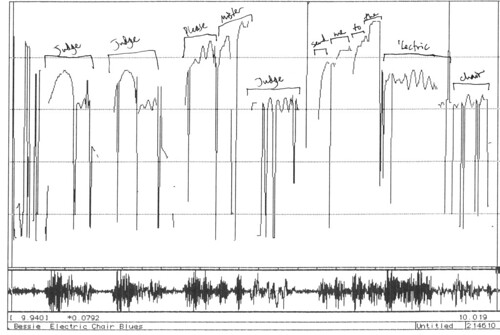
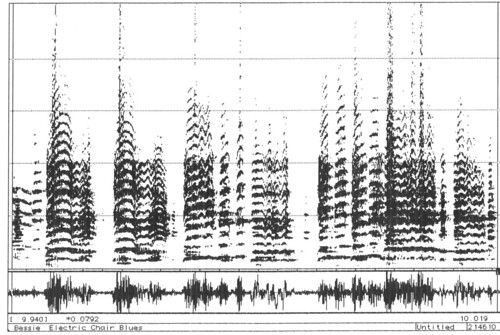
ADDENDUM: I did some experimenting with Praat, and here’s an extract of pitch contour. Not sure just what it all means, but it sure is fun.
Silent Dignity
I left the room with silent dignity, but caught my foot in the mat.
—Charles Pooter
links for 2006-09-28
-
“super easy photo prints at home”