-
Perry-Castañeda Map Collection – UT Library Online
Author Archives: oook
Gem tintypes
I unearthed another trove of Nova Scotia Faces photographs, hidden in a box with an enigmatic label (that’s what happens when you move) and rediscovered an album of what are technically called “gem” tintypes –about 0.75 x 1 inch, which is to say small enough that they are difficult to see. I’m scanning them at 1200 dpi and and applying some Photoshop magic to adjust the brightness and contrast, and I’m rewarded with astonishing portraits, like this one:
See others in the set
links for 2006-03-13
-
“an indispensable tool for the global newsjunkie” –but time horizon is a bit blurry, including stories from at least the last 3 months
Today’s walk
About 3 miles, across the St. George Peninsula from Martinsville on the Atlantic side
to Turkey Cove on the St. George River
and back. Spring definitely out there somewhere.
Juicy invective
Kieran Healy twirls a stick in a Comments hornet’s nest with his post which includes these bonbons:
…it is nevertheless an important fact that an elite French education can entail learning quite a lot of math in addition to ploughing through the great philosophers. So your typical Next Big French Intellectual often has the wherewithal to bug the shite out of technoids and comp-litters, although only one of these constituencies is typically targeted… The cafés at the Collège de France sell bottled reflexivity instead of Evian.
A Steig example
Come to think of it, everybody didn’t grow up with The New Yorker Album 1925-1950, but I sure did. I can trace all sorts of fundamental bits of Weltanschauung (and probably basic sensayuma) to specific cartoons that I puzzled over for years before I learned/discovered what they were really about. There are great depths, largely unplumbed, in the stratigraphies and ontogeny of humor. William Steig is good and dead, so I don’t feel that I’m somehow stealing from him or from the much-beloved New Yorker by putting this one up here. It might inspire a reader to buy the (foolishly DRM’d, but nonetheless utterly indispensable) Complete New Yorker:
I’ve always been especially charmed by the look on the horse’s face.
Dreams of Glory
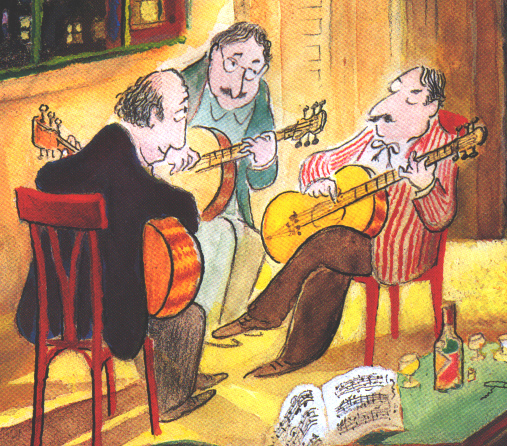
This bit of detail from this week’s New Yorker cover (by Jean-Jacques Sempé) seems like it was drawn with my peculiar sensibilities in mind. It took me about 1.5 seconds to recognize that and for the well-known lump to generate in the throat, but none of the several generally-astute-and-knowledgeable people I’ve shown it to have had anything like my reaction. They (the g-a-&-k persons) aren’t guitar players, but I wonder if the image is even more specifically targeted? It all hangs on (1) who the dude in the stripes is and (2) the precise placement of lines in the faces of the other two players.
There was a wonderful series of cartoons in the New Yorker in the 40s and 50s, captioned as Dreams of Glory, drawn by William Steig and depicting the fantasy lives of kids, who imagine themselves rescuing maidens from dragons or arresting Hitler with a cap gun… The two unstriped guitarists are the grownup versions of those kids. It’s just paralyzingly obvious that (1) the stripy guy is Django Rinehardt (look at the left hand, but take in as well the insouciance of the posture), and (2) the event of Django coming over to play music is in the realm of glorious fantasy…
Anyway, Sempé really GOT me with this one.

links for 2006-03-09
-
uses Yahoo! Maps API to zoom to any of 20K US cities
Fantasy, and gaming?
Personally, I just don’t get it with games and gaming, and I never have. Two kindsa people in the world, right? But here’s a sentence from an essay on China Miéville that makes the light go on for a possible understanding of gaming-as-pedagogy:
…fantasy should become a way of arguing about our social condition, of re-presenting our dilemmas, and creating a space for the imagination in which we can identify new possibilities of action.
Henry Farrell, Fantasy Remade: China Miéville’s New Crobuzon novels
Here’s why Language Log is indispensable
I lead a sheltered life here in Splendid Otium ME 04860, and without Language Log I suspect I’d never have encountered The Eggcorn Database. Etymology:
In September 2003, Mark Liberman reported (Egg corns: folk etymology, malapropism, mondegreen, ???) an incorrect yet particularly suggestive creation: someone had written “egg corn” instead of “acorn”. It turned out that there was no established label for this type of non-standard reshaping. Erroneous as it may be, the substitution involved more than just ignorance: an acorn is more or less shaped like an egg; and it is a seed, just like grains of corn. So if you don’t know how acorn is spelled, egg corn actually makes sense.
And who knew that mondegreens were, well, mondegreens?
If your dictionary doesn’t include “mondegreen,” throw it out and buy a better one.
The term “mondegreen” was coined by Sylvia Wright in a 1954 Atlantic article. As a child, young Sylvia had listened to a folk song that included the lines “They had slain the Earl of Moray/And Lady Mondegreen.” As is customary with misheard lyrics, she didn’t realize her mistake for years. The song was not about the tragic fate of Lady Mondegreen, but rather, the continuing plight of the good earl: “They had slain the Earl of Moray/And laid him on the green.”