…and watch this 1993 AT&T Vision of the Future (via Paleo Future, “a look into the future that never was”). You won’t be sorry…
Author Archives: oook
Sphyngolipids and beyond
I finally got around to watching The Inner Life of the Cell from the Biovisions at Harvard initiative (via Make’s blog a week or so ago). The animation is, well, amazing. The narration tumbles along polysyllabically (can you say ‘Leukocyte Extravasation’? I thought you could…), and it’s a damn good thing that one can watch and re-watch, and that there won’t be a quiz… On a more serious note, the watching prompted me to scratch my head again over the challenge of Gardner’s comment to my Grand Jeté post, which ends with this interesting observation/question:
…the notion that knowledge is dynamic, ever-circulating, breathing in and out, washing some books up to shore while washing others away to the great unbounded deep, works very well for certain of the humanities, but works only occasionally for the physical sciences. A test case: what about advances in medical knowledge? Are they part of this great sussuration of knowledge, or are we really getting somewhere? Do we really need to rethink, oh, the idea of a cell?
Higher fi
I’ve just connected my laptop into the sound system (via an Indigo Echo unit that I bought a while ago), and I’m enjoying mp3s and YouTube stuff through the Earthworks speakers. Can’t think why I didn’t do this long ago. Stuff like this from Nederlands Blazers Ensemble comes through amazingly, and renews one’s faith in humanity:
Tom Ze is Out There
If Tom Ze isn’t a household word out your way, give a listen to the four items linked at Captain’s Crate (“Rare, funky, and soulful music from the treasure trove of Captain Planet and Murphy’s Law”)
links for 2007-04-20
-
“The Interstitial Library’s Circulating Collection is located at no fixed site. Its vast holdings are dispersed throughout private collections, used bookstores, other libraries, thrift stores, garbage dumps, attics, garages, hollow trees, sunken ships, th
-
Uncyclopedia and Interstitial Library and Borges …Everything is Miscellaneous
-
“some proper names include a definite determiner (and some languages put determiners with proper nouns more regularly–so in German, I’m told, it’s much more natural to call someone the equivalent of the Donald than it is in English).”
-
yes indeed
-
the True Vine
-
pretty much exemplary
-
“…any depiction of animals that act as though they wish to be consumed.” (I’ve been thinking about doing this myself for years)
-
joyful food
Grand jeté
The Glossary of Ballet may turn out to be a fruitful source of imagery.
Patrick Lambe is really onto something over at Green Chameleon, and it fits remarkably with my Pirouettes thread. Today’s post points to and quotes wittily from The Interstitial Library and Uncyclopedia, and I’ll reproduce a couple of bits here to tempt you to read Green Chameleon further:
We contend that every reader is an amateur librarian, with a mental library organized according to a private cataloguing system that is never identical with that prescribed by the AACR2R (the Anglo-American Cataloguing Rules, Revised). Since every system of organization highlights some kinds of information and obscures others, we contend that these idiosyncratic catalogues have advantages—advantages that could be shared.
We do not consider the “authoritative” taxonomies of the Library of Congress (or Barnes & Noble) to be superior to private ones. We are suspicious of taxonomies that appear self-evident, unbiased, objective. All taxonomies are interpretations. All interpretations are valuations. We ask, how does a given taxonomy, which is always a reduction and a generalization, come to be associated with objective or ideal categories of knowledge? We contend that the question of what matters and what does not is a political and philosophical one that should be open to the input of individual readers.
(that one is from Interstitial Library, and the next is Patrick Lambe himself)
Taxonomies and category systems are filters. They render certain things visible and help ensure those things are preserved. The things in between, not captured in our official categories, are ignored, and hence easily forgotten and lost.
If they are there but not seen, then we need strategies for seeing them – or for bumping into them. These strategies need to directly counter the mechanisms we use for rendering this stuff invisible. We need inversionary mechanisms.
…To counter the invisibilising effects of limited taxonomies, we need interstitial categorisation systems, that deliberately break sensible rules, and bring stuff together on idiosyncratic principles. Individuals do this all the time, so we simply need to be able to see their idiosyncracies.
What were they thinking
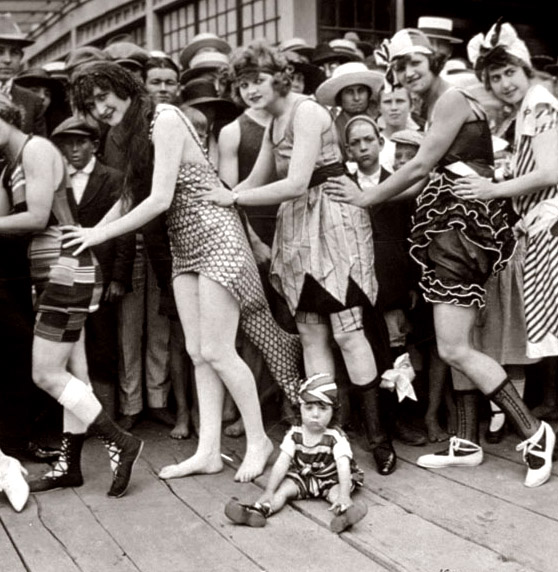
Shorpy keeps pumping out wonderful images like this detail I’ve extracted from a panoramic image:
(see the whole thing)
Where to begin? The architecture (there’s no other word for it) of those costumes is breathtaking, but the looks on the faces of the background spectators are just too wonderful.
A detail from another one:
…and the whole thing
Pirouettes continued
Still thinking about the Prelinger Library article, and considering that we need some models/visualizations for the kinds of distributed collections I’m working on, or toward. I made a marginal note when this phrase tripped through the forebrain:
tesseracted Whole Earth Catalog
and now I want to follow it up with some interlinked digressions.
First, the Whole Earth Catalog and, seriatim, its various successors (CoEvolution Quarterly, Whole Earth Review, the WELL, Long Now Foundation…) have been essential to me for …bless us… almost 40 years, ever since I first frequented the Whole Earth Truck Store in Menlo Park. The basic model of knowledge as a sprawling and interconnected and navigable system of tools for understanding the world has been with me ever since, and some of that snuck into a summary of Goals and Methods of Teaching that I wrote at tenure time, about 12 years ago, and still find apt. And Fred Turner’s From Counterculture to Cyberculture: Stewart Brand, the Whole Earth Network, and the Rise of Digital Utopianism is a fine entrée into the dramatis personae and associated mindspaces.
The word ‘tesseracted’ isn’t one I can remember seeing or thinking before, but it seemed to fit the model of multidimensionally interconnected broad-ranging knowledge that I was imagining as an antidote to the geocentric but shelf-bound linear array that is described as the ordering principle of the Prelinger collection. The ‘tesseracted‘ form turns out to be not uncommon.
I first encountered the Tesseract as a concept in a Robert Heinlein story (“And he built a crooked house”) reprinted in Clifton Fadiman (ed.) Fantasia Mathematica (1958). The book was used as an auxiliary text in a marvelous math class (Plane and Solid Geometry) I had as a high school sophomore, taught by Phil Coyle, who went on to grander things.
Google found a 1996 text by Michael Jensen (now Director of Web Communications at National Academies Press) which is wonderfully prescient: Here there be Tygers: Uncharted Tesseracts in the Age of Disintermediation. Some bits:
Intermediation is what we all do, every one of us in this room, in some form or another. What happens when so many institutions are put in doubt or confusion because their primary role of intermediation is challenged by direct digital access to anything we want?
…Something quite separate from the technology –though predicated upon it– something under the sun that is truly new, something unfathomably transformative, is being loosed upon us: disintermediation.
I think of societial disintermediation as the online tesseract –you remember, the “wrinkle in time” that shortens the distance between two points.
Two things are required to make possible the tesseract of disintermediation: rapid easy access to distant digital content, and easy financial exchange.
The first of the pair is here, as we all know. I can pull down a Web page located in Australia as easily and almost as fast as I can one from Duluth. Any material –whether a recording, a video clip, a multimedia presentation, a monograph, a poem, an encyclopedia– can be put online by its creators, and pulled down and displayed the viewers. In three years, it’ll be absurdly easy.
The second part isn’t quite there yet, but we’re almost there, and that’s online micropayments… To my mind, when I can easily, safely, and comfortably pay a buck, a quarter, a nickel, or a tenth of a cent online, then a day of revolution will have arrived.
I don’t say that lightly, or with too much melodrama. I’m quite serious. Micropayments will be transformative, challenging most institutions, most governments, and most economies, perhaps even more than the Internet itself.
…It was Colin Day, director at the University of Michigan Press, who first described the Internet as a “giant disintermediation machine,” and he’s right. The Internet will be–heck, is–challenging the historical intermediaries like publishers, movie studios, television stations, printing companies, libraries, specialty stores, universities, schools, salespeople, even governments. The filterers, the gatherers, the duplicators, the distributors, the finders, will all find themselves sprinting to restructure themselves in the new economy, and they won’t all make it.
Just how to build and manage tesseracted collections is up for grabs, and seems like sort of an apotheosis of conventional hyperlinkage. I flirt with ‘holographic’ and ‘fractal’ as other terms that might convey the multiple interrelationships among objects in such collections, but I’m not as clear as I should be about where the metaphors outrun the requisite lexical precision. Working on it…
links for 2007-04-18
-
another audio tool with promise
links for 2007-04-17
-
now THAT’S what we need more of: tools for managing audio snippets
-
wonderful, just wonderful