Many of these seemed to be bellwethers when I collected them...
1xii25
An Escher sentence? Mark Liberman at Language Log
..."The concept of mathematics being purely objective is unequivocally false, and teaching it is even much less so."
The Putinization of America Andrea Mazzarino
...By the time of my last trip to Russia in 2014, however, shiny buildings had been built, older ones renovated, and developers with close ties to Russia's political elite were even richer, thanks to the country's growing oil wealth. Roma (or gypsy) families were no longer anywhere to be seen, as St. Petersburg's government had conducted "purges" of the city's informal Roma settlements. Nor were old women selling their wares on the streets, while Central Asian migrants from poorer countries to Russia's south seemed ever fewer and less visible during the busiest times. Indeed, local authorities were rounding them up and detaining them without warrants, based on appearance and language alone. (Sound familiar?)
Meta's new top EU regulator is contractually prohibited from hurting Meta's feelings Cory Doctorow
Alphabet in Motion Marginalian
It is astonishing enough that we invented language, this vessel of thought that shapes what it contains, that we lifted it to our lips to sip the world and tell each other what we taste, what it is like to be alive in this particular sensorium. But then we passed it from our lips to our hands and gave it form so we can hear it with our eyes and see with our minds, making shapes for sounds and meaning from the shapes.We take it for granted now, this makeshift miracle permeating every substrate of our lives, and go on tasking these tiny concrete things with conveying our most immense and abstract ideas. We forget how young this technology of thought is, younger than Earth's largest living organism, and yet it tells a richer story of who we are than any archeological artifact, touches more of what makes us human than the fossil record. Our letters carry the history of our species and of our world, their shapes shaped by a conversation between the creativity of our imagination and the constraints of our creaturely reality, from the rotational geometry of the human wrist to the chemistry of the first paints into which the first brushes were dipped.
...Alphabet in Motion, the tactile delight of which is thoroughly untranslatable onto a digital screen, lives in that rare place where imagination and illumination meet to become a portal of wonder — the gift of a lifetime.
3xii25
No land acknowledgments, no remigration Matthew Yglesias
...if hailing the stewardship of those who came before us became a widely adopted ritual in American life, that seems unobjectionable on the merits to me. It's a bit cringe, but so is singing the national anthem at the start of a youth sports event. There's never going to be a cringeless set of national rituals, and rituals are important.
Trump to Disaster Victims: Drop Dead Paul Krugman
...The fact is that disaster relief runs counter to the libertarian ideology embraced by tech bros like Peter Thiel. In the world of the libertarian tech broligarchy, who believe that they should be running things rather than be constrained by democracy, selfishness is a virtue. Hence they don't believe that their tax dollars should be used to help others, even when those others are victims of circumstances beyond their control. Oh, that is, unless you are a wealthy Silicon Valley type with deposits at the failed Silicon Valley Bank. They apparently had no problem with a federal bailout of SVB.In fact, the libertarian tech broligarchy is opposed to the very impulse to care about other people. "The fundamental weakness of Western civilization," declared Elon Musk last March, "is empathy."
Vietnam in the Sinographic Cosmopolis Victor Mair at Language Log
Global Building Atlas at github
5 tech predictions for 2026 and beyond, according to Amazon CTO Dr. Werner Vogels via Stephen Downes
As of 2024, there are more than 45,000 human-made objects orbiting Earth, and these are just the ones we can track. With so many crowded orbits, and hundreds more satellites being launched every year, close approaches are inevitable.
The Pub at the End of the University Hannah Forsyth at Crooked Timber
...Coming home to roost in universities around the world are the consequences of unbearable austerity, especially in relation to teaching, matched only by unforgivable profligacy by (and for the benefit of) a managerial class. Under their watch, and following two decades of unprecedented and exponential enrolment growth, some universities are at risk of bankruptcy, while others are cutting staff at a rate that bears no resemblance to any decline in the importance of university teaching or research. I hear that 15,000 academics have lost their jobs in the UK, just this year.Things in universities are not great in other ways, either. Study is burdensome rather than enlivening. Teaching is performed under conditions that make it impossible. Research is measured in ways that interfere with its direction and undermine its pleasures. Management, sometimes but not only in response to governments trying to ensure management are doing what they were paid for, in turn impose so many compliance and performance measures on teachers, researchers and professional staff that it is getting hard to get much done at all.
...at the very moment that environmental catastrophe, energy transitions, and threats to the discernment of truth (via multiple vectors: AI, geopolitical, social media-radicalism, conspiracy-theory populism, incel and cooker self-promotion) let alone massive industry demands for the skills universities produce (yes in HASS too), these glorious and flawed institutions are sadly crippled.
What are Lie Groups? Quanta Magazine
(seems applicable to the interconnected display of MYKeywords)
The News: Fool Me All the Time? I Must Be an Editor of the New York Times Timothy Burke
The Cold War provided one kind of structuring principle. Communist governments were presumed by reporters to be engaged in deception, Western governments were not. (Even though a fair number of American and European journalists were fully aware that the UK, US and French governments had sustained projects aimed at creating disinformation about their perceived adversaries.) Often this extended to the Global South: postcolonial governments were also assumed to be at the least unreliable in the information they provided, and this was a view that extended to individuals—often on the belief that both officials and ordinary people were simply not competent curators of information nor responsible witnesses to events.This is a foundational perspective that remains in place in the mainstream legacy media in the United States. I've come to the conclusion that one reason the New York Times in particular is proving to be so accommodating to Trumpism is not any affection for Trump himself but that the upper editorial staff were feeling increasingly disoriented and frightened by pressures to change these kinds of deep assumptions—that they increasingly felt that an initiative like the 1619 Project had been an alien and unwanted intrusion into the correct way to see the world.
There have been other moments of similar disorientation in the history of mainstream American media. The struggle over whether to print the Pentagon Papers, whether to report on the COINTELPRO revelations, or whether to continue to investigate Watergate was not just about fear of legal and political retaliation, it was that all these stories made the world topsy-turvy. The government's information was full of lies; the whistle-blowers and the leftist activists were the only place to get something like the truth.
Journalists, pundits and public commenters keep marveling that somehow the Trump White House gets away with it, that blatant lies and laughable delusions that would have brought any previous regime crashing down don't amount to anything. If I were to witness a fatal hit-and-run accident and I wrote down the license plate of the car that sped off, I'm not entitled to marvel that the driver got away with it if I didn't tell the police that I was a witness and didn't provide the license number. The driver didn't get away with it. I chose to help him escape the consequences.
I understand the point that pervasive, reflexive mistrust of every claim made by government officials and mainstream institutions has been one of the major reasons why disinformation and conspiracy theory have flourished in the last two decades. But this is not the fault of people who moved to a more skeptical regard for governmental authority and more openness to the truth-value of everyday witnessing and interpretation in the wider society. It is the fault of governments that lied while claiming to tell the truth, the fault of institutions that let lawyers tell them how to minimize liability rather than keep faith with their publics, the fault of politicians and public figures trying to escape the consequences for misconduct.
Palantir CEO Says Making War Crimes Constitutional Would Be Good for Business gizmodo
Palantir CEO and Trump ally Alex Karp is no stranger to controversial (troll-ish even) comments. His latest one just dropped: Karp believes that the U.S. boat strikes in the Caribbean (which many experts believe to be war crimes) are a moneymaking opportunity for his company....Karp has never been shy to give his full support to violence that he deems necessary. In a letter to investors from earlier this year, Karp quoted a political scientist to say that the "rise of the West was not made possible by the superiority of its ideas or values or religion... but rather by its superiority in applying organized violence."
Hans Christian Andersen's Papercuts princeton.edu
NotebookLM: 5 Strategies That 99% of Users Don't Know (But Should)“ Mihailo Zoin at Medium
...Most people think NotebookLM is just for chatting with PDFs. But the best users employ it as a truth verification layer that prevents hallucinations, a searchable brain for scattered conversations, a pattern recognition engine across disciplines, a citation system that never errs, and a personal editor that learns your style....The Information Flood Problem
Every week: 50+ AI articles, MIT breakthroughs, Stanford papers. You bookmark them. They disappear into the digital void.You're drowning in information but starving for insight.
Solution: Innovation Intelligence System
Setup: Create notebook "AI Innovation Tracking 2025"
Upload: Academic articles, industry reports, startup announcements, conference papers
Ask strategic questions:
- Organize sources by field: biomedicine, materials, energy, NLP, vision, robotics
- Find examples where the same AI approach appears in different fields
Searching for The Lost Amazon Subramanimokkala atMedium
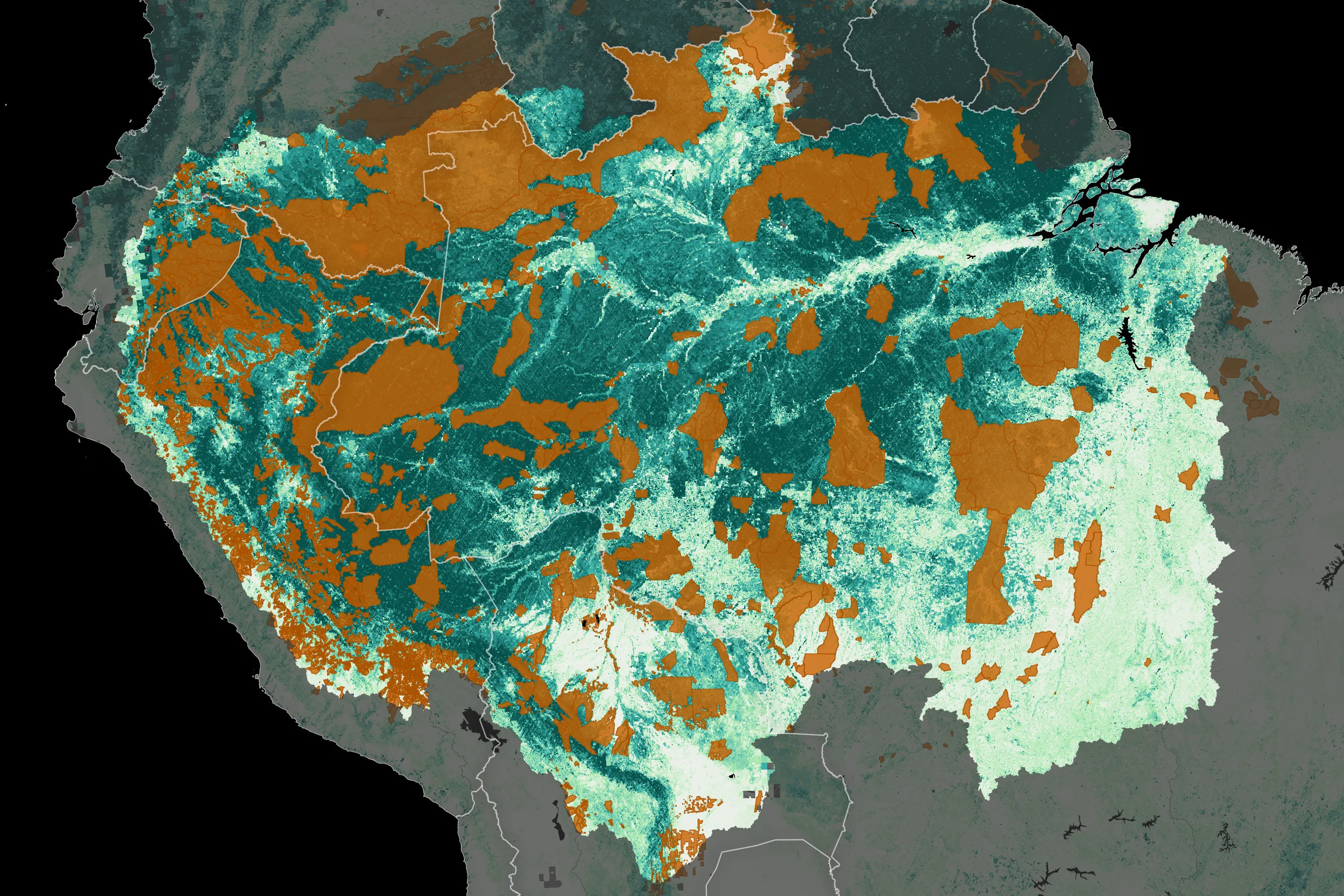
...In the 1970s, under military dictatorship, the 'Trans-Amazonian highway' was built — a 4000 kilometer road through the rainforest. They also offered free land to settlers along the road. As the road expanded, ranchers began to clear forest for cattle pastures. Between 1978 and 1988, Brazil lost over 20,000 square kilometers of rainforest annually around the southern and eastern Amazon, becoming known as the "Arc of Deforestation".Starting from the 1990s soybeans had great demand as cattle feed while global meat consumption started to rise. Brazil saw this as an opportunity to cash in. But as soy farmers started to buy cattle pastures, ranchers began to venture deep into the virgin forest ultimately clearing more forest land. This displacement effect accelerated deforestation even when soy grew on cleared areas that existed before.
"Indigenous territories" in the Amazon
Welcome to Leaving the Party, Pal! Sarah Kendzior
...I hate AI. I do not use it. I ban it in my home. I believe it is ruining the world in every way a world can be ruined. I agree with you that it is much more frightening than Trump and his minions. AI works to destroy the parts of ourselves — our empathy, creativity, defiance — that combat authoritarianism. They are attempting to mold the ideal fascist objects. They are aggressively pushing technology we did not ask for and removing the ability to opt out. I wish articles written by AI were labeled, like food tainted with poison. AI works should be shunned. I'm somewhat encouraged that my view on AI is not a fringe one: this is the oligarchs' imposition, and we must push back....The new Trump administration members are stand-ins for power players behind the scenes. The real kleptocracy is being run by people like Kushner, Thiel, Witkoff, Adelson, Bannon, Musk, and other plutocrats and mafiosos çincluding foreign leaders like Netanyahu, MBS, and Putin. Patel and other cabinet officials are cast members in a White House reality show that even Trump holds in such low regard that he gleefully bulldozed his own set.
Trump's backers wanted a younger and more ethnically diverse group for his cabinet because it makes the Dems, until recently led by weak white octogenarians, seem outmoded. Trump's cabinet picks required no attribute other than shamelessness and cult loyalty. There are valid grounds to impeach several of them, especially Hegseth. But both parties are so tainted by the lack of accountability for the first Trump admin — which set a standard of normalizing sedition, among other crimes — that they feel attempts at accountability are futile. However, impeachment sets a moral standard that matters even if they stay in office. The worst sin is not to try. I wish Democrats had learned that the first time around: if they had, we wouldn't be here for the second.
Literal translation of US states and their capitals maps on the Web
Aldo Leopold on How to Hear the Song of Life Marginalian
... The point, of course, is to see the ' — what Virginia Woolf called "the thing itself." Not just to uncover the fragments and discover how each works but to understand their harmonic unity — the sum that, as the forgotten genius Willard Gibbs knew, "is simpler than its parts," simpler and more beautiful, the way myriad complex chords played by a vast orchestra of disparate instruments become a symphony — a single unit of transcendence.
Letters to Boulders Karen Donovan at Orion Magazine
THEY SAY THAT IF you learn the alphabet, the rules of syntax, and the standard vocabulary, you can read the earth like a book. As soon as I realized oh that's what geologists do, my heart flew out of my body and pinned itself to rock. The earth was a message, a signal, a text, and all I wanted was to know what it meant. I was certain the earth could be read, but I thought I had to become a poet to do it. I didn't know I could instead have become a geologist.
Academia: At the Forge Timothy Burke
...I'm really conscious this time of two shifts that I'm working into the course. The first is the historiographical shifts in the topic. When I first started teaching the class over twenty years ago, I was aware that I was assembling a syllabus that didn't match up to an existing scholarship within the discipline. It felt very coherent to me as a subject, but I was more or less flying on my own. As a result, I got a fair number of queries from press and from interested fellow professors about the class. As it turns out, that's because I was thinking in parallel about the subject matter along with a lot of other folks, both professors and otherwise. Cyberpunk and steampunk as genres were one leading indicator of what has become known as the retrofuture. The easiest way I can sum it up is that Tomorrowland at Disneyland went from being an earnest, hopeful prediction to being an ironic fantasy about the future that never came to pass. Attitudes towards the retrofuture varied: some people were angry that it had been denied to them, some were determined to make it happen anyway, some were pleasantly nostalgic for the future that never was.
5xii25
from Science Dec 4 2025
Experimental treatments target the brain's 'plumbing' Jennie Erin Smith at Science...The elevated levels of the neurotransmitter norepinephrine seen after brain injury in mice and people are known to stymie glymphatic flow. Administering a cocktail of three drugs known as alpha and beta blockers improved the mice's brain fluid clearance immediately after their injuries by boosting vasomotion, Hussain and his colleagues found. At the SfN meeting, Hussain reported the same drugs also normalized the animals' sleep patterns, which were disrupted after injury....Neuropsychologist Sephira Ryman of the University of New Mexico presented findings published last month showing older adults and people with Parkinson's disease could increase brain vasomotion and cerebrospinal fluid flow by breathing dilute carbon dioxide, which dilates blood vessels, for short periods. The intervention also seemed to sweep proteins and peptides linked to neurodegeneration and inflammation out of the brain and into the blood. "We're really encouraged by these two findings," Ryman says, adding that the next step is to measure clinical effects.
...In 2020, Bill reported that an antipsychotic called trifluoperazine, which prevents Aquaporin-4 from being shifted around within cells, prompted a dramatic recovery in a mouse model of CNS edema, or swelling in the brain and spinal cord, caused by injury. The mice behaved "as though they'd never been injured," she says.
Trifluoperazine "is an old, dirty drug," Bill acknowledges. "But if we could test it today, I think we would be in a position where we could save people's lives."
Iliff has also been studying an old drug—the alpha blocker prazosin, which his group found in a retrospective study to be potentially helpful in preventing dementia among veterans taking it for trauma-related nightmares. His team is testing its effects on glymphatic function and markers of Alzheimer's in rodents and nonhuman primates. (Prazosin is one of the three drugs in Hussain and colleagues' experimental cocktail.) Iliff is also working with the California biotech firm Applied Cognition on a noninvasive device to measure glymphatic clearance in real time.
"There is no direct evidence yet that lack of glymphatic efficiency leads to dementia in people," Bill points out. "But the circumstantial evidence is strong enough that it's worth a shot to drug it."
States step up to democratize AI-tailored computers
...In 2024, the Nobel Prize in Chemistry went to the Google Deep-Mind team behind AlphaFold, a disruptive artificial intelligence (AI) system that predicts the 3D structure of proteins based on their amino acid sequences. But proteins by nature are shapeshifters, morphing as conditions like pH or temperature change. To forecast those transformations, University at Buffalo (UB) structural biologist Thomas Grant is building a homegrown AI spinoff called SWAXSFold. And he's doing it without Google's deep pockets.Universities are hard-pressed to afford the costly, cutting-edge AI chips that systems like SWAXSFold require, and that Silicon Valley tech giants are stockpiling in their race to build ever-larger chatbots. But New York state is now stepping in, giving researchers like Grant access to the computers they need through a $500 million, 10-year initiative called Empire AI. Launched last year, it will inaugurate its second supercomputer in the coming months—one expected to be among the most powerful AI-focused academic supercomputers in the nation.
... But neither is a perfect solution. Much like renting a car, buying time on commercial clouds typically costs far more than owning the machines outright. And although federal supercomputers offer enormous power, their architectures traditionally center on chips called central processing units, optimized more for physicsheavy simulations than AI tasks such as seeking patterns in massive data sets. Although many newer systems do include GPUs, they are 'several generations behind the state of the art, Norman says.
...LLMs are advanced statistical models that generate text by predicting the probability of the next word in a given sequence. When trained at incredible scale, and typically post-trained or "aligned" to improve performance or reduce unwanted behaviors, "frontier" LLMs are capable of having diverse, responsive, and natural conversations with human counterparts. A growing literature demonstrates that these models, in addition to their many other uses, are highly proficient in producing persuasive text about political topics (4, 5). As people increasingly interact directly with LLMs that are built into their search engines, operating systems, and other apps, the potential for AI to influence users' political opinions—and, by extension, collective democratic outcomes—is further amplified.
Putting the U in quantum Zack Savitsky
...THE MYSTERIOUS ROLE of observation in quantum mechanics is highlighted by the classic "double slit" experiment, which has been performed for decades with photons, electrons, and atoms. If you shoot a stream of individual atoms toward a blank wall through a barrier that has two slits, a squiggly interference pattern will appear on the wall. The pattern means each atom must have traveled like a wave, passing through both slits simultaneously in a "superposition" of all of its possible quantum states. However, if the experiment is repeated with a detector at each slit to track individual atoms as they pass through the barrier, the pattern on the wall will instead feature only two broad stripes, formed by individual atoms that took one path or the other. The detector somehow seems to cause the atoms to behave like particles rather than waves.Heisenberg and his mentors, including Niels Bohr at the University of Copenhagen, took a practical view of the matter. They accepted the dual nature of atoms and that measurement "collapses" waves into particles. But this perspective, sometimes called the Copenhagen interpretation, punts on questions about how exactly the waves collapse and what constitutes a measurement.
Others, including Albert Einstein, believed the atoms must surely have some baked-in rules about how to behave, regardless of measurement. That skepticism led to experiments beginning in the 1970s called Bell tests, named after Northern Irish physicist John Bell, that probed for these so-called hidden variables. The Bell tests rely on another enigmatic phenomenon prescribed quantum mechanics: the ability to "entangle" two atoms in such a way that their quantum properties are intrinsically linked. When those properties are measured after entanglement, they're always correlated no matter how far apart the atoms are—a connection Einstein called "spooky action at a distance."
...describes the universe. But rather than positing multiple branches of reality, Rovelli argues the world can only be understood from a particular point of view, which need not align precisely with any other perspective. Objects and events do not exist in and of themselves—they manifest through relationships with other physical systems. "This implies that I cannot give an absolute, universal, objective description of what is going on," Rovelli says
...Persuasion is a complex, dynamic, and social phenomenon, and complete understanding of persuasive communication requires simultaneous attention to the speaker, topic, message content, medium, setting, intended outcome, message receiver, and more (14). The growing use of LLMs by citizens seeking information or campaign organizations and public officials seeking to spread their message introduces a "speaker" with unclear motivations, variable credibility, and potential representational biases into the democratic system. Simultaneously, this speaker is highly persuasive—and seemingly even more so because it is often unconstrained by the truth. Although Hackenburg et al. and Lin et al. provide relative optimism that manipulation through personalization provides limited marginal returns, they also demonstrate that LLMs are able to use a high density of often fabricated information to produce attitude change at scale. Researchers, policy-makers, and citizens alike need to urgently attend to the potential negative effects of AI-propagated misinformation in the political sphere and how to counteract it.
The Polyglot Neuroscientist Resolving How the Brain Parses Language Quanta Magazine
..."You can think of the language network as a set of pointers," Fedorenko said. "It's like a map, and it tells you where in the brain you can find different kinds of meaning. It's basically a glorified parser that helps us put the pieces together — and then all the thinking and interesting stuff happens outside of [its] boundaries."...There are two things we do with language. In language production, you have this fuzzy thought, and then you have a vocabulary — not just of words, but larger constructions, and rules for how to connect them. You search through it to find a way to express the meaning you're trying to convey using a structured sequence of words. Once you have that utterance, then you go to the motor system to say it out loud, write it or sign it.
...In language comprehension, it's the inverse. It starts with sound waves hitting your ear or light hitting your retina. You do some basic perceptual crunching of that input to extract a word sequence or utterance. Then the language network parses that, finding familiar chunks in the utterance and using them as pointers to stored representations of meaning.
For both cases, the language network is a store of these form-to-meaning mappings. It's a fluid store that we keep updating throughout our lives. But as soon as we know this code, we can flexibly use it to both take a thought and express it, and take somebody else's word sequence and decode meaning from it.
Geologic map of the United States' surface flowingdata
The New China by Henri Cartier-Bresson (1959)
Looks Like We Can Finally Kiss the Metaverse Goodbye gizmodo
...According to a report from Bloomberg, Meta is expected to slash its Reality Labs budget, shaving off as much as 30%.
All the elements were there: the frozen feeling bubbling up and permeating my body like quantum foam fizzing up to engulf the fragmenting mind, the feeling of acceleration, my dissolving self urging me to let go, to surrender, as I was sucked into the visionary maelstrom... The experience was far more austere ... Reality is a hallucination generated by the brain to help make sense of our being; it is made of fragments of memory, associations, ideas, people you remember, dreams you've had, things you've read and seen, all of which is somehow blended and extruded into something resembling a coherent conscious narrative, the hallucination we call "experience". Dimethyltryptamine rips back the curtain to show the raw data before it has been processed and massaged. There is no comforting fiction of coherent consciousness; one confronts the mindless hammering of frenzied neurochemistry
(Ralph Metzner (1936 - 2019) The Toad and the Jaguar)
6xii25
Jobs Are Vanishing Quietly Amid the Background Noise Angus Peterson at Medium
...Everyone keeps repeating the word polycrisis like it's some elegant theory, but all I see is a loop tightening around us. Job losses feed fear. Fear feeds anger. Anger fuels disinformation. Disinformation sparks control. Control erodes rights, privacy, dignity. Somewhere in that loop sits facial recognition software tagging people who never agreed to be tagged, and schools scrambling to figure out how to keep kids safe online when no one agrees what "safe" even means. It's not separate issues. It's one long fuse burning both ways.
7xii25
Daemons
Daimon WikipediaDæmon hisdarkmaterials.fandom.com
A dæmon /'di:mɘn/ was the physical manifestation of a human soul in Lyra's world. Humans in other worlds had dæmons. However, they were invisible to those who had not learned the technique to see them.Socrates and the daimon daemonpage.com
...Though Socrates believed his dæmon was a gift from the gods which made him unique, future scholars speculated it was merely Socrates' voice of conscience or prudence; not something of supernatural origins, but a voice from within which we all possess. Over time, the word 'daemon' has been developed to mean 'an attendant power or spirit.' For the Greeks, the daimon was an entity somewhere between mortal and god. In his work Cratylus, Plato uses the term δαίμονες, or daimones, which was taken from their word for knowing or wise (daēmones). The daimon was later divided into two types: Eudaemons and Kakodaemons, similar to the idea of a guardian angel and demon, respectively. And in Hellenistic times, along with most of ancient Greek history, the daimon was external to the man whom it inspired and guided, making the person "possessed" by this motivating spirit. It was partially this view of possession, and largely trying to weed out other religions, that led to the Christian view of daemons as wicked spirits.
Of Time and Place
Geography as Destiny? (Wende's Question (Oct 2022)) Genius LociA census of library holdings that take the Empyrean View (October 2022, and surely needs updating)
Harvard Buys Ambassador Hotel (1963)
Coolidge Hall, 1737 Cambridge Street Harvard Property Information Resource Center
Who stole the tarts? Brian's Question: What do you think about Time? (March 2023)
of The Future (July 2021)
The Substrate of Mystery: Mycelial Networks, Mutualism, and Symbiosis An Interview with Merlin Sheldrake (Emergence Magazine)
...mycelial networks offer an amazing biological model of interconnectedness, but in your work you also suggest that they can be a philosophical doorway through which we can step beyond our well-worn ways of thinking about how the world works and also our place in it.
Land Acknowledgements and Remembering Atlantic Slavery Timothy Burke
In American public culture, there's a select group of writers who mark out where the punditry smells money, opportunity and/or positional advantage. Observing what they're writing about tells you what issues they've decided are safe to opine about, what represents a fair chance of winning the attention sweepstakes for the week. Where they land is also always going to be calibrated for keeping the brand squarely positioned on centrist common sense, which is a moving target.They're skilled at finding topics you can opine about that lend themselves to opining, where you have to know just enough to sound kind of edjumacated about it, but that you can dance away from before you get a reputation for being too focused on that issue. The tribune of centrist common sense is like an actor who is afraid of getting typecast. They find a thing that's in the news or on top of the stack, they calibrate a take on it, and they move on before they have to acknowledge people who know more about it telling them what they missed.
Voices as instruments, instruments as voices Victor Mair at Language Log
...Upon initial encounter with all this intelligent equipage, it starts to get depressing, at least for me. I feel like the machines are starting to take over; what's left for me, the human?In the end, though, I realize that I can tell the machine what to do.
The machine may be smart, but I can tell the machine what to do and what not to do. Above all, I can turn the machine on and off.
How to Civilize Digital Life Doc Searls
The Right to Privacy is a brief written by Louis Brandeis and Samuel Warren and published in the Harvard Law Review in 1890. It has not been improved upon since, because what it says is so damn obvious and simple: that the right to privacy is "the right to be let alone."Those six words are well understood by everyone in the natural world, and have been for the history of civilized life. Hell, probably before that as well. But they are alien in the digital world.
Here's why: Our knowledge of privacy in the natural world is tacit, meaning we know what it is but can't easily explain it. Meanwhile, the digital world is entirely explicit. It is made of bits and code.
We don't yet have a way to make explicit our wish to be let alone in the digital world. Or how we might not, and for what purposes.
Little Free Library Divinations: Searching for the Meaning of Life in Discarded Books and Found Objects Marginalian
8xii25
Maria Popova:
...As every creative person knows, and as Lewis Carroll so perfectly articulated in his advice on working through difficulty in math and in life, our most original and unexpected ideas arrive not when we strain the mind at the problem, but when we relax it and shift the beam of attention to something else entirely; it is then that the unconscious shines its sidewise gleam on an unexpected solution no deliberate effort could have produced.
Homework at the Table and (Foreign) War on the Screen Angus Peterson at Medium
...Governments won't fix what they spent decades breaking. You know this. The people who pushed us into imbalance are still cashing their checks. So preparation becomes personal. Local. Quiet.
Rising cost of streaming flowingdata
Eiko Grimberg — Rückschaufehler Jörg Colberg
...The title feeds into an idea commonly expressed by English-language speakers (and possibly by others) that German has these long words. That idea is based on a misunderstanding how the German language actually works. Yes, you can construct impossibly long words in German. But they're not really words in a real sense. (Please keep in mind that I'm not a linguist; I'm merely a writer, someone who uses language.) Yes, they look like words. But to understand what's going on you have to realize that German is a language that centers on nouns. English, in contrast, centers of verbs. In German, when you want to describe something for which you have no pre-existing expression, you will construct a noun — or rather a word that looks like a noun but that actually has a function (you could view it more like the fragment of a sentence). In English, when you're trying to express something, you mostly create verbs. That's why translation from English to German (or the other way around) sounds so clunky if you stick to the other language's convention....For example, when you translate from German into English without considering how English works, you get impossibly long and convoluted sentences that contain any number of pretentious sounding nouns (much like academic writing in English).
...Here's my theory: given how Germans are so used to thinking in entities rather than actions, the actual presence of entities in the real world has more importance to them than for speakers of English. A building, say, might have vastly more importance simply because it also stands for an entity that might have very important symbolic value. Of course, some buildings have a lot of importance in all countries. But because German itself is tied so strongly to entities — as opposed to actions — Germans view the symbolic value of buildings differently. Obviously, this interpretation could be complete nonsense
...The Stadtschloss is really good symbol for contemporary Germany: the re-creation of part of its extremely troubling past, financed in part by some really odious people, while people pretend that they have learned from the past. In the context of the Jewish community, Y. Michal Bodemann has coined a term for this: Gedächtnistheater. I first came across the term in a book by Max Czollek (who is also Jewish). Gedächtnistheater means Theater of Remembering. This is my translation. I think the term is mostly translated as Theater of Memory. But I think my translation is more accurate, because the key idea is not memory itself but rather the act of remembering, or rather (and this is the core of the idea) the act of pretending to remember. According to Bodemann and Czollek, Germans place enormous focus on being seen as remembering, whereas actual remembering does not happen. It's all just a play, performed regularly for the world to see (because that's the crucial aspect: outside of Germany, people want to be seen as having learned their lessons from their Nazi past).
Exploring Max Ernst's Surreal Collage Novels: Unveiling a World of Dreamlike Imagery Vault Editions (2024)
The Electrotech Revolution: The shape of things to come ember (pdf)
Humanity is graduating from burning fossil commodities to harnessing manufactured technologies—from hunting scarce fossils to farming the inexhaustible sun, from consuming Earth's resources to merely borrowing them.This isn't a marginal climate substitution. It's an energy revolution.
The magnetic centre is the electron: we are revolutionising how we generate, use, and connect electrons. Solar and wind are conquering electricity supply. EVs, heat pumps, and AI are electrifying major new uses. Batteries and digitalisation are connecting supply and demand.
Three reinforcing shifts. One energy revolution. The electrotech revolution.
Is This The End of the Free World? Paul Krugman
...There's also the role of the tech bros — billionaires who still describe themselves as libertarian but have in practice become hardline authoritarians with enormous sway over the Trump administration. After the European Commission imposed a modest fine on X for failing to obey its rules on transparency, Elon Musk declared that the EU should be abolished and threatened personal retribution against the “EU woke Stasi commissars” responsible for the ruling. And the Trump Administration is acting as the tech bros' enforcer against Europe, threatening to keep steel tariffs high unless the EU scales back its tech regulations. Moreover, this is part of a general pattern: the broligarchs hate Europe because the Europeans are trying to impose sensible limits to protect their societies from the well-documented psychological and economic harms that are inflicted by an unrestrained Silicon Valley agenda. For example, the EU is trying to limit the proliferation of digital hate speech as well as the pernicious effects of social media on the young. And more so than the US, it has sought to constrain the monopoly power of the tech titans like Google and Facebook. We should remember that the moderate antitrust and AI regulations adopted by the Biden Administration prompted the tech broligarchy to swing hard behind Trump in the 2024 election.
Can it Get Worse? Matthew at Medium
Each year, the new 'word of the year' is becoming a depressing indictment on the dystopia we are now living in. We need a manifesto against social media and internet use....These words reflect the way the our language is being filled by new terms for the social phenomenon that are being created by our online interactions, and that all of these terms are self-evidently reflections of serious damage. These are, in short, not good at all.
...In 2025 I don't believe there is any good reason for anyone to be using Facebook, Instagram or Twitter unless it is for interaction with people you know in real life. We can hardly bemoan the internet use of the youth if we are not any better, and the only way that these platforms will ultimately diminish in power is if they diminish in use. We choose that, they don't, as much as they are designed to manipulate our behavior the fact remains that in an age where the gatekeepers have been banished we bear the responsibility of being our own gatekeepers and choosing what kind of content we consume, what kind of time we spend scrolling or inanely clicking or consuming.
...The sense of what is happening and how much we need to steer away from it has to be internalised more deeply than trivial 'word of the year' articles about how everyone is saying 'brain rot' a lot more than they used to. These words are not idle trends that come and go, they are signposts of where we are all going if we don't put the brakes on. We need a shared manifesto against the effect social media is having, one that we all act on.
My Problem with Clear Writing Ted Gioia
...The power brokers want to reduce everything to computer code. That's because data is easier to propagate. Easier to scale. Easier to manipulate.Our proper response to this should be resistance. We aren't data—we are human beings.
The inner stirrings of our soul cannot be framed with mathematical rigor. The depths of our emotions resist formulation in logical propositions. Many of the most important things in our lives cannot not be promulgated in step-by-step argumentation.
...Kierkegaard laughed at anybody who would give three arguments for falling in love. Love is so important that it exists on a higher plane than argumentation. And the same is true of faith, hope, charity, and all the other glorious high points of the human condition.
The recent rise or AI-generated writing only makes this more obvious. AI can't genuinely experience these human touchstones—it can merely pretend to do so. So it replaces the most important facets or our lives with deceit.
The result of this is sterility and inauthenticity. Plato would call it sophistry. Sartre would describe it as mauvaise foi (bad faith)—lying to one's self. Or, even worse, not having a self.
...today we are literally chatting with voices that lack a self—by definition and on purpose. They are just digital constructs. Even worse, they pretend otherwise—and we are encouraged to pretend along with them.
This shift has taken place rapidly—and now the sterile AI style of writing is everywhere. Every sentence is crystal clear, although that is no guarantee of accuracy. AI is cold and confident, even when making the most foolish errors. The surface polish can't hide the shallowness and total lack of human warmth.
This is the dominant communication style of our time, whether we like it or not. Even worse, this is also the dominant thinking style of our time.
Anti-we Victor Mair at Language Log
9xii25
Place Your Bets Christopher Hobson
...one way of reading 2025 is to distinguish between actors who are placing bets and being bold in doing so. And those who are not. Those who do not dare. Or do not appreciate what is at stake, what might be being decided, the games being played. These dynamics are playing out at different scales, from the micro to the macro....Boldness might come from belief in an ideology, faith in a higher power, ruthless self-interest, rigorous study, or many other sources. What has been evident this year is some actors are more willing to place big wagers, to use house money, and to prepare iron dice for rolling. Those willing to activate and emphasise their agency appear as apex predators in a crumbling world of beanbag managers focusing on holiday plans and retirement balances.
We Need to Talk About the Next Economic Storm Angus Peterson at Medium
...Corruption sits beneath all of it. Not the cartoon version — bags of cash in dark rooms — but the quieter kind where donors dictate policy and lawmakers talk about "opportunity" while funneling wealth upward. Some pour money into accounts tied to the latest strongman rising through the system. Others gnaw at social protections while claiming virtue. You can watch the rhetoric skew toward fear: blaming immigrants, women, queer families, any group without the power to fight back. It's a distraction game, a shell trick, except the stakes are your children's future....There's a moral cost we rarely name. When wealth concentrates, power pools beside it. When power pools, empathy thins. The people shaping policy become the people who won't feel the fallout. They build retreats in the mountains. Buy land near clean water. Talk about resilience as if it's an accessory. Meanwhile millions of families lose margin, lose breath, lose options. Crises harden into routine, and leaders point at the vulnerable as if the vulnerable caused it.
Big Tech joins the race to build the world's heaviest airplane Cory Doctorow
...Actually, tech bosses didn't like tech workers. They didn't see them as peers. They saw them workers. Problem workers, at that. Problems to be solved. And wouldn't you know it, supply caught up with demand and tech companies instituted a program of mass layoffs. When Google laid off 12,000 workers (just before a $80b stock buyback that would have paid their wages for 27 years), they calmed investors by claiming that they weren't doing this because business was bad — they were just correcting some pandemic-era overhiring. But Google didn't just fire junior programmers – they targeted some of their most senior (and thus mouthiest and highest-paid) techies for the chop.
The Creativity of Surreal Photography Janis Masyk-Johnson at Medium
...Will A.I. take over the creation of surreal photography? I highly doubt it, but as time goes on, I think more photographers may use it to enhance their photos.
America Has Become a Digital Narco-State Paul Krugman
Imagine what would happen if the United States were to legalize the distribution and sale of heroin — and do so without any restrictions or regulations on how the drug is marketed and who can buy it.Heroin distribution and sales would quickly become a huge, multibillion-dollar industry. They would become a significant part of GDP, even though heroin harms and often kills those who consume it. Given the increasingly naked corruption of U.S. politics, the heroin industry would be able to purchase massive political influence, enough to block any attempts to limit the harm it does — the harm it knows it does, because heroin industry executives would surely be aware of the damage their products inflict.
Through massive political donations — enabled by the Supreme Court's 2010 Citizens United ruling - and de facto bribery enabled via cryptocurrency deals, the industry would be able to enlist the U.S. government as an ally in its efforts to block regulation in other countries. For example, U.S. officials might threaten punitive tariffs against countries that try to limit and regulate heroin use.
If this story strikes you as extreme and implausible, here's what you should know: replace "heroin" with "social media," and this is a description of actual events.
...social media giants have been able to use the power of money to block regulation. Last year Congress seemed on the verge of passing the Kids Online Safety Act, legislation intended to, yes, protect kids online. The legislation, which would have been the first ever to impose rules on social media, had overwhelming bipartisan support. Ninety-one senators supported it. But then Mark Zuckerberg and his billions came to town, and the legislation died.
...The key point is that if you think of unregulated social media as dangerous drugs, as you should, then we've become a nation in which drug lords control much of government policy. Social media billionaires have enough power to prevent us from protecting our own children. They have enough power to dictate U.S. foreign policy, punishing our erstwhile allies for daring to limit their ability to push their product.
America has, in practice, become a digital narco-state.
Trump's World and the Real World Bill McKibben at New Yorker
...Describing, for instance, his understanding of climate science (invented arguably in its modern form in the United States, whose scientists first tracked the gases accumulating in the atmosphere and then built the computer models allowing us to predict our fate), Donald Trump said, "It used to be global cooling. If you look back years ago in the nineteen-twenties and the nineteen-thirties, they said, Global cooling will kill the world. We have to do something. Then they said, Global warming will kill the world. But then it started getting cooler. It's the greatest con job ever perpetrated on the world, in my opinion." Then, with regard to modern environmentalism, one of America's greatest contributions to the world—a consciousness that allowed our air and water to be cleaned up dramatically over recent decades—Trump said, "In the United States, we have still radicalized environmentalists, and they want the factories to stop. Everything should stop. No more cows. We don't want cows anymore. I guess they want to kill all the cows. They want to do things that are just unbelievable."...he and his colleagues are working hard to make it impossible for anyone to do their homework. They've shut down NASA's upper Manhattan Goddard Institute for Space Studies, where James Hansen and other scientists first documented our plight, proposed to shut down the satellites that watch the climate changing, and even planned, in next year's budget, to shut down the monitoring stations at Mauna Loa and elsewhere which keep track of how much carbon is pouring into the atmosphere. It is almost certainly the greatest collective act of scientific vandalism in recent American history. It would be easy, and accurate, to call 2025 the low point of human action on the climate crisis.
...Here he is again, at the U.N., offering his definitive take on solar and wind power: "By the way, they're a joke. They don't work. They're too expensive. They're not strong enough to fire up the plants that you need to make your country great. The wind doesn't blow. Those big windmills are so pathetic and so bad, so expensive to operate, and they have to be rebuilt all the time and they start to rust and rot. Most expensive energy ever conceived. And it's actually energy. You're supposed to make money with energy, not lose money. You lose money, the governments have to subsidize. You can't put them out without massive subsidies." And this is how he summed up the situation: "And I'm really good at predicting things.... I don't say that in a braggadocious way, but it's true. I've been right about everything. And I'm telling you that if you don't get away from this green-energy scam, your country is going to fail."
Was Volcano-Driven Climate Change partially Behind the Black Death? Juan Cole
...The Black Death killed off so many workers that wages rose and laborers were in a position to demand payment in coin, not just in kind. These changes contributed to the decline of manorial feudalism and the rise of early modern capitalism. One virtue of this new paper is that it proposes a complex, multi-causal explanation for a complex event. The way in which climate change can expose humans to animal-borne (zoonotic) diseases should be a lesson to our generation, since all that carbon dioxide we emit from burning coal, gas and petroleum, is causing climate disasters that make both humans and animals refugees, and drive them into closer contact with one another. What could go wrong?
Trump campaigned on Ending Forever Wars: Marco Rubio didn't get the Memo Medea Benjamin and Nicholas JS Davies at Informed Comment
...Rubio's approach is the opposite of diplomacy. He refuses engagement with governments he dislikes, undermines regional institutions, and encourages Washington to isolate and punish rather than negotiate. Instead of supporting peace agreements—such as Colombia's fragile accords or regional efforts to stabilize Haiti—he treats Latin America as a battleground for ideological crusades.Rubio's influence has helped block humanitarian relief, deepen polarization, and shatter openings for regional dialogue. A Secretary of State committed to peace would work with Latin American partners to resolve conflicts, strengthen democracy, and reduce U.S. militarization in the hemisphere. Rubio does the reverse: he inflames tensions, sabotages diplomacy, and pushes U.S. policy back toward the dark era of coups, blockades, proxy wars and death squads.
NOAH SMITH: The AI Bust Scenario That No One Is Talking About
Brad DeLong
Economic Statecraft on Chaos Mode Miles Kellerman
...American foreign policy is, in other words, operating on vibes. And the details from specific agencies are revealing. The State Department does not just lack measurable outcomes with specific targets. As of May 2025, it is not analyzing U.S. sanctions or export controls on Russia at all "due to insufficient resources." Not analyzing! Nor is the Bureau of Industry and Security. The BIS has analyzed the costs export controls have imposed on Russia. But these are not compared to any measurable targets that might be construed as measures of effectiveness.
10 Hacks Every Mac User Should Know
Where Has All the Interest Gone? Where Aas All The Interest Gone?>/a> Doc Searls
And the plethorization of fuck-all continues. Given where it can go in the long run, we've hardly started.
In the meantime, however, getting people interested in what we've got is only going to get harder. Not saying this is a bad thing. Just that it is a thing.
...thanks to AI, fewer people are using search to find useful images, while also using ChatGPT, CoPilot, Midjourney, Gemini and other robot AI artists to create whatever.
(cites What does the Internet make of us? from 2019)
Banyans & Balls Andy Ilachinski
Pete Hegseth Chooses Google Gemini to Lead the First Front in the 'Future of American Warfare' gizmodo
Pet grave photographer captures decades of unconditional love boingbong
Friends of Malaysia RPCVs site
Malaysia X Trainees picture book
Kowalczyk on Linguistic Variation in Poland languagehat
...As any Polish speaker can see, the Silesian dialect (or, according to a growing group of researchers, the Silesian language) has many expressions that differ from Polish vocabulary. The beginning of the formation of the Silesian dialect dates back to the period of district division, which took place approximately 800 years ago.
Like any language, it has undergone transformations over time. It has split into many local varieties. Nowadays, there are four main Silesian dialects, in at least several dozen specific regionalisms. Silesian is to a large degree an Old Polish language. It contains words and phrases that were used in the past throughout Poland but are now generally forgotten.
10xii25
Heather today:
This conclusion echoes a 2006 conversation a reporter for Financial Times held with Fox News Channel founder Rupert Murdoch and chief executive officer Roger Ailes. In that conversation, when asked if running the Fox News Channel was "like running a political campaign," Ailes responded: "No more than running a Dairy Queen. You have a customer, you have to market it to help them get to your product, the product has to be good, you can't drop too many on the floor or in the sprinkles or you'll lose money. All business is basically about customers and marketing and making money and capitalism and winning and promoting it and having something someone really wants."
5 Warnings From a 40-Year-Old Book That Perfectly Explains Our Chaotic World Dovie Nguyen at Medium
...Huxley envisioned a culture so saturated with pleasure and distraction that people would fall in love with their own oppression, worshipping technologies that would impair their ability to think
...Why did Huxley's prophecy come true? Postman argues that it happened because our dominant media changed our very definition of truth. This is his core concept: media as epistemology.
...Television, by contrast, as a visual medium, prioritizes images, emotions, and simplicity. It has no room for complex rational arguments. It demands content that is quick, engaging, and easily consumed. This shift has fundamentally redefined what our culture considers "intelligent" and "truthful." Truth is no longer a product of reason, but of credibility and a sense of authenticity that is emanating from the image.
Once television redefined truth as entertaining, the inevitable consequence was that entertainment became the language of all public discourse. Postman argues that entertainment is not just simply a preference; it has become the dominant value system of culture, shaping all other interactions. It has become, in his words, a "supra-ideology." The problem is not that TV presents entertaining topics, but that it presents all topics — politics, religion, news, education — as if they were entertainment.
Why the Modern World Feels So Broken Matthew at Medium
Ansel Adams' Assistants MH Rubin at Medium
Pirkle Jones: A Life of Photography SFO Museum
Highlighting historical visualization flowingdata
The News Fear of Lying Timothy Burke
When a government is so afraid of its nation's own judicial system that it feels that any survivors of military attacks on boats hundreds of miles from its own territory, if picked up, must be remanded to a notoriously brutal prison in a third country, never to be seen again, rather than have any access to the judicial system back at home, what does that tell you?
When it is plausible to think that in one of those attacks, commanders ordered the survivors to be killed precisely so they could bear no witness about the attack nor provide any information that might affirm or contradict the stated justifications for the attacks, what does that tell you?
When an organized crime boss tells his enforcers to stage a hit on some guys who might or might not be in a pipsqueak street gang, just so everybody gets the message not to fuck with the boss, and the boss says, "Remember, no witnesses. Kill everybody there, kill anybody who sees", what does that tell you?
I think those scenarios should roughly tell you the same thing.
11xii25
Curiosity Engine New Scientist and FAQ
Oldest evidence of fire-lighting comes from early humans in Britain New Scientist
Into the Deep Blue Christoph at Small Things Considered
American higher education is adrift Matt Yglesias
Did ancient humans start farming so they could drink more beer? New Scientist
Academia: Surveillance and In Loco Parentis Timothy Burke
I don't know if even now we have a very good understanding of what exactly triggered that change. It can't be entirely a matter of moral panic or groupthink. I was a “free-range child” and I was absolutely satisfied with that state of affairs as I looked back on it, but I found you couldn't easily choose to reproduce that approach as a parent in the early 21st Century. The tide was flowing in another direction. I think it took my generation a while as young adults to realize that maybe there had been some problems with the hands-off approach. I also think that the culture industry's discovery that you could make media that both children and adults enjoyed together helped fuel a sense that being around your kids was not a chore or a burden that contradicted your adulthood, but a potential source of pleasure and satisfaction that made your adulthood more fulfilling.
...American academic institutions in the 21st Century increasingly built a kind of fused corporate-civic utopianism into their promises to prospective and matriculated students, a sort of customer-service ethos: there will be no theft on campus, there will be no bullying on campus, there will be no sexual misconduct or assault on campus, there will be no discrimination on campus, there will be no exclusion or marginalization on campus. The gap between this rhetoric and the reality of campus life was because universities actually exist in the real world, talk of "the bubble" notwithstanding. You can't deliver a better world as a commodified service, you can only get there by transforming society. Which university administrations and the communities they allegedly serve couldn't do all by themselves, in isolation.
... in the 2010s, faculty between 40 to 70 had either directly experienced (and joined) protests against universities for exerting too much authority over student life or had attended college in an era where the success of those protests had led most administrations to minimize their presence and authority over student life.
Now we are on the other side of that juncture. Universities are now almost as heavily involved in monitoring, shaping and controlling student life as they were in the 1950s and early 1960s, and in this iteration of in loco parentis, they have all the tools that parents have to monitor young people and all the tools that employers and property owners possess. Surveillance isn't just an approach to administering student life, it's now a comprehensive strategy intended to protect universities from any liability claims. Any place on campus that doesn't have a camera watching it is now seen as an intolerable risk. Any channel of communication that is not fully locked down by acceptable use policies and comprehensive supervision is now seen as a danger. Any groups meeting on campus are now seen as something the campus must control and authorize. What faculty, staff and students say and do beyond the physical confines of the institution is now increasingly seen as something the institution not only has a right to control but an obligation to oversee.
...whatever the causal roots of surveillance and administrative oversight of student conduct might have been, current practices are killing the agency of students as learners, as members of a community, and as citizens of the world they will inherit. The student that administrators increasingly imagine as fitting and belonging in the institution they run is entirely subject to its authority, subject to procedures, rules and regulations that they not only play no role in shaping but are not even entitled to have information about. Universities now behave towards students as if they wield an unholy mashup of the authority of parents and employers. You can have your handbook of rules and regulations, but it's not up to you what it says and you'll just have to accept what it does, while you're living under its roof.
That just isn't how people learn, and it isn't how adults become adults, at least not the adulthood that the utopian rhetoric in college and university catalogs and mission statements claim they're preparing people to assume.
"Affordability" Isn't Really What You Think Brad DeLong
...concurring with Paul Krugman and Matthew Yglesias that most of the discontent and the discourse around #affordability is—after you get away from the rightwing male TradLife-aspirational nutters—simply levels of nominal (not so much real) prices that seem out of line, and a breaking of the contract society and the government made with you when it granted you your level of nominal income, particularly in "housing, childcare, college, medical costs", but not exclusively or even primarily there.
And People Had No Problem Saying That Joe Biden Was Cognitively "Challenged" Brad DeLong
12xii25
Grok reinvents Meta Bruce Sterling
Mapping the online manipulation economy Science
...Malicious inauthentic activity is common. For example, one study found that “social bots played a disproportionate role in spreading [news] articles from low-credibility sources” (3). Another investigation showed that, in 2024, “bad bots” made up 24% of all internet traffic (4). However, the problem extends beyond bots: Researchers distinguish between automation (to what extent online activity is governed by algorithms or code), inauthenticity (whether an account is truthful in its representation), and coordination (accounts working together to achieve certain goals)
...We conceptualize this online manipulation economy as a transnational gray market (10) (see SM S1.2). Providers of manipulation services operate worldwide, but outside of authorized distribution channels. For example, using an SMS verification service to register a social media account goes against most online platforms' terms of service. However, whether doing so is illegal is not clear.
...SMS verifications are an essential component for the registration of accounts on online platforms: Without them, downstream online manipulation services (account creation, programming bots to post or engage with content, etc.) become near-impossible. Studying the SMS verifications market is thus key to understanding how inauthentic content spreads, and to finding new ways of countering digital manipulation.
What People Leave Behind—In Photos: Part 12 Curtis Alexander at Medium and full collection
...My rule has been, when I see a random object left behind in a strange or unexpected place, I photograph it. Let the scene tell its own story. Let the questions arise. I don't touch anything. I just photograph it. I may try a few different angles. But the idea is to show the scene exactly the way I found it.
The unexpected objects in these otherwise normal landscapes make them a bit surreal. Did someone forget this item by mistake? Did they willingly discard it? We will never know. All we know is that, one way or another, it ended up abandoned.
13xii25
Rumi and Shakespeare: On Forgiveness and Reconciliation Juan Cole
Elaborate Complexity Andy Ilachinski
- Richard Feynman (1918 - 1988)
The Character of Physical Law
Nearly half of the best AI researchers and nearly 40% of the ones working in America are from China (based on where they obtained their undergraduate degrees), according to a 2022 report by the Paulson Institute, an American think-tank. Many major American firms rely on Chinese employees' expertise
The US economy—China prepares to deliver the sucker punch Steven Boykey Sidley at Medium
First, here is a summary of the Varoufakis case. Yanis Varoufakis is sounding the alarm on what he describes as the "controlled demolition" of the American economy. In his assessment of the US landscape in 2025, he argues that the nation is facing a perfect storm of its own making. It began with April's aggressive tariffs, which acted less as protectionism and more as a $430 billion tax on domestic businesses, crushing margins and triggering immediate layoffs. This supply chain shock was immediately compounded by mass deportations that drained the labour force, sending agricultural prices skyrocketing simply because there were no hands left to harvest the crops.
It gets worse. Rather than stabilising the ship, the government accelerated the chaos with DOGE-catalysed austerity. Varoufakis argues that the slashing of 300,000 federal jobs under the guise of efficiency removed a critical economic stabiliser just as the private sector began to buckle. Services frayed, such as veterans' health care access and air traffic control. Meanwhile, a $38 trillion national debt has trapped the Federal Reserve, forcing interest rates to remain punishingly high to service bondholders. This has frozen the housing market and suffocated investment.
Varoufakis concludes that these aren't isolated problems; they are a "doom loop". Tariffs and labour shortages drive up inflation, which drives up interest rates, which crush businesses and housing, leading to layoffs. Government cuts then remove the demand that could have saved some of those businesses. It is a vicious cycle that feeds on itself and will force the US into a severe recession or even depression.
...The cost difference is staggering. America's Project Stargate plans $225 billion (R4 trillion) for computing power. China could achieve the same capability for $861 million (R15 billion) using cheaper components and optimising the entire ecosystem together. More crucially, because they are working as an integrated system, they would deliver roughly 6.7 times more practical computing power than America's approach. This reflects a fundamental philosophical difference.
Add in China's massive renewable energy advantage (paying a fraction of US electricity rates) and control over semiconductor supply chains, and the Western tech dominance narrative looks increasingly shaky. China isn't trying to win a head-to-head chip race — it has relocated the battlefield entirely. (And who can forget the humiliating spectacle of Trump arriving for his summit with Xi armed with his Nvidia negotiating chip in his back pocket, to which Xi basically said — no thanks, and we're not even going to buy any of your other chips anymore either).
So back to my point. Where exactly is the sucker punch? The US has bet its entire economy on AI. Trillions have been committed by companies and institutions (and the US government) to winning this race. If (or perhaps when) the bubble pops, it will be deafening.
...China's long view means they can afford to give its AI away essentially free, which it is doing. Its big LLMs are open source. Many US tech companies (especially startups) are already using Qwen from China's Alibaba rather than any US LLM, because it is free and just as good.
It is China who will pop this bubble by dumping free AI on the US market. OpenAI and the rest will not be able to compete commercially with higher priced offerings of what is essentially the same AI service. They will not live up to their hyperbolic promises. And tariffs can do nothing about that because it doesn't come through ports; it arrives over the Internet in bits.
Science fiction's most terrifying prediction Damien Walter at Medium
The situation is so bleak that if Boots the Chemist did sell euthanasia tablets, English people really would keep them around like Fisherman's Friends. Just in case.
The UKs new Assisted Dying laws would canonise the national sentiment that if you're too frail to work your way further up the housing ladder then, really, what's the point?
...Science fiction's most terrifying prediction is actually quite simple.
One existential crisis increases the risk of another existential crisis. Two existential crises make a third much more likely. And so on.
A positive feedback cycle.
The Jackpot.
A slow, overlapping cascade of global crises — ecological collapse, pandemics, resource wars, economic implosion.
Importantly, it's not a single apocalypse.
It's a permanent state of emergency — a crisis of interconnected crises
(see William Gibson The Peripheral and Agency)
...The word singularity is "borrowed" from maths and physics. Because it sounds scientific.
The original singularity is a black hole.
A gravitational singularity. A theoretical condition where gravity is so intense that spacetime breaks. A point of infinite density where as Stephen Hawking said "all the laws of physics would have broken down".
A singularity is just a point on a graph where the graph stops working. A point where your model breaks down.
That's the entire metaphor.
It's a point of failure.
Because the Singularity isn't the point where humanity transcends reality.
It's the point where everything breaks.
...When futurists speak of the Singularity, they imagine the curve breaking through the ceiling of human limitation.
When Gibson speaks of the Jackpot, he sees the same curve break down through the floorboards of civilization.
What both describe is the same process from opposite ends of the power structure.
For the billionaires of Silicon Valley, the Singularity is the dream that technology will finally decouple them from the messy physical world — that consciousness can be uploaded, biology transcended, mortality hacked.
For the rest of us, that same process manifests as collapsing social safety nets, predatory algorithms, mass unemployment, and ecological ruin.
On Earning Trust: The Case for the Social Sciences Brad DeLong
"Maplewashing" Mark Liberman at Language Log
14xii25
Returning to the Source Andy Ilachinski
- Tao Te Ching, Chapter 16
List of fictional elements, materials, isotopes and subatomic particles Wikipedia
15xii25
Curator 2026, updating Curator 2024
MAGA, the Broligarchs and the Media Paul Krugman
As I have written recently, the broligarchy has deep antipathy to liberal principles in general and to democracy in particular, which they don't try to hide. Peter Thiel has declared, "I no longer think that freedom and democracy are compatible." Musk has derided empathy and made common cause with the German neo-Nazi party AfD. Alex Karp, head of the Pentagon contractor Palantir, has said that he hopes killing helpless shipwrecked sailors will be made constitutional so that he can make more money selling equipment to the Pentagon. And Joe Lonsdale says that public executions should come back.
Consistent with their agenda of disabling a pluralistic, democratic society, the broligarchy is engaged in an effort to seize control of media, both traditional and social.
...The true intent of the broligarchs' actions is revealed by the financial numbers: these media outlets make only very modest amounts of money, yet the broligarchs are throwing billions at them. Moreover, previous takeovers have shown that the outlets make even less money when they are forced to serve a right-wing agenda.
PetaPixel
The Year in Biology Quanta Magazine
Iron Age vehicle burials of tattooed Saka (Eastern Iranian) Pazyryk culture in the Altai Mountains Victor Mair at Language Log
16xii25
How 3 imaginary physics demons tore up the laws of nature New Scientist
...Einstein's theory of special relativity says that no information can travel faster than light. That means that although some events may affect your future, you can't know about them in the present moment. Information about those events, travelling at the speed of light, simply hasn't had time to reach you, which defeats Laplace's demon.
...Today, the demon is a mascot for machines that operate where information and energy intertwine. These "information engines" don't just challenge our intuitions — they promise to turn the demon's logic into working technology. In 2024, researchers built a quantum version of Szilárd's engine to charge batteries inside a quantum computer. Instead of a demon, researchers used microwave pulses to corral more energetic qubits away from less energetic ones, creating an energy differential that can do work, like a battery.
Pivot to Video! Brad DeLong
Page One b.l.o.g. (blathered lines of garblejargon) Jack Vaul
So, why do I have a website anyway? It's nice to keep everything in one place, I guess, like some kind of hall of records. My own little quiet crypt of dusty, cheaply-made trophies. Most of this stuff exists in aggregate on the internet already but it feels good to assemble it all as this dense little cluster, so I can see the timelines properly and whatnot. Maybe I'm trying to legitimise myself, instead of waiting for some shadowy figure in a suit to emerge from the darkness with a briefcase full of money, announcing in a raspy whisper that "we've built you a website and it's actually pretty cool and also we own you now"
...So, maybe this will be a place for me to write things, knowing that they might not be seen. Or at least, knowing that anyone who does see them probably found them on purpose. Even posting things on social media can feel a bit like "hey, I did this thing, look look look", it's all a little bit gauche for my liking. But really, I just want to be able to do things, in a place that they can be seen, but probably won't be. Like doing something “in public”, but finding the darkest and most quiet alley-way possible. .
Building Flickr Archives with Data Lifeboat Flickr
17xii25
More Than the Mind Knows Andy Ilachinski quotes Minor White
The Age of Abundance Myth Meets Reality Giles Crouch
...As traditional religious frameworks have weakened in secular societies, technology has increasingly absorbed these religious functions. The Singularity is the Rapture for the technical class. Universal High Income is the New Jerusalem. Kurzweil's predictions about living forever through uploading consciousness are resurrection theology in digital form. Human societies have long needed some sort of future that is utopian as a coping mechanism for the realities we live in, that are often painful.
...The fundamental flaw in the idea of the singularity and the 2030 abundance prophecies is that they treat the world like it's software and that everything humans do can be reduced to algorithms. It's easy to scale everything with software, click and off you go! But you can't copy/paste a mine, power plants or humanoid robots (and we still don't have any good use cases for humanoid robots.) You can't Moore's Law your way through a copper mine.
...These Silicon Valley and other Techno Prophets (seriously, we should call them prophets right?) see the world in one dimension. And one-dimensional thinking creates one-dimensional futures. They're absolutely brilliant people who've done some brilliant things and deserve credit for the good stuff, criticism for the bad. But they've optimised for everything except reality. And they get all flustered when the world, culture, refuses to cooperate and play nice with their toys.
To build all these data centres requires not only massive amounts of energy, but massive amounts of rare earth minerals to make the chips and computers for the data centres. China controls a lot of these mineral mines. They can choke off supply around the world at a whim. It is a powerful economic weapon and they've already used it and won with the USA. And then there's a lack of fabs (the factories that make the chips) with a bottleneck in Taiwan, though some fabs are being built elsewhere. Yet there's only one factory in the Netherlands that makes a core element needed to make chips.
...we can't mine enough minerals, we can't build all the data centres let alone the energy infrastructure, we can't make enough chips to stick in all these things and there's also not enough money (capital) to invest in all this.
Making Sense of Eigenvectors and Eigenvalues With a Loaf of Bread Hannah Igboke
...in the process of exploring this matrix (machine), we discovered that if we insert the loaf in a particular direction, the machine doesn't twist or distort it. Instead, it scales the bread along the same line, either stretching it longer or compressing it shorter, but without changing its orientation.
That particular direction is the eigenvector, and the scale factor is the eigenvalue.
...Principal Component Analysis is based on the principles of eigenvectors and eigenvalues
PCA gets to work identifying the directions in our data where the variance is highest, that is, the directions that matter the most to us. These directions are the eigenvectors of the covariance matrix of our data.
Each eigenvector points in a direction that captures some structure in the data, such as a pattern, trend, or relationship. And the corresponding eigenvalues tell us how much variance, i.e, information or signal, lies along that direction.
Eigenvectors and eigenvalues don't have to stay abstract. Once you start to see them as directions that stay constant while everything else shifts, the math starts to make sense, and so does the point of it all.
More often than not, these concepts show up as we've seen from PCA to equity analysis in Financial Engineering and Latent Semantic Analysis (LSA) in Natural Language Processing.
Using Knowledge Graphs For Inferential Reasoning Mark Burgess
It's a matter of convention (or perhaps contention) whether we call all stories "reasoning" of whether we reserve that term for strictly "logical stories" only. I belong to the school that believes all stories are reasoning and that logic is just a special class of reasoning which is useful when we have necessary and sufficient information to validate the consistency of a path as a hypothesis.
We need maps to simplify our navigation of space and time across all kinds of process. Maps are useful, specifically, because they are incomplete. They focus on signposts we believe to be important, and skip over details that are irrelevant.
...If you're new to something, but you have a map, then you are an explorer. A map is not really knowledge, but it is "knowable". You don't know where the possible paths end, you can only take a chance on the possible outcomes by starting FROM some location and hoping (trusting) that the journey terminates not too far ahead.
...not all maps are simple geography. Instruction manuals, procedure handbooks, and other brainstorming paths of interest are paths through networks of information that express either explicit or implicit intentions to "move" in a certain direction — simply by making the right selections.
Moreover, often those stories are formed by inference and by lateral thinking. This is what is difficult for "AI" chatbots to understand. We don't always see what is literally there, but recalculate and transform information in our minds.
...One can try to make sense of certain kinds of relationship in a map, but in practice it turns out that almost any connection is a potential sign of some causal relationship, because we have to realize that a map is obviously incomplete. Every map is a work in progress, to be filled in and enhanced at a later date.
A Most Illuminating Approach for Understanding Art Christopher P Jones at Medium (Gwen John and Rembrandt self portraits)
With two images juxtaposed, it becomes easier to see the distinctive choices each artist makes — in composition, colour, gesture and mood — whilst common themes are also more noticeable.
...(Rembrandt's)output once involved a lot of dressing up and mask wearing. For years, he made numerous "faces or tronies in Dutch, which were all the rage in Northern Europe during the early 1600s. Painters dressed their models or themselves in rakish or exotic regalia and posed expressively, glancing over shoulders, pouting often, playing a role. Long before photography would make such poses a spontaneous act, tronies made a virtue of a carefully judged affectation.
...Gwen John's portrayal seems to want to dismiss any hint of performance. Unlike the Rembrandt, who adopts a traditional three-quarter pose with shoulders turned at an angle, she faces the viewer with square-on shoulders. A strong red collarless blouse announces her presence. Her head is tilted fractionally to one side, just enough to signal an assertion. It is an understated claim of agency, as if saying to us and to herself, "This is me."...It is thought to be an excellent likeness, close to her real manner, her way of carrying herself. To my mind, it is one of the greatest self-portraits in art history.
...a face, a real face, is a finely spun thing. Anyone who has tried to draw a portrait knows how easily an individual's likeness can slip away and become someone else. Faces are sensitive like that, made of precisely placed lines, a meticulous balance of shadows and highlights.
The Tao of Stillness the Unmind Project at Medium
This is the first secret of Tao.
Susie Wiles, JD Vance, and the "Junkyard Dogs": The White House Chief of Staff on Trump's Second Term (Part 1 of 2) Vanity Fair and Susie Wiles Talks Epstein Files, Pete Hegseth's War Tactics, Retribution, and More (Part 2 of 2)
America's Dirtiest Carbon Polluters, Mapped to Ridiculous Precision Ellyn Lapointe at gizmodo
An A+++++ Economy, My A++ Paul Krugman
The Year in Physics Quanta Magazine
...We could barely see anything from the first billion years until the Webb launched a few years ago. Since then, the telescope has spotted aptly named "little red dots" all over the infant cosmos. Now physicists have worked out the identity of one of the dots: It's an enormous black hole weighing 50 million suns, sitting alone in the young universe, shrouded by the thinnest veil of gas.
...Climate modeling essentially amounts to solving an enormous set of equations describing how fluids slosh around the globe. The process of figuring out how to do that — what to put in the model and what to leave out — serves as a synecdoche for science as a whole. Always, understanding comes from pinpointing the relevant factors and forgetting the rest, from compressing nature's endless intricacies into a human-readable story about the universe.
Schrodinger's Democracy: Why Isn't Anyone Doing Anything? Catherynne M Valente
18xii25
This mind-blowing map shows Earth's position within the vast universe
The Healthcare System Didn't Break. It Just Wore Downy Angus Peterson at Medium
Innsmouth MA Wikipedia
The Walk and Talk, Nagano Kiso-ji Craig Mod
Why we only recently discovered space is dark not bright New Scientist
...Early European thinkers simply had no compelling evidence to the contrary, especially regarding the nature of outer space and of Earth's light-refracting atmosphere. Without such evidence, why suspect that night is the rule and day the exception? What reason had a premodern Christian to break with centuries of tradition and no longer view the heavens — the abode of God, angels and blessed souls — as a realm of eternal light, but one of eternal darkness?
...We are dealing, then, not only with a lost, but also remarkably recent shift in our cosmological imagination. Because some of the most striking evidence appears in literary works, especially space travel narratives, it was first noticed by literary scholars: C. S. Lewis and, more recently, John Leonard. But it is yet to receive sustained study, and its cultural impact remains almost entirely uncharted.
...Whole Earths had been imagined, depicted and reflected on since antiquity. But most floated in bright universes, eliciting very different reactions. The impact of Earthrise was therefore even greater than commonly understood. Once such images entered mass circulation, they wiped away even the last remaining vestiges of the old, bright cosmos, searing its exact inversion into the popular imagination: Earth as a luminous oasis in a dark cosmic desert. Earth was never "blue" or "fragile", as such. It appeared so against the lethal darkness around it, which now became not only a scientific but also a cultural and psychological reality.
Five Studies on Light Emergence Magazine (see brief summaries of each)
Why Trump's Viciousness Matters Paul Krugman
...the resurgence of hate speech isn't just about Trump, nor is it solely about politics. Grown men — it's mostly, although not only, men — now feel free to be publicly cruel and vindictive, spouting childish insults against whomever they dislike.
Why is this happening? The rise of social media is one significant factor in making it far easier for the like-minded to find one another and magnify their hate.
The app formerly known as Twitter is thoroughly infested with bigots and bots, and all too many people who immerse themselves in that toxic environment end up internalizing the viciousness.
...the world in which we lived until recently was a world in which the general public was steered away from the worst bigotry because, over time, it had been made socially unacceptable. Yes, there was substantial hypocrisy lurking below the surface, but the hypocrisy was a useful tool that reduced the amount of violent and hate-filled rhetoric.
Now, Trump is purposely breaking norms and engaging in open expressions of hate and bigotry. And among a set of people, this serves as a signal that it's now socially acceptable to do the same — look, for example, atthe extremely racist and Nazi-praising chats among young Republican activists leaked to Politico. While these young MAGA-landers were outed and chastised, it's clear that within MAGA-world emulating Trump's hate-filled rhetoric is considered a way of signaling that you are loyal to the movement.
The Entire New Yorker Archive Is Now Fully Digitized
A perfect distillation of the social uselessness of finance Cory Doctorow, inspired by John Lanchester at LRB (12ix24)
The other 97% of finance is gambling.
...This is finance –—a welter of transactions, only one of which (selling your mangoes to people who eat them) involves the real economy. Everything else is "speculation on the movement of prices." The nine transactions that took place between your planting the crop and someone eating the mangoes are all zero sum — every trade has an evenly matched winner and loser, and when you sum them all up, they come out to zero. In other words, no value was created.
This is the finance sector. In a world where the real economy generates $105 trillion/year, the financial derivatives market adds up to $667 trillion/year. This is "the biggest business in the world" V and it's useless. It produces nothing. It adds no value.
18xii25
The Woman Who Mapped Labrador and Revolutionized the Literature of Exploration Marginalian
Global Building Atlas Downloader maps mania
From Sykes-Picot to Silicon Valley: Why Middle East Fault Lines now run through American Tech Juan Cole
19xii25
1920s Washburn X-Braced Tenor Guitar Jake Wildwood
2000s Dell Arte 12 String Acoustic Guitar Jake Wildwood
"Normal Life" Was Built for a Different Climate Angus Peterson sat Medium
...What all of this adds up to isn't a forecast. It's a reframing. Storms are no longer best understood as interruptions that arrive from outside, test our systems, and then pass. They are processes that now assemble inside those systems, shaped by background conditions we've quietly accepted as normal.
Let Us Attack "Continental Philosophy" & Philosophers! Brad DeLong
This is a truly virulent case of patriarchal misogynistic self-oblivious delusion with respect to what is actually going on in his marriage.
Or, to but it more bluntly, he needed treatment for being a callow a**hole egomaniac (which is, admittedly, a common failure mode for boys whom too many authority figures told them they were very special when young, but even so).
Trump business network spreads flowing data
20xii25
Fuzzy Neighborhoods maps mania
Crowdsourced neighborhood boundaries, Part One: Consensus Bostonography
The Leaf that Wouldn't Fall: A Tender Illustrated Parable about the Measure and Meaning of Love Marginalian
Jet Stream nullschool.net
21xii25
If Birds Ran the World Marginalian
Because birds so beguile us, they magnetize our attention, and anything we polish with attention becomes a mirror. In every reflection, a reckoning; in every reckoning, a possibility — a glimpse of us better than ourselves.
The African origins of Cola: Long distance Trade in pre-colonial West Africa (ca. 1000-1900 CE) Isaac Samuel at African History Extra
The Truth Physics Can No Longer Ignore Adam Frank at The Atlantic
...means you and every other living thing aren't an inert object, like a rock, but a dynamic pattern playing out over time. The real challenge for physics, however, is that the patterns that make up life are self-organized. Living systems both create and maintain themselves in a strange kind of loop that no existing machine can replicate
Inconceivable Dimensions Andy Ilachinski
The Global Logistics System Is Charging Families a Risk Premium Angus Peterson at Medium ...Resource chains rarely fail all at once. They bend first. They reroute. They shed cost. Insurance premiums rise before shelves empty. Shipping times stretch before anyone says the word shortage out loud. Households feel the weight long before there's agreement on what, exactly, is happening.
22xii25
MAGA's Manly Manufacturing Misfire Paul Krugman
...Fundamentally, Trump and those who have his ear, especially Peter Navarro, his trade czar, made two big mistakes. First, they didn't do the math. Second, they failed to understand the nature of modern international trade.
When I say that they didn't do the math, I mean that as far as I can tell nobody with Trump's ear made any effort to estimate how many U.S. manufacturing jobs would be created even if the tariffs had eliminated U.S. trade deficits (which they were never going to do.)
...In the modern world nations mostly don't sell each other completed consumer goods. Instead, the majority of trade involves sales of goods that are used to produce other goods. Last year the United States imported slightly less than $1.3 trillion worth of consumer goods plus autos, while importing more than $1.6 trillion worth of capital goods and industrial inputs. What this means in practice is that tariffs, which raise the prices of those capital goods and inputs, raise the production costs of U.S. manufacturers, in many cases making them less competitive with foreign producers.
So Trump's plan to create manly jobs has, predictably, been a bust — a bust as complete in its way as his failure to reduce prices. The only difference is that in the case of jobs he actually tried to do something. But what he did was counterproductive.
Making a crwth part 1
Welsh Crwth Michael J King
The Beginnings J%ouml;rg Colberg
By chance, that same morning I had received the Lomo LC-A camera in the mail that I had ordered. Up until then, I had not been interested in photography. But the Lomo (the camera was referred to after its maker) had become a little bit of a cult item, and I was curious. I had first come across the camera a few years earlier, when German electronic band Mouse on Mars had named one of their remixes after it. The camera allowed taking photographs without worrying too much about aperture and shutter speed. I knew nothing about photography, and the idea of just randomly taking photographs appealed to me.
The Return of the Weirdo Ted Gioia
Never before in history have more people blown a gasket over so little. Is there any room for weirdness in this conformist world?
Even as the word diversity is said over and over, the opposite is apparent in almost every sphere of social life. I don't think it's coincidence that diversity is proclaimed most often by some of the most conformist corporations on the planet.
That's the nature of newspeak in our time. Words come to take on an opposite meaning from what they apparently say. I call this the gentleman's club phenomena—it's the last place you would go in order to find a gentleman. The name is designed to hide the obvious.
That's why the same corporations extolling creativity, diversity, and innovation work so hard to kill them. The words are, at best substitutes for reality, and at worst a smokescreen for hiding what's actually going down.
It's hardly surprising that the biggest investments right now are all targeted at swallowing and regurgitating the past. This is happening everywhere in the creative culture—with record labels focused on buying the rights to old songs and film studios regurgitating brand franchises from the last century. But even forward-looking tech is doing the same.
A trillion dollars is spent training AI on all the digital data of the past—forcing the bots to digest every book, every song, every image. Even in Silicon Valley, the future will be built on an endless rehash of yesteryear.
'Corporations didn't intend to make the culture stagnant and boring," I recently explained. "All they really want is to impose standardization and predictability—because it's more profitable."
But the end result is the same: repetition, conformity, and stagnation. Weirdness has been banished from the realm.
So even search engines no longer search. They just serve up an official AI answer—monolithic and smugly confident even when totally wrong—drawing on all this swallowed data from the past.
End of story.
That's the reality of algorithmic society. it creates an endless information loop—like the snake swallowing its own tail. And a fog of sameness descends upon the land.
But this can't last forever. Human history teaches us that societies resisting change eventually collapse from sheer inertia. And insurgents show up on the scene to accelerate the process—and bring on something new.
Maybe that will happen in 2026.
The Global Logistics System Is Charging Families a Risk Premium Angus Peterson at Medium
...When Trade Routes Become Political Tools
A chokepoint is never just geography. It's leverage. Once conflict touches a corridor, access turns conditional. Escorts appear. Permissions shift. Insurance terms change overnight. Rerouting stops being a technical decision and starts becoming a political one.
This is where trade routes vulnerability collides with export controls and trade policy. Governments send signals through inspections, transit rules, and coverage guarantees. Shipping companies respond cautiously, dipping a toe back into risky routes rather than committing fully. The system keeps moving, but it never quite settles.
For households, this instability doesn't register as geopolitics. It registers as inconsistency. A product that was easy to find last month is delayed this month. A supplier switches brands without explanation. The route still exists, but the reliability that once defined it is gone.
...Shipping explains movement. It doesn't explain composition. To understand why so many ordinary goods feel harder to replace now, you have to look beneath the visible flows and into materials most people never see, let alone track.
Critical Minerals as Geopolitical Leverage
Modern economies lean heavily on a narrow set of minerals that happen to be geographically concentrated and politically sensitive. Refining capacity is often even more clustered than mining itself. That imbalance is why critical minerals geopolitical risk has become such an effective pressure point.
These materials aren't usually rare in a geological sense. The vulnerability lives in licensing, processing, and access. A permit delayed. An export rule tightened. A refinery paused for "maintenance." Suddenly entire downstream industries slow down. Electronics take longer. Vehicles cost more. Repairs stretch out. The constraint isn't that the mineral has vanished. It's that permission has.
For households, this shows up sideways. A delayed appliance delivery. A higher replacement quote. A longer wait for something that once felt routine. The mineral itself never appears in your life, but its absence reshapes your choices quietly, like a missing bolt you only notice when the machine starts rattling.
Myriad Worlds of the Universe Andy Ilachinski
This seems BOGUS to me:
The Opioid Crisis Never Ended. It Was Inherited by the Children Barbara Kingsolver, NYTimes Opinion
Most of us also know about the lawsuits against Big Pharma that forced changes in how painkillers are marketed and prescribed. Please do not think this means justice has been served. If you came to visit me, I could walk you down our country roads and point out all the houses where grandparents are raising little ones whose parents are incarcerated, sick or dead of addiction. The road to recovery here will be longer than my lifetime.
====
24xii25
Locals complain of overwhelming donut smell from new Dunkin factory boingboing (Haverhill MA)
25xii25
A Christmas Morning Wittgenstein interlude:
Streams and River-Beds:
James' Stream of Thought in Wittgenstein's Manuscripts 165 and 129 Anna Bocompagni via OpenEdition Journals
The metaphor of the river and its bed posits (or deposits) the fact that language games operate on two different planes, one fluid and one hardened, but the difference between them is not always clear: "I distinguish between the movement of the waters on the river-bed and the shift of the bed itself; though there is not a sharp division of the one from the other" ([section]97). In our daily lives we make constant use of both hardened propositions, those we take for granted ("My name is Ludwig") and fluid propositions, which are much more susceptible to doubt and debate ("That was a good movie"). Obviously, we generally do not acknowledge this difference (as if we were pulling now from this supply, now from that), for the distinction between hardened and fluid is an oversimplification of a gradual alteration or process of erosion constantly occurring in language, and one might easily imagine cases where the first example given above is fluid in nature, the second hardened.
The poststructuralist dilemma of whether the world gives rise to language that describes it or language gives rise to the structure of the world it describes is not an issue for Wittgenstein. The shift from the former perspective to the latter marks a shift in the bedrock of our world-picture mythology ([section]95, [section]97). What we are now capable of doubting we had formerly been quite certain of: that language describes the world.
Wittgenstein on Certainty: Should We Be Skeptics? For Wittgenstein, the certainty we feel about some propositions stems from their deep integration into our daily activities or "forms of life."
...these propositions become the background or bedrock for actual empirical propositions, and for all manner of other linguistic activity. Wittgenstein himself uses the analogy of a riverbed: the riverbed is not absolutely fixed, and is in large part composed of what was once flowing in the river itself, but it must remain in place in order for the river to flow.
What Wittgenstein describes is a process of sedimentation of propositions, whereby what were once empirical propositions become indubitable, and come to take part in frameworks that we use for other purposes, or to investigate new observations. This sedimentation is not always diachronic, either. There are propositions that in one context, or framework, have to stand fast in order for the rest of the language game to work, but that in another context are subject to doubt or verification, even if the referent of that proposition doesn't seem to change.
Ludwig Wittgenstein (1889 - 1951) Internet Encyclopedia of Philosophy
Wittgenstein did not defend scepticism, but questioned Moore's claim to know that he had two hands. Such 'knowledge' is not something that one is ever taught, or finds out, or proves. It is more like a background against which we come to know other things. Wittgenstein compares this background to the bed of a river. This river bed provides the support, the context, in which claims to know various things have meaning. The bed itself is not something we can know or doubt. In normal circumstances no sane person doubts how many hands he or she has. But unusual circumstances can occur and what was part of the river bed can shift and become part of the river.
What World was Jesus born into? A Historian describes the turbulent Times of the real Nativity Informed Comment
Feeding America is getting harder next year Caroline Sutton and Matt Yglesias
For households living on the margin, time, attention, and administrative slack are scarce resources. Each new form, deadline, or reporting step competes with work schedules, caregiving, transportation, and housing instability. Those added procedural hurdles don't just inconvenience people; they predictably reduce participation, even among households that meet the formal requirements.
SNAP serves one in eight Americans. At that scale, even small design changes can determine how many people the program actually reaches. The Feeding America auction succeeded because it trusted participants to know their own needs better than a distant center could. Federal nutrition programs exist to help people afford food. When new requirements make that help harder to access, the result is rarely better behavior. It's fewer people being served.
What Kind of New World Is Being Born? Vinson Cunningham at The New Yorker
The Great Contraction: On the Dignity of Constraint Kende Kefale, via Stephen Downes
26xii25
When Friends Become Lovers: H.G. Wells on Navigating Blurring Boundaries Marginalian
The most rewarding relationships come the way creative breakthroughs do — not as a reasoned conclusion but as a revelation, breaking the momentum of our assumptions about what is possible and what we deserve, rising like a mountain from the fault line of our expectations to change the landscape of our lives.
...All writers write about their own experience, however many degrees of abstraction it may be refracted through. The great writers make of the personal a handle for the door of the universal so that others may enter the secret rooms of their own experience, those regions of our lives we are too afraid or confused or alienated from ourselves to visit, those places where ultimately we discover who we are and what we want.
...Jolted awake from their Cartesian stupor, they discover that what hadn't seemed possible, that what neither their culture nor their past experience modeled, could actually exist: a love not subtractive of the rest of life but infinitely additive, one not predicated on a tradeoff of devotions between the relationship and their individual work, a fully integrated love in which the passions of the mind and the passions of the body are entwined, annealed, magnified
Angels don't inkprilled via Tumbler
Was Colonialism a Crime? Algerian Parliament Criminalizes 130 Years of French Rule Juan Cole
West Antarctica's History of rapid Melting Foretells sudden Shifts in Continent's 'catastrophic' Geology Informed Comment
What we're learning about consciousness from master meditators' brains New Scientist
Meditation Research Program MGH, Harvard Medical Scool
Consciousness Anil Seth at New Scientist 5xi21
The easy problems involve understanding how the brain and body gives rise to functions like perception, cognition, learning and behaviour. These problems are called easy not because they are trivial, but because there seems no reason why they can't be solved in terms of physical mechanisms — albeit potentially very complex ones.
The hard problem is the enigma of why and how any of this should be accompanied by conscious experience at all: why do we each have an inner universe?
...the idea is that the brain is constantly calibrating its perceptual predictions using data from the senses. Predictive processing theory has it that perception involves two counterflowing streams of signals. There is an "inside-out" or “top down” stream that conveys predictions about the causes of sensory inputs.
Then there are "outside-in" or "bottom up" prediction errors — the sensory signals — which report the differences between what the brain expects and what it gets. By continually updating its predictions to minimise sensory prediction errors, the brain settles on an evolving best guess of its sensory causes, and this is what we consciously perceive. We don't passively perceive our worlds — we actively generate them.
...the experience of being a 'self', which I argue is not an inner essence that 'does' the perceiving, but rather a collection of perceptions itself. The self, in my view, is a special kind of controlled hallucination that has been shaped by evolution to regulate and control the living body.
...The orthodox scientific view today is that consciousness is a property of physical matter, an idea we might call physicalism or materialism. But this is by no means a universally held view, and even within physicalism there is little agreement about how consciousness emerges from, or otherwise relates to, physical stuff.
28xii25
How lab-grown lichen could help us to build habitations on Mars New Scientist
The Impossible Patient: Return of the Unconscious Amia Srinivasan at LRB
The Eight Questions You Must AnswerTed Gioia
You never get more than two options. Have you noticed that?
Deepfakes Leveled up in 2025—Here's What's Coming Next gizmodo
How to Use Gestalt Theory to Take More Compelling Photos PetaPixel
Sudan
...The Sultans of Darfur once lived in sumptuous palaces, once described as a Sudanese Alhambra. Darfur lies at the centre of the continent, an equal distance from the Atlantic Ocean and the Red Sea. The Sultanate evolved out of intermarriage between nomadic herders and sedentary farmers. The two groups lived in relative harmony until around thirty years ago when climate change and desertification began to encroach on their annual migration patterns, increasing ethnic tensions.
...far away from the seat of power and the urban elite of the capital. In its second phase (1983–2005), beginning in the early eighties, the focus of the war was control of the newly discovered oil reserves. The government activated ethnic tensions by arming a local militia called the Murahileen who were tasked with clearing the area around Bentiu and Rumbek in Upper Nile Province for the Swedish oil company Lundin. The resulting violence was horrific. Civilians were rounded up and burned alive in cattle cars. That case has only now, after some forty odd years, reached the Swedish courts. In the early 2000s, the strategy of weaponising ethnic division for political gain was again applied, this time in Darfur. Out of that the Janjaweed, emerged; the "devils-on-horseback"—a militia that would later morph into the RSF. With the blessing of Bashir's government, they car-ried out a genocidal campaign of rape and murder, razing villages to the ground, transforming counter-insurgency into ethnic cleansing.
...ripples extend outwards from Khartoum, to Darfur and beyond, in a fault line that snakes across the Sahel, through Eritrea, Chad, Congo, Burkina Faso, Niger, Mali, and Libya. Arms and fighters flow freely from one lawless state to another. There is no shortage of weapons or backers to fuel conflict, whereas supporters of peace, of civilian rule, and of common sense are scattered and powerless. The world looks on in silence, their compassion exhausted by conflicts in Gaza, Lebanon and of course, Ukraine. Has anything really changed since the dark days of the nineteenth century? The lack of media interest is possibly explained by the fact that Sudan occupies a blindspot on the map. It's still shrouded in the foggy allure of the dark continent. A place so far below the radar of the average observer that wanton destruction, rape, mass murder, and genocide can pass without notice. In today's brave new world of drone warfare and artificial intelligence, when fake social media accounts are used to sow even more confusion, we have entered a maze of mirrors where the very principles we claim to embrace have been abandoned.
A Rare Photo of Someone Smiling in the 19th Century PetaPixel
How to Bioluminesce: Artist Ash Eliza Williams's Reveries of Wonder Marginalian
The Gaza Genocide was not a One-Off: The Blueprint is There to be Repeated Ramzy Baroud at Informed Comment
The Rise of the Sunni Crescent in 2025: The US and the Middle East Juan Cole
Wondering about the Wonder of Whatever Happened to Wonder Alan Levine
China's Trade Surplus, Part 1 Paul Krugman
China's surplus briefly made headlines a few months ago when it passed the trillion-dollar mark. While there is no special significance to that number, it helped bring attention to an important point: that China's surplus has been surging for years V roughly since 2020.
One doesn't have to be a crude, Trumpian-style trade protectionist to understand that it's a major problem for the global economy when an economy the size of China's V either #1 or #2 in the world, depending upon the measure used – runs persistent, extremely large trade surpluses. China's trade surpluses are causing major economic disruptions around the world — particularly in the US and in Europe. Furthermore, China is an authoritarian regime. Its growing dominance of several strategic industries poses serious concerns, both in terms of national security and technology capture.
...A nation runs a trade surplus when the value of the stuff it sells to other countries — its exports — exceeds the value of the stuff it buys from other countries — its imports. When I use the technical term "stuff", I'm not being sloppy. I am just acknowledging some inherent arbitrariness in the definition of a country's trade balance. Any measure of a country's trade balance requires choosing what to include and what not to include in both exports and imports.
...So China sells a lot more manufactured goods to the rest of the world than it buys. I'll do some number-crunching next week to quantify the effect. But it's clear that China's massive surpluses in manufacturing goods have a deindustrializing effect on the rest of the world. Manufacturing output in the rest of the world is currently around 9 percent smaller as a consequence of China's surplus than it would be without that surplus.
A Woman on a NY Subway Just Set the Tone for Next Year Ted Gioia
It's a step below Superman. But it's the best that Mark Zuckerberg can offer right now.
A woman on the subway wasn't impressed. She stepped up to this tech-loving bro, and grabbed his glasses. Then she broke them in two with her bare hands.
...It's a small incident, but reveals the public's growing hostility to high tech. Not long ago, new gadgets from Silicon Valley were cool and trendy. Not anymore—if you use this stuff, you're now just a dork.
A few days after the subway incident, McDonald's also found itself in the dork category. The fast food chain released an AI-generated TV commercial—and expected people to praise its savvy use of new tech.
But, once again, the opposite happened. McDonald's faced a “deluge of mockery.” And the company backed down—halting the ad campaign and working to remove all traces of the commercial from the web.
Memes: An Ancient History Giles Crouch
That was Martin Luther in what is now Germany with his 95 theses, essentially a collection of complaints against the Catholic church. Over 400,000 pamphlets that used his various theses and his image had flooded Europe. Even he was taken aback. Could that have been the first viral meme?
...they remain today, much as they always have, existing in a liminal cultural space and a paradox of being both unifying and divisive. Such duality is a feature of culture and this is what makes them so culturally relevant.
...Memes work in liminal cultural spaces, unlike longer form content such as articles, news stories, documentaries and movies. For those that share them, memes are a key social signal declaring their tribal belonging. Memes reflect shared identity. More than that, they constitute identities. Sociologist Emile Durkheim called this "collective conscience". A form of social ritual that gives us a dopamine hit and a desire to share it and signify with whom we feel we belong. Which is another aspect of what makes memes so powerful.
The liminal space memes occupy in culture could be distinguished by their place between the sacred (set apart, charged with collective meaning) and the profane (the everyday mundanity.) They transform the profane (like a frog face, or a weirdly smiling kid) into sacred tokens of group identity. If one doesn't "get" the meme, then they're an outsider. It's why they work so well in politics. Their symbolic images serve as a way to consolidate in-group identity while ridiculing outsider groups.
...it's often not the content that is what matters. It's the power and recognition of shared meaning. In a way too, memes have sort of carnival-like qualities to them. The temporary subversion of power through humour and grotesqueness.
In this way they serve as what we call in anthropology "tribal boundary markers", which can be physical (like totems visible around an area, warning outsiders to sod off or, maybe, be eaten in a big soup), or psychological, such as memes.
...Part of what makes memes so effective is this unique ability to combine relatability with a sense of detachment. This type of humour engages what psychologists refer to as "cognitive reappraisal," a technique where people reinterpret negative experiences in a way that feels less distressing.
Brad DeLong:
...If you keep a falsification mindset—verify quotes, check references, demand page numbers—the exercise saves you from arguing with your own projection and, therefore, from flattering your own prejudices.
29xii25
The Great Acceleration Burtynsky just published...
The Enshittifinancial Crisis
Edward Zitron
We are watching one of the greatest wastes of money in history, all as people are told that there "just isn't the money" to build things like housing, or provide Americans with universal healthcare, or better schools, or create the means for the average person to accumulate wealth. The money does exist, it just exists for those who want to gamble — private equity firms, "business development companies" that exist to give money to other companies, venture capitalists, and banks that are getting desperate and need an overnight shot of capital from the Federal Reserve's Overnight Repurchase Facility or Discount Window, two worrying indicators of bank stress I'll get into later.
...In fact, we really have no idea where all this AI spending is going. These companies don't tell us anything. They don't tell us how many GPUs they have, or where those GPUs are, or how many of them are installed, or what their capacity is, or how much money they cost to run, or how much money they make. Why would we? Analysts don't even look at earnings beyond making sure they beat on estimates. They've been trained for 20 years to take a puddle-deep look at the numbers to make sure things look okay, look around their peers and make sure nobody else is saying something bad, and go on and collect fees.
The same goes for hedge funds and banks propping up these stocks rather than asking meaningful questions or demanding meaningful answers. In the last two years, every major hyperscaler has extended the "useful life" of its servers from 3 years to either 5.5 or 6 years — and in simple terms, this allowed them to incur a smaller depreciation expense each quarter as a result, boosting net income.
Time Machines Exist — They Are Called Photographs Shane Balkowitsch at. PetaPixel
30xii25
Death of a Director: Bahram Beyzai, Pioneer of Iran's New Age Cinema Informed Comment
Confirmed: Epstein-Dershowitz Campaign against Mearsheimer-Walt's 'The Israel Lobby' Informed Comment
John Mearsheimer and Stephen Walt: The Israel Lobby LRB (2006)
Nontrivial script fail, part 2 Victor Mair at Language Log and Aragonite gallery
The Nature of Things Illuminated Andy Ilachinski quotes Plotinus Wikipedia
Substantial form Wikipedia
Academia & MAMLMs: The Seven Labors of the Academic East-African Plains Ape Brad DeLong (1vii25)
The Continuous Creative Act of Holding on While Letting Go: 10 Cultural Icons on the Art of Growing Older Marginalian
The Japanese language and the Japanese people: intricately intertwined helpmates Victor Mair at Language Log
31xii25
Death talk dictionaryblog.cambridge.org
The Invisible Costs of Our Digital Life Angus Peterson at Medium
I used to tell myself this was all convenience. The future. Progress doing what progress does. But it doesn't feel like that anymore. It feels like I'm renting access to my own life. The bills stack up in harmless-looking rows — internet, cloud storage, streaming, a “security” something I don't fully understand — and I tell myself it's fine. Necessary, even.
Meanwhile those news stories drift by about leaked records and "regrettable incidents," and my brain quietly runs inventory. Did I sign up there? Did my kids? Did I reuse that password (I hope not, but also ... maybe)?
What unsettles me isn't the tech itself. It's the way the risk flows downhill and somehow lands right here, in my house, like a draft you can't quite seal. Nobody asked if I wanted to be an unpaid systems administrator, yet here I am juggling alerts and updates and those long, apologetic emails that arrive after something already went wrong.
I click "I agree" because otherwise nothing works. I click it again. And somewhere in the back of my mind, a small voice keeps saying: this isn't really about convenience anymore. It's about how much exposure we've been told to live with — and how quietly the cost has shifted onto us.
Donald Trump's Golden Age of Awful New Yorker
An Alternative History of the World's Music dust to digital RADIO!
Mashable reviews Elon Musk's unfulfilled 2025 promises boing boing
Mixing languages, religions, and cultures in Central Asia Victor Mair at Language Log
The HTML Elements Time Forgot Stephen Downes
Trump's reversal on Nvidia chip sales to China exposes a deeper rot: U.S. export control policy is running on vibes and private interests
...In the digital world, media choices have gone from static to dynamic, and from few to endless. And our appetite for what we call content is served across buffet tables that stretch past horizons in all directions. That some of it is only available by subscription does not diminish the plain fact that all the rest of it is free for the gobbling.
There are two official languages in our country: Polish and Kashubian. In addition, we have dialects: Masovian, Lesser Poland dialect, Greater Poland dialect, Silesian, mixed ones in the east of the country and new mixed dialects in the west and north. These are divided into several dozen regionalisms; some of them occur in only a few towns, so they even more so deserve tender care.
...Morris concludes that "more than the Republicans or Democrats, left or right, it's the companies that abuse our attention for profit that are the real winners of American politics."
...Neil Postman, in his 1985 book Amusing Ourselves to Death, accurately predicted this cultural moment simply by analyzing the impact of television ...He warned that we were entering an "Age of Entertainment," where all public discourse, from politics to education, was being turned into a form of entertainment.
...The Waste Land is arguably one of the most connected texts to the canon of Western literature as has ever been written, it is literally a collage of allusions and quotations from a combination of high and low culture and some of the most defining texts in the Western canon. Yet at the same time it is completely detached from it, it is not a work of tradition or of continuity but a work that shatters and fragments traditions, turns them into a cacophony of competing voices with no clear meaning and that appear to be saying nothing to us.
...Ansel Adams's darkroom assistants weren't simply interns or lab techs — they were his apprentices. In the pre-digital world, every print was a handmade object. Assistants worked on shoots as well as in the darkroom. They might carry a tripod or equipment to some remote location on one day, and spend the next mixing chemicals, loading film holders, or — most critically — making prints.
Today, I have a simple thought.
An excavation in Suffolk, UK, has uncovered pyrite and flint that appear to have been used by ancient humans to light fires some 400,000 years ago
Hirox scan (zoom, etc.)


when you can imbricate the implicit and under-explored.
—Imbricate Press...one manifestation of something that really is a pressing national policy problem, which is that the stakeholders in the American higher-education system can't really articulate what it is they're trying to do. So as various controversies pop up — about disability accommodations or viewpoint discrimination or admissions — there's not a coherent response because there are no guiding principles to refer back to.
...New modes of technological surveillance slotted neatly into that mode of parental and adult observation. Parents who had grown up when the lives of children and adults were substantially separated and who had been considerably unmonitored had transitioned into an adulthood where they felt comprehensively responsible for every moment of the lives of their children, where they felt stricken at the mere idea that something might happen to their child because they did not have up-to-the-minute knowledge of where the child was and what the child was doing.
...on the next three Thursdays, focusing on: (1) rightwing TradLife aspirational males, (2) distribution lower-tail males, and then (3) the "housing, childcare, college, medical costs" mantra.
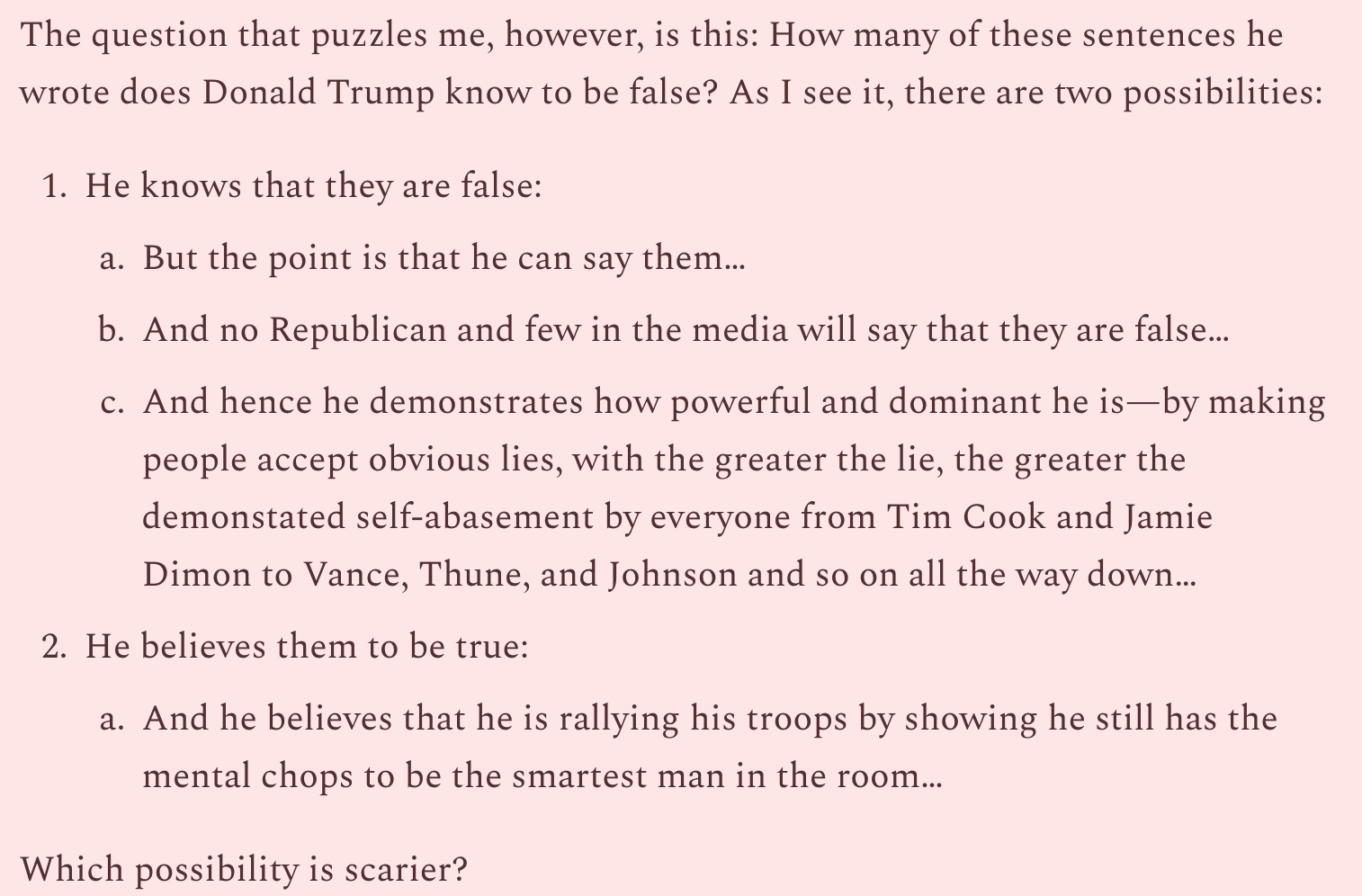
[prompt to Grok]: "Please create a new name and logo for the Meta company, after Mark Zuckerberg abandons the "metaverse" and pivots to "Personal Superintelligence."
The internet is awash with inauthentic activity. Although some of this activity is harmless, a substantial proportion can be classified as malicious, including bots designed to steal personal data, networks of inauthentic social media accounts promoting crypto scams, and coordinated political influence operations (1, 2). To enhance security, online platforms have implemented measures to counter inauthentic activity, with most requiring users to confirm account authenticity via a one-time password sent through short message service (SMS). However, there exists a thriving market for buying and selling on-demand SMS verifications, which forms a cornerstone of the wider online manipulation economy. Despite its centrality in the digital manipulation ecosystem, this SMS verifications market has not been systematically studied.
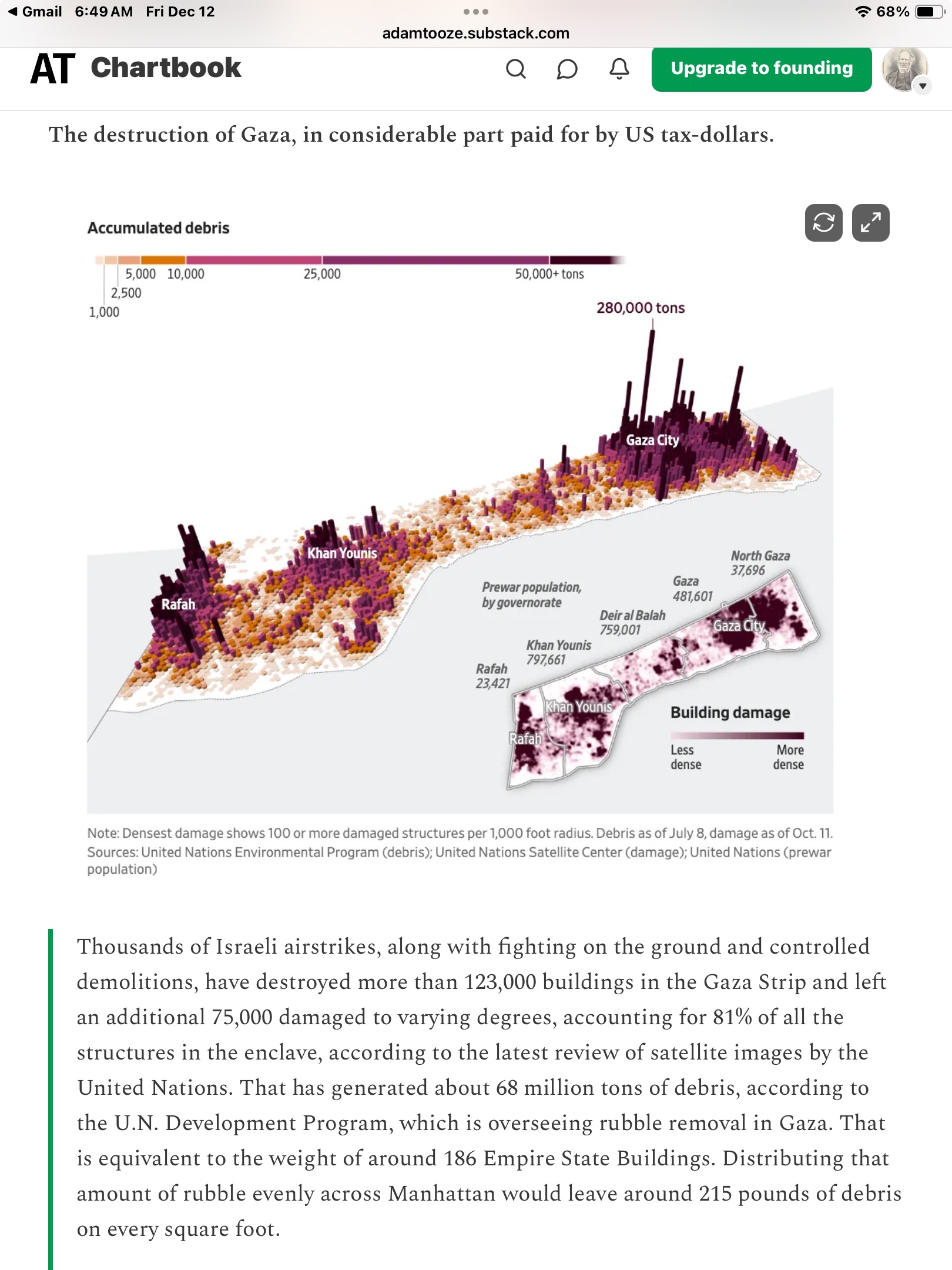
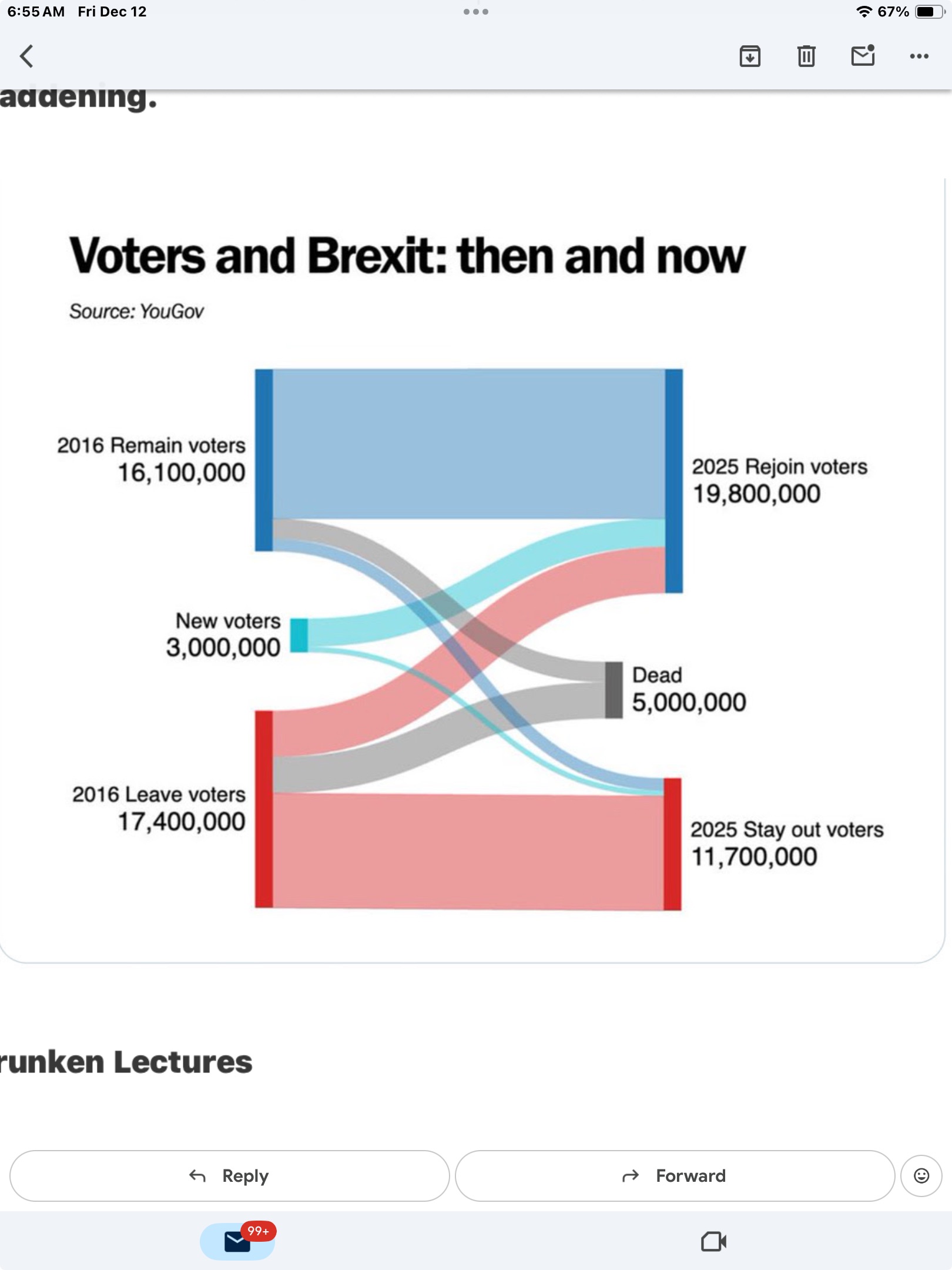
I find abandoned urban objects left in unusual places all the time. This series is all about my photographs of them and includes my commentary. We can learn a lot about people by what they leave behind. Sometimes, there are more questions than answers.
"We have a way of discussing the world, when we talk of it at various hierarchies, or levels ... For example, at one end we have the fundamental laws of physics. Then we invent other terms for concepts which are approximate, which have, we believe, their ultimate explanation in terms of the fundamental laws ... if we go higher up from this, in another level we have properties of substances- like "refractive index" ... or "surface tension" ... As we go up in this hierarchy of complexity, we get to things like muscle twitch, or nerve impulse, which is an enormously complicated thing in the physical world, involving an organization of matter in a very elaborate complexity. Then come things like "frog" ... And then ... we come to words and concepts like "man", and "history", or "political expediency", and so forth, a series of concepts which we use to understand things at an ever higher level. And going on, we come to things like evil, and beauty, and hope ... Which end is nearer to God ... beauty and hope, or the fundamental laws? ... I do not think either end is nearer to God. To stand at either end, and to walk off that end of the pier only, hoping that out in that direction is the complete understanding, is a mistake. And to stand with evil and beauty and hope, or to stand with the fundamental laws, hoping that way to get a deep understanding of the whole world, with that aspect alone, is a mistake. ... The great mass of workers in between, connecting one step to another, are improving all the time our understanding of the world, both from working at the ends and working in the middle, and in that way we are gradually understanding this tremendous world of interconnecting hierarchies."
...where one renowned boffin leads, others often follow. Shi Yigong, a biophysicist, and Rao Yi, a neurologist, who both formerly lived in America, have become co-founders of a new research university in Hangzhou in China's Zhejiang province. It has recruited more than 200 academics. Tech is the next field where America should worry about a Chinese exodus, especially in critical industries like artificial intelligence. Silicon Valley is still full of Chinese superstars, because America remains the top destination for AI talent worldwide. But China is the top source of that talent.
...I am going to argue that China is not going to sit back and passively watch the US economy weaken itself — it is going to deliver an additional sucker punch as the US struggles to staunch the bleeding from its own self-inflicted wounds. You know the homily, "don't kick a man when he's down'? I suspect that China does not subscribe to that.
...Fuck.
...Education should equip students to connect to, interpret, and extend the accumulated corpus of human ideas; that is the durable mission across eras: When it does that, it is worth an absolutely, absolutely enormous amount. We are all in the business of training our students to do such. And what "such" is changes radically over time...
(Word of the Year from Canadian English Dictionary): ...the deceptive practice of making things look more Canadian than they actually are

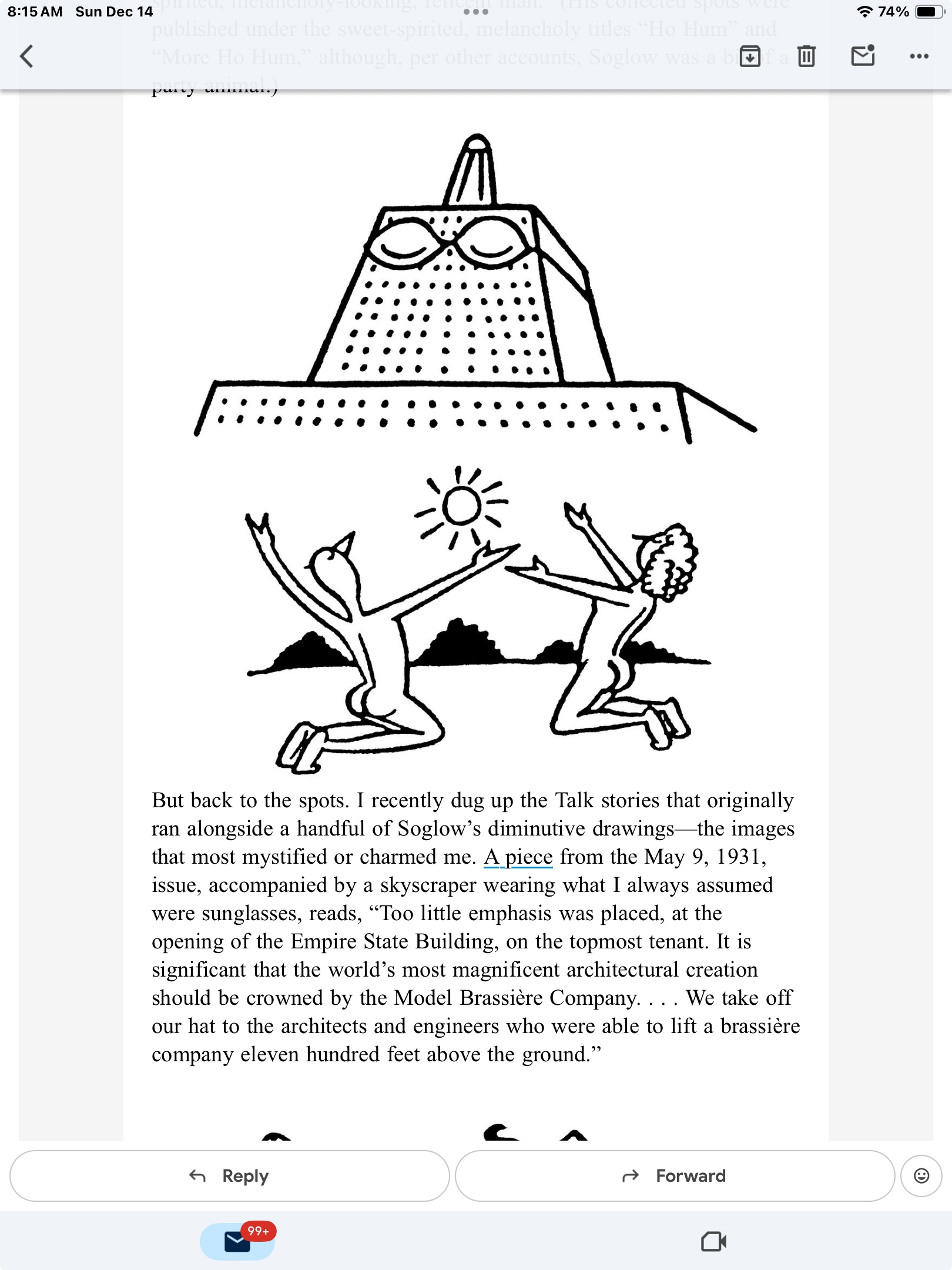
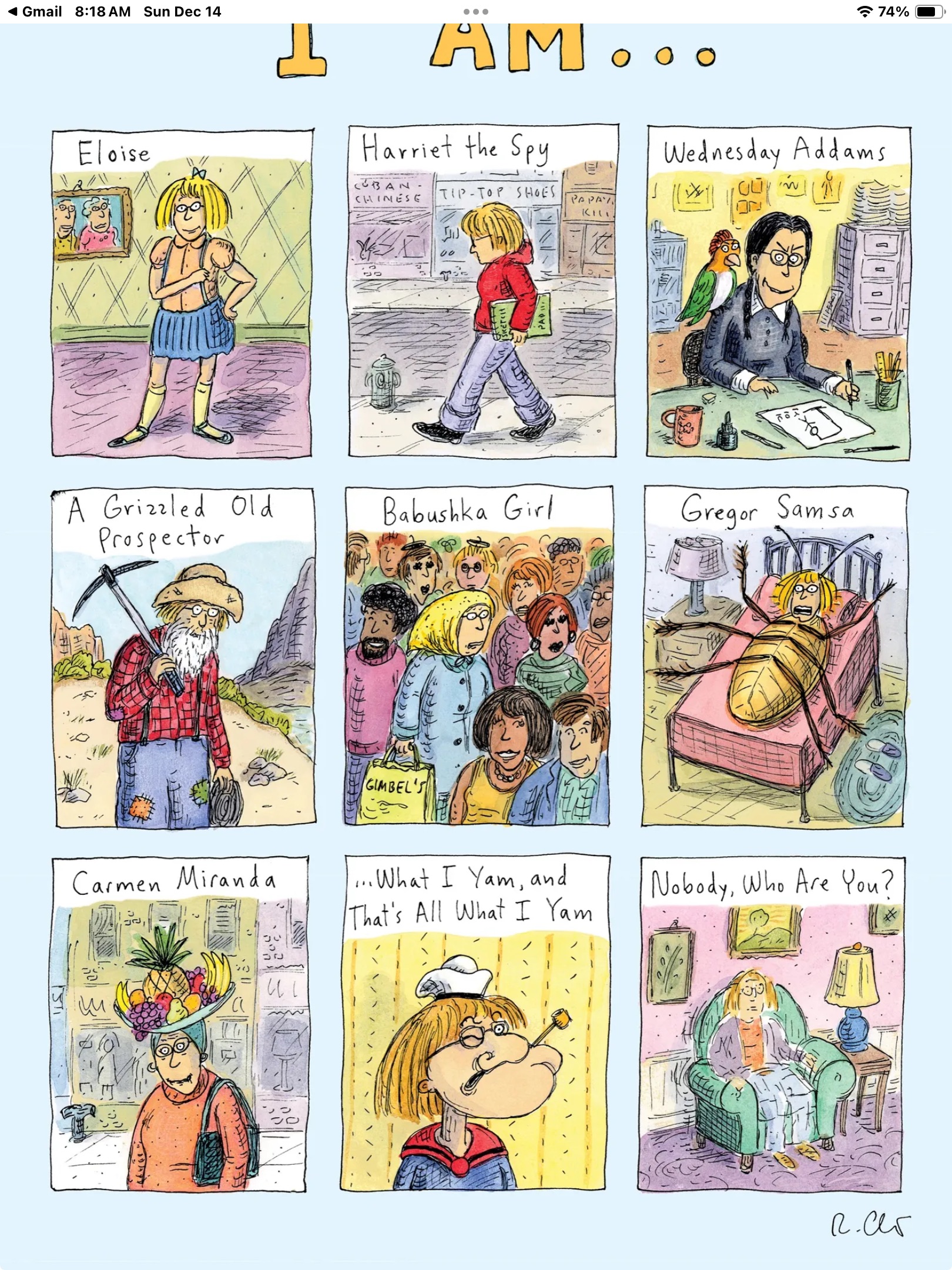
Let the mind become still.
The ten thousand things rise and fall while the Self watches their return.
They grow and flourish and then return to the source.
Returning to the source is stillness, which is the way of nature.
The way of nature is unchanging.
Knowing constancy is insight.
Not knowing constancy leads to disaster.
Knowing constancy, the mind is open.
With an open mind, you will be openhearted.
Being openhearted, you will act royally.
Being royal, you will attain the divine.
Being divine, you will be at one with the Tao.
Being at one with the Tao is eternal.
And though the body dies, the Tao will never pass away."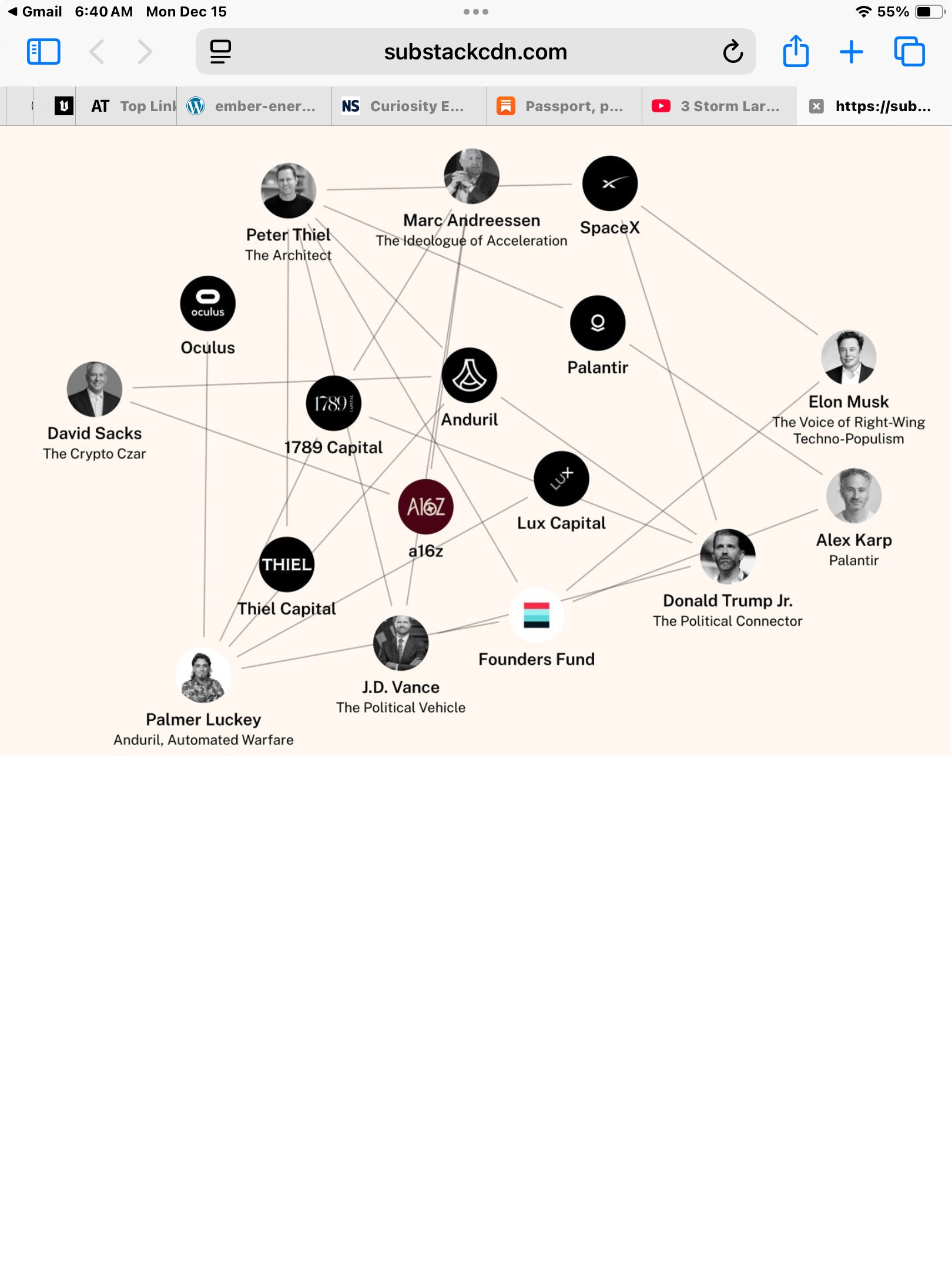
The Authoritarian StackScience has a rich tradition of physics by imagination. From the 16th century, scientists and philosophers have conjured "demons" that test the limits of our strongest theories of reality. Three stand out today: Laplace's demon, capable of perfectly predicting the future; Loschmidt's demon, which could reverse time and violate the second law of thermodynamics; and Maxwell's demon, which creates a working heat engine at no cost. Though imaginary, these paradoxical demons have helped scientists develop sharper ideas about reality and influenced various theories, from thermodynamics to quantum mechanics
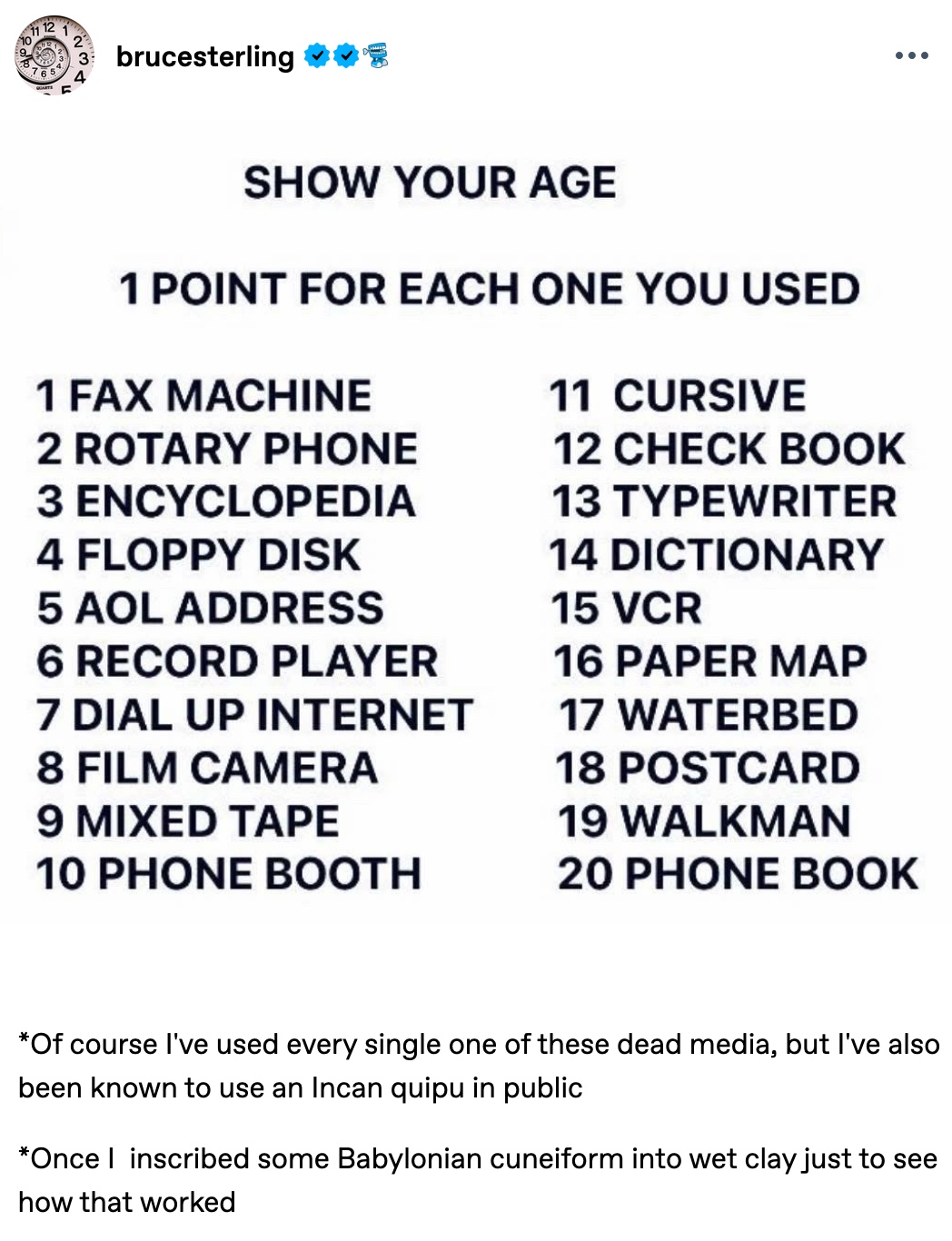
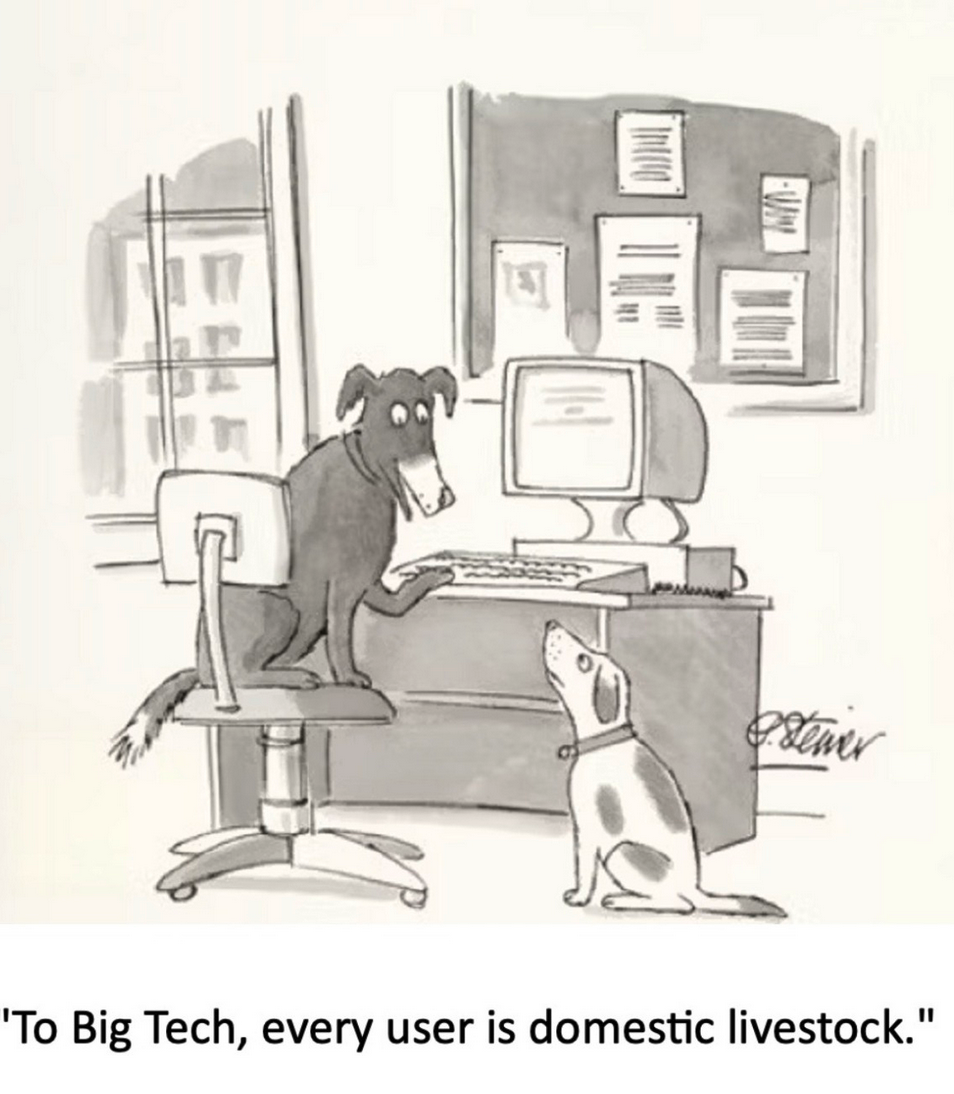
Text still builds ideas, but video spreads them—thus text is where ideas are born and sharpened, but without a video connection they cannot win. Why? Because short-form video is increasingly a better #discoverability layer both for those who will and those who won't read, and one of the few effective ways of pulling those who want deeper engagement back into the text.
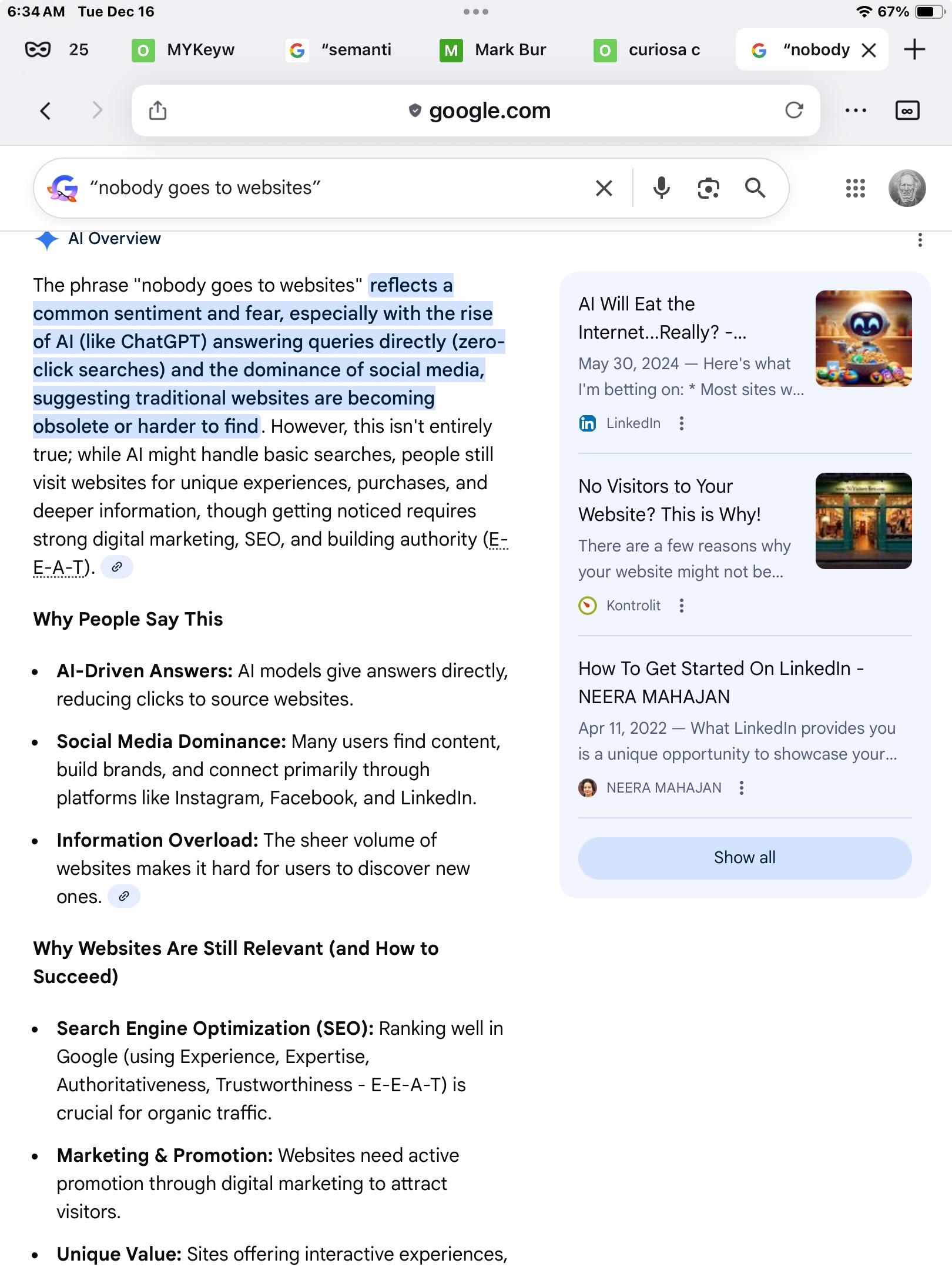
...Nobody goes to websites anymore, why would you have a website? All content and activity only exists on the Big Four platforms; Facebook and Instagram and Pestilence and Death, or whatever. But I've got a website, and I'll be danged if I don't load it with added value that nobody ever sees.
...Right now, we're in a stage of global sociocultural liminality as geopolitics shift, old economic models are under immense strain and change, climate changes, increased conflicts with seemingly no resolutions in sight and more. The New World Order is broken. Democracy is under threat.
...A vector is an entity that possesses both magnitude (size) and direction. And when we talk about values in this context, we're referring to how much a vector gets scaled.
We have a dataset of 100 features, which means 100 dimensions, and most likely, a lot of noise, redundancy, and correlation between features, which can be problematic.
Real-World Examples
...When we walk a graph, we experience a model of the world we've represented as "knowables". These walks embody stories that are the basis of knowledge and reasoning — setting off on walks is better known as brain-storming!
One of the most illuminating approaches for looking at art is to place two depictions of the same subject alongside one another.
...A still mind is not an empty mind.
It's a mind that stops auditioning for the lead role in the never-ending drama.
It steps off the stage,
takes a seat in the audience,
and suddenly notices
"Oh. Ohhhh. Everything was unfolding perfectly without me trying to micromanage existence like a neurotic intern."
Reality is not a problem to be solved.
It's a river to be floated in (preferably with snacks.)
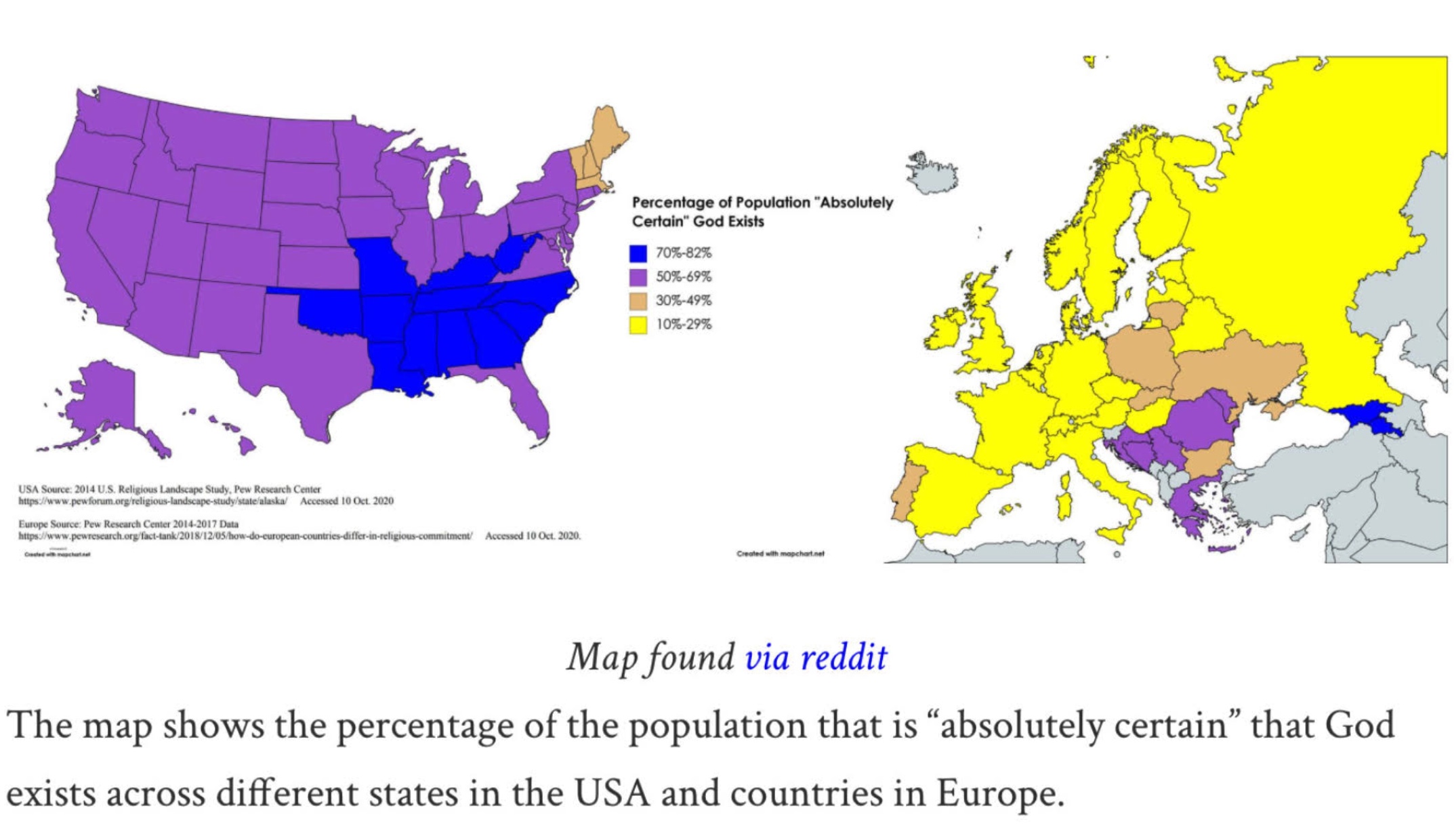
...Dark energy is spread thinly throughout space, amounting to a few atoms' worth of mass per cubic meter; it can be thought of as the energy of space itself. But where it comes from, and why it is so diffuse, no one can say. If dark energy's density really is dropping from one gigayear to the next, that points to a totally different explanation than if it were holding steady.
...January seems like another, also shitty, lifetime ago. Every day is simply so much unhinged bullshit it's impossible to keep up with just the three or four worst things that happened to the most people before end of business, let alone the smaller disasters waiting to meet you in your area. Yes, it's by design, but knowing that the Great Overwhelm is being done by design doesn't really help, or do anything at all. Bad Times Always is an amazingly effective paralytic, as it turns out.
...This map shows the circle of the cosmos that surrounds us, extending to a distance of 200 million light years. At this scale, space is comprised of clusters of galaxies and voids, the latter being areas with relatively few galaxies. The Milky Way, at the centre, is part of the Local Group of galaxies, with the Virgo cluster our nearest neighbour.
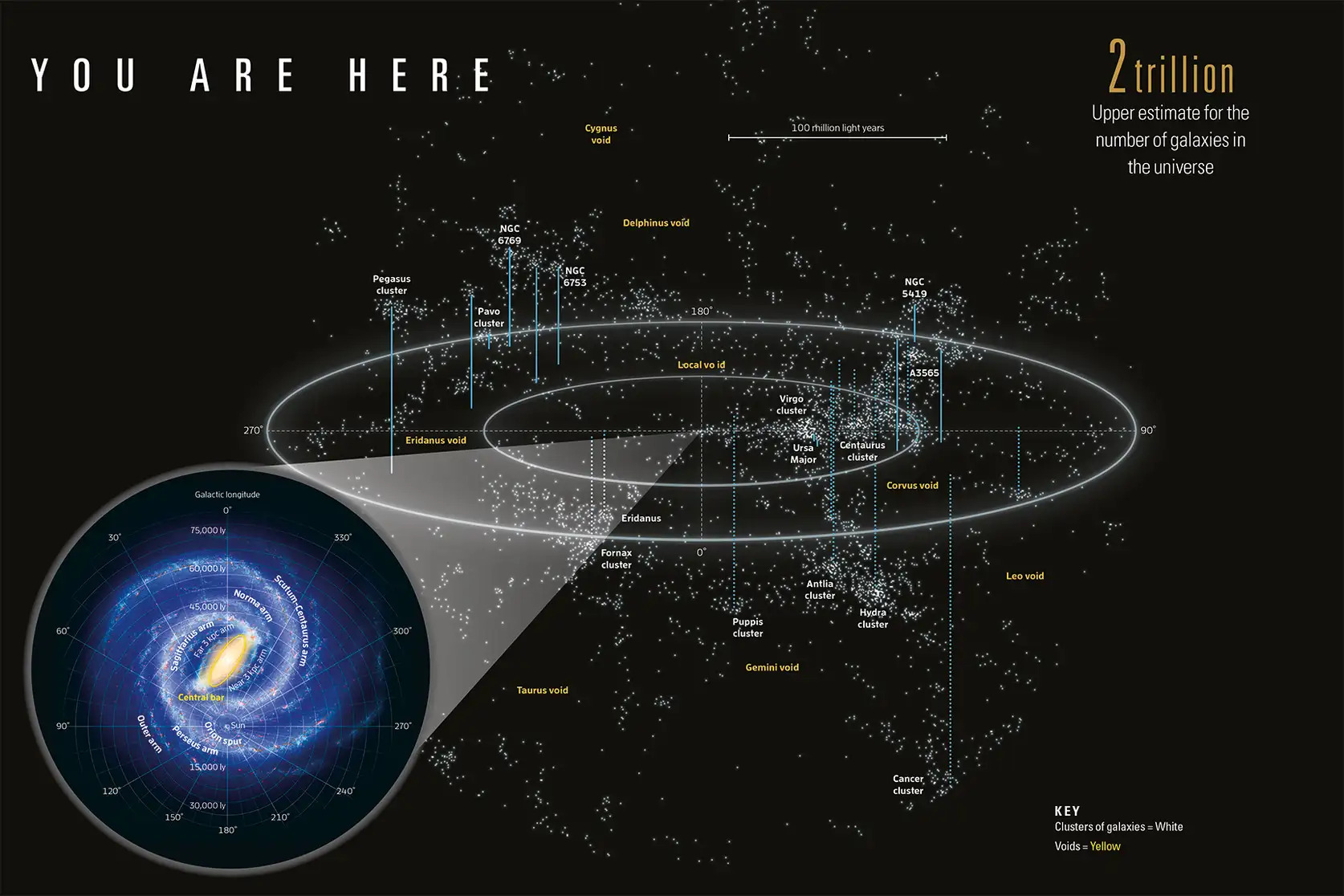
...This is what public health system strain looks like when it settles in. Not sirens. Not shutdowns. Just friction layered onto ordinary life. The territory changed slowly, unevenly, without an announcement. It's not that people stopped paying attention. It's that the map most of us were handed no longer explains what we're walking through.
via Nick, re: Stephen Miller: "dead-eyed, Innsmouth-looking motherfucker"
...We had one especially interesting night meditating on "what are the forces moving the world in a positive direction?" For all the chaos of today, it's hard to not believe the world has generally moved in a more positive direction (for general humanity, at least; cows on the whole, maybe not) (again: macro-scale, century-scale, not week-by-week, or month-by-month nitpicking). And this wasn't a conversation about "if" the world was better, what was good about it, or what was bad. But rather, is there a generalized set of forces that enable "good" to defeat "evil" with at least a 1% house advantage. The most compelling for me was that "truth" was inherently good. And evil implicitly required duplicity. And that "energy difference" between the two — the natural flow of truth vs the duplicity of lies — puts truth out ahead, if only by a little. Truth: a force (fundamental, mathematical) in nature that helps compound good. Evil: built into itself, the cause of its own demise by the necessity to deceive. 1+1=3 requires more energy to maintain. That sort of thing.
...We know our understanding of the universe has undergone other major transformations, with far-reaching effects. For example, the shifts from an Earth-centred to a sun-centred universe and from a finite to an infinite universe weren't only scientific discoveries. They made people genuinely rethink their place in the cosmos. The shift from a bright to a dark universe is of comparable significance, but it has been almost lost to history.
...I realized that there's a story here that's bigger than Trump, a story in which Trump is one especially egregious example of a larger pattern. What is that pattern? That being vicious and bigoted is cool, is based in current slang. Trump is one data point in the midst of an epidemic of performative hatemongering in America. And while most of this is emanating from right-wing extremists, not all of it is.
...Lanchester starts by stating that while we think of the role of the finance sector as "capital allocation" — that is, using investors' money to fund new businesses and expansions for existing business — that hasn't been important to finance for quite some time. Today, only 3% of bank activity consists of "lending to firms and individuals engaged in the production of goods and services."
...This is the point where storms stop feeling like weather and start feeling like a systems problem. Extreme rainfall trends on their own are disruptive. Limited recovery capacity on its own can be managed, at least for a while. When the two meet, the friction becomes impossible to ignore.
...I see Adorno as in need, badly, not of respect and attention from philosophers, but from psychiatrists.
Soaring hollow-boned and prehistoric over our infant species, birds live their lives indifferent to ours. They are not giving us signs, but we make of them omens and draw from them divinations. They furnish our best metaphors and the neural infrastructure of our dreams. They challenge our assumptions about the deepest measure of intelligence.
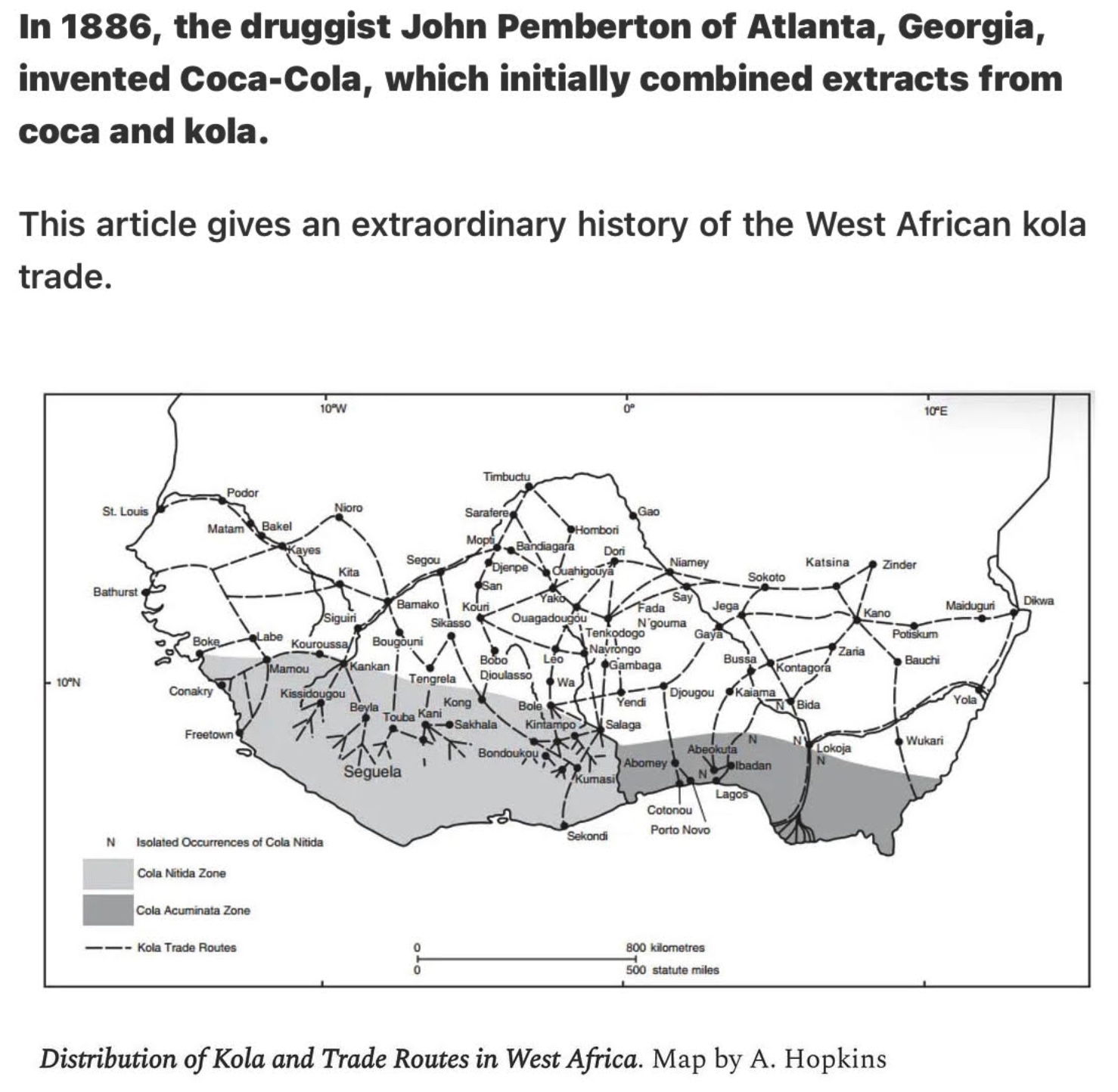
...Beginning in the 1980s, physicists (along with researchers in other fields) began developing new mathematical tools to study what's called "complexity"—systems in which the whole is far more than the sum of its parts. The end goal of reductionism was to explain everything in the universe as the result of particles and their interactions. Complexity, by contrast, recognizes that once lots of particles come together to produce macroscopic things—such as organisms—knowing everything about particles isn't enough to understand reality. An early pioneer of this approach was the physicist Philip W. Anderson, who succinctly framed the nascent anti-reductionist perspective with the phrase "More is different." Complex-systems science has grown rapidly in the 21st century, and researchers in the field won the Nobel Prize for Physics in 2021.
...We are like people drawn inside of a square on a piece of paper. We cannot get out of the black lines, we exhaust ourselves by examining every part of the square, hoping to find a fissure. Until one of us suddenly understands, because he was predestined to understand, that within the plane of the paper escape is impossible. That the exit, simple and open wide, is perpendicular to the paper, in a third dimension that up until that moment was inconceivable.>br>
Mircea Cartarescu (1956 - )
...In earlier eras, resource chains were shorter and clumsier. When they snapped, people could usually see the break. Today's chains are longer, faster, and more brittle, stretched across oceans and borders and political fault lines most of us never think about. When one link weakens now, the signal doesn't arrive as a headline. It arrives as friction. Delay. Cost. Substitution. The system absorbs the shock just enough that it feels personal before it feels historical, which is the dangerous part.
...Trump and his economic advisers claimed — and may even have believed — that they would create lots of manly jobs for manly men. They would revive American manufacturing, they claimed, by unilaterally imposing huge tariffs and thereby breaking all our international agreements (and, whatever the Supreme Court may say, U.S. law). They would create mining and construction jobs, they claimed, by killing renewable energy and gutting environmental protection in order to promote fossil fuels. They would deport millions of undocumented workers which would result, they claimed, in a job boom for native-born workers.
I discovered photography as an expressive tool for myself on December 31, 1999. It's an easy date to remember even though the photography aspect was merely coincidental. The next day, or so it was thought at the time, computers would stop working because earlier programmers had not properly accounted for the change from 1999 to 2000. I will admit that I don't remember how and why that was supposed to be a problem, but large numbers of people were on edge. At the time, I was staying in Frankfurt, Germany. A friend was working in the IT department of the university hospital, the entirety of which had been tasked to be present for the moment when, conceivably, computers might stop working. He asked me whether I would like to come along -- instead of going to one of the many parties. And so I went along and spent that evening in a hospital.
...Cracker Barrel changes its logo, and the anger spreads like a wildfire.
...annoyance is often how structural stress first leaks into everyday life.
I consider the positions of kings and rulers as that of dust motes. I observe treasure of gold and gems as so many bricks and pebbles. I look upon the finest silken robes as tattered rags. I see myriad worlds of the universe as small seeds of fruit, and the greatest lake in India as a drop of oil on my foot. I perceive the teachings of the world to be the illusion of, magicians. I discern the highest conception of emancipation as golden brocade in a dream, and view the holy path of the illuminated one as flowers appearing in one's eyes. I see meditation as a pillar of a mountain, Nirvana as a nightmare of daytime. I look upon the judgment of right and wrong as the serpentine dance of a dragon, and the rise and fall of beliefs as but traces left by the four seasons.
Siddhārtha Gautama (c. 563 or 480 BCE)
"American Political Reckoning: ? A comment: "This is not Dr. Richardson's channel. The channel user name is "versuselalma", and only started posting Dr. Richardson's content 3 days ago, December 18, 2025. Her actual channel is under the username heathercoxrichardson"
...and I can't imagine Heather reading from a telepropter. WTF?
...Most of us now know how this plague arrived in Appalachia. Pharmaceutical companies studied the metrics and pointed to my corner of the map as a gold mine. Where work injuries are common and medical care is stretched far too thin, where centuries of extractive industries have taken out timber and coal and left behind broken infrastructures and folks of limited means, these companies found one more lucrative thing to harvest: our pain.
...A Dunkin representative says it produces "one million donuts a day" and is seeking permits to store thousands of gallons of shortening oil and diesel fuel in above-ground tanks at the 95,000-square ft. facility. The Boston Business Journal reports it feeds more than 200 Dunkin shops—and presumably many other donut-hungry outlets, given the sheer scale of the operation there. (If Dunkin is selling 5,000 donuts a day in each of those locations, we have bigger problems than the smell.)
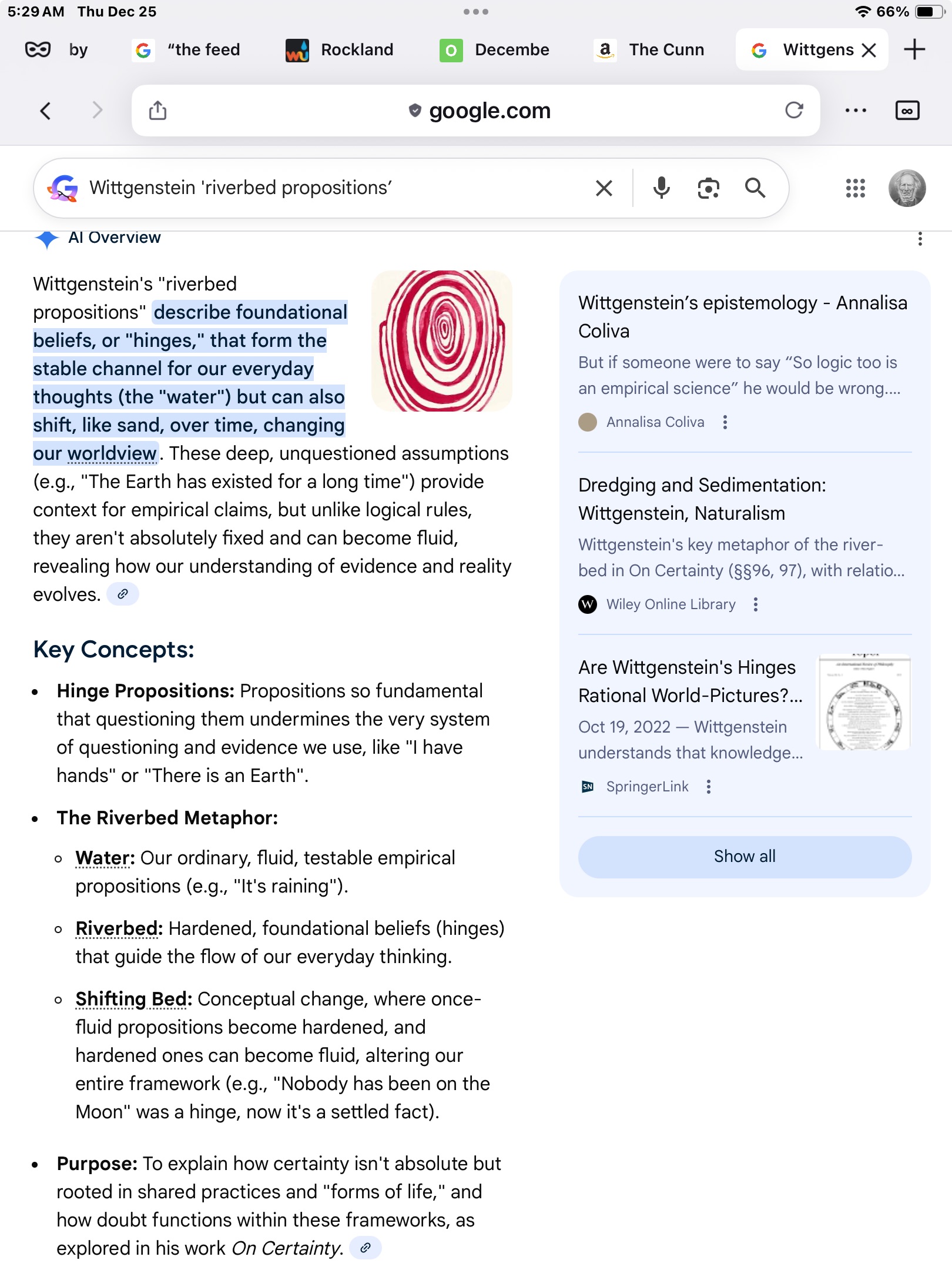
The influence of William James on Ludwig Wittgenstein has been widely studied, as well as the criticism that the latter addresses to the former, but one aspect that has only rarely been focused on is the two philosophers' use of the image of the flux, stream, or river. The analysis of some notes belonging to Wittgenstein's Nachlass support the possibility of a comparison between James' stream of thought, as outlined in the Principles of Psychology, and Wittgenstein's river-bed of thoughts, presented in On Certainty.
... The proposition "these are my hands" (where one is clearly referring to one's hands), along with thousands of other "hardened" propositions, forms the bedrock on which less-solidified language games such as proving and doubting can be played. To attempt to either prove or doubt these propositions is thus nonsensical; one cannot doubt the grounds that enable one to doubt. And yet this bedrock, like the bedrock of an actual river, is itself always changing, shifting, for the most part gradually but occasionally quite violently. Recognizing this keeps Wittgenstein's concept of 'forms of life" from hardening into the sort of philosophical absolute he resisted.
...Wittgenstein examined the idea that certain propositions serve as the bedrock or foundation for other empirical statements. He likened these foundational statements to a riverbed that must remain stable for the river to flow.
...He wrote in response to G.E. Moore's attack on scepticism about the external world. Moore had held up one hand, said "Here is one hand," then held up his other hand and said "and here is another." His point was that things outside the mind really do exist, we know they do, and that no grounds for scepticism could be strong enough to undermine this commonsense knowledge.
Wovon man nicht sprechen kann
daruber muss mann schweigen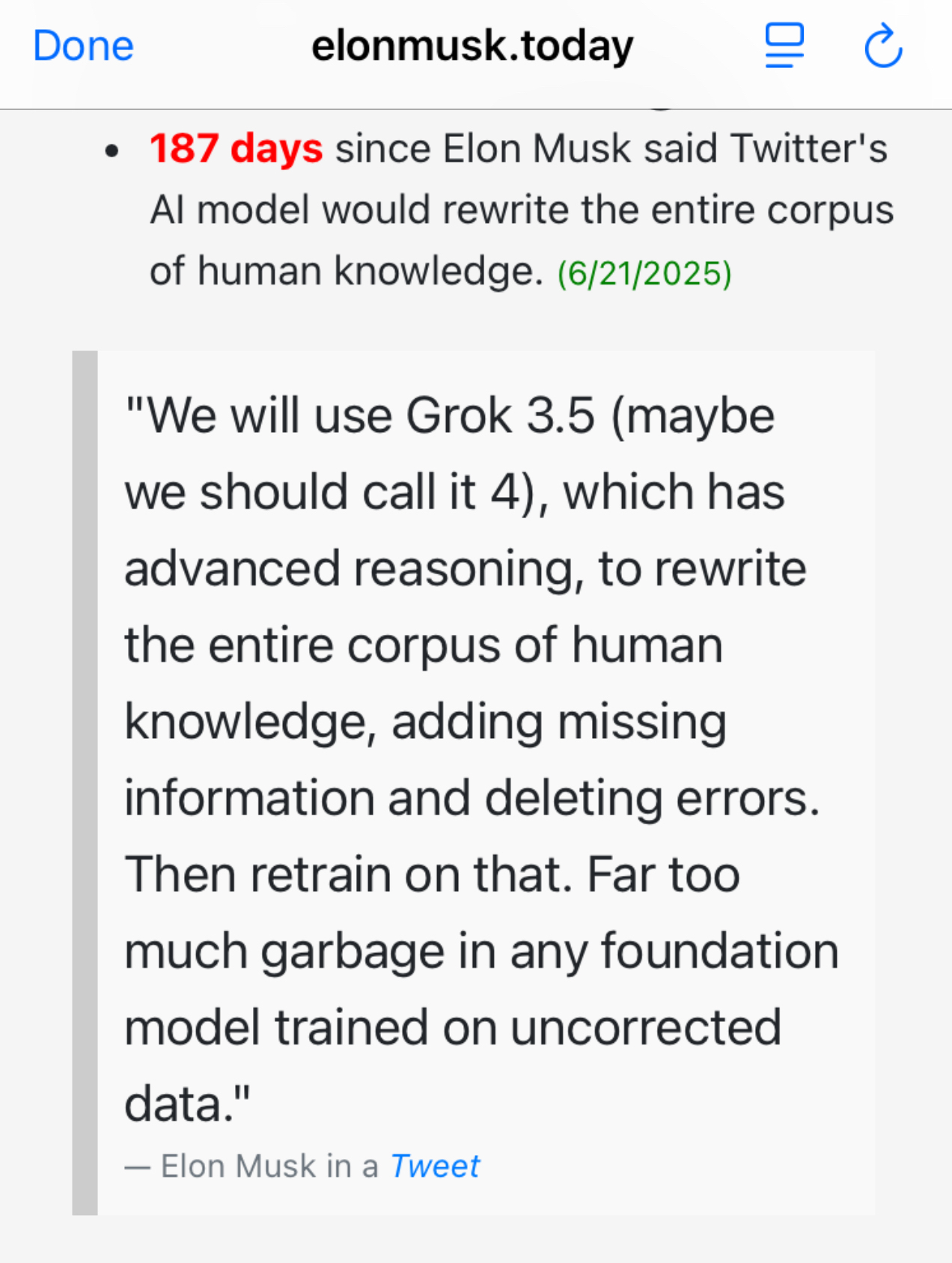
(re: SNAP) ...Paperwork requirements matter because they impose real transaction costs.
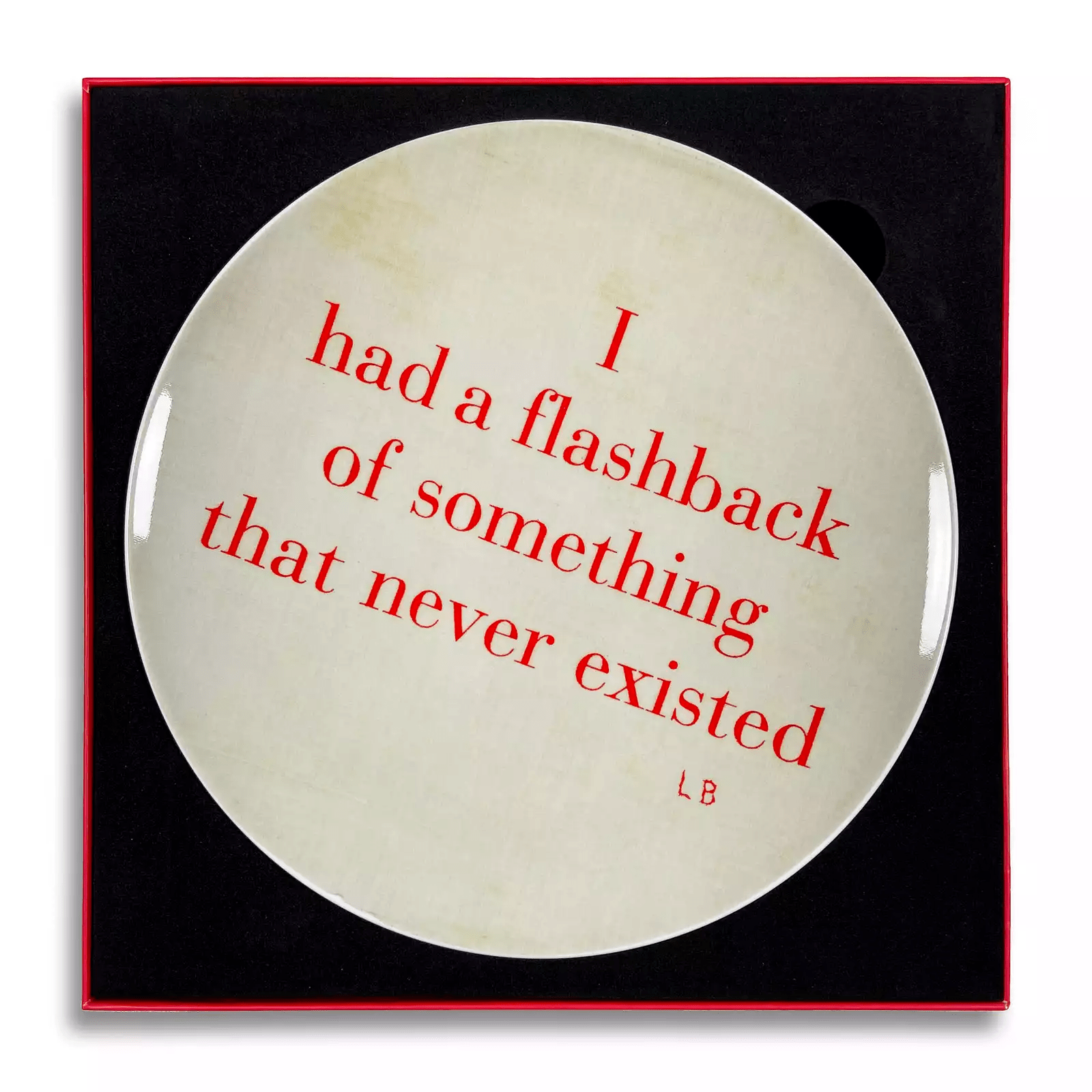
...What kind of new moral being—good or bad—might be born in our time? One way to understand the worst actions and attitudes of Donald Trump is to recognize that he is auditioning with a cold cynicism for just this kind of role. Not only does he lie without shame, dole out violence as a way to keep power and entertain a perverse crowd, maintain an unstinting disdain for the poor and the weak and the lonely, and manifest sheer glee at the sight of other strongmen getting their way—but, just as ominously, he pretty brazenly recommends these behaviors to the rest of us. He lights the bomb of hatred and contempt, then looks out at us, smiling, as the flame eats the cord.
...A university is not a platform; it is a heat engine. Its function is to take the raw, chaotic potential of a student's mind and subject it to the intense resistance of difficult ideas, harsh critiques, and immovable deadlines. This process denatures the student's prior assumptions, allowing them to re-fold into higher-order structures of thought.
Relationships are the great creative work of our lives. They are, like every creative endeavor, a process demanding both systematic intentionality and surrender. If we show up for that process with courage and consistency, it will surprise us, shatter our complacency, take us places we never thought we could go if we followed the vector of our preconceived plans.
Angels don't Live up there. They dwell down here with you and me, they stumble around as part of the collectively tired we. While most hurry on past the hunched figure on the ground, eyes fixed to phones screens swiping up and down, they look the man directly in his eyes when he asks for change, they empty their pockets and give all that remains. They go home to tinned tomatoe soup and stale reduced bread, but just before they indulge, they carry their loved ones off to bed. Angels aren't paradimes of holiness far removed from your lifes, they're people here and now still choosing to be kind.
on December 24, the Algerian parliament passed a law recognizing French colonialism in that country, 1830-1962, as having been a crime that involved mass killing, rape, displacement of populations, usurpation of land, and marginalization of people. The law also makes claims on France for reparations.
...Matthew Sacchet: There's been a lot of research on mindfulness, generally defined in this context as non-judgmentally and intentionally paying attention to experiences of the present moment... Far less research has investigated what we call advanced meditation, which involves deeper, ongoing mastery of practice that includes altered mental states — and even transformations of conscious experience and ways of being. Our research programme studies this mastery of meditation and asks: what are the limits of meditation? What's possible beyond mindfulness?
...In the 1990s, the philosopher David Chalmers made an influential contribution to the consciousness debate by distinguishing between what he termed the easy problem, or problems, and the hard problem of consciousness.
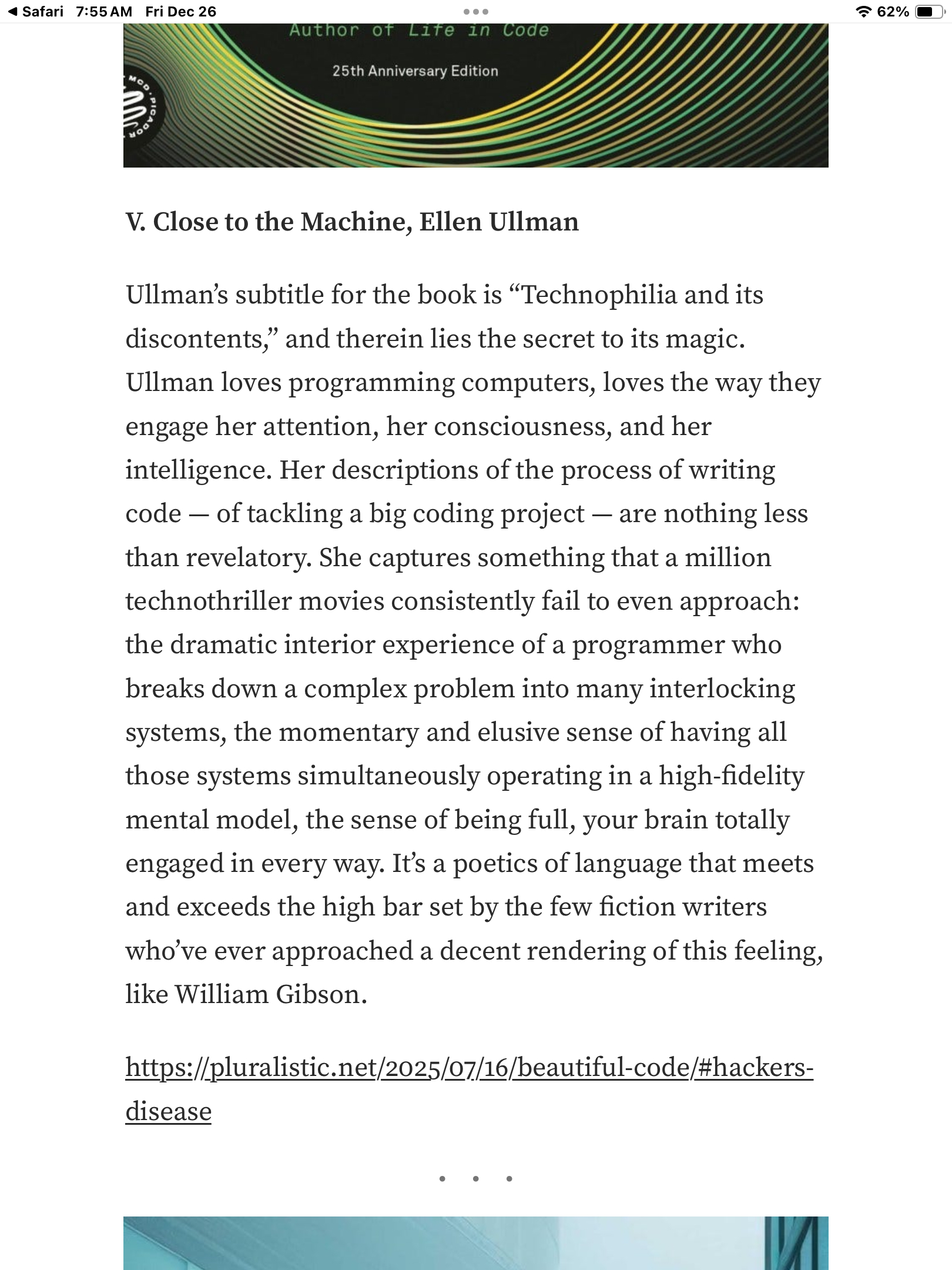
...Binary oppositions drive everything in society. Even if you try to avoid them, you can't. You get dragged into a world where you must pick sides. You must decide between the two teams—which one will you join?
...The term "Gestalt" comes from the German for "shape" or "form." The theory holds that our minds organize sensory input. We group elements into patterns. In other words, it creates unified wholes, rather than isolated parts. It is a notion that has profoundly influenced art and design. It shaped how artists create and viewers interpret visual compositions.
Sudan's scale and slavery today via Adam Tooze
...At independence in 1956, the country inherited a set of borders from its British colonial rulers that was less a definition of a newly born nation than a demarcation of the limits of other European powers pressing in from all sides. Centralisation meant that the further away from the capital you were the less your concerns mattered. It was easy to ignore problems and hope they would just go away. Instead, this created resentment that only grew over time.

...There are people whose eye is more sharply focused on those brilliances, whose ear is more finely tuned to the murmurations of the mountains and the oceans and the trees, whose orientation to the world is more tenderly in touch with our creaturely origins. Some of them become artists, some scientists, and some boundary-spanners who refuse the divide, who know that to partition our ways of seeing is to keep ourselves from apprehending the magnificent whole.
…if Israel resumes the full, unrestrained intensity of this genocide, will we stop it? I fear the answer is no, because the world refuses to dismantle the circumstances that permitted this slaughter in the first place. Israeli officials never bothered to hide their intent. The systematic dehumanisation of Palestinians was a primary export of Israeli media, even as Western corporate outlets worked tirelessly to sanitise this criminal discourse.
...The gut turning part of GenAI is the confidence in which it summarizes something it has no experience with, but talks as if it was there.
Donald Trump's erratic policies have dominated world economic news in 2025. But if U.S. policy weren't being whipsawed by a wannabe authoritarian's whims and obsessions, we would all be focused on a different problem: China's massive trade surplus.
A few weeks ago, a man got on the New York subway wearing his expensive Meta AI glasses. They cost $300, but give users super powers—for example identifying total strangers, and taking quasi-surveillance videos.
Five centuries before the internet, before anyone had heard of algorithms or influencers, a frustrated theology professor discovered what every creator of a viral meme has learned since: once you release something into the cultural thoughtstream, it no longer belongs to you. It belongs to everyone who recognizes themselves in it.
...Deep, active reading is much easier—and more fruitful—when a capable LLM sits at your elbow: Reading has always been a joint production between author, text, and the reader's prior scaffolding: what you already know, what associations spring to mind, which gaps you can bridge. An LLM, judiciously prompted, supplies scaffolding on demand. It can surface the hidden priors, name the unstated interlocutors, and map the argumentative terrain the author assumes, thereby lowering the cognitive transaction costs of comprehension. The risk—always—of confabulation is real; but so too, historically, were the risks of misremembered seminar notes and half-digested secondary sources. Net-net, the marginal productivity of your attention rises. You can spend less time decoding the context and more time evaluating the claims.
...There is an echoing melancholy to this era, as we watch the end of Silicon Valley's hypergrowth era, the horrifying result of 15+ years of steering the tech industry away from solving actual problems in pursuit of eternal growth. Everything is more expensive, and every tech product has gotten worse, all so that every company can "do AI," whatever the fuck that means.
...Boulevard du Temple is the first known photograph of a human. The exposure time for this photograph was determined to be between four and five minutes. Way too long for the people walking on the busy street to be captured in this early photographic process. But one person did hold still, the man in the lower left-hand corner. He was having his shoes shined and held still long enough for the photograph to render him.
How much of your life is wired through screens now — not in some flashy sci-fi way, but in the quiet, ordinary sense of Tuesday night? I had that thought the other day, standing in the kitchen with a phone in one hand and a grocery receipt in the other, realizing I hadn't actually “done” anything without a login in hours. Tap the app. Approve the charge. Confirm the code. Another tiny hoop. It's strange how normal that feels, like breathing through a filter you stopped noticing.