- A "nutrition company" ...the largest online marketplace for endurance athletes ...a technological advancement
The Feed...We are athletes like you. We have experienced how eating smarter can make a meaningful difference in our training. Improving your nutrition is one of the quickest ways to see meaningful improvements in performance.
Others that display other facets of the semantic field of 'feed:
- The Feed (British TV series) Wikipedia
...takes place in London in the near future and follows the British family of Lawrence Hatfield, the man who invented an omnipresent technology called The Feed. Implanted into nearly everyone's brain, The Feed enables people to share information, emotions and memories, called mundles, instantly. But when things start to go wrong and users become murderous, the family is driven apart as they struggle to control the monster they have unleashed.
(adaptation of a 2018 novel by Nick Clark Windo)
(Amazon Prime Video) - The Feed SBS Australia
- The Feed: Outsourcing Knowledge & Attention to Machines J Nathan Matias at citizensandtech.com
Feeds are everywhere today, from social media to law enforcement. How might we think differently about society if we understood feeds more clearly?
...The Facebook News Feed, like any feed, is a constant stream of information that is curated in some way. Developments about computing technology have made it easier for computers to make automatic decisions about what we see. The idea of automated curation of continuous information has now appeared everywhere.
Originally, the Facebook algorithm was barely worth calling an algorithm- it was everything your friends did in reverse chronological order. The feed was originally based purely on likes, and now it's a complex trade secret that employs "hundreds of factors”"including the network of relationships, how long your eyes spend on something, whether your friends are involved in the conversation, and others.
...What does it mean for the newsfeed to be a genre of information, perhaps as important as the novel?
- The Feed is Dying. Social Network Series Hits 1M Messages by Changing How You Share Online businessinsider.com
...social media faces an existential crisis. The head of instagram Adam Mosseri commented on a 'paradigm shift' away from public posting, with users increasingly retreating to direct messages and closed groups. For non-creators, the pressure to curate perfect content has made sharing feel like work rather than genuine human connection.
Series solves this by removing the concept of posting altogether. Users instead send a customizable message to a curated list of people within the platform, entirely on iMessage. The term series comes from the sequential approach the product takes to ensure a user's message reaches the right people. Users have sent messages that have resulted in hired videographers, dates in Amsterdam and co-founding a business.
- The Hypewriters Fredrik Scheide at Medium
Open the feed on your phone any given morning and there it is: another breathless proclamation that everything you know has changed. A new AI capability that will "transform" knowledge work. Something that will revolutionise how we build products. A new technology that will reshape public institutions in the next six months, and render public servants out of a job. The language in these articles is always the same — urgent, definite, demanding our immediate attention.
I have my feeds, constructed by myself via RSS delivered by Feedly, and pushed to me by Amazon and YouTube and Netflix and so on (those are creatures of The Algorithm, drawing upon my past digital engagement with those platforms), and via email from those who Have My Email Address, and of course I also rely on print-medium feeds (NYRB, LRB, New Scientiast, Science, New Yorker etc etc) as well — but these days little radio (which was a daily source until the 20024 election) and not much online newspapers (Guardian and NYTimes still on the desktop, though).
And of course it used to be that newspapers and magazines were much more potent information feeds, and for many people television was a primary source, The interwebs have utterly transformed the "news" landscape, and affordances like smartphones and tablets are predominant in 2025, in pretty much everybody's hands and consciousness.
The continuing evolution of the digital feed traces its origins to transistors and semiconductors and Silicon Valley (a shelflist could be generated), and continues to bloom down to the present. It includes the appearance of deepfakes and hardly-surprising malicious actors and (increasingly) "AI". My world was invaded a few days ago by several pretty obvious deepfakes of Heather Cox Richardson, in which she appears to be reading from a teleprompter. It looks like her, sounds like her, but the message is bogus. She mentions the existence of not-Heathers at the head of last night's Politics Chat (about 1:00 in the video linked above).
So I was provoked to look a bit more at 'deepfake':
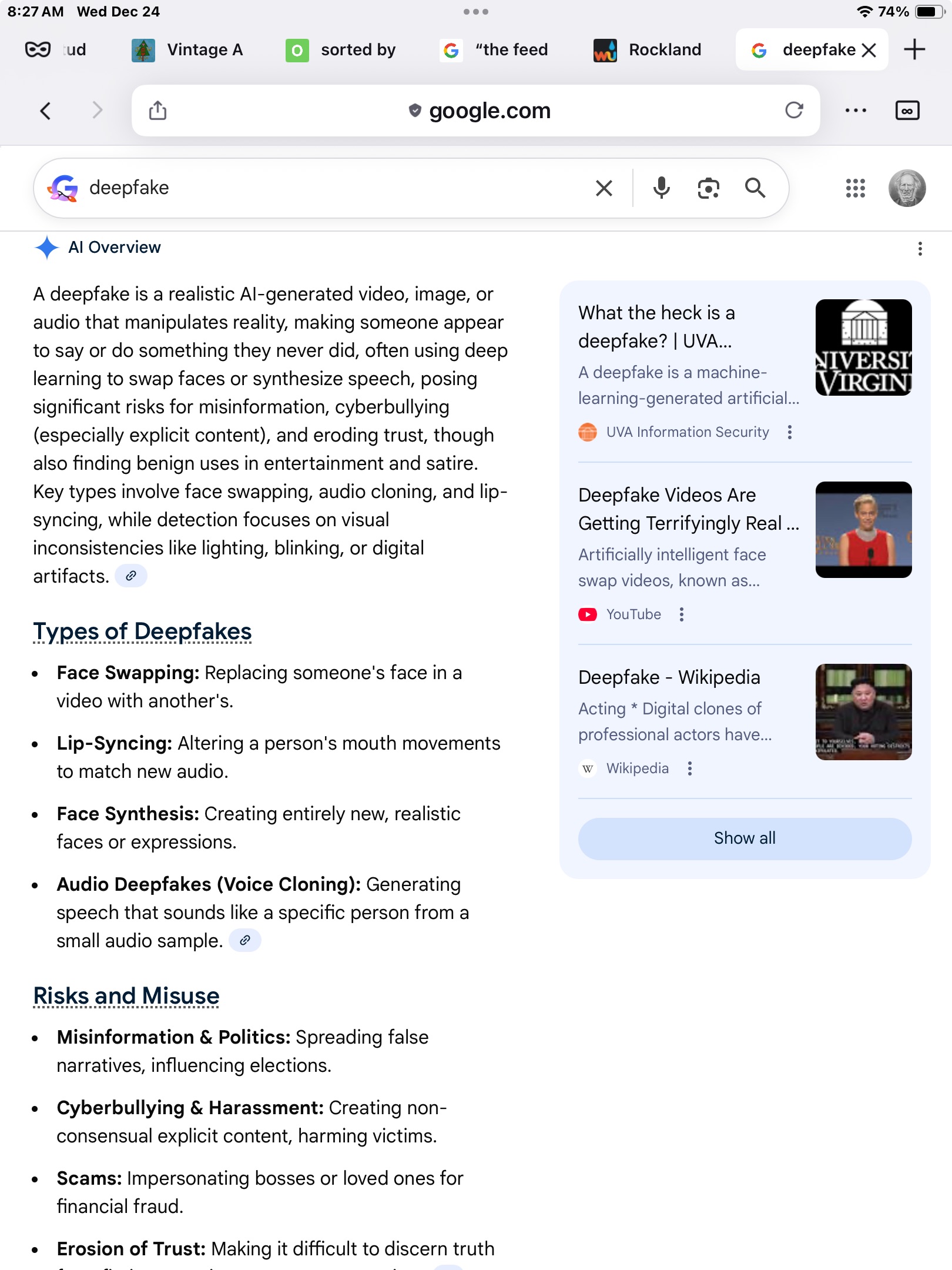
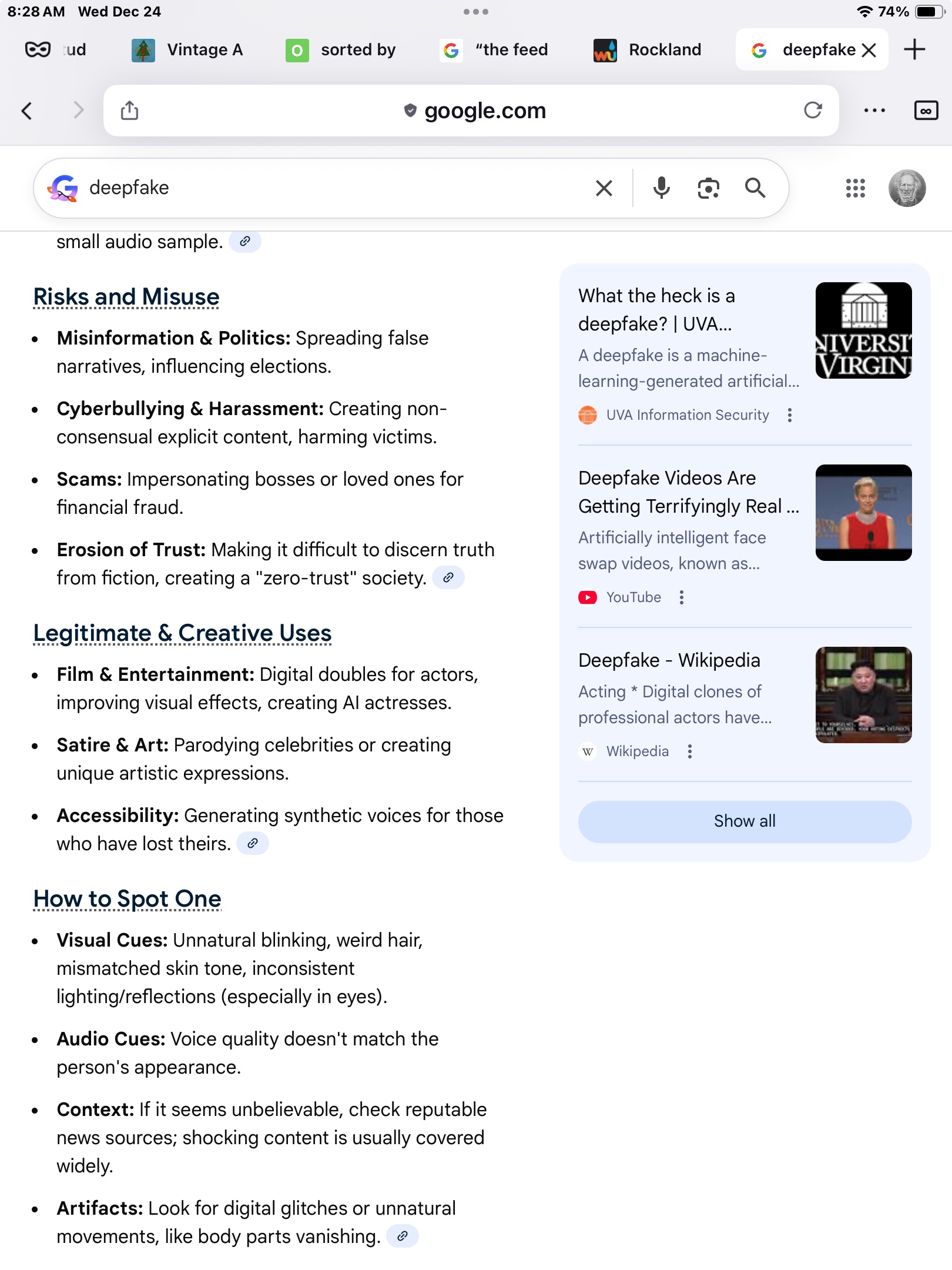
- Deepfake Wikipedia
- Deepfake AI Generator deepfakesweb.com
- deepfakes explained mitsloan.mit.edu
- Increasing Threat of Deepfake Identities dhs.gov
- Deepfake-O-Meter buffalo.edu
...an open-access platform that integrates state-of-the-art, open-source research methods for detecting AI-generated images, videos, and audio. The platform serves a dual purpose: for researchers, it offers a testing ground to evaluate detection methods against real-world data; for public users, it provides a free tool to experiment with and better understand recent advances in synthetic media detection. It is important to note that the incorporated detection methods are research prototypes and may not always produce accurate or consistent results. These outputs should be interpreted with caution and in appropriate context. DeepFake-o-meter does not assume responsibility for any inaccuracies or misclassifications generated by individual detection modules used within the platform.
- Artificial intelligence, deepfakes, and the uncertain future of truth John Villasenor at Brookings.edu
- The Rise of Artificial Intelligence and Deepfakes buffett.northwestern.edu
...Deepfakes are generated by machine-learning algorithms that can create realistic digital likenesses of indviduals with- out permission. When execution is excellent, the result can be an extremely believable— but totally fabricated—a text, video or audio clip of a person doing or saying something that they did not.
- What Are Deepfakes and How Are They Created? IEEE Spectrum
...There's a lot of confusion around the term “deepfake,” though, and computer vision and graphics researchers are united in their hatred of the word. It has become a catchall to describe everything from state-of-the-art videos generated by AI to any image that seems potentially fraudulent.
...To make a deepfake video of someone, a creator would first train a neural network on many hours of real video footage of the person to give it a realistic "understanding" of what he or she looks like from many angles and under different lighting. Then they'd combine the trained network with computer-graphics techniques to superimpose a copy of the person onto a different actor.
...Many people assume that a class of deep-learning algorithms called generative adversarial networks (GANs) will be the main engine of deepfakes development in the future. GAN-generated faces are near-impossible to tell from real faces. The first audit of the deepfake landscape devoted an entire section to GANs, suggesting they will make it possible for anyone to create sophisticated deepfakes.
- Dangers of Deepfake: What to Watch For stanford.edu
- DeepFaceLab github.com
- Everything You Need to Know About How to Use Deepfake Technology discoverdatascience.org
...Deepfake methods intersect disciplines and industries from computer science and programming to visual effects, computer animation, and even neuroscience. They can be convincingly realistic and difficult to detect when done well and with the aid of sophisticated and powerful technologies.
But ultimately, machine learning is a foundational concept for data scientists, and as such, it offers an interesting area of study in the context of deepfakes and the predictive models used to create them. The training methods, algorithmic structures and synthetic output of these models offer insight into deep learning and data.
I changed the search to 'newsfeed', with interesting results:
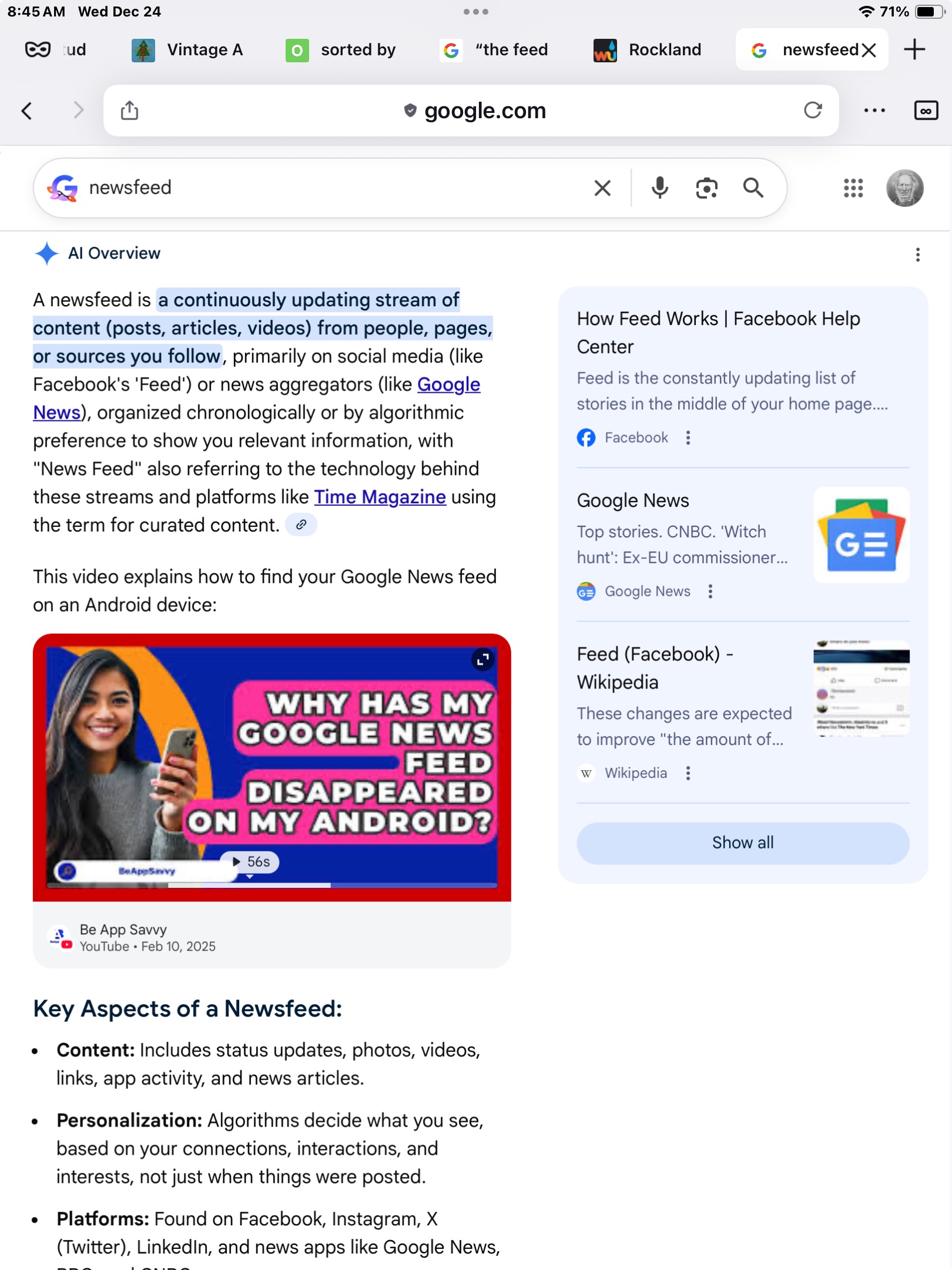
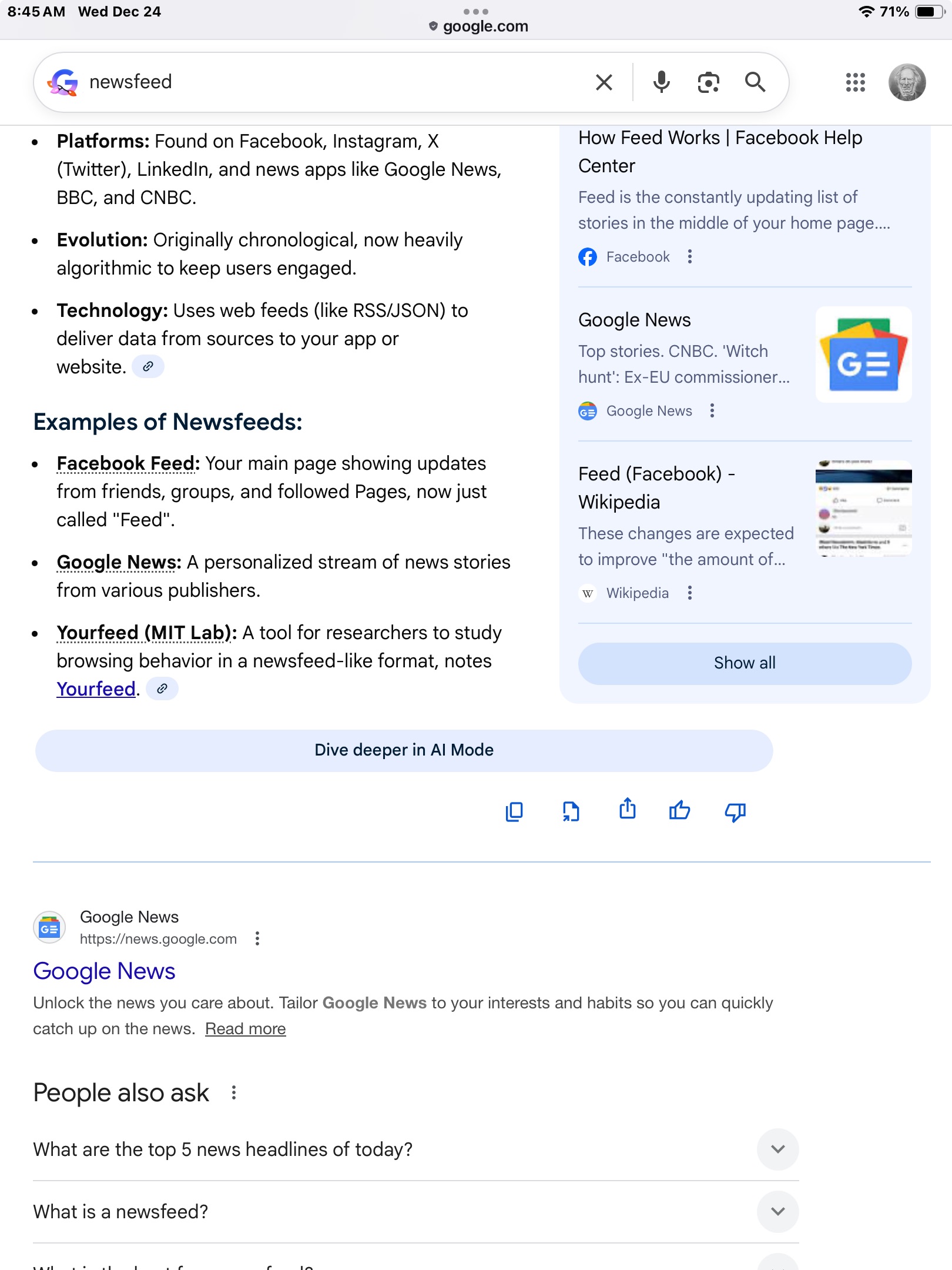
- OED 'newsfeed'
...1991: Once a message gets to the nearest Internet-linked newsfeed, it is everywhere else in the Internet world it is supposed to go, more or less instantly.
H. Rheingold, Virtual Reality iii. ix. 198 - Feed Facebook Wikipedia
- Feeds fbi.gov
- feedly.com news-reader
- Fine-Tune Your Feed and Get News You Can Use J. D. Biersdorfer at NYTimes Personal Tech
Apps from Google, Apple and other companies let you customize your content so you're always up to date on the matters you care about most.
- How Does News Feed Predict What You Want to See? Meta (2021)
- Web feed Wikipedia