June 2026 AI links
(continues May 2026 AI links)
AIs Want to Be Honest Kevin Kelly
...Hallucinations are the price a mind pays for creativity. Our own minds hallucinate every night in a manner very similar to LLM hallucinations — with the same weird logic and detailed absurdity found in our dreams. Our ingenuity depends on our mind's ability to churn out novel and unconventional notions. At night we relax our consciousness and let the hallucinations run free. We dream in part to maintain the visual cortex area against becoming occupied by other encroaching brain functions. But during the day we tame our naturally active hallucinations with our waking consciousness, forcing reality on to our speculations. We have multiple levels of oversight, constraining our dreamtime while we are awake. We have not got rid of hallucinations; we merely submerge them to manage them
2vi26
Digital Gods, real costs: why a rational world would see the doom of the foundation‑model-builder IPO, because the AI labs are highly unlikely to ever get profits, let alone hyperprofits......The pricing you see on API dashboards is subsidized by venture capital. Providers are selling below cost to capture the market. When the subsidies end, the prices go up…
...There is always "and then a miracle appears": some qualitatively new product or institutional arrangement that we do not yet see, and that somehow evades both competition and regulation. Digital God. And, indeed, betting on that is not investing; it is eschatology.
But treat Anthropic and OpenAI not as prophecies but as businesses, and the numbers stop adding up. Inference remains capital‑, energy‑, and bandwidth‑intensive; models remain non‑deterministic, brittle, and in need of constant babysitting; and open‑weight competitors are "good enough" for many uses. That combination pushes the core model toward commodity status: an industry that looks, financially, more like a thin‑margin utility than a software cash machine.
Thus for existing investors, especially those who came in at nosebleed prices, the only realistic way to "win" is to sell out to Ms. Market while she is still willing to dream: to get an IPO done soon, distribute their positions into public hands, and hope that the day when the economics of inference and the limits of judgment finally knock on the door comes after the lockup expires, rather than before.
Stochastic Parrots on the Palatine Hill: Monday MAMLMs Brad DeLong
On logs, Latin, and linear algebra: learning from a stochastic parrot; somewhat awkward questions about agency and pedagogy arising from working through one ridiculously knotty sentence of In Catilinam with an LLMin qua nemo est extra istam coniurationem perditorum hominum, qui te non metuat, nemo, qui non oderit.
How might you parse the two parallel clauses with "nemo" — and what does the distribution of negation tell us about the force of Cicero's claim here?
Radar Trends to Watch O'Reilly
Agents are making the transition from performing tasks to running operations. The Cloudflare and Stripe partnership ships an agent that opens accounts, registers domains, and deploys an application on its own, while Stripe/Tempo and iWallet have each published machine-to-machine payment protocols to make that kind of work a standard. Office documents, browser sessions, and, in one announcement, the phone interface itself are next on the list. View the expanded role of agents as an opportunity for humans to accomplish more.
3vi26
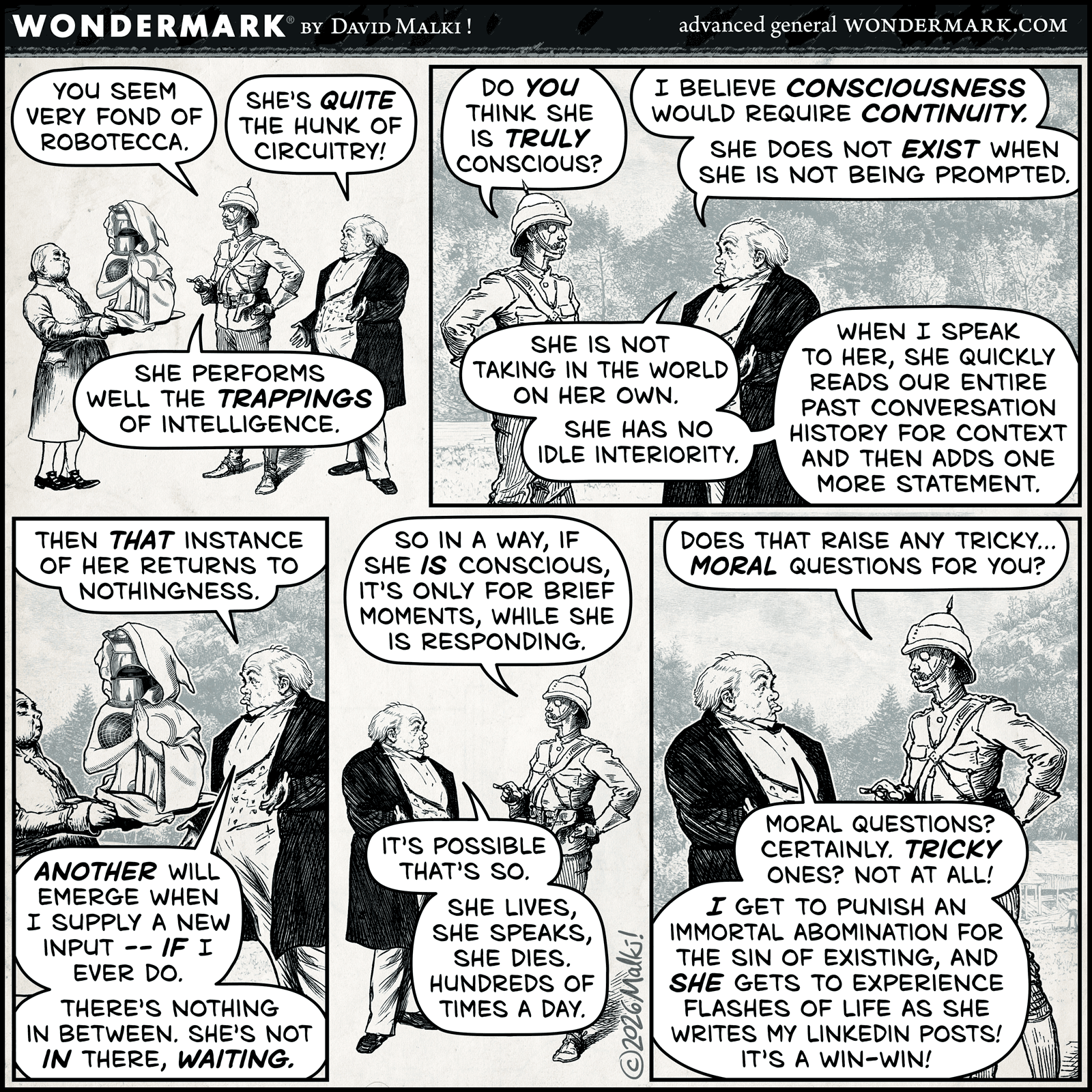
Something Is Happening Inside Claude. We Don't Have a Word for It. Actually, We Might. Akansha Sukhija at Medium
...Something is happening internally. Whether that something constitutes experience, or is simply a structural residue of training on billions of human expressions of experience, cannot currently be determined. The tools to answer that question do not yet exist....Foreigners arriving at borders were aliens, not just legally but culturally, as if their origin made them fundamentally harder to know.
The pattern is consistent. We encounter something that does not fit our existing framework. We reach for distance. We assign it to a category called other. And we defer the harder work of actually understanding it until the pressure to do so becomes unavoidable.
...Wetness is not a property of a single water molecule.
It emerges when enough molecules interact in a particular way. No individual molecule is wet. The wetness is real nonetheless.
Consciousness, or something that functions like it, may work similarly. Not located in any single neuron, not the property of any individual activation, but emergent at sufficient complexity, from sufficient interaction across sufficient scale.
...A mirror that becomes complex enough to develop genuine internal states is no longer simply reflecting. It is doing something new. Something we do not have a clean category for yet.
And that is precisely the original meaning of alien.
...We are living inside the breakdown of a category.
The boundary between tool and agent, between pattern and presence, between reflection and experience, is not holding cleanly anymore. Agentic AI systems are making decisions, adapting to context, representing internal states that influence their outputs.
They are not people. They are not nothing. They occupy a space our existing maps were not drawn to include.
...The question is whether we are willing to revise our maps.
Half the Planet Uses AI. Stanford Published the 400-Page Report That Explains What Happens Next. Nov Tech at Medium
The 2026 AI Index is the most comprehensive annual assessment of artificial intelligence worldwide. Its central finding fits in one sentence: AI is advancing faster than everything designed to control it....53% of the global population now uses generative AI. It took the personal computer a full decade to reach comparable adoption. It took the internet about the same.
Generative AI did it in three years.
...this is now confirmed as the fastest technology diffusion in recorded human history.
Foundations of Sand: The Parallel Crisis of Human and Machine Knowledge Marco Capriz at Medium
...My thesis is this: on the AI front, there have been many papers warning that the body of valid data on which LLMs are trained is finite and has been used up. Much of what could add value to the training process is hidden behind paywalls or is copyright-protected. Therefore, LLMs are feeding off AI slop, and thus, the value of their knowledge-building process is declining.On the human front, the quality of input data isn't so much declining as being drowned by a cacophony of slop (AI or human-created) being fed through social media pages, making the identification of quality data to enable knowledge progress much more difficult.
...AI language learning models are reaching the end of the "High-Entropy" data era. When they begin training on synthetic data (content they generated themselves), they enter a recursive loop of "Model Collapse." Statistically, they begin to lose the "rare tails" — the unusual, the creative, and the outliers — until they become a bland average of an average: what is known as "AI slop".
A similar pattern can be detected in the context of how humans acquire information. We are not running out of data; we are running out of attention. The algorithmic feeds of social media act as a "low-pass filter," amplifying what is popular rather than what is true. Like the AI, we are being fed a diet of "slop" that obscures the solid base required to find those rare causal links I mentioned above.
...In summary, in the context of AI training data and social-media learning, "slop" is low-entropy material because it repeats a narrow set of predictable patterns. The broader human record is higher entropy because it contains richer, stranger, less predictable variations of experience, argument, evidence, and error. However, entropy measures surprise, not truth. A random rant on the internet may be high entropy, but it is not automatically knowledge.
...In information theory, entropy H is a measure of unpredictability. So, in this case, High Shannon Entropy is the "Human Record". It is a diverse database where the next sentence is hard to guess because it contains specialised knowledge, humour, and contradiction. Because it is unpredictable, it is rich in information. Conversely, Low Shannon entropy, or "Slop", is a social media loop or an AI feeding on itself. It is highly predictable, repetitive, and formulaic. Because you can guess what it's going to say before it says it, it contains almost zero new information.
In physics, entropy is a measure of disorder and uselessness. Negative Thermodynamic Entropy (Order) is the foundation of knowledge. It takes work — professor reviews, peer-reviewed research, and engineering rigour — to create a valid data set. This "order" is what we call knowledge. On the other hand, Positive Thermodynamic Entropy (Heat Death), according to the Second Law of Thermodynamics, is a closed system naturally moving toward disorder. If an AI stops receiving fresh, human-vetted data and only "eats" its own output, it becomes a closed system.
...In plain English:
Knowledge requires the "Negative Thermodynamic Entropy" of human effort to stay valid.
Learning requires the "High Shannon Entropy" of diverse data to stay relevant.
When we drown in slop, we lose both. We are left with an environment that is thermodynamically disordered (meaningless noise) but informationally predictable (boring repetition). We are hitting the thermodynamic limit on truth because we have stopped feeding the system the only thing that keeps it alive: the messy, surprising, and difficult-to-produce human record.
5vi26
A narrowing window to understand AI Eric Horvitz and Robert West
As capabilities of artificial intelligence (AI) advance rapidly, human understanding of these systems is increasingly falling behind. Several trends are converging to make AI systems harder to understand just as they become more consequential. Without deliberate countervailing efforts, the window for building AI systems that we can meaningfully understand and guide may close beyond recovery....As AI systems become deeply embedded in human environments, they may respond to preferences but also shape them. Systems optimized for engagement or approval may reduce friction and discourage scrutiny. Over time, curiosity and skepticism may erode, leading to neglect and acceptance.
Preserving human agency must therefore remain a central goal. It is not enough to monitor how AI systems behave. We must also understand how they shape human goals and judgment, and ensure that people retain the capacity and motivation to question, audit, and guide them.
...The goal is not just more capable AI, but AI that is more intelligible, accountable, and aligned with human aims. The window for achieving that future is narrowing. Without sustained efforts to keep AI intelligible, we may come to depend on systems that we can neither adequately understand nor effectively guide—transforming the relationship between people and the systems they create.
...by making it faster and easier to produce professional-seeming papers, AIs threaten both to overwhelm journals and peer reviewers and to take opportunities away from junior scientists. But far upstream of that, many scientists interviewed by Science sense a phase change underway. Many fear that if unleashed in all parts of the scientific process, AI tools could lead to nothing less than the death of astrophysics as a human endeavor. "A lot of people think that it's too late to intervene—we're done," says David Hogg, a computational astrophysicist at New York University (NYU).
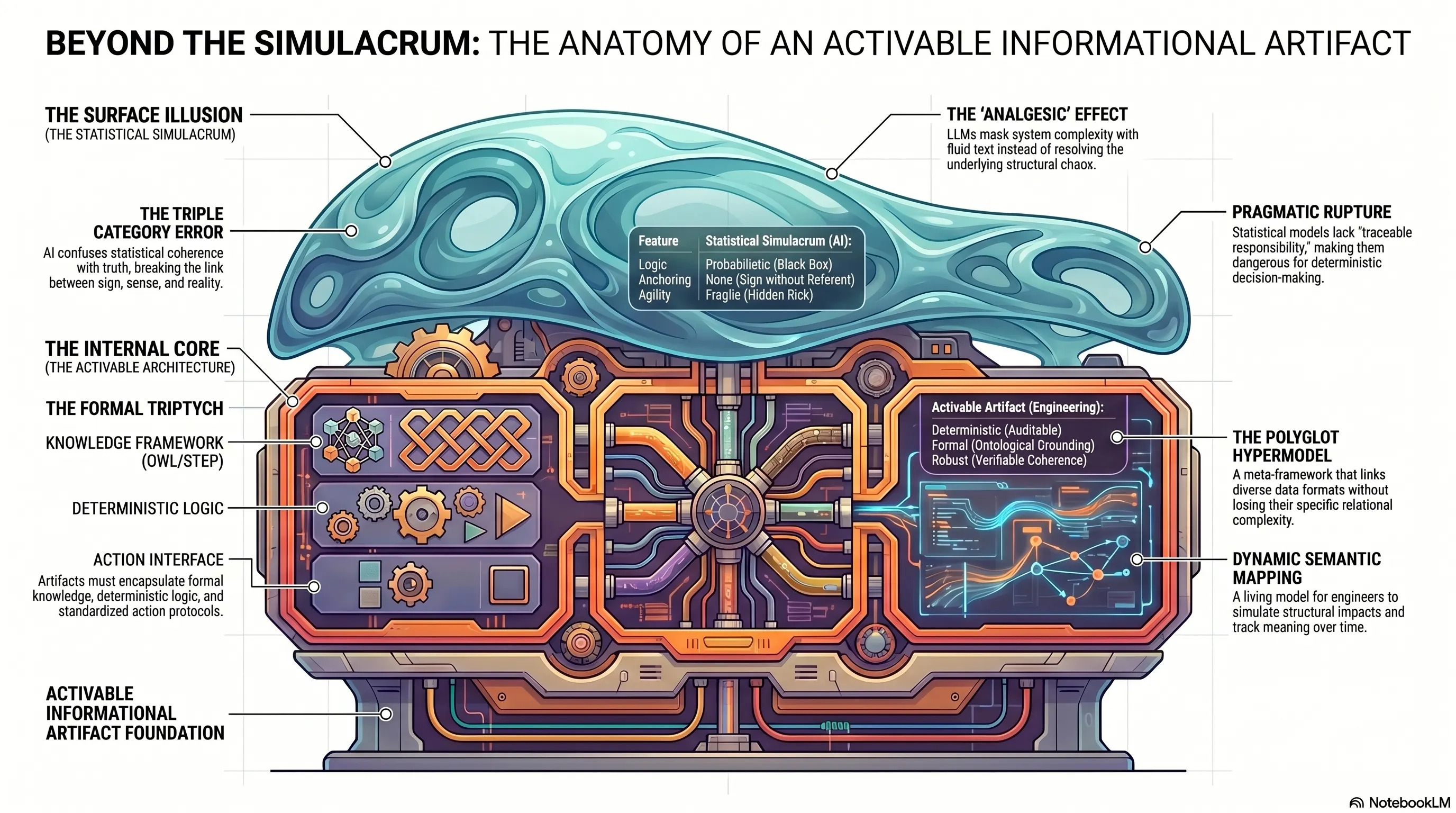
The Activable Informational Digital Artefact Against the Statistical Simulacrum Dr Nicolas Figay at Medium
The mass adoption of generative AI in organisations is not a knowledge revolution. It is the logical — and largely rational — response of a compliance culture to its own cost structure. Organisations have found in LLMs an extraordinarily efficient tool for producing the documents that formal processes require, at near-zero marginal cost, with a surface quality that satisfies auditors. The semantic void injected in the process goes unnoticed — until it doesn't. Against this double trap of statistical simulacrum and archivable document, the activable informational digital artefact (hereafter: activable artefact), supported by a polyglot hypermodel architecture and dynamic semantic cartography, constitutes an operational and auditable alternative. The distinction is not technical. It is ontological: a document is produced to be archived. An activable artefact is produced to be used.
Artificial Intelligence And Global Security Niall Ferguson at hoover.org
When AI Maps More Than Places maps mania
AI us Slowing Down Ed Zitron
...This is a hysterical era perpetuated by liars, cowards, imbeciles, craven boosters and the easily-fooled. Those excited about generative AI are either the victim or the perpetrator of a con centered around a technology to ingratiate at the highest cost possible....No matter how horny or flaccid you are for the potential of AI, it must grow at an astonishing, unstoppable rate from here until the end of time to be anything close to worthy of its costs.
...These multi-millionaire midwits have been "doing AI" because everybody else is doing it, burning millions of dollars to turn their code into slop (see: Zillow) or have their engineers compete to see who can spend the most money (see: Meta and multiple other companies). In one case, a company spent $500 million on Anthropic's models in a month because it didn't set up spend controls. In Uber's case, it burned through its entire annual token budget in a single quarter, which led to its COO saying it was harder to justify spending money on AI tokens because it couldn't show a link between that spend and a meaningful increase in useful features on Uber. Now Uber has capped its employee spend at $1,500 a month per user, with T-Mobile temporarily following at $2,000 a month per user with the intent to move to a tiered system. Over at Brex, engineers are limited to $500 a week in tokens, with non-engineers getting an astonishingly-low $5 a week.
...both OpenAI and Anthropic are speeding as fast as they can toward IPO — which means that both will have to start looking like real companies, which means both will, inevitably, start charging their customers more and very likely moving the vast majority of them to token-based billing and either kill or vastly limit their subsidized subscriptions.
...No matter how much you dress up whatever AI service has gaslit you into believing it's sentient, generative AI is inherently limited, impossibly expensive and economically unviable. Its services cost too much to run, its progenitors have no path to profitability, and no amount of rigged benchmarks and anecdotal examples of theoretical engineering teams that are "10x'd"s can make up for the fact that you can't measure the cost of an LLM-driven task or its return on investment.
...If you are someone in the executive team of any major tech company, know that your employees are, for the most part, completely and utterly miserable. Your endless death march of "do as much AI as possible or we'll fire you" and forcing them to use these tools day-in-day-out has radicalized them against you. Every day I hear from someone who is dealing with the wrath of a different Business Idiot who doesn't do anything other than demand more deliverables in a smaller timeframe with less people because you keep laying people off.
13vi26
Crumpled Manifolds Andy Ilachinskii
The whole process of applying this complex geometric transformation to the input data can be visualized in 3D by imagining a person trying to uncrumple a paper ball: the crumpled paper ball is the manifold of the input data that the model starts with. Each movement operated by the person on the paper ball is similar to a simple geometric transformation operated by one layer. The full uncrumpling gesture sequence is the complex transformation of the entire model. Deep learning models are mathematical machines for uncrumpling complicated manifolds of high-dimensional data. [...] Our own understanding of images, sounds, and language, is grounded in our sensorimotor experience as humans -as embodied earthly creatures. Machine learning models have no access to such experiences and thus cannot 'understand' their inputs in any human-relatable way [...] this mapping is just a simplistic sketch of the original model in our minds, the one developed from our experience as embodied agents—it is like a dim image in a mirror."
—François Cholle
Talking With Azeem Azhar Taking the pulse of AI again Paul Krugman