May 2026 AI links
(continues April 2026 AI links)
4v26
Local AI O'Reilly
Estimating how much text on the internet is generated flowing data
6v26
Am I Meant To Be Impressed? Ed Zitron
9v26
The AI Revolution Nobody Saw Coming: Why Ontology Just Beat Vector Embeddings Aftab at Medium
Palantir built a $80B empire on it. GraphRAG outperforms traditional RAG by 40%. And 78% of companies realize their data isn't AI-ready because they ignored ontologies. Here's how knowledge graphs are rewriting the rules of enterprise AI....Welcome to the ontology revolution. Where structured knowledge beats unstructured vectors, semantic reasoning defeats keyword matching, and the AI systems that will dominate 2026–2030 aren't the ones with the biggest models — they're the ones with the deepest knowledge graphs.
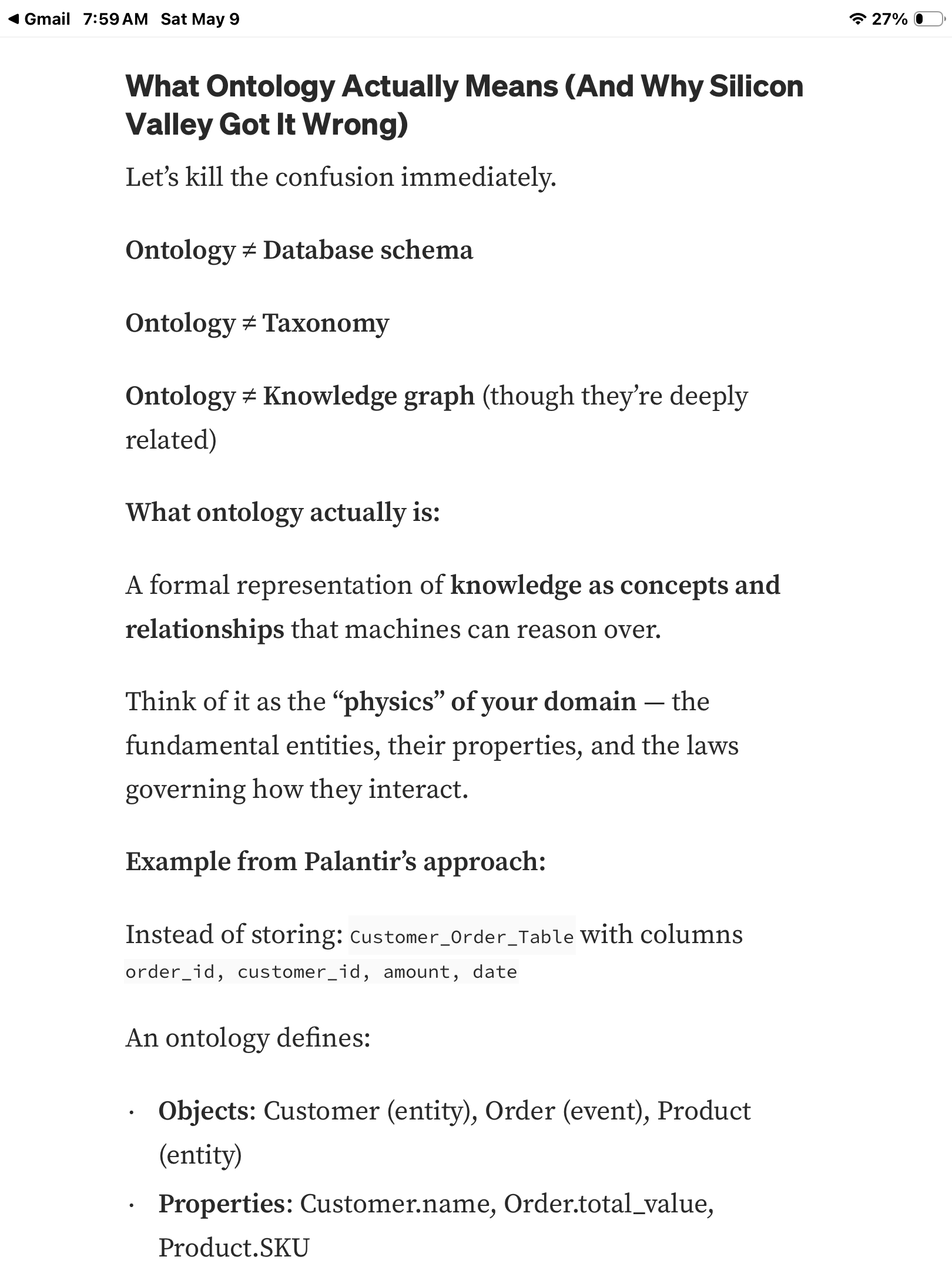
...What ontology actually is:
A formal representation of knowledge as concepts and relationships that machines can reason over.
Think of it as the "physics" of your domain — the fundamental entities, their properties, and the laws governing how they interact.
10v26
Semantic Layers Translate &mdas h;Ontologies Reason — And here is why that doesn't matter for enterprises (for now)! Suresh Kandula at Medium
...This post is to deep-dive from theory to practice from scratch. We will build all the layers of the ontology stack by hand.
Personal Agentry Doc Searls
...In Know your .agent, Esther Dyson suggests that we need a DNS-like registry of AI agents. She and her colleagues at the Agentic AI foundation (agentcommunity.org) have started one, and it has some good premises, such as accountability for AI agents and their operators. .agent is clearly designed—so far—to make Anthropic, Google, Microsoft, OpenAi, Perplexity, et. al. accountable for what their agents do. But what about personal agents: ones that are entirely ours? That's what I would want respected if such a registry were required for all the world's AI agents.
11v26
What Claude thinks of Kevin Kelly's essay about Claude boing boing
13v26
Brain Rot, AI Slop and the Work of Thinking via Stephen Downes
Your AI Problem Is a Data Problem O'Reilly
18v26
When Two AI Giants Clash: LeCun vs. Xing on How Machines Should Actually Understand the World evoailabs on Medium
...The core of the debate revolves around two different philosophies for building "world models" — AI systems that can simulate reality to reason, plan, and think ahead. On one side, you've got Yann LeCun championing JEPA (Joint Embedding Predictive Architecture). His argument is elegantly simple: the world is messy, noisy, and mostly unpredictable. Trying to reconstruct every pixel of a video or every detail of a scene is not just computationally expensive, it's fundamentally misguided. Why waste energy predicting the random flutter of leaves in the wind when what you really need is an abstract representation of the useful stuff — like "if I turn the wheel right near a cliff, the car goes off." JEPA is designed to learn those abstract, predictable patterns and ignore the rest. LeCun calls this ignoring of unpredictables a feature, not a bug. It's how physics works: we don't simulate every molecule of air to calculate lift on a wing, we use higher-level abstractions like pressure and velocity.
Claude Project LiveBook: A Method for Turning Static Books into Interactive Workspaces Mihailo Zoin
19v26
OpenAI Cofounder Andrej Karpathy Joins Anthropic as Sam Altman's Fortunes Turn gizmodo
AI's giant rural job machine mostly appears to manufacture hype boing boing
20v26
Contrarian:
...As AI explodes in size, one option before the federal government is to categorize the hardware and software driving it as a national asset. This could protect citizens from predatory hacking products but also create a grey area around what is and isn't strategic to the national interest. AI-driven identity analysis should perhaps not be in private hands. Other systems may simply make sense to nationalize, like an open-source LLM that could reduce reliance on OpenAI and Anthropic. Regardless, we should expect a shift in power from Washington to Silicon Valley that we haven't seen since defense contractors first set up next to the early chip fabricators in the late 1950's. This comes on the heels of the tech sector's massive investments in the 2024 elections in the form of a move westward of thousands of state and local representatives in organizations like the GovTech Center, headquartered in San Jose.
Musk has shot himself in the foot Will Lockett
..I cannot fathom an AI application that depends on AGI more than Optimus. Not only does this AI need to interpret human commands into real-world actions, which is infinitely more complex than what AI chatbots do, but it also needs to have a human-level understanding and reasoning of the world, how it works, and the aim of the task at hand. Humanoid robots also exist in far more chaotic environments than self-driving cars, and even the simplest tasks they will be asked to do are much more complex, chaotic, and unstructured than driving a car. To put it simply, these robots will encounter exponentially more edge cases than FSD will. Overcoming those hurdles will require human-level reasoning. For Optimus to work as promised and even have a chance of being the commercial success Musk says it will be, it needs AGI....Now, don't get me wrong; AGI is not possible with today's AI technology. We need something totally different, a revolution from the ground up, and a move from statistical extrapolation to actual cognition. We are not even close to being able to create AGI. In a way, Musk is right not to pursue AGI, because as it stands, it is a fool's errand. Had Musk not bet the entire future of his most valuable company on unlocking AGI in the next few years, I would be absolutely fine with him not chasing it. But he has bet the entire future of Tesla on creating AGI in the next few years
...This is especially true for edge cases. These are exceedingly rare scenarios that aren't well represented in the AI's training data. The only thing modern AI systems do is use statistical trends in training data to calculate what the next step should statistically be. This means modern AIs almost always fail on edge cases they encounter, as they don't have enough data to form accurate trends. Individual edge cases are exceedingly rare, but there are practically an infinite number of different edge cases, especially with self-driving cars (since public roads are highly chaotic), so this is quite a frequent problem. This also means that training an AI on data to solve this issue isn't viable, as each individual edge case happens so infrequently that we can't gather enough data. Because FSD has no other systems to help it navigate edge cases safely, it needs to develop human-level reasoning abilities to do so.
Guardian re: Musk vs Altman
..."The trial also served as a reminder of how much the future of AI still depends on a remarkably small group of powerful tech figures and their personal rivalries," said Kreps. "It highlighted a broader disconnect between the people building these systems and many of the people increasingly expected to live and work alongside them."
...enough money to give any positive return to its investors at all rests on its becoming one of three things:They have to do this in a context in which Microsoft, Amazon, Google, and FaceBook have every incentive to keep them from succeeding.
- The lowest-friction provider of and near-monopolist at natural-language coding, analysis and information-management services for the enterprise—The way first IBM and then Microsoft were back in their heyday.
- The lowest-friction provider of and near-monopolist at natural-language information-butler and clown services for the consumer—like Google, FaceBook, Amazon, still to a degree Microsoft, and Apple when iPhone "just works" today.
- The builder of a unique Digital God.
Reuben Steiger
...The economic future of AI also remains far from clear. The basic contours of the financial angle come from the unique nature of AI as a tool that can learn, absorbing knowledge and industries as it goes. The highest valued company today is NVDIA, the dominant manufacturer of the chips on which AI models run, despite a strong case that it and other such hardware companies should have much lower multiples. The relationship between market valuation and enduring profitability also remains an open question from the software side; with OpenAI and Anthropic making noise about going public later in 2026, we may soon know more about the hard value behind the hype.
The Agent Stack Bet O'Reilly
Rethinking the Agent Harness O'Reilly
What's going on in computational neuroscience nowadays? (part 1) via Stephen Downes
...One thing that matters to me: "we find that networks tend toward distributed representations and mechanisms, which make understanding both artificial and biological networks a pain, equally..., the most natural computational unit of the neural network — the neuron itself — turns out not to be a natural unit for human understanding. This is because many neurons are polysemantic: they respond to mixtures of seemingly unrelated inputs."
24v26
Our AI Fears Have Been Confirmed by Will Lockett Will Lockett
There has been this meme floating around the internet for a while about how stupid the 'AI revolution' is. All these tech bros have been loudly claiming that AI will take everyone's jobs and revolutionise the economy. But, as the meme goes, if no one has a job, then no one can buy anything, and the economy collapses. This idea that AI is actually a fatal own-goal for oligarchic big tech has become so common that many have been treating it as true. But we now have evidence to back this notion up.This takes the form of a peer-reviewed paper by economists Brett Hemenway Falk and Gerry Tsoukalas, titled The AI Layoff Trap. In this paper, they created a model that assumed AI automation will make businesses more efficient by replacing jobs previously held by workers, and then saw what played out. It turns out it will create competitive market pressure so intense that individual businesses will be forced to adopt massive AI automation to compete. But this will create mass AI layoffs, which will ultimately eliminate the consumer demand these companies depend upon by destroying the working and middle classes, and so these companies will fail. As the authors put it, each individual business acts ‘logically' in isolation, meeting market demand, but collectively they drive the economy towards systemic failure.
...AI doesn't increase productivity on a business or economic scale. One of the best lines from the Oxford Economics report is when it directly asks, "If jobs are being replaced, where's the productivity surge?" Everyone seems to have forgotten that productivity is something we measure, and if the AI rhetoric is true, that metric ought to be skyrocketing. But it isn't; it is stagnating.
...its use is deskilling us at a remarkable rate. We have known that overexposure to AI in the workplace damages expertise and skill for a while now, thanks to studies like those from JYX and Carnegie Mellon. Even Anthropic found that coders using its tools lost coding skills and comprehension. But researchers and professors are starting to notice a striking, consistent trend in recent findings: workers using AI at work are deskilling at disturbingly rapid rates.
Why is this a problem? Well, thanks to constant hallucinations (which aren't going to stop any time soon, read more here) and shocking high costs, AI can't replace workers. So, this deskilling will inevitably harm the economy.
...AI has also placed a ticking time bomb at the core of our economy too. No AI lab is profitable; they are all running on venture capital and debt. In fact, they have already generated over $1.2 trillion of AAA-rated debt. That not only means that AI is now tied to more debt than banks, but it has also flooded the bond market. A bond is effectively debt sold as an investment. The riskier the debt is, i.e., the more likely the debtor is to default, the lower-ranked it is, with AAA at the tippy top, considered investment-grade, and good enough for our financial system to invest in.
...AI is a massive threat to our economy. However, can we stop pretending that it is because these hollow plagiarism tools are themselves a threat because they are so capable? They aren't; they cannot replace us, and it is moronic to suggest otherwise. The real threat is big tech grifting the stock and debt markets to turn their value into a perpetual-motion machine and, as a result, undermining the financial systems our economy is built on
26v26
Stanford's AI Report 2026: AI isn't going anywhere. Neither are you — if you pay attention Patrick Neeman at Medium
Google has found the AI answer. The web will pay for it Enrique Dans at Medium
...For twenty-five years, Google has trained us to think in the form of keywords. Now it wants us to think in the form of tasks. And that is going to have far-reaching consequences.The search box is no longer a space to enter terms; it's now an expandable, multimodal, conversational, and above all, agentic interface: text, images, videos, files, open tabs, personal context and successive questions that rather than take us to a page, aim to solve something within Google.
...The shift was inevitable. Search quality had been declining for years under the weight of SEO, advertising, content farms, useless comparison sites and a web increasingly written for algorithms over people. Asking AI to read, contrast, synthesize and allow successive prompts is an obvious improvement. We don't want ten blue links: we want to understand, decide, compare, monitor, buy, book, schedule, learn or act. Google isn't "adding AI" to search: it's acknowledging that search, as we knew it, is no longer enough.
...it is no longer the intermediary that channels attention to the web, but the environment where that attention is captured, processed, and monetized. The web ceases to be a destination and becomes a raw material. A user, on many occasions, does not want a specific search, but an agent who notifies them when something related to it arises.
...The problem is that the ecosystem that powered Google for two decades wasn’t designed for this. Publishers, media, blogs, forums, creators, databases, specialized pages and experts accepted the implicit pact: Google indexed, ordered and sent traffic; the producers of information received visits, reputation, subscriptions, advertising or customers. That pact is broken when Google synthesizes the answer and reduces the incentive to visit the source.
...Socially, the change is even more profound. The traditional search, for all its defects, forced users to compare sources. The user saw origins, biases, brands, dates, styles, contradictions. The agentic search tends to hide this process under a polished, plausible and comfortable answer. That can reduce friction, but it can also reduce information literacy. A society that delegates the search also delegates part of its criteria. And when that delegation is concentrated in a single company, the risk is not only technological: it is epistemological.
28v26