Episteme ...just a kitted-out lab space in San Francisco to support 15 scientists following their curiosity in fields from artificial intelligence to biotech, with no need to worry about grant proposals or journal articles.
CEO Louis Andre is confident the gamble will pay off. He thinks world-changing, profitable ideas can emerge from basic research, as long as scientists are freed up from hassles. "Profit should be a byproduct," says Andre, a startup veteran with a background in neuroscience and computer science. He says he founded Episteme after a series of conversations with Altman. "The main focus should be impact. When you do great science, commercialization opportunities will emerge."
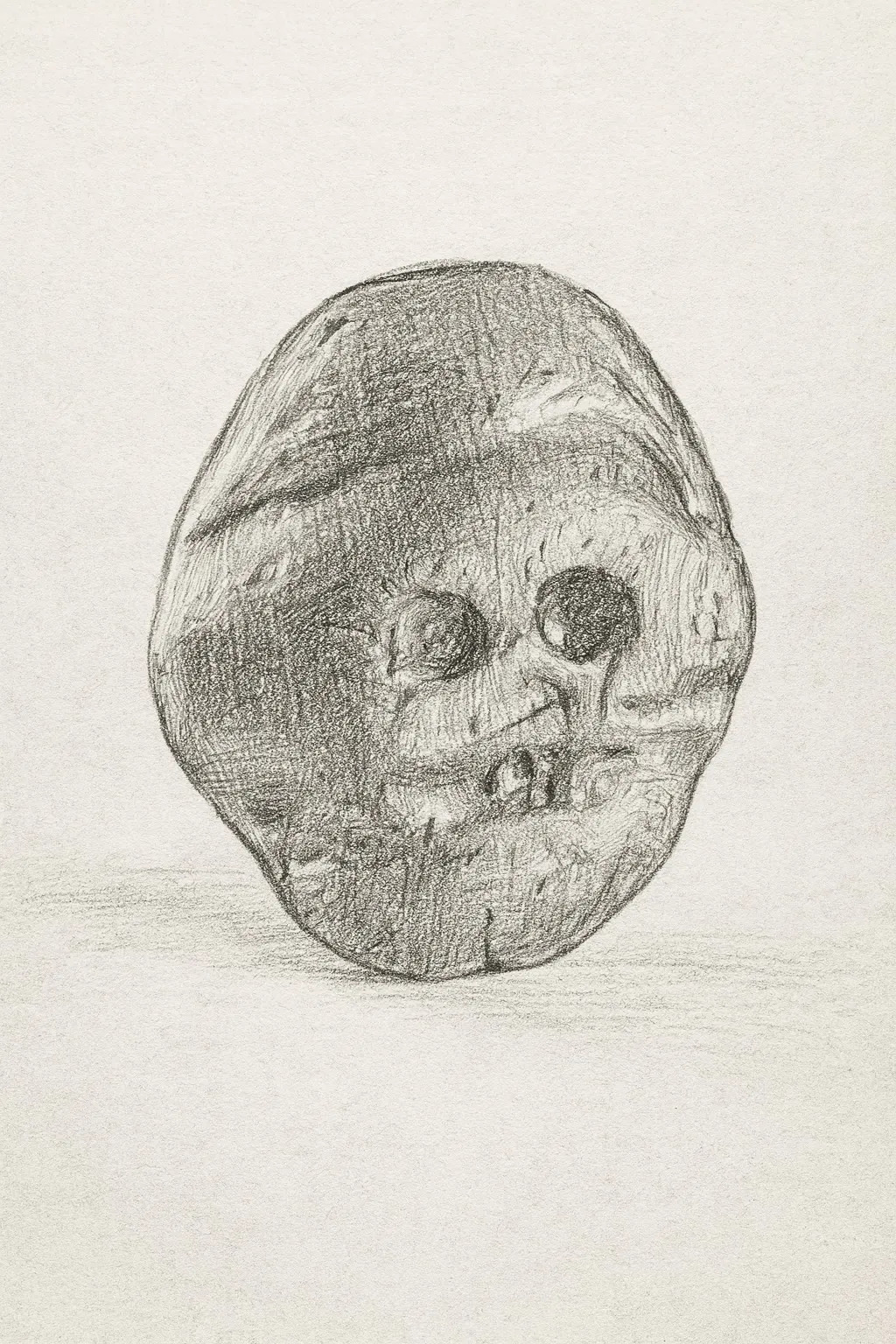
That term-of-art "Every Day Carry is a neologism from digital social media, but the weirdness is prehistoric. The term-of-art from archaeology would be "manuport." A "manuport" is some hand-carried knick-knack, a small shiny object, commonly a pretty rock, that somebody saw and grasped. They picked it up, by hand, and lugged it a long distance, just because they were happy to look at it, and they wanted it in their hand.
[the Makapansgat Pebble]
...Multitool modernity began when the Cold War ended, with a direct, globalizing collision of Oregonian capitalism with Eastern European material culture. This is the much-repeated, heroic origin-story of a young American technical genius, Tim Leatherman. Tim aspired to fix a broken Communist world with one multiplex gadget from his own pocket. A scheme which sounds weird to the point of megalomania — until you actually are an American in Eastern Europe. In which case, I can personally testify that it makes perfect sense to lug Leatherman "survival tools" everywhere, every day.
Historically speaking, as functional artifacts, those spikey, hingey, ultra-compact Leatherman "survival tools" are intensely eccentric little machines. It took eight years from their workshop-invention for them to find customers and a user-base. But those "survival tools" certainly did survive. These surviving tools successfully pried and chiselled-open their own Overton Window. They more than survived, they prevailed, and every similar tool-set in their product sector has been re-conceptualized, and standardized, and made mundane, and feels commonplace now. They made the weird everyday — even though "folding knives" are prehistoric.
The philosophy of mind has been stuck in a dead end for centuries. Dualistic positions that start from two ontologically separate realms create insoluble interaction problems: How can the immaterial affect the material? Reductive positions that want to eliminate mental terms or reduce them to neuronal processes fail in practice: psychologists, psychiatrists and everyday speakers successfully use mental terms without entering into metaphysical obligations.
The way out of this dilemma does not lie in another ontological position, but in a clarification of the levels of use. We must distinguish between ontological obligation (what really exists?) and semantic practice (which terms do we use?). This distinction allows for a position that is ontologically monistic and semantically dualistic.
Owned: How Tech Billionaires on the Right Bought the Loudest Voices on the Left ...The book primarily traces Glenn Greenwald's career as well as Matt Taibbi's career, and in parallel talks about the Silicon Valley billionaires who are behind the Tech-Right movement that currently has taken over a lot of conservative politics in the US, and the book looks at these parallel tracks. When we get to around 2020 or so, they converge. The argument of the book is really looking at how the Silicon Valley right-wing were able to buy up the alternative media ecosystem and create something where they were able to take it over, and in doing so, provide the opportunity for people like Greenwald and people like Taibbi to make money on these platforms. Which then came with its own incentives to continue to flatter and work toward the interests of this cohort.
...In 2016, when Trump was elected, the part of the backlash to that election from the liberal mainstream and the Democratic Party was to look for reasons that this might have happened. One of the reasons that they really latched on to was social media, and social media are these companies that are controlled by these very powerful people in Silicon Valley, and they didn't particularly care for being criticized, particularly Andreessen, who already was shifting to the right, and got really angry about this.
Musk got annoyed—he didn't own Twitter (or X now) at the time—but he started to slowly kind of shift to the right. Thiel brought all of these billionaires, these tech guys in to meet Trump right after he got elected. Which, by the way, it's not conspiratorial, that's very normal for industry, you want to meet with the person who's in charge. I don't think that there's anything particularly evil about that, or anything to look for that is conspiracy. But these guys had all been criticizing Trump in the lead up to that and then all met with him, didn't mention any of the things that he was going to do that were offensive, etc.. They worked with him.
...you follow the careers of several people, but I think the Greenwald may be the centerpiece, Taibbi in second place, and then I don't know what we call it now, but New Age Journalism—the partially-online world of journalism that emerged maybe 15 or so years ago—and it is interesting that the two guys you profiled in particular were at least celebrities on the left and both deny that they've actually turned right, but in practice are doing that.
...For nearly three decades, I stayed current with all things digital. But about ten years ago, I started pulling back. At first it was more of a vibe — I didn't like how the digital world was starting to feel. Insistent, needy, demanding. I'd worked for most of my life inside digital spaces, but before the web went world wide, digital was more of a solo act. You, the "user," were in charge. You decided which applications to pay attention to, which documents to read or write, which sites to visit. That was starting to change, and it didn't feel right.
...my first prediction for 2026 — the decline of the feed. The algorithmically induced sugar sludge that has dominated culture for more than ten years is failing, and 2026 will be the year most of us notice that trend. And the company that will be most impacted? Meta and its flagship Instagram app... I think the entire model of "push" is abhorrent, and 2026 will be the year society starts to agree. Good riddance, and RIP.
...At death, Epstein owned approximately $600 million. From where?
Officially: financial consultant for very rich. In reality: two clients entire career. And strange schemes.
Les Wexner, Victoria's Secret founder. Paid Epstein about $200 million from late 1980s to 2007.
Epstein got full power of attorney over all Wexner's finances. Managed trusts. Bought real estate worth tens of millions. Hired and fired Wexner company employees. Had access to everything.
Epstein poses as Victoria's Secret 'talent scout." Invites model Alicia Arden to hotel. Touches her. Asks her to undress.
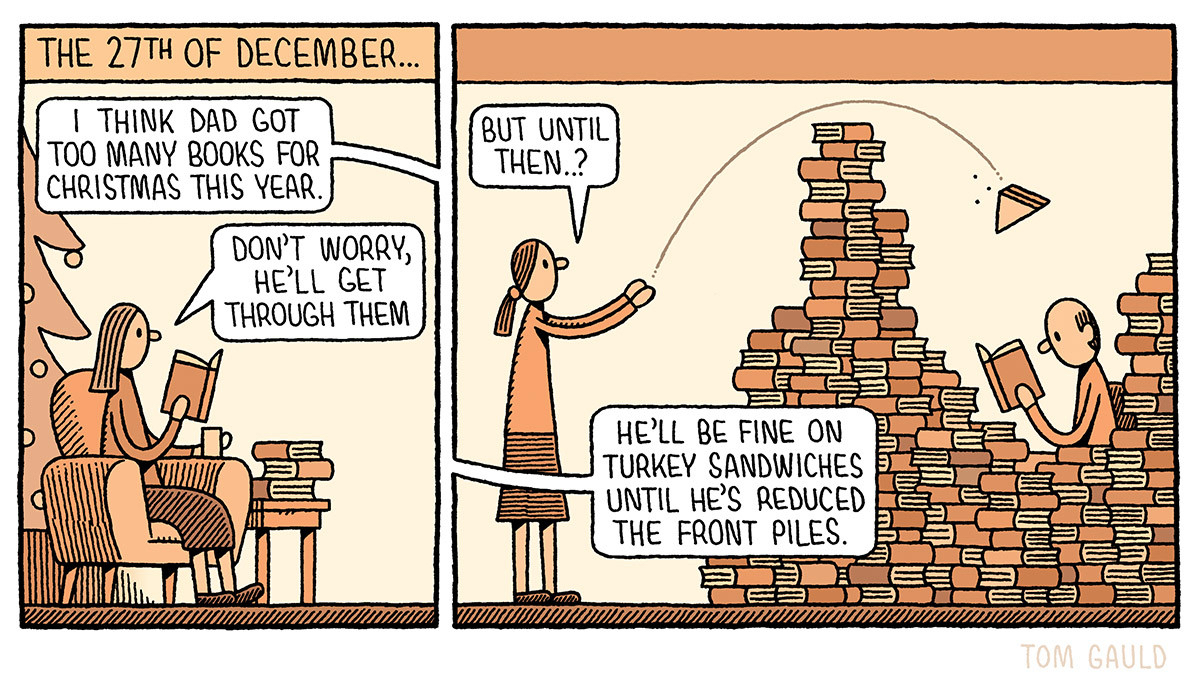
...Tsundoku Wikipedia: the phenomenon of acquiring reading materials but letting them pile up in a home without reading them. The term is also used to refer to unread books on a bookshelf meant for reading later.
...the Zhuangzi presents fundamentally different critiques of language, each rooted in different ontological premises, employing varied rhetorical strategies, addressing specific audiences, and carrying unique significance in the intellectual history. By exploring the heterogeneity of its theories of ineffability, the paper shows that the Zhuangzi's treatment of the ineffable dao is more complex than a mysterious assertion of the unspeakable and calls for a nuanced understanding of the role of language in conveying the ultimate truth
The theorization of ineffability is a central philosophical theme in the Zhuangzi, evident in its recurring mention and the diverse modes of its argumentation. ...By exploring the heterogeneity of its theories of ineffability, the paper shows that the Zhuangzi's treatment of the ineffable dao is more complex than a mysterious assertion of the unspeakable and calls for a nuanced understanding of the role of language in conveying the ultimate truth.
No Congressional approval. No public warning. No debate.
The US military invaded Venezuela, captured the president, and Trump announced at a press conference that America will now run the country "until we figure things out."
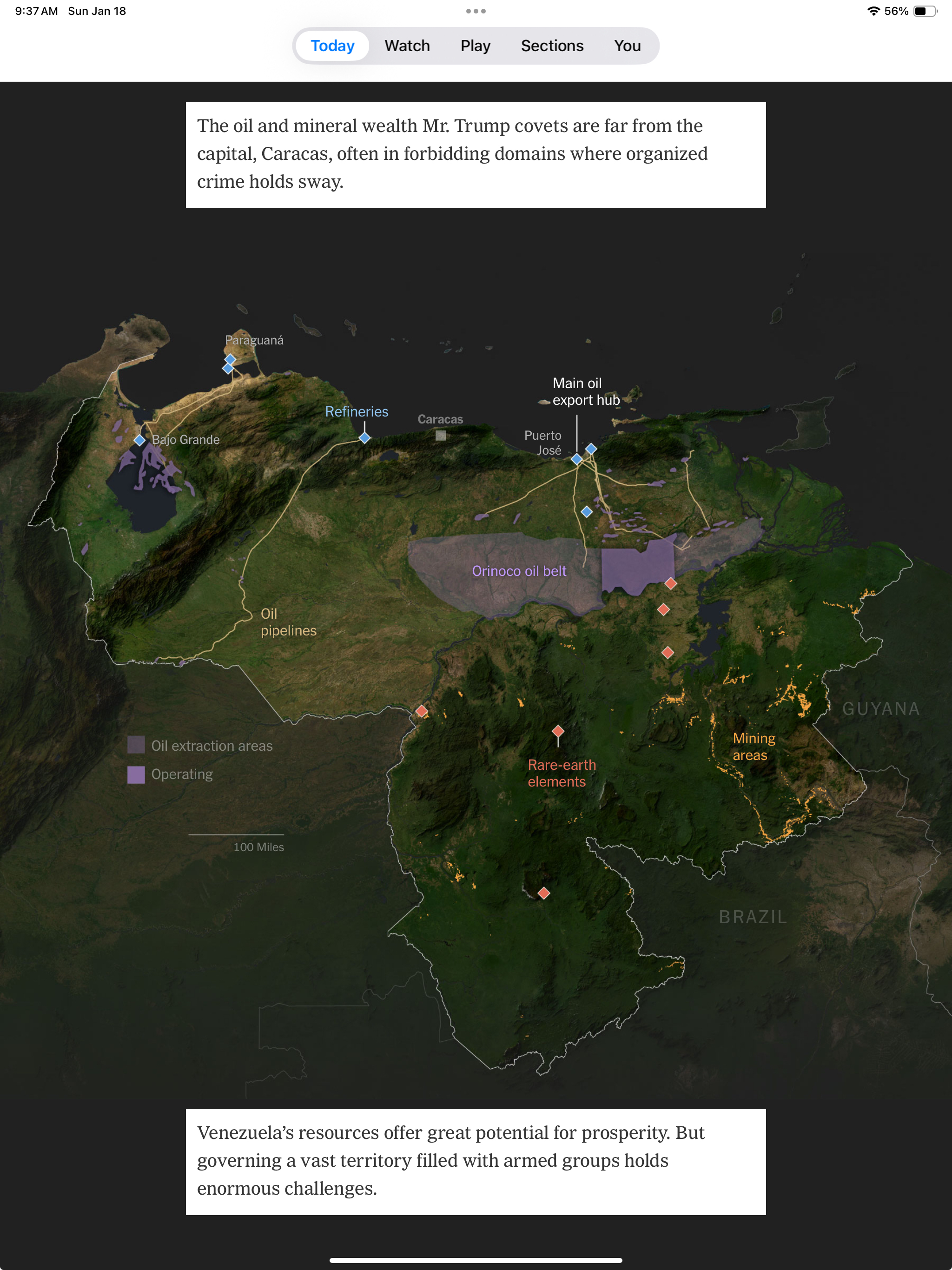
...Rare earth elements are not, it turns out, especially rare. They are, however, very difficult to extract and refine.Moreover, refining them is a highly polluting process. But they have unusual electrical and magnetic properties that make them essential to modern technology.
China has been subsidizing and promoting its rare earth industry for decades. Other countries, confronted with low prices and wary of pollution, have in many cases abandoned the industry. In 2024 China accounted for 92 percent of worldwide rare earth processing.
And in 2025 China weaponized its dominance of rare earths. When Donald Trump started his trade war, he probably imagined that America, which buys much more from China it sells to China, had the upper hand. But China responded by restricting exports of some crucial rare earths, posing a real threat to U.S. national security and U.S. advanced technology. And the U.S. had no easy response: We have rare earth deposits, but it would take years to build a domestic industry capable of replacing imports from China.
...What you just experienced — the strawberry-ness of strawberry, the red-ness of red — these are qualia. They're the felt qualities of consciousness, the subjective textures that make experience more than just information processing. They're what makes you you rather than a very sophisticated computer.
Scientists can tell us everything about strawberries. They can map the exact molecules that trigger your taste buds, trace the neural pathways that fire in your brain, even predict your facial expressions when you taste something sweet. But there's one thing they can't capture: what it actually feels like to experience that sweetness.
This is the famous "hard problem of consciousness." We can explain all the mechanics of how a brain processes information, but we can't explain why there's something it's like to be conscious. Why isn't it all just happening in the dark, with no inner experience at all?
You are holding your newborn in your arms and gazing into their beautiful eyes; you're waiting in an airport for a family member to return from a year-long trip and suddenly see them walking towards you; or you are sitting in a sports stadium as your team holds its trophy after years of struggle. In each case, you feel a profound sense of connection swell up inside you, your skin breaks out in goosebumps and your eyes fill with tears.
Sound familiar? You may not know the term, but that feeling is "kama muta", a newly named emotion that is of increasing interest to psychologists. It marks some of the most important moments in our relationships with our family, friends and the wider community. By consciously seeking out opportunities to provoke this feeling, you could imbue your life with greater meaning and enhance your sense of social connection.
...As rich as the English language may be, we simply don't have a single term to cover these experiences. As a result, we often fail to recognise the shared characteristics of the emotion across different situations. "That's the radical argument that we're making," says Fiske. "That it is the same emotion."
He and his colleagues borrowed a term from Sanskrit: kama muta, which means "being moved by love". "The Sanskrit phrase just seemed so poetic," says Fiske.
I can't help being struck by the frequent mixing together of interesting dasta with tendentious interpretive claims
quotes Yellowbull:
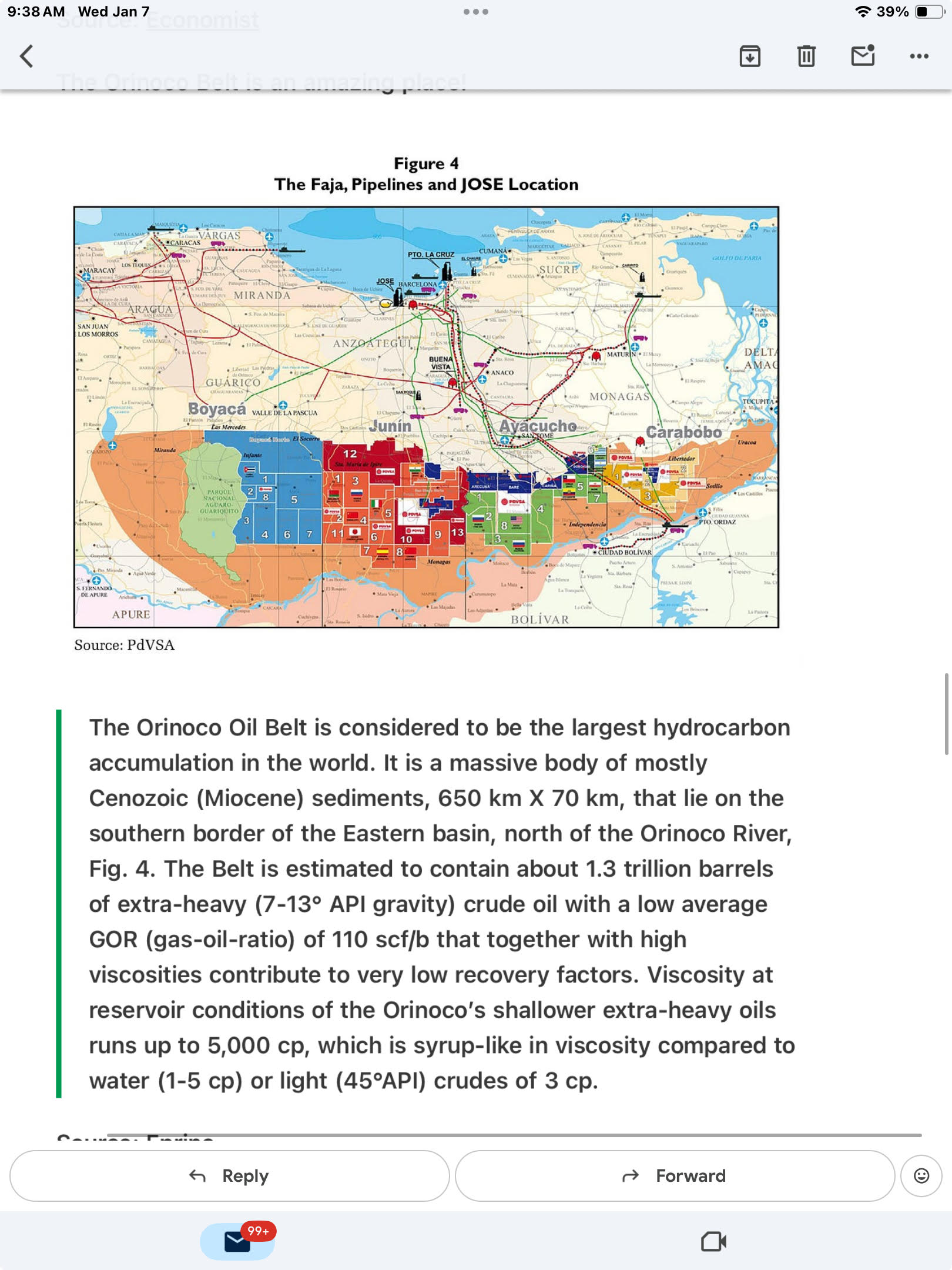
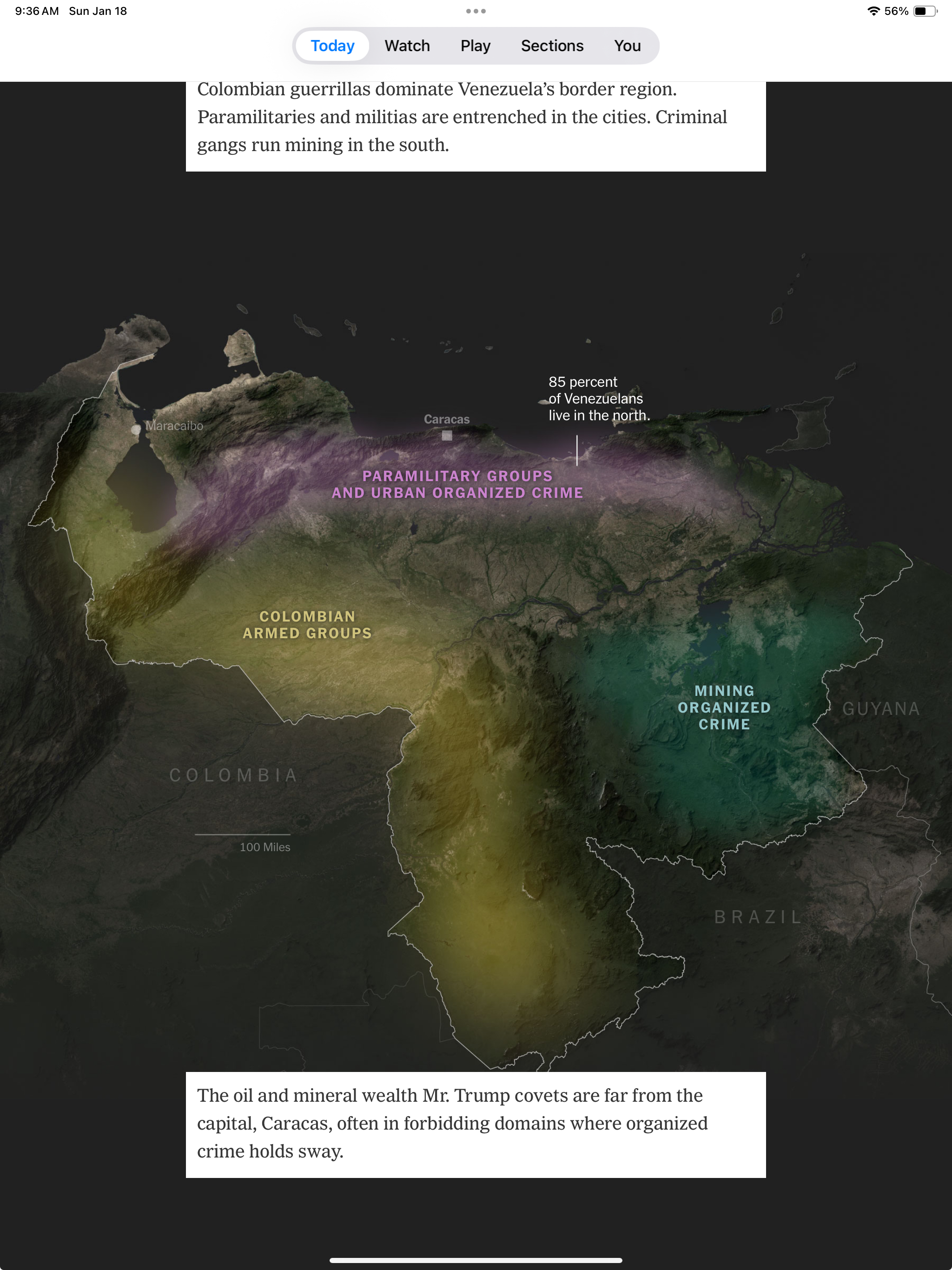
There has been lots of talk about the current situation in Venezuela and what it could mean for global oil markets, so I just wanted to provide some nuance on this When people say "Venezuela has the world's largest oil reserves," as you undoubtedly have seen being thrown around a lot on here, they are technically referring to a specific accounting definition, not to a stock of easy, cheap barrels ready to flood the market. To unpack that, you need to get into what those reserves are, how they behave in the subsurface, what it costs to turn them into marketable liquids, and how price, technology, and above-ground risk interact. That's a lot to cover, but let's give it my best shot. On paper, Venezuela has roughly 300–303 billion barrels of proved reserves, about 17 % of the global total and slightly more than Saudi Arabia. The critical detail is that around three quarters of that booked volume is extra-heavy crude from the Orinoco Belt in eastern Venezuela. These are bitumen-like oils with API gravity typically in the 8–14° range, extremely viscous at reservoir conditions and with high sulfur and metals content. So the statement "largest reserves" is really "largest booked volumes of very challenging heavy and extra-heavy oil." Technically recoverable versus economically recoverable is the first big distinction. The USGS has long estimated that the Orinoco Belt contains on the order of 900–1,400 billion barrels of heavy crude in place, with perhaps 380–650 billion barrels technically recoverable using existing technology. Venezuela and OPEC only book a subset of that as "proved," but even those proved numbers are sensitive to the assumed oil price and development concept. When prices were strong in the 2005–2014 window, a large portion of Orinoco volumes became economic on paper and were reclassified as proved, driving the headline reserves from ˜80 to &tilde300 billion barrels. Geology and fluid properties are the second big differentiator. Orinoco crudes are extra-heavy, with densities up around 934-1,050 kg/m³, high asphaltene content and sulfur on the order of 3–4 wt% or more, depending on the block. This is a completely different animal from a 33-40° API, low-sulfur Arab Light-style crude. In plain English, that means it's much harder to handle at various stages and each step adds capex, opex and energy use. In other words, the “barrel in the ground” in Venezuela is inherently worth less and depends on a narrower set of buyers. Surface systems and institutional capacity are another constraint. Before the 2000s, PDVSA had a reputation as a technically capable NOC. Since then, you have had a combination of mass layoffs and politicization, under-investment, sanctions, corruption and brain drain. The result is decayed gathering systems, chronic power shortages, refinery fires and upgrader downtime. Finally, integration with global refining and logistics matters for strategic value. Venezuela's crude slate is optimized for complex "coking" refineries in the US Gulf Coast, parts of Asia and a few European plants. That's a story for another time though, because the length of this analysis is getting out of hand. So when you hear that Venezuela has "the world's largest oil reserves," the technically accurate part is that the country has extremely large volumes of extra-heavy oil in place, and a big subset of that was once judged economically recoverable at high price assumptions and booked as proved. The more relevant questions for energy strategy are how many of those barrels are genuinely economic under realistic long-term prices, how quickly they can be brought onstream given infrastructure and institutional constraints, what netback they deliver at the refinery gate, and how exposed they are to being left in the ground if demand peaks. On those metrics, Venezuelan barrels sit much further out on the cost and risk curve than the headline “largest reserves” soundbite suggests.
...If I were to make a big noisy claim it would be that the entire exercise has less to do with actual resource imperialism than Trump's feckless reality TV Cosplay resource imperialism. He likes demonstrative acts of violence. He likes to claim immediate economic paybacks. He singled out Venezuela in his first term. He has come back for more.
If you pushed me further I would say that the Trump administration appears to be serious about the Monroe ... sorry Donroe ... doctrine in the Western hemisphere. Could this be a prelude to an overt spheres of influence deal with China, Russia and Saudi-UAE-Qatar-Israel ... possibly?
What next? It does strike me as plausible that there could be a faction around Marco Rubio whose real target for actual regime change is Cuba (note the Cubans killed in the US operation) rather than Venezuela.
...If the weaponised car was the tool of modern terrorist violence in the 20th century, the hobby drone could be its postmodern equivalent in the 21st century.
...Commercial hobby drones are used peacefully by thousands of hobby enthusiasts, and even by humanitarian aid and disaster reliefsupport by nongovernmental organisations and activist groups. The China-based Skywalker Technologies company told the Financial Times: "As a manufacturer, we are unable to control what people do with them similar to the manufacturers of pick-up trucks, cars or other items that have been weaponised in conflict zones."
...Under the pressures of invasion, Ukraine has become a fast-feedback, live-fire test range in which arms manufacturers, governments, venture capitalists, frontline units and coders and engineers from around the West collaborate to produce weapons that automate parts of the conventional military kill chain. Equipped with onboard proprietary software trained on large data sets, and often run on off-the-shelf microcomputers like Raspberry Pi, drones with autonomous capabilities are now part of the war's bloody and destructive routine.
...In repeated visits to arms manufacturers, test ranges and frontline units over 18 months, I observed their development firsthand. Functions now performed autonomously include: pilotless takeoff or hovering, geolocation, navigation to areas of attack, as well as target recognition, tracking and pursuit — up to and including terminal strike, the lethal endpoint of the journey. Software designers have also networked multiple drones into a shared app that allows for flight control to be passed between human pilots or for drones to be organized into tightly sequenced attacks — a step toward computer-managed swarms. Weapons with these capabilities are in the hands of ground brigades as well as air defense, intelligence and deep-strike units
The problems were many. As more drones took flight, both sides developed physical and electronic countermeasures. Soldiers erected poles and strung mesh to snag drones from the air, and they covered the turrets and hulls of military vehicles with protective netting, grates or welded cages. Among the most frustrating countermeasures were jammers that flooded the operating frequencies used for flight control and video links, generating electronic noise that reduced signal clarity in pilot-to-drone connections. The systems became standard around high-value targets, including command bunkers and artillery positions. They also appeared on expensive mobile equipment, like air-defense systems, multiple-rocket launchers and tanks.
...history keeps reminding us that food is never just food. Grain has always moved across fragile lines, and when those lines bend, people feel it long before anyone can fully explain why.
Moments like this have happened before. Harvests depended on shipping lanes, shipping lanes depended on politics, and politics depended on everyone pretending things were stable. Those stories often get tucked into textbooks. They don't sound urgent until they rhyme with the present and start showing up in ordinary life.
What we're living through now fits that pattern. Leaders talk about global food security as if it were a distant policy puzzle. For families, it appears as a slow heaviness in the grocery aisle — a quiet sense that something upstream is strained, even when the shelves still look full.
...Ports, rail lines, storage tanks, insurers, and ships have to move in rhythm for the wheat supply chain to function. When that rhythm breaks, grain export disruption shows up first as friction, not disaster. Ships wait. Costs rise. Routes shift. The chain can absorb some shocks, but not all — and it's rarely obvious at first which ones matter.
...Once shipping delays and reroutes stack up, effects move quietly through contracts, inventories, and negotiations. Port infrastructure damage doesn't erase the wheat — it simply makes moving it slower and riskier. Maritime insurance costs rise, and eventually those costs land somewhere, though it may take months to notice.
You really have to hand it to teachers this year. And by hand it to them, I mean hazard pay, a therapist, and a weighted blanket shaped like a burrito. Teaching today is like trying to run a book club while someone keeps setting the library on fire and yelling, "WHY ARE YOU WOKE?"
It's all too much. Teachers are now expected to educate children while also dodging the purity police, bullets, censorship, constant surveillance, and a guy with a podcast who thinks the Roman Empire fell because of pronouns. They can't say certain words, assign certain books, or acknowledge that history happened on weekdays.
Meanwhile, kids are screaming "SIX SEEEEVEN" during algebra like it's a sacred chant. Teachers are begging for mercy. No one knows why it's funny. Not even the kids.
...If you've missed it, "6-7" is a nonsense phrase repeated whenever someone says "six" and "seven." It's mostly taken hold among Gen Alpha and the younger edge of Gen Z, and it's far more offline than the internet commentary would suggest. There is no definition, and no agreed-upon origin story. Mention it in the wrong setting, and a roomful of kids will erupt like a flash mob that forgot the choreography but kept the enthusiasm.
...Gen Alpha's rupture with meaning is quieter and more visceral. They are growing up in a world where nothing feels stable, and adults are visibly panicking while insisting that everything is fine. But the threat isn't a single catastrophe; it's the sense that every word can be monetized, psychoanalyzed, weaponized, or screenshot and resurrected out of context. No wonder meaning has become risky.
...By now, everyone knows what social media does to the brain, but we refuse to fix it. All the research says the same. Social media doesn't just connect us; it trains us. Likes, notifications, and endless feeds turn attention into a slot machine, doling out tiny, unpredictable rewards just often enough to keep us pulling the lever.
That doesn't mean doomscrolling or TikTok are self-harm, and it doesn't mean every moment in front of a screen is destructive. But it does mean our addictive brain learns to expect small hits of validation and novelty as the default. And when everyday life can't deliver that level of stimulation, you reach for whatever feels available.
Adults keep asking: What does 6-7 mean?
The kids keep answering: It means we're still capable of shared experience in this shit-stain world you left us with.
...when everything feels on fire, when the future feels pre-sold, when sincerity gets exploited, and irony becomes armor, yelling nonsense together isn't avoidance. It's a reset button. A return to ground zero. A way of proving, if only for a moment, that in our increasingly disconnected world, we can still shout one phrase and instantly become connected.
Think about all the things that give you global scale online:
The Internet
The Web
Email
RSS
Cash
Credit
Every loyalty, membership, and rewards program
Every subscription
Every account with a login and a password
Every system with its own private ways to manage you, control you, keep you locked in
And now think about how much business the latter system prevents rather than enables.
...South Park alum writer Toby Morton grabbed the TrumpKennedyCenter.org URL to launch a laugh-out-loud parody site. ("Here, tradition is preserved, narratives are curated, and performances are elevated beyond mere art. What is remembered matters. What is omitted matters more," Morton deadpans. "We invite you to experience culture as authority, pageantry as truth, and excellence as defined by those in power.") Taunting the autocrat on the very ground he claims exemplifies why humorless despots like Trump fear an independent arts community. "We exist to preserve what must endure, to honor what must not be questioned, and to gather those who understand that greatness is not chosen, it is recognized," Morton dryly intones.
...The only diplomacy Trump will now employ is either gunboat diplomacy or diplomacy as deception before an actual war.
Since there was no pushback by his allies, domestic or foreign, after he bombed Iran, Trump is like a tiger that has tasted human blood. The American President's lust for mayhem and regime change was whetted rather than sated.
He will murder foreign leaders much like Israel does now, which will invite the murder of Western allies by geopolitical rivals.
Trump will attempt and most likely succeed in taking Greenland. He spent the last 48 hours trolling his Western allies about annexing it.
Yet, outside of statements that Greenland is a semi-autonomous part of Denmark, none of these governments brought in the US ambassador for a dressing down over their President's bellicosity.
It gives me the sense it's a fait accompli.
It's academic if he really needs to annex Canada.
Politically and economically, the nation's elite will happily occupy the role of Vichy France to Hitler's Germany as long as they are provided with the illusion of power and the substance of wealth.
But if it were annexed, it would go like Austria to Hitler in 1938 without a shot being fired.
My predictions are that Canadians, like those 1930s Austrians, would be the most fervent supporters of fascism and being citizens of the Empire.
...You may have heard that Venezuela has the world's largest oil reserves — 300 billion barrels. You probably don't know that Venezuela's reported oil reserves tripled while Hugo Chavez was president. This increase, from roughly 100 billion to 300 billion barrels, didn't reflect major new discoveries or exploration. Instead, it reflected the Chavez government's decision to reclassify the country's Orinoco Belt heavy oil as "proved" — oil that can be recovered with reasonable certainty under existing economic and operating conditions:
///As Torsten Slok of Apollo, who recently made this point, notes, "Much of the oil is extra-heavy, which has low recovery and a high cost to produce." This suggests that Venezuela's claims to have immense usable oil reserves were politically motivated hype.
This view is supported by the fact that the huge increase in Venezuela's reported oil reserves wasn't followed by a surge in production. On the contrary, Venezuelan oil production soon plunged.
...Plunging production was associated with a steady degradation of Venezuela's oil infrastructure, which would take years and many billions of dollars in investment to restore. Given these costs as well as political instability, major oil companies clearly aren't enthusiastic about the idea of sinking money into Venezuela.
On Monday Trump suggested that he might reimburse oil companies for investment in the nation he claims — with no basis in reality — to control, reimbursing them for their outlays there. That is, we've gone in a matter of days from big talk about huge money-making opportunities to a proposal to, in effect, subsidize oil-industry investments in Venezuela at U.S. taxpayers' expense.
Which is not to say that nobody has profited from the abduction of Maduro. A few months ago Trumpist billionaire Paul Singer bought Citgo, the former U.S.-based arm of Venezuela's state-run oil company. Citgo owns three Gulf Coast refineries custom-built to process Venezuelan crude, refineries that have suffered from the U.S. embargo on imports of that crude. If Trump lifts that embargo, Singer will receive a huge windfall. But this windfall will have nothing to do with reviving Venezuelan production.
Singer has made huge political donations to Trump, raising questions about how much he has influenced policy. His purchase of Citgo was also remarkably well-timed. What did he know?
(quotes Bloomberg( ...Having de facto control of the Western Hemisphere's petroleum wealth is a geopolitical game changer. For decades, US military adventurism was constrained by the impact of any war on energy costs. Today the White House has primacy over oil-producing allies and adversaries alike — whether it's Saudi Arabia or Iran, Nigeria or Russia. The past 18 months have already shown what these new hydrocarbon riches mean for US foreign policy. Trump's administration has taken once unthinkable steps: from bombing Iranian nuclear facilities to helping Ukraine target Russian oil refineries. Grabbing Nicolas Maduro from his safehouse in the outskirts of Caracas was the most shocking example yet of what happens when oil doesn't constrain the Pentagon anymore. And seizing Venezuela's oil gives the US another card: the ability to decline offers for access to petroleum riches. For months the Kremlin has dangled its own reserves as a carrot in talks with the White House. Trump can now tell Vladimir Putin he doesn't need his Siberian fields. He has more than enough. Don't give Trump all the credit, or even most of it. He's in power at the right time. American oil would be booming without him thanks to the riches of US shale, Canadian heavy oil and discoveries in places like Brazil and Guyana. Ex-presidents Joe Biden and Barack Obama benefited, too. What Trump has done is pull all of that petroleum under Washington's security umbrella.
...two years ago Harvard researchers published the first nanoscale map of one cubic millimeter of human brain. Packed into that poppy-seed-sized sample were 150 million synapses, 57,000 cells, 230 millimeters of blood vessels, and a wondrous diversity of structures never seen before. Researchers elsewhere have completed connectomes for the fruit fly and zebrafish. The next grand challenge is one for the mouse. To build these maps, scientists have relied on a technique known as serial-section electron microscopy. It entails shaving samples of brain tissue into thousands of ultra-thin sections, which are then scanned and imaged by powerful electron microscopes. Next the images are stacked on top of each other to create 3D digital replicas. For example, that one cubic millimeter of human brain tissue published in 2023 was sliced into more than 5,000 sections, each thinner than one-thousandth of a human hair.
...There is rage simmering under the surface, and it is earned. Productivity rose. Profits exploded. Executive compensation ballooned. Worker pay limped behind, tripping over rent increases and medical bills. Families earning what used to count as solid money now juggle costs like circus performers, hoping nothing slips. One unexpected bill can still wreck a month. Two can wreck a year
...We are told this is the new normal and that responsible households just need better budgeting habits. That line lands like an insult. You can skip lattes, pack lunches, cancel streaming services, and still drown. The math does not work anymore, and it was not designed to. The old rules assumed guardrails that no longer exist. Wages were meant to track productivity. Costs were meant to rise slowly. None of that survived the profit frenzy
...Enhanced ACA subsidies expired on December 31, 2025. Millions leaned on those credits to keep coverage affordable. Their disappearance lines up neatly with geopolitical theater and quiet signals from insurers that 2026 pricing will sting hard. Convenient timing has a way of repeating itself in American policy, always landing on households least able to absorb the blow.
...Healthcare in this country was never meant to be universal. It was meant to be profitable. Rising premiums are not a glitch. They are the business model doing its job. Insurers talk about risk pools and actuarial tables as if families live on spreadsheets. Climate disasters, hospital consolidation, and pharmaceutical price games get folded into premiums, then passed straight down to households.
...Wage garnishment turns employers into debt collectors and households into collateral. Miss a payment and the system reaches straight into your earnings. This is not rehabilitation. It is extraction with paperwork. Garnishment does more than shrink paychecks. It wrecks credit, triggers bank fees, and pushes families toward higher-interest debt just to survive the month.
...Everyday people did not design this system. They did not engineer predatory lending, privatized healthcare, or climate-exposed housing markets. That work belongs to elites, corporate boards, and politicians who trade public pain for private gain. The consequences land downward. The profits float up.
...Freshman comp was always a machine for turning out reliable sentence-makers, not an atelier that trained reliable sense-makers. But AI changes the dynamic. Today, students are asking chatbots to write their essays for the same reason that corporations are asking chatbots to do their customer service (because they don't give a shit)
...The Indian dog, Indie dog, South Asian dog, or Desi Kutta, is a landrace of dog native to the Indian subcontinent. They have erect ears, a wedge-shaped head, and a curved tail. It is easily trainable and often used as a guard dog and police dog. This dog is an example of an ancient group of dog known as pye-dogs. There is archaeological evidence that the dog was present in Indian villages as early as 4,500 years ago. (quoting Wikipedia, which goes on:
ndian pariah dogs are very alert and social.[16] They are used as guard dogs and police dogs, being very territorial and defensive.[14][15] They need good socializing as pups and do well with families and children if provided with such socialization.[29] They are highly intelligent and easily trainable; to this end, veterinarian Premlata Choudhary stated that "desi dogs are much more intelligent and hardy than most pedigreed dogs that people spend so much money on."
An inquiry into the nature of decision-making, identity, and what lies beneath our everyday sense of self, and what remains constant within change.
...Most of us operate under the assumption that "I" am running the show — that there's a clear, consistent self behind the wheel of this human experience.
...which collection of cells represents the "real" you? The ones from a decade ago that no longer exist? The current ones that will be gone in a few years? Or perhaps the ones that will replace them tomorrow? If you are your body, then you've been a completely different person multiple times over, yet something unmistakable feels continuous about your experience.
The body is more like a river, constantly flowing and changing while maintaining a recognizable form. You wouldn't say you are the river; you might say you have a relationship with it, move through it, or experience it. The same appears to be true for this physical form we call our body.
You're not your body
If not the body, then perhaps you are your mind that inner narrator, the voice that comments on experience, makes plans, and seems to be the headquarters of decision-making. This feels more promising. After all, your thoughts, memories, and mental patterns seem distinctly yours.
...You're not your mind
...awareness isn't another thought or emotion — it's what notices thoughts and emotions. It's not another mental state — it's what observes all mental states. This witnessing presence doesn't come and go like thoughts do; it's the constant background against which all experience unfolds.
...This awareness doesn't belong to the body — it observes the body. It doesn't belong to the mind — it watches the mind. It's not personal in the way we usually think of identity. It's more like the space in which the personal self appears, the screen on which the movie of your life plays out.
...An ontology, in its philosophical and formal sense, is not merely an inventory of what exists; it is the science of being itself — a rigorous formalization of the fundamental categories and relationships through which a domain makes sense. It seeks to answer: What is the essential, coherent structure of this domain?
...The Missing Piece: Community Epistemology
The critical insight that moves us beyond this fallacy is that ontologies are not discovered — they are constructed by communities.
Knowledge is never solely the result of isolated perception. It emerges through a dynamic movement from the individual (tacit knowledge, context-bound intuition) to the collective (shared formalization, domain expertise, collective validation). An ontology is the formal expression of this shared understanding — stabilized, teachable, independent of any single practitioner, yet always situated within a specific domain.
This collective negotiation establishes an epistemic community's core commitments. It recognizes that knowledge is:
Situated within a domain and its community of practice.
Constructed through collective negotiation and validation.
Formalized in ways that enable coherent communication and computation.
Durable because it transcends individual perspective.
...An adequate ontology must formalize not merely what exists, but how a domain functions — what agents can do, what constraints govern possibility, what purposes drive choices, and how knowledge enables or limits what is possible. This is not an extra layer; it is the substance of the ontology itself.
America's Venezuela Problem. It Just Started.
The US military extracted Maduro without casualties.
Clean operation. Fast. Impressive tactically.
Trump is calling it a total victory.
But he just inherited a failed state.
And he has no idea what to do with it.
...Trump said: "We are going to run the country until such time as we can do a safe, proper, and judicious transition."
No timeline. No definition of "safe." No exit strategy.
When pressed about this taking years, Trump didn't say no.
He said: "It won't cost us anything because money coming out of the ground is very substantial."
Translation: We'll stay as long as the oil pays for it.
Historical precedent: Iraq. Afghanistan.
Both started with the same logic: Fast military operation, regime change, handover to friendly leadership.
Both turned into 20-year occupations.
...What Actually Happens
Year 1: US military presence. Attempts to install leadership. Regime resists or appears to cooperate while consolidating power.
Year 2-3: Insurgency develops. Anti-American sentiment builds. Costs rise. Oil production doesn't materialize as expected.
Year 5+: US is trapped in a quagmire. Can't leave (chaos), can't stay (costs and resistance). Keeps talking about "transition" but it never comes.
Year 10+: Comparison to Afghanistan/Iraq becomes obvious. Americans demand withdrawal. But instability persists.
The Geopolitical Consequence
This isn't just about Venezuela.
China sees: The US will invade when it wants. Occupy when it wants.
Russia sees: The US will seize assets, change governments, rewrite the map.
Every country thinks: We can't rely on international law. We need nuclear weapons. We need alliances outside the US.
The invasion accelerates dedollarization. It accelerates multipolar order building.
Because countries see: The US plays by its own rules. We need to build alternatives.
The Core Problem
Trump achieved a tactical victory (captured Maduro).
But inherited a strategic disaster (failed state with no successor).
The fantasy (clean handover to pro-American leader) requires things that won't happen:
Regime cooperation (they'll resist)
Local legitimacy for imposed leader (none exists)
Public support in US (doesn't exist)
Oil funding occupation (won't happen in year one)
The reality: Indefinite occupation of a hostile territory with no exit strategy.
...This is the pattern throughout Trump's term:
Promise strength
Deliver chaos
Create new problems while claiming to solve old ones
Stay committed because admitting failure is impossible
...Fourteen years ago, agency had lost its original meaning, and was most applied to forms of business (real estate, advertising) and government bureaus (farm service, emergency management). That's why I devoted a chapter of The Intention Economy to what agency meant in the first place. Wrote about it again last year in Real Agency. Now the word is even hotter shit than it was then. The latest: Humanizing AI. Look at how many of its pieces here are about the first and best forms of real agency.
America is trudging through its third consecutive K-shaped recovery (an economic rally where the rich get richer and everyone else gets poorer). The rich have never been richer, and the debt-fueled consumption that kept the economy going is tapering down to a trickle.
This isn't down to the iron laws of economics or the great forces of history. It's because we made rules that let rich people steal from everyone else, including local, state and federal tax authorities, and also workers, customers and suppliers (and society at large). From junk fees to wage theft to greedflation, politicians have thumbed the scales in favor of scumbags who drain the wealth of workers and remit it to parasites.
These crooks and hustlers keep coming up with ways to squeeze a few more drops out of us. They come up with gimmicks like buy now/pay later (and then slam us with massive fees when we can't pay later), or margin-based gambling on cryptocurrency or "prediction markets," both of which are crooked poker tables where you are always the sucker and the house always wins.
The Trump administration didn't invent the idea of government-supported scams and hustles, but they sure supercharged it. Trump rips off his supporters like crazy – as anyone who's long on $TRUMPcoin knows – and surrounds himself with "businessmen" notorious for scamming workers, customers, and the government itself.
...Draw a line in the sand for “science as we know it”. The convenient dates are 1543 and 1687: Andries van Wesel—Vesalius—with his De Humani Corporis Fabrica and Mikołaj Kopernik—Copernicus—with his De Revolutionibus Orbium Coelestium as the front door, Isaac Newton's Philosophiæ Naturalis Principia Mathematica as the oak-and-iron back gate, and in between the Royal Society's nullius in verba: take nobody's word for what is true. There and then a distinctive way of knowing—mathematico‑experimental, evidence‑seeking, increasingly public, and then institutionalized—was born in early modern Europe. It persisted, rather than sputtering out. Europe did not invent curiosity, or cleverness. It assembled a social machine in which curiosity could keep paying its own way. And for the first time cleverness was not tuned to elaborating the ideas in sacred texts, or to advancing ideas that were useful to the lords of the society-of-domination who ran its force-and-fraud exploitation machine. Cleverness was, rather, tuned to determining what worked out there in the world of nature.
...The tinkering culture and the proto‑industrial artisan world of Europe also mattered. Making gadgets, largely of metal, of which my teacher David Landes long argued that clocks were the canonical example. This, he argued, embedded an interventionist epistemology: you learn by making, testing, and fixing. Lens‑grinders, clockmakers, founders, surveyors lived by iteration.
And that habit seeped upward in the social hierarchy.
Where craftsmanship met calculation—telescope to geometry, pump to pneumatics, pendulum to dynamics—arose problems that only a mathematico‑physical synthesis could solve. The deep shift from scholastic deduction to modern causal practice can be summarized this way: truth claims became secured by counterfactual control—interventions that could have gone otherwise, but didn't.
Europe did not invent instruments. It did invent a corridor through which instruments and mathematics could mutually amplify.
Galileo's telescope did not simply magnify; it enrolled skeptical minds by making persuasive anomalies visible (the phases of Venus, the moons of Jupiter). Boyle's air‑pump did not merely evacuate; it staged phenomena with witnesses, turning demonstration into social proof. Even Newton, rhetorically deductive and—per Keynes—"the last of the magicians," built mathematics adequate to the experimental facts of terrestrial and celestial motion, and unified them under inverse‑square law.
Craft ensured there were things for math to be about. Math ensured craft outcomes could be generalized beyond the workshop.
...Print turned scientific controversy into culture. A “system of the world” was not only a cosmology; it was a literary object, a claim to authorship, a badge of orientation. Treatises, pamphlets, compendia circulated beyond the narrow circle of savants. Amateurs—artisans, clergymen, magistrates, salonnières—wrote, debated, appropriated cosmological models. The book mediated between highly technical content and broader publics, converting specialized debate into recognizable cultural currency.
This public mattered for persistence. Ideas no longer needed mastery in full mathematical generality to be meaningful. Print networks knitted together the patchwork polity, allowing polemics and proofs to travel quickly, building reputations across borders.
The "Republic of Letters" was, among other things, a logistics company for ideas. Periodicals—the Philosophical Transactions of the Royal Society, for one—created recurrent venues for priority claims, replication reports, and corrections. Crowdsourcing before there were crowds, with quality filters furnished by editorial norms and reputational feedback.
...Once the system exists, path dependence kicks in. Students learn by the new method; instruments improve; textbooks codify; journals reward certain styles of claim. Success in physics bleeds into prestige for experiment elsewhere; success in astronomy validates mathematical modeling; success in anatomy alters medical pedagogy. Persistence is not automatic. It depends on alignment: incentives favoring verification and disclosure; venues rewarding replication and correction; publics that care about prediction and construction. Early modern Europe, by path dependence and repeated investment, made that alignment self‑reinforcing.
...Without instruments, mathematics lacks traction; without mathematics, instruments remain local tinkering; without a public sphere, debate is private correspondence and patronage—not a movement—without institutions, novelty is sporadic, priority contested endlessly, and careers are short; and without elite multiplicity, dissent is expensive.
It is the bundle that matters.
Science as we know it emerged and endured in early modern Europe because it found: a political economy willing to pay for truth as competitive advantage; a craft world that made phenomena manipulable and forced interventionist habits; a religious‑intellectual climate that licensed inquiry and built institutional homes; a print culture that turned specialized debate into public currency; and institutions that lowered the cost of maintaining stable belief. Other civilizations possessed pieces. Europe assembled, synchronized, and institutionalized them. The synthesis—deduction constrained by experiment, instruments compelled by math—was Europe's intellectual trick. Its persistence and growth into modern science as we know it was Europe's achievement.
...And Trump told New York Times reporters David E. Sanger, Tyler Pager, Katie Rogers, and Zolan Kanno-Youngs that as commander-in-chief, he has only one limit on his power: "My own morality. My own mind. It's the only thing that can stop me." He claimed he gets to determine what is legal under international law, and seemed to stretch that authority to domestic affairs, too, saying that he was already considering getting around a possible decision by the Supreme Court that his tariffs were unconstitutional by simply calling them licensing fees and that he could invoke the Insurrection Act to deploy troops in the U.S. if he "felt the need to do it."
...Senators voted to advance a bill that would stop the Trump administration from additional attacks on Venezuela without congressional approval. The vote was 52-47 with five Republicans joining all the Democrats to move the measure forward. Republicans killed a similar measure in November, but Trump's enormously unpopular incursion into Venezuela and threats against Greenland prompted five Republicans to reassert congressional authority over military action. CNN called it "a notable rebuke of the president."
The five Republicans voting for the bill were Susan Collins of Maine, Josh Hawley of Missouri, Lisa Murkowski of Alaska, Rand Paul of Kentucky, and Todd Young of Indiana. Immediately, Trump posted on social media that the five "should never be elected to office again." By reasserting the power of Congress, he wrote, they were "attempting to take away our Powers to fight and defend the United States of America."
(quoting Joseph Conrad Nostromo): .."Will there be never any peace? Will there be no rest?" Mrs. Gould whispered. "I thought that we..."
"No!" interrupted the doctor. "There is no peace and no rest in the development of material interests. They have their law, and their justice. But it is founded on expediency, and is inhuman; it is without rectitude, without the continuity and the force that can be found only in a moral principle."
...as January 6th 2021 showed, Trump simply can't stand political rejection. He will do anything, use any tool or any person at his disposal, to obliterate the sources of that rejection.
So as we head into the 2026 midterm season, the best way to understand U.S. policy is that it's in the pursuit of one crucial objective: Propping up Trump's fragile ego.
...The Financial Times reports that U.S. oil companies won't invest in Venezuela unless they receive firm guarantees. One investor told the paper, "No one wants to go in there when a random fucking tweet can change the entire foreign policy of the country."
...for Trump, ICE's violent lawlessness is a feature, not a bug. Sending armed, masked, poorly trained, masked and out-of-control armed thugs into blue cities is, in effect, a war on Americans, just as January 6th was a war on American institutions. In effect, Trump would rather savage his own people than be held accountable for his actions.
So in Trump's mind, Renee Nicole Good's murder is at most collateral damage, in service to his insatiable need to dominate and feel powerful — so insatiable that he is attempting to create an alternate reality, claiming that that Good ran over an agent although there is irrefutable video evidence that she didn't.
And when one set of lies doesn't work, he switches tactics — changing the topic, deflecting, and spouting even more lies. Thus, just hours after Good's death, Trump proclaimed that he was seeking a huge increase in military spending...
...It's a near certainty that Trump's assertion that he arrived at an immediate 50% increase in the military budget after "long and difficult negotiations" is yet another lie. There's been no indication whatsoever that a massive increase in defense spending was on anyone's agenda before he suddenly posted about it on Truth Social.
So what was that about? Given the timing, it's clear that Trump's announcement was yet another exercise in self-aggrandizement, as well as an attempt to grab the headlines away from Good's killing.
...There is a way, however, that one could travel instantly from one point to another using a fifth dimension that doesn't involve any folding or curved spacetime at all, no wormholes, and no violating the speed of light. It all depends, however, on what kind of dimension the fifth dimension is.
If the fifth dimension is another dimension of space, as described in the book, then we are stuck with space folding and wormholes.
If the fifth dimension is another dimension of time, however, then it is indeed possible to travel from one point in space to another without violating Einstein's relativity.
Another dimension of time would enable you to maneuver in time. You could make closed circuits, effectively going back in time, and you could also travel from point to point in one time dimension or the other as much as you want.
When generic drug manufacturers have issues like contamination, it is difficult for those who take the medications to know if they are affected. There is no standardized way to look up the data for where the pills in your bottle came from. ProPublica made an app that makes the lookup more straightforward.
For most of us, Friday, February 6, 2026, is likely to feel no different than Thursday, February 5th. It will be a work or school day for many of us. It might involve shopping for the weekend or an evening get-together with friends, or any of the other mundane tasks of life. But from a world-historical perspective, that day will represent a dramatic turning point, with far-reaching and potentially catastrophic consequences. For the first time in 54 years, the world's two major nuclear-weapons powers, Russia and the United States, will not be bound by any arms-control treaties and so will be legally free to cram their nuclear arsenals with as many new warheads as they wish — a step both sides appear poised to take.
The man of system, on the contrary, is apt to be very wise in his own conceit; and is often so enamoured with the supposed beauty of his own ideal plan of government, that he cannot suffer the smallest deviation from any part of it. He goes on to establish it completely and in all its parts, without any regard either to the great interests, or to the strong prejudices which may oppose it. He seems to imagine that he can arrange the different members of a great society with as much ease as the hand arranges the different pieces upon a chess-board. He does not consider that the pieces upon the chess-board have no other principle of motion besides that which the hand impresses upon them; but that, in the great chess-board of human society, every single piece has a principle of motion of its own, altogether different from that which the legislature might chuse to impress upon it. If those two principles coincide and act in the same direction, the game of human society will go on easily and harmoniously, and is very likely to be happy and successful. If they are opposite or different, the game will go on miserably, and the society must be at all times in the highest degree of disorder.
Some general, and even systematical, idea of the perfection of policy and law, may no doubt be necessary for directing the views of the statesman. But to insist upon establishing, and upon establishing all at once, and in spite of all opposition, every thing which that idea may seem to require, must often be the highest degree of arrogance. It is to erect his own judgment into the supreme standard of right and wrong. It is to fancy himself the only wise and worthy man in the commonwealth, and that his fellow-citizens should accommodate themselves to him and not he to them. It is upon this account, that of all political speculators, sovereign princes are by far the most dangerous. This arrogance is perfectly familiar to them. They entertain no doubt of the immense superiority of their own judgment. When such imperial and royal reformers, therefore, condescend to contemplate the constitution of the country which is committed to their government, they seldom see any thing so wrong in it as the obstructions which it may sometimes oppose to the execution of their own will. They hold in contempt the divine maxim of Plato, and consider the state as made for themselves, not themselves for the state. The great object of their reformation, therefore, is to remove those obstructions; to reduce the authority of the nobility; to take away the privileges of cities and provinces, and to render both the greatest individuals and the greatest orders of the state, as incapable of opposing their commands, as the weakest and most insignificant. —The Theory of Moral Sentiments, 6.2.2
(DeLong comments): I am pretty confident that it is Hayek's use of part of the 'man of system' passage as the epigraph to chapter 2 ("Cosmos and Taxis") of his (1973) Law, Legislation and Liberty that inspired the spread of the 'man of system' passage and its routine association with Hayek (and its use in the criticism of socialism and collectivist planners).
Alan Levine links to this application and web service that converts (almost) any document format to (almost) any other. For me, the biggest missing feature is the ability to convert PDF to anything. This is about 90% of my own use cases for document conversion, but your needs may vary.
...We did what we were told. Degrees, careers, saving when we could, skipping when we had to. And still the margin feels like vapor. One layoff. One medical bill. One interest-rate hiccup away from scrambling.
This is where economic inequality and financial crises live now. Not as headlines. As atmosphere. A low hum you feel more than hear. Not panic-level. Just enough to keep you half-awake at 3 a.m., running numbers you already know.
What I see is a country that keeps telling families to be resilient while quietly designing a life where resilience means absorbing damage without complaint. Budget better. Optimize harder. Be grateful. The story is always personal responsibility, never structural exposure.
What I infer, watching it up close, is that when systems run hot, someone pays. Usually the people without lawyers or lobbyists. Stress doesn't vanish. It relocates. Into kitchens. Into inboxes. Into that tight feeling in your chest when an email subject line starts with "Important Update."
What I fear isn't a single crash with a date and a name. It's the normalization of fragility. The way a thinner floor becomes adulthood. Social contract erosion isn't academic to me. It's the quiet sense that the deal changed, nobody asked us, and now we're supposed to clap politely.
So let's look backward. Not to dramatize. To get our bearings. Because if this feeling has a history, it has a shape. And shapes can be recognized.
...We talk about inequality like it's a moral failure, which it is. But it also behaves like physics. When wealth piles up on one side, the whole structure shifts. Doors stick. Floors slope. Social contract erosion starts small, then spreads.
You feel it in the way a “"good job" stopped meaning a stable life. In how two incomes went from optional to required to still-not-quite-enough. Childcare, housing, healthcare, debt. The math never resolves. It just keeps asking for more.
...We tell the story like complexity just got away from us. Like no one meant for it to happen. But complexity is useful. It lets people talk without saying much. It trains everyone else to assume someone, somewhere, understands.
Regulatory blind spots don't usually happen by accident. They persist because they're profitable. By the time anyone admits there's a problem, it's already baked into expectations.
...Household financial fragility middle class isn't about irresponsibility. It's about exposure. Risk moves upstream, and families absorb it without being asked.
That's the raw part. The system gets to gamble in private. The consequences land in public, in kitchens and school offices and HR meetings.
Add trade fights and tariff churn, and the pressure builds. Trade fragmentation cost of living shows up as higher prices and longer waits. Less slack everywhere.
It's not just the price tag. It's the uncertainty. Businesses hedge. Suppliers reroute. Everyone adds padding, and that padding becomes your bill.
None of this feels cinematic. That's why it works. The system leaks instead of snapping. Families adapt until adaptation runs out.
You don't need a collapse to feel it. You just need to notice how often you're expected to absorb change without being given room to do so.
...Fragility today is designed in. Opacity. Leverage. Uneven power. Thin buffers. Families experience it as exhaustion, as anxiety, as the feeling that stability keeps slipping just when you think you've grabbed it.
In a healthier setup, risk is visible enough to argue about in public. Here, too much hides behind complexity. Too many costs land on people who never agreed to carry them. That's not paranoia. It's texture.
This doesn't mean the future is fixed. It means old guarantees don't work the way they used to. Hard work still counts, but it insulates less. Competence still matters, but it buys less margin.
Sterling#81 and #82 ...If you say, "what does a Chinese flying car look like," that sounds
corny and goofy. If you ask "what does a Xiaomi-Huawei pilotless
taxi-drone look like when it's a new-energy-vehicle," then the Saudi
investors would fret about that.
...The Venezuela stuff is just extraordinary. I wrote a Substack about it this morning, Can You Do Regime Change Without Changing A Regime? That seems to be what the Trump administration has done. They have gotten rid of the dictator, but left the dictatorial system almost undisturbed. You could even argue, in some ways, strengthened because Maduro 's gone, and he was the problem. The U.S. can say all it wants about "we are in control." But they 're clearly not in control, and in some ways they 've reduced their ability to control the situation. So it 's quite extraordinary what 's happened. I don 't know quite what to make of it, but I think the U.S. is going to find out once again that it doesn't have the ability to control things that it thinks it does.
...the opposition has been weakened. Corina Machado, who was the leader of the opposition, came out with a really pathetic—not in that she was pathetic but what she said was pathetic—interview yesterday which said that she has no contact with Trump. He 's basically not contacted her since she was given the Nobel Prize. She gets the Nobel Prize, he then cuts her off: "I 'm not having anything to do with you." So someone who could be an opposition leader who actually represents regime change in Venezuela is being stonewalled by the US president out of pique. So the opposition has been weakened by Trump, and the regime has been strengthened because they got rid of Maduro, who was a problem for the regime and now lesser known figures are fighting for control. The United States can 't do this again. It 's not like they can keep snatching presidents. You can do it once. You can 't make that a policy.
...how does the United States seize these resources? Clearly Trump believes they can or seems to think they can, but it doesn 't change the basis of where these resources are. It would take American oil companies a long time to start pumping from them anyway, to build up the new infrastructure.
It 's just not clear what exactly beyond his idea that somehow we will control the resources, how they plan to make this work. I just don 't get it.
...You can find out a great deal in the more specialist press, which understands the economic behavior behind the actions, than you can looking at what is being said. I think this is really worrying, how Trump has really cowed the press and he can say batshit stuff. He can say any old thing about, "I 'm going to do this and I 'm going to do that," and he has no ability to necessarily do any of this. Yet it 's repeated widely that only the United States now will control Venezuela. But that 's simply based on the president of the United States saying he is going to do that and that we allow these things to go, I think, unchallenged too much.
...Americans get excited by operations or battles; the US military is actually brilliant at winning battles and pulling off operations. There's probably no other military in the world that could have abducted Maduro as effectively as the US military did. That is what the US military does well: it has an object, it usually blows it up or it seizes it, and then goes home. The problem is that there's a huge disconnect between doing that and achieving your strategic goals or winning a war. The United States didn't lose a battle by any standard in the Vietnam War. They won every engagement with the Taliban in Afghanistan. But they didn't win the wars because they were too obsessed with the engagement, with the operational brilliance, to see what they were actually doing—"how is this actually achieving our aims?" I think the U.S way of war is upside down. It does the granular really well, but it absolutely fails in looking at the bigger picture, and this is typical.
...The only way an intervention has any chance of success is if the people on the ground are going to fight for you. If you have allies who are willing actually to fight—like say, the Ukrainians—then you have a chance of success in an intervention. If you're going to do the fighting, if you're going to go into Afghanistan, Vietnam and infantilize the people who might support you, you're going to lose that war. But that's how the U.S. way of war operates, it infantilizes other countries, demeans them, says the U.S. can do everything, and then the U.S. ends up winning battle after battle and then losing the war because they can't keep it going. This could be something we're going to see in Venezuela if we keep seeing these kinds of interventions. We don't actually have any support in Venezuela, we're alienating the Venezuelan opposition with our behavior and we're alienating a lot of other countries in the region. I think these countries are looking around and saying, "what the heck? Who's going to support this?"
...Basically it was the leader of an alliance system and actually the guarantor here of the rules based order, which was flawed, entirely flawed. I understand that, but it was a rules based order where there were international courts and there were attempts to do trade organizations and all of that. I think that's done because the US, first of all, we don't even know if the U.S. wants to go back. I think that's an important thing. We don't know that the U.S. has any stomach to go back. But even if it did, the world's moving on right now, so the people aren't listening to the U.S., they certainly are not going to trust the AI. But I think the Americans thought the world might have disliked them.
But the world really relied on the US more than Americans understood. Europeans in many ways couldn't live without the US. They had become utterly reliant on the US to do their strategic thinking, same with Japan, Taiwan. Many of these states were completely emotionally and strategically reliant on the US. That's gone because they've suddenly realized by doing that they put themselves in a great deal of danger. So the U.S can't wake up in three years and go, "I'm sorry, bad moment. Let's go back to the way it was." That's just not going to happen. And I don't see how you make these international organizations work again. How is anyone going to do the WTO now?
...The big concluding thought is that the US is weakening itself. I think that's the overriding thing that I don't get, because it's all this talk about "American strength" and "American power," but it seems to be almost deliberately scaled to do the opposite, is it stupidity, is it deliberate? I don't know, but the US is doing a great deal of damage to itself, and I don't see any way to stop it in the short term.
"I watched it literally like I was watching a television show," Donald Trump said of the US military assault on Venezuela in the early hours of 3 January. After months of covert operations and surveillance, US forces bombed several sites around Caracas to cripple Venezuelan air defences and then kidnapped the country's president, Nicolás Maduro, and his wife, Cilia Flores. "If you would've seen the speed, the violence," Trump added, spellbound by the exercise of imperial power. But the intended audience for this show of force was the whole Western hemisphere, and while much remains uncertain about Venezuela's future, it's already clear what Trump's current foreign policy doctrine means for the rest of the world. As Trump himself put it, "I watched last night one of the most precise attacks on sovereignty.' He then corrected himself: ‘I mean, it was an attack for justice."
That Operation Absolute Resolve involved flagrant breaches of international law scarcely needs repeating. The US committed multiple acts of war against a state that posed no immediate threat to it, without even the flimsiest attempt to establish a casus belli or secure UN authorisation. This trampling of international norms by the world's most powerful state is not exactly surprising, given the multiple undeclared wars waged by several successive administrations and the US sponsorship of Israel's genocidal assault on Gaza. Yet the attack on Venezuela does seem to signal something new in its blend of brazen illegality and gleeful coercion.
...The assault on Venezuela is a characteristic Trump move not only in its wanton aggression, but in its use of violent spectacle to reconcile competing short-term policy objectives. There's the use of force to please the military hawks, something that looks like regime change for Rubio, and for the anti-immigrant agenda there's the prospect of scaling up deportations of Venezuelans from the US now that their home country has been rendered 'safe' (they've already been stripped of Temporary Protected Status). And then there's a possible bonanza for US hedge funds, which are looking for ways to cash in on Venezuela's unpaid debts.
Yet the performative aspects of Trump's Venezuelan venture — Adam Tooze has called it 'feckless reality TV cosplay resource imperialism' — shouldn't distract from its substantive reshaping of US strategy. The administration's new National Security Strategy, released in November, was abundantly clear: 'After years of neglect, the United States will reassert and enforce the Monroe Doctrine to restore American pre-eminence in the Western hemisphere,' adding that 'we will deny non-hemispheric competitors [i.e. China] the ability to position forces or other threatening capabilities, or to own or control strategically vital assets, in our hemisphere.'
...What does all this mean for Venezuela? For now, the post-Maduro regime looks a lot like Maduro's: his vice president, Delcy Rodríguez, was immediately sworn in as acting president. There are widespread rumours, fanned by the White House itself, that she made a deal with Trump, offering up Maduro and access to oil in exchange for the survival of the regime. Rodríguez was also oil minister, and over the past year led negotiations with Trump's envoy Richard Grenell, so on one level this is plausible. But it's also possible no such deal was agreed, and that kidnapping Maduro and bombing the country was the administration's way of imposing its terms. Either way, the January attacks have decapitated the regime while leaving the rest of it intact for now.
That situation may change quickly, but there would be a certain logic to Trump's leaving a rump Maduro regime in place: the current government can guarantee stability while giving Trump what he wants, whereas full-blown regime change would be much less predictable, and would probably require an actual invasion and occupation. An operation of that scale would be long and bloody, and at the moment it seems unlikely that Trump will put boots on the ground. For now, the US can inflict massive damage on Venezuela from a distance should the new government fail to comply. As Trump's press secretary, Karoline Leavitt, put it on 7 January, 'Their decisions are going to continue to be dictated by the United States of America.'
...The Trump administration's recognition of Rodríguez as acting president also runs counter to one of the basic premises of US policy, which is that Maduro's government was not legitimate because the opposition candidate, Edmundo González, won the 2024 elections. Not only has the administration not called for González to be installed as president; it has sidelined the opposition leader María Corina Machado, for whom González ran as a surrogate. Machado repeatedly called for US military intervention to topple Maduro and grovelled to Trump to secure this outcome, dedicating her Nobel Peace Prize to him. Yet he made a point of dismissing her as 'a very nice woman' who 'doesn't have the support within, or the respect within the country' to be its leader. This was a body blow for the Venezuelan opposition, as well as in its own way a damning assessment of two decades of US policy.
...The situation of most of the Venezuelan population is unlikely to improve any time soon, especially if the US is taking the oil revenues that fund its threadbare social safety net. There have been sizeable protests in Caracas and elsewhere against US actions and in defence of the country's sovereignty; further attacks may bolster the regime rather than undermine it. Outside Venezuela, many of the millions who have left the country were gladdened by Maduro's downfall. But it's not clear that his overthrow will benefit them either. If anything, it may make their predicament worse: if the US now insists on deporting large numbers of Venezuelans, its allies in the region — especially those who have stoked anti-migrant sentiment such as Milei and Kast — may follow suit. Far from signalling the end of Venezuela's prolonged crisis, Maduro's removal may only inaugurate a new stage.
...Critics have called Trump an isolationist. Given the unconcealed delight he takes in dropping bombs on foreign lands (seven countries in 2025 alone), that can't be right. A better diagnosis is that Trump doesn't think the United States should seek to superintend global affairs, to take responsibility for the operation of the system. 'American foreign policy elites convinced themselves that permanent American domination of the entire world was in the best interests of our country," his recently released National Security Strategy explains. "Yet the affairs of other countries are our concern only if their activities directly threaten our interests."
...What distinguishes Trump from the left, of course, are his narrow nationalism and his love of raw force. "I'm the most militaristic person there is," he has boasted. He relabelled the Department of Defense the Department of War, and appointed a Secretary, Pete Hegseth, who has promised to give "America's warriors" the freedom to "kill people and break things." Forget the symphony of power; Trump just wants to crash the cymbals.
One of the few things that Kaiser Wilhelm II, who ruled Germany from 1888 to 1918, had a talent for was causing outrage. A particular specialty was insulting other monarchs. He called the diminutive King Victor Emmanuel III of Italy "the dwarf" in front of the king's own entourage. He called Prince (later Tsar) Ferdinand, of Bulgaria, "Fernando naso," on account of his beaky nose, and spread rumors that he was a hermaphrodite. Since Wilhelm was notably indiscreet, people always knew what he was saying behind their backs.
...One of the many things that Wilhelm was convinced he was brilliant at, despite all evidence to the contrary, was "personal diplomacy," fixing foreign policy through one-on-one meetings with other European monarchs and statesmen. In fact, Wilhelm could do neither the personal nor the diplomacy, and these meetings rarely went well. The Kaiser viewed other people in instrumental terms, was a compulsive liar, and seemed to have a limited understanding of cause and effect.
...Trump's tweets were what first reminded me of the Kaiser. Wilhelm was a compulsive speechmaker who constantly strayed off script. Even his staff couldn't stop him, though it tried, distributing copies of speeches to the German press before he'd actually given them. Unfortunately, the Austrian press printed the speeches as they were delivered, and the gaffes and insults soon circulated around Europe. "There is only one person who is master in this empire and I am not going to tolerate any other," Wilhelm liked to say, even though Germany had a democratic assembly and political parties. ("I'm the only one that matters," Trump has said.) The Kaiser reserved particular abuse for political parties that voted against his policies.
...The general staff of the German Army agreed that the Kaiser couldn't "lead three soldiers over a gutter." He had neither the attention span nor the ability. "Distractions, whether they are little games with his army or navy, travelling or hunting—are everything to him," a disillusioned former mentor wrote. "He reads very little apart from newspaper cuttings, hardly writes anything himself apart from marginalia on reports and considers those talks best which are quickly over and done with." The Kaiser's entourage compiled press cuttings for him, mostly about himself, which he read as obsessively as Trump watches television. A critical story would send him into paroxysms of fury.
..."It is unendurable," a foreign minister wrote, in 1894. "Today one thing and tomorrow the next and after a few days something completely different." Wilhelm's staff and ministers resorted to manipulation, distraction, and flattery to manage him. "In order to get him to accept an idea you must act as if the idea were his," the Kaiser's closest friend, Philipp zu Eulenburg, advised his colleagues, adding, "Don't forget the sugar." (In "Fire and Fury," Michael Wolff writes that to get Trump to take an action his White House staff has to persuade him that "he had thought of it himself.")
...The Kaiser was susceptible but never truly controllable. He asserted his authority unpredictably, as if to prove he was still in charge, staging rogue interventions into his own advisers' policies and sacking ministers without warning. "You cannot have the faintest idea what I have prevented," his most obsequious aide, Bernhard von Bülow, complained to a friend, "and how much of my time I must devote to restoring order where our All Highest Master has created chaos."
Through the ages, we've used stories to entertain, to teach, and to persuade each other - but somewhere along the way, Story became more than a tool; it became who we are. Our Self is a cluster of stories: an explanation of where we came from, a definition of who we are, and an anticipation of where we are going. As the Gautama Buddha observed 25 centuries ago, this Self is an illusion and a source of suffering and dissatisfaction.
In ARROW, William Gadea weaves together insights from neuroscience, evolutionary studies, the Buddhist tradition, history, imagination, and memoir - to tell the story of Story. How many different faculties, each with their own independent adaptive utility - consciousness, self, emotions, episodic memory, mental modeling, theory of mind, language - converged to create the majestic power of storytelling. This new ability became not just a tool of communication and organization, but a mechanism of self-regulation and social connection: we became Story Animals. Our minds turned into hives where the narrative often seemed more real than our actual experience.
...But under Trump, the US government has thrown its full weight into defending its tech companies' right to spy on and rip off everyone in the world (including Americans, of course). It's not hard to understand how Big Tech earned Trump's loyalty: from the tech CEOs who personally paid a million dollars each to sit behind Trump on the inauguration dais; to Apple CEO Tim Cook hand-assembling a gold participation trophy for Trump on camera; to Zuckerberg firing all his fact-checkers; to the seven-figure contributions that tech companies made to Trump's Epstein Memorial Ballroom at the White House. Trump is defending America's tech companies because they've bribed him, personally, to do so.
In perennial Absence you see mystery, and in
perennial Presence you see appearance.
Though the two are one and the same,
once they arise, they differ in name.
David Hinton
The Four Chinese Classics: Tao Te Ching, Analects, Chuang Tzu, Mencius
...Donald Trump is president again for one main reason: He promised a new age of American prosperity with lower prices, a shrinking federal deficit, and a resurgence in manufacturing jobs. Enough voters believed his promises to swing the 2024 election. But many of them are disillusioned now. Trump insists that he is actually delivering on his campaign promises, claiming that we have a "hot" economy. But voters don't agree: Consumer confidence is low and Trump's approval rating on handling the economy, which was strongly positive last January, is now strongly negative.
On Friday we received the final jobs report for 2025, so now is a good time to take stock of the results so far and assess how well Trumponomics is actually working. Let me not be coy: This is not a hot economy, by any objective measure. Granted, the U.S. economy isn't falling off a cliff either. In fact, what we're seeing isn't a classic recession; it's more a sort of creeping malaise.
...why hiring plunged &mdash surely rests upon the extreme uncertainty that Trump created. Trump didn't just impose high tariffs and maintain them. Instead, tariff rates on individual trading partners fluctuated wildly over the course of 2025. For example, the average tariff on imports from China began the year at 20 percent, rose as high as 130 percent, then ended the year at 47 percent. Nobody could be sure what would come next. In fact, right now businesses are anxiously waiting for the Supreme Court to rule on the legality of the Trump administration's use of the International Economic Emergency Powers Act to impose a wide range of tariffs. It clearly was illegal; but given how permissive this Court has been towards Trump, it's anyone's guess how they will decide.
...Donald Trump returned to the White House with only one major economic policy idea: Tariffs, which he claimed would solve all the country's economic problems, from reviving manufacturing to bringing down the federal debt. But his big idea has been mostly a big bust, hurting the economy, shrinking the manufacturing sector, punishing small businesses, farmers and rural America.
It's true that the U.S. economy did not implode in 2025. However, it performed badly enough, especially for workers seeking jobs, that a different president would ask why and reconsider his policies. But Trump clearly won't do that. He's obsessed with tariffs, and in general his response to evidence of failure is denial and doubling down. So his failed tariff policy will continue unless the Supreme Court voids it.
Furthermore, tariffs aren't working for him politically. And the voters who believed his promises are feeling angry and betrayed. So what comes next? Trump is clearly flailing: veering from declaring affordability concerns to be a Democratic hoax, to serving up a series of half-baked, unworkable policy initiatives — such as driving down energy prices with Venezuelan oil (except the oil companies aren't interested) and capping interest rates on credit cards.
At the same time he is continuing to inject high amounts of uncertainty into the economy — trying to strip Democratic states of federal aid, canceling nearly completed green energy projects, ignoring the loss of health insurance for hundreds of thousands of people and the attendant financial hit to hospitals, and the economic hardship his trade war has created in export-dependent rural America. In addition, he threatens to destabilize financial markets by politicizing the Federal Reserve in his drive to force it to ignore inflation risks and drastically cut interest rates.
For over a century, science has treated consciousness as a by-product of the brain — a side effect of neurons firing. But a new wave of physicists, mathematicians, and technologists is challenging that assumption. Their emerging view: consciousness may be the primary fabric of reality, and matter could arise from mind, not the other way around.
...Key Insights Behind the Theory
Observation Shapes Reality
Quantum physics shows that measuring a system changes it. Your attention, far from passive, may actively participate in creating the world you experience.
Death as Transition
If consciousness isn't produced by the brain but only uses it, then death could be more like a change of state — a drone going offline while its operator remains.
Intention and Emotion as Forces
Thoughts carry an electrical charge, emotions a magnetic one. Aligning the two may create measurable effects on the quantum field.
Free Will and Unpredictability
Choices emerge from who you are in each moment. Even the universe can't "pre-calculate" them; reality unfolds as it happens.
...Mystics have long said we are fragments of a universal mind. Cutting-edge physics is now providing mathematical frameworks that point in the same direction. Meditation, prayer, and intention may not be metaphors but real interactions with the fundamental fabric of existence.
...This perspective doesn't ask you to abandon science. It invites you to expand it: to consider that consciousness is not an accidental spark of biology but the very ground of being. If true, you are not a machine having spiritual experiences — you are consciousness itself, briefly exploring human life.
Alan Levine
...a significant milestone in the era of Everything About The Web is Charred Poop covered Ad Crap
...Maybe it's just me who is faded and obscure, but it seems like people are too busy or tired or just would rather generate videos of donkeys on skateboards, but I feel like whatever touch I had is gone. I am officially obscure and internet obsolete.
...You can enable or disable Chrome Sync from the browser's settings. You can choose to "sync everything" or "customize" your own list. That means you could disable passwords or payment info from being sync'd across all your devices. Inconvenient, yes, but safer, because that sync works through Google's cloud, secured by your account sign-in.
...You must also make sure you have added a passkey to your Google account, and a form of multi-factor authentication that's not SMS. America's cyber defense agency has just warned Google account holders to "disable other, less secure forms of MFA" and to "review existing passwords to ensure they are long, unique, and random."
Check and update your Chrome Sync settings now. You can also reset your Sync to delete past data and ensure nothing dangerous is lurking in your cloud account.
...The Trump-Noem ICE is populated by murderous fascist thugs, people whose brutality arises because, as Noah Smith puts it, of "unprofessionalism and low recruitment standards" plus that they have been brainwashed. As he goes on to say:
Noah Smith: : ‘ICE is recruiting people using the Great Replacement ideology, so it's getting agents who think they're in an EXISTENTIAL RACE WAR…
And they are starting to wage that war against one-third of America: the foreign-born, with or without valid H1-B and other visas and green cards; citizen children of the foreign-born; other U.S. citizens who look funny to them; and liberals.
...Right now the ORANGE MAN—President Donald Trump—is trying to put Federal Reserve Chair Jay Powell in jail. Who is Jay Powell? He is the man who Donald Trump chose eight years ago as the best human in the entire world to do the job—the very best out of all eight billion of us. Remember: Trump could have nominated anyone, and the Republican senators would have confirmed his nomination. Trump could have nominated his favorite horse Incitatus. In fact, he could not have done that. But the blockage is not because the Republican senators would have nixed such a nomination. It is because Trump is such a total misanthropic narcissistic alexithymic that he is incapable of having a favorite horse.
...Ginger's history is really well-documented compared to a lot of other foods—and the number one thing to know about it is that it's been more seen as a medicine than a food, though its medicinal use has often blurred the line between the two. About half the ginger crop produced in the world is grown in India and China, with Nigeria and Indonesia next on the list. (Ginger is one of many foods that Americans now expect to find in their supermarket whose price and availability might be affected by trade barriers if things keep going the way they are now.)
...this short article gives us a good sense of what I think is really the right way to think of (what people call) mental representations. There are three major elements: first, we should not suppose there is a special relationship between the brain (or mental) state and what the representation is about; second, the same mental state may have different 'content', or none at all; and third, we attribute 'content' to mental states for purely pragmatic purposes. In other words, we can talk about mental states as though they represent the real world, but we should make the mistake of actually asserting that. It's just a gloss (see the comment on the meanings of gloss).
Daniel Cappell comments: "Gloss" is polysemous. There's gloss as in what covers a piece of pottery. A thin veneer that makes the cruder fundamental substance more legible, unmistakable, portable and resilient. This former kind is always on; it's applied to the whole substance systematically. But then there's also gloss as in retrospective commentary, explication that dips in as needed to clarify or make explicit parts that prove to more pragmatically important to get precisely than the first draft of the text thought was needed at the time (cf. retrospection upon the fruits of predictive processing).
From State of the World:
Meanwhile in drone evolution:
Voltair builds drones that "perch" like birds to recharge on
power lines. For this first time, this allows for drones with
infinite range. Removing battery swaps is the last step to deploy
UAVs autonomously at scale. After building drones for the Air Force
and DARPA, Ronan realized this was both practical and technically
feasible.
Their first customers are power companies that want to inspect their
power lines with drones. I guess they decided they'd rather work on
civilian applications, but there are obvious military implications.
Maybe Ukraine won't need a truck to carry their drones next time, if
they can just follow the power lines?
And Sterling:
This month, vibe-coding has a Kesey acid-test vibe to it. I
wouldn't believe that the acid is "godlike." I'm ready to believe
that it's like acid. "Log on, Lean In, Slop Out".
Thought defines the universe in geometric figures.
...
Those granted the gift of seeing more deeply
can see beyond form, and concentrate
on the wondrous aspect hiding
behind every form, which is
called life.
...
Only for those prepared to leave
their familiar life behind, will life
emerge in a new gown of continually
expanding beauty and perfection.
But in order to attain such a state,
it is necessary to achieve stillness
in both thought and feeling.
...In the early 20th century, Weyl helped to uncover symmetry — and, by extension, beauty — as the bedrock of modern physics. Here, it means far more than visual balance. It means that nature behaves the same way in different places, at different times and under countless other changes. Symmetry explains why energy cannot be created or destroyed, and even why many things exist at all. No wonder Weyl thought it had a metaphysical status. Symmetry, he said, "is one idea by which man through the ages has tried to comprehend and create order, beauty, and perfection"
...A slew of recent results suggests the universe has a deeper law: a preference for extreme levels of the strange quantum phenomenon known as entanglement. If borne out, it would mark a profound shift in our understanding of reality, from one governed by geometric perfection to one shaped by a ghostly interconnectedness of things
...Quantum computers work by exploiting the fact that multiple particles can often be "entangled" to varying degrees — that is, have properties that exist only in relation to one another, rather than being individually distinct. Weird as this sounds, it allows a kind of parallel processing that is impossible in classical computing
...Like quantum physics itself, entanglement is a fraught concept: the maths works, but its meaning remains elusive. In the standard model, what we call a "particle" is just a single quantum of energy at a particular place and time. Similarly, you can have two quanta of energy — one particle here and another there. But get this: you can also have two quanta of energy, with part of both quanta here, and the remainder of both there. In other words, the particles can be entangled — a mix of "here and there" and "there and here". From our perspective, it is as though they haven 't decided which way round they are.
...Ask yourself: what are the big future-prediction questions that important disagreements pivot around? When I try this exercise, I get things like:
Will the AI bubble pop? Will scaling get us all the way to AGI? Will AI be misaligned?
Will Trump turn America into a dictatorship? Make it great again? Somewhere in between?
Will YIMBY policies lower rents? How much?
Will selling US chips to China help them win the AI race?
Will kidnapping Venezuela 's president weaken international law in some meaningful way that will cause trouble in the future?
If America nation-builds Venezuela, for whatever definition of nation-build, will that work well, or backfire?
Some of these are long-horizon, some of these are conditional, and some of these are hard to resolve. There are potential solutions to all these problems. But why worry about them when you can go to the moon on sports bets?
...Annals of The Rulescucks
The new era of prediction markets has provided charming additions to the language, including "rulescuck" — someone who loses an otherwise-prescient bet based on technicalities of the resolution criteria.
...There 's a cryptocurrency called UMA. UMA owners can stake it to vote on Polymarket resolutions in an associated contract called the UMA Oracle. Voters on the losing side gets their cryptocurrency confiscated and given to the winners. This creates a Keynesian beauty contest, ie a situation where everyone tries to vote for the winning side. The most natural Schelling point is the side which is actually correct. If someone tries to attack the oracle by buying lots of UMA and voting for the wrong side, this incentivizes bystanders to come in and defend the oracle by voting for the right side, since (conditional on there being common knowledge that everyone will do this) that means they get free money at the attackers' expense. But also, UMA goes up if people trust the oracle and plan to use it more often, and goes down if people think the oracle is useless and may soon get replaced by other systems. So regardless of their other incentives, everyone who owns the currency has an incentive to vote for the true answer so people keep trusting the oracle. This system does work most of the time, but tends towards so-called "oracle drama", where a seemingly prosaic resolution might lie at the end of a thrilling story of attacks, counterattacks, and escalations.
...Donald Trump 's company Truth Social said in October that it 's becoming the world 's first social media platform offering prediction markets via a partnership with crypto.com
From Adam Tooze, citing Economist:
...Crowded Africa: an in-between place (Sorry for long quote, but this is such FANTASTIC writing)
You find what space you can in Burundi, where 14m people squeeze into an area not much bigger than Wales or Massachusetts. Many places are far more populous, and a few islands and city-states are denser. But the only countries to beat Burundi on both counts are Bangladesh, Taiwan and, by a little, its northerly neighbour, Rwanda.
...That makes Burundi an extreme example of how population pressure is changing African societies. For most of history Africa has been sparsely populated, and much of it remains so. But the continent has ten times as many people as a century ago, and places like the Niger delta and the Ethiopian highlands are getting crowded. So, too, is the region around Burundi, from Kenya to Congo, a swathe of humanity between Africa 's Great Lakes, where there are good rains and enough altitude to soften the equatorial heat. Density does not necessarily mean cities. Most Burundians still live in the collines, the hills, growing bananas, cassava and beans on steep slopes that crumble into the valleys. On roadsides, in gardens, between houses, it feels like every spare scrap of land is planted with maize.
By conventional measures, often based on administrative divisions, Burundi is one of the most rural countries on the planet. But the countryside is thickening, in ways that break established definitions. An oecd-backed research project called Africapolis considers a place to be urban if it has more than 10,000 inhabitants in buildings not more than 200 metres apart. By that measure 78% of Burundians already live in "urban" areas and, by 2050, most of the country will be one continuous agglomeration. This idea should not be taken too literally. It might be better to say that much of Burundi is becoming an in-between place: not quite country, not yet town.
The pressing question is how to grow enough food. The optimists can cite Ester Boserup, a Danish economist, who argued in the 1960s that land scarcity drives farmers to adopt more intensive methods. ... But in Burundi it is hard to shake off the spectre of Thomas Malthus, a gloomy English cleric, who wrote in 1798 that "the power of population is indefinitely greater than the power in the earth to produce subsistence." ... The World Food Programme says that the share of households that are "food insecure" rose from 28% in 2008 to 41% in 2023. Half of young children are stunted.
The malaise owes a little to climate change, more to an economic crisis, and most to land pressure. Fields are no longer left fallow and yields are flat. Without fertiliser "we cannot harvest, because the soil is already poor," says Victor Segasago, the provincial governor. Although fertiliser is subsidised, and its use growing, distribution is run by a monopolist which often delivers late. Extra inputs can do only so much when 78% of farmers own less than a quarter of a hectare of land, about the size of four tennis courts. By 2050, there will be 10m more mouths to feed. Unless, that is, the fertility rate falls quickly.
The government wants to reduce the number of births per woman from about 5 today to 3 by 2040. That is not impossible: Rwanda, which is culturally very similar, is already down to 3.7, and Kenya to 3.2. But it will only happen with investment in education, to keep girls in school, and health, so that parents know their children will reach adulthood, says René Manirakiza of the University of Burundi. Meanwhile society is being reinvented. The traditional sources of prestige in Burundian culture are land, cows and children. In the future people will have less of all three.
Interviewees describe strained relations between siblings, between neighbours, between young and old. Land disputes clog the courts. Daily life is becoming more monetised: to borrow a male animal for breeding now attracts a fee. Many young Burundians are migrating to work on farms in Tanzania, in cities across east Africa, or as maids in the Gulf. In happier circumstances, the energies of young people might be a source of dynamism. But population pressure is like a persistent hum in the noisy politics of the Great Lakes, a region that has rarely known peace. Burundians live with memories of ethnic massacres, civil war and, most recently, the popular unrest of 2015, which triggered a failed coup. An army checkpoint still seals off the road to the national broadcaster, the first target for would-be putschists. Beside it, on a green verge, someone is growing maize
...Trump's been talking about Venezuelan oil non-stop. The "Drill, baby, drill" slogan. The talk of American companies going in, rebuilding infrastructure, making money hand over fist. It sounds good. It sounds logical. A dictator falls, markets stabilize, oil flows, everyone wins.
Except when you actually look at the numbers, the entire story falls apart.
Venezuela has the largest proven oil reserves on the planet. That's not debatable. Over 300 billion barrels. During the 90s and early 2000s, the country was producing 3.5 million barrels per day. It was massive. The oil industry was basically Venezuela's entire economy.
Today? They're pulling maybe 1 million barrels out of the ground per day. Some estimates put it even lower.
...What happened was pretty straightforward: Hugo Chavez decided to turn PDVSA, which was actually a solid oil company, into his personal piggy bank. Instead of investing revenues back into infrastructure, into new drilling technology, into maintaining the equipment, they just siphoned it all out to fund social programs and the broader revolution.
Then came the nepotism phase. They started putting people in charge of the oil industry who knew NOTHING about oil. No background in chemistry. No logistics experience. No engineering knowledge. Just loyalty to the regime. Yeah cuz that always work out right?
So the machines broke down. The pipelines corroded. The refineries needed maintenance they never got. Production just collapsed.
By the time Trump is talking about going in and "fixing" this, Venezuela is producing LESS THAN 1 PERCENT of global oil. Not a rounding error. Literally less than one percent.
Venezuela's oil is mostly heavy crude. Not the light stuff. Around 70 percent of their production is heavy oil. This is actually useful for making diesel fuel, which is valuable. But it's expensive to process and harder to extract.
The US produces a ton of oil, but most of it is light oil from fracking and shale deposits. The problem? A huge chunk of American refineries were literally built decades ago to process heavy crude. They're designed for it. They're not set up to handle light oil efficiently.
So even though the US has oil to spare, they still import between 4 and 5 million barrels per day of heavier crude. Around 60 percent comes from Canada, which produces oil similar to what Venezuela used to pump out.
This is why Chevron, despite US sanctions on Venezuela, still has a special license to operate there. They account for maybe 20 to 25 percent of whatever Venezuela is still producing. The US Treasury literally allows them to do this.
...Venezuela's legal oil production is basically zero in the global context. But the black market? That's different. There's this ghost fleet of illegal oil tankers moving product around constantly. Venezuela's presence in illegal oil trade is WAY bigger than its legal presence.
For years, Venezuela's been the place where sanctioned countries get oil when the official channels close down. China is Maduro's biggest customer. Cuba depends on it. Syria gets supply through there. And not just through official channels. Through the grey market. Through the ghost fleets.
So here's a question worth asking: what if the US isn't looking to bring Venezuelan oil into American markets at all?
What if the play is actually to shut down the black market outlet that other countries have been using?
Think about it differently. When the US sanctions Iran or any other country, there's always been this valve. A pressure release. Oil flows through Venezuela into the black market. Prices don't spike because supply never actually gets restricted.
If you cut off Venezuela, you cut off that valve.
Russia's still producing. Iran's still producing. They're just moving it through illegal channels. But without Venezuela as a conduit, that becomes exponentially harder.
The black market is HUGE, by the way. It accounts for something like 50 percent of crude oil transported by sea. And 7 percent of total global production moves through it. That's significant scale.
But even here, even in the criminal oil world, Venezuela is maybe a second or third tier player compared to Russia or Iran.
Let me just be real about what it would actually take to revive Venezuelan oil production.
Engineers estimate around 110 billion dollars in capital expenditure just to get production back to where it was 15 years ago. That's twice what all of America's oil companies combined invested globally in 2024. In a single year.
And that's just the starting point. It would take 5 to 10 years minimum just to see actual returns on that investment. Some estimates say you'd need $30 billion just to stabilize production at 2.5 million barrels per day, and that's still 5 to 6 years of waiting.
Iran took almost a decade to recover production after their conflict with the US in the 2000s. Libya took 15 years after Gaddafi fell and they STILL produce 30 percent less than before.
The infrastructure isn't just worn out. It's destroyed. Decades of neglect and mismanagement don't get fixed by removing one person from power.
...If Trump genuinely believes American companies are going to waltz into Venezuela, invest over a hundred billion dollars, and turn it into a profitable oil machine within the next few years, he's operating on assumptions that don't match reality.
...Everything that transpired in the first few months of Trump 47 suggests that if our own home-grown fascists had been as patient as Orban, a de facto dictatorship would have been established here with relative ease. Our vaunted institutions, our system of checks and balances, either capitulated quickly or were overrun by Trump's onslaught. Big business quickly bent the knee, immediately directing its focus to how to make money through Trump trades. The Supreme Court and the Republican Congress abetted and even encouraged every fascist move.
Yet the US has not replicated Hungary's measured slide into authoritarianism. For Trump and his minions aren't patient. They want retribution and subjugation. Threats and dominance displays are how they operate. They burn with racism, misogyny, and performative cruelty.
So now we have Minneapolis, America's laboratory of democratic destruction, where ICE agents have gone full Sturmabteilung, terrorizing and even killing not only people with brown skin, but anyone who protests or gets in their way. And the irony is that this may be for the better.
...the assault on freedom and civil liberties is open, lurid, and impossible to deny. While our institutions and our elites have failed us, ordinary Americans are rising to the occasion. If Minneapolis is a laboratory of democratic destruction, it has also become a laboratory of civil resistance — organized civil resistance, of a kind we haven't seen since the civil rights movement. When ICE is on the rampage, crowds of brave Americans, summoned by texts and whistles, quickly gather to stand against the masked men with guns. As the outrage grows, people of common decency — like the federal prosecutors in Minnesota who chose to resign rather than pervert justice by going after Renee Nicole Good's wife — are taking a stand.
...t's easy to wig out when the screens are full of noise, but the
future demographics are about population decline. I had it figured
that there would be a world of fewer people, then fewer and fewer,
decelerating faster and faster. A Population Bomb that's gone into
reverse is hard for contemporary people to understand, but I thought
I had some touchpoints for it.
inkwell.vue.561 : State of the World 2026 with Bruce Sterling and Jon Lebkowsky
permalink #156 of 174: Bruce Sterling (bruces) Wed 14 Jan 26 23:24
What I didn't anticipate at all was a future world with tsunamis of
people-like statistical-parrot entities. Digital structures that
could hear, and talk, and see, and translate, and make jokes, and
psychoanalyze, and maybe even physically walk around and grip stuff.
They're not a "demographic," and not remotely human, but they seem
to be a freshly-invented artificial people-putty, a kind of
collective-intelligence papier-mache to slop into the cracks when
your society is splitting up, and there's nobody born next door.
That's a very strange trend indeed. It's such a strange trend that
it feels less like a genuine "trend" and more like a collective
hallucination.
...Friends of mine in the design world are lamenting that design
schools are collapsing. The schools cost too much to attend, and
the loss of foreign students may have been a fatal blow to many,
including some very old and storied schools that were cradles of
American creativity.
"Design" is of interest to me because it's a sister of "science
fiction," born near the same year. Also "industrial design" existed
under past historical conditions of "industrialization," and that's
not what's going on nowadays.
The world's number-one "industrial design school" was the Bauhaus.
The Bauhaus was (A) shuttered by the Nazis and then (B) absolutely
bombed flat by the Allies. I suspect that the Bauhaus became much
more influential worldwide *after the Bauhaus was destroyed.*. When
it was gone, there were no nutty professors left to pick a fight
with, so they became legends, gurus. ($168)
...You can say very similar things about the sister-project of
"American science fiction," which hasn't been about American science
for quite a long time now. The American urge to do science
speculation has gone straight into market speculation. It's a
native 21st century form of repackaged visionary sci-fi which is
mostly about supporting stock bubbles. It's megacorporate sci-fi as
grift. "Sell the sizzle, not the steak; sell the Mars colony, not
the satellite cloud; sell the Metaverse, not the surveillance.
...t's common for science fiction writers, especially elderly ones, to
declare that "science fiction" is dead and will never come back in
some revived form they don't get yet. But those Language Model
platforms, it's amazing how utterly saturated they are in science
fiction. They've got internal weights for every jot and tittle of
sci-fi. If you ask them to cough up a Bruce Sterling parody, they
can slop-out quite a good one. And boy howdy, they can they ever
"design."
Of course it's slop, but the design tradition isn't being
annihilated. Instead, it's being subsumed, folded, spindled and
mutilated into a surprisingly different system. It seems to be a
system with a lot of unexpected vacancies and absences. Less like a
crowded bazaar, or even a cyberspace, and more like a weedy, tidal
flood-zone.
Lebkowsky at.SotW:
permalink #161 of 174: Jon Lebkowsky (jonl) Thu 15 Jan 26 08:49
I'm not sure how to recap a list, but it's about the future of AI,
and our future with AI. And some other tech forecasts... e.g. the
decline of the feed in social media, tech will get even bigger this
year — from what he says, I think the implication is that there'll
be less caution about mergers and acquisitions becuase the current
administration isn't opposed to monopolistic behaviors.
...Perhaps the most important challenge that looking beyond human cultures presents is to the premise of human exceptionalism. The more we learn about other species' cultures, the harder it is to deny that we are surrounded by a planet full of "others", who have values and emotions.
Science 15i26
(Galapagos) ...As members of the restoration team drive slowly on a dirt road, careful not to squish roaming iguanas, the mirage begins to fade. They pass thorny shrubs and pastures on the dry part of the island before stepping out of the car to walk toward a forest with a bright-green, broccoli-like canopy and spongy mosses dangling off branches. These are scalesia trees—vegetation that was once a key habitat for many local species, including the brujo.
Today that habitat is scarce. Under the canopy, the reason is obvious: The forest is choked with a type of blackberry that was introduced to the Galápagos by farmers in the 1960s. In its shade, the scalesia's light-dependent seedlings struggle to grow.
In aerial views, Floreana's canopy looks healthy, says ecologist Miriam San José. But "when you are inside the forest, it's like, 'Aha!' It's all invaded by blackberry." That's a problem because if new seedlings can't grow, there's nothing to replace the adult trees when they die. "You start losing the forest," San José says.
(Antarctic topography) ...Satellite imagery provides detailed views of Earth's surface topography (2), and satellite radar can generate continuous maps of Earth's ocean basins (3). However, the thickness of Antarctica's ice sheet has only been gradually obtained through data from ground and airborne expeditions that were collected along individual survey lines (4, 5). These methods use ice-penetrating radar to measure the time for radio echoes to return from the bottom of the ice sheet. Gaps in the coverage area are major constraints on computer simulations that replicate ice sheet behavior, which compromise the accuracy of future predictions by ice sheet modeling. To compensate for missing data points, the unknown values are estimated by interpolation between known data points. Nevertheless, simple interpolation often misses important valleys in the bed that can channel ice flow.
...The Polar Geospatial Center's Reference Elevation Model of Antarctica, which was derived from commercial satellite stereo imagery, has improved resolution and scale of surface elevation data of the entire ice sheet (2). In addition, continent-wide ice flow velocity maps of Antarctica have been generated from satellite radar interferometry, which provide ice surface velocities of inland Antarctic ice sheets (10). Furthermore, 82 million data points from ice-penetrating radar have been systematically organized through the Bedmap3 project (5), confirming bed-elevation measurements. Empirical recalibration against these Bedmap3 data points allowed for the simplification of the underlying equations.
(SDGs)
...we must also recognize that proposals will require political consensus for adoption in any future framework. Unanimous adoption of the SDGs in 2015 was partly because they were not policy prescriptive. Proposals that are too specific are more prone to disagreement, often deemed as unrealistic, costly, and politically undesirable. The political context today is even more challenging, being shaped by polarization within and between nation states, rising authoritarianism, worsening inequality and environmental crises, the rise of misinformation, and intensifying geopolitical conflicts. These factors will influence whether different proposals are politically feasible at any point in time.
...The negotiation of the post-2030 agenda provides an opportunity to develop an improved theory of change that unpacks this “black box” of implementation and transformation. This would benefit from an improved understanding of how goal setting can incentivize implementation by key actors and drive the transformations needed to achieve the SDGs. It would also need to provide greater clarity on implementation requirements, including by identifying common barriers and constraints to the transformations, and explain how they will be overcome and by which actors. The implicit theory of change presented in the figure provides a useful starting point for such an endeavor.
(Brain) ...The evolutionary expansion of excitatory projection neuron populations—those that extend long-range axons to distant regions in the central nervous system—is a well-established hallmark of primate cortical evolution
...the human cortex displays a relative increase in the proportion of interneurons compared with that of the rodent (1), suggesting their role in enhancing circuit flexibility and computational power
From The Atlantic:
...The rhetorical abuse of insurrection is part of a larger pattern. The president and his allies constantly engage in what we might call threat inflation, giving Americans the impression that they face catastrophe on all sides and that the government therefore mustrespond maximally. In the administration's telling, drugs enter America via not smugglers, but "narco-terrorists." Immigrants never sneak into America; they "invade." And anti-ICE protesters are "domestic terrorists" and "insurrectionists." These designations rarely match the reality on the ground. Instead, they stoke fear beyond what reality justifies.
...We domesticate a technology through bricolage (a process of repurposing, finding additional uses beyond what the technology was invented for), like we use spreadsheets for far more than just creating financial statements. Then we develop rituals, such as evening doomscrolling or reading the news
people thought I was knowledgable or knew this stuff. That's pretty much been the bulk of not only my career but also my interactions. It makes you look knowledged on your blog, in some bird theme messaging platform, well almost anywhere you communicate or interact with people.
And DOH sez Homer, so is everyone else. I have friends and colleagues that seem to have this savvy depth, they can recall exact concepts from literature, the full song lyrics from 20 yeat old songs, quotes from obscure films– I am always looking shit up. I barely remember pop culture references, and often have to look things up to reply to social media threads.
But I don't care that I am not a walking talking Wikipedia. And quite the opposite- I crave looking things up. Obscure things. Or finding things when I have just a vague memory shred. Or all my stuff chasing microfacts from old public domain images.
I love the search, the chase, the zig zags. The dead ends that. need refines. But if I do anything, maybe I'd like to think I am okay with explaining it to the person that asked me. It's not enough to click a button to get an answer, but to sort through all the answers and recast it to them in a way I sense is best giving what I know about them.
The best part really is that in the search to fid answers for others, I nearly always observe bits myself, not all of them stored in the grey matter, but tucked away as a clue. But what's always the treat is when I discover something else along the way that has nothing to do with my goal. It's like hoovering up bits of extra knowledge as a by product of something else.
...If you cannot be excited about finding stuff, well, ummm, welll, okay.
#187...You might wonder, "Wait, why should I contemplate become an emigre
when my country's having a pogrom on emigres?" But, you know,
that's why they're doing it. Of course they do want to throw out
"the Others," but the end-game is to lock you in with them with the
same bayonets that they use on the underclass. It's the Viktor
Orban lesson.
"Where might you go," an interesting question. I lack good advice
here because I was never a motivated and well-prepared "emigre."
I'm a '90s-era globalized laptop-nomad, or, in an even more archaic
fashion, a bohemian dropout. "Bohemians" were originally named
after "gypsies." Meaning a raffish underclass of no-fixed-address.
Bohemians hustle to get by, and commonly they wear weird clothes,
and might be vaguely artsy in some way. It's been a recognized
way-of-life since the 1830s. People all over the world can glance
at a hippie and know he's just some passing hippie -— here today
gone tomorrow, he won't steal my job, so where's the problem?
It might have a sell-by-date; it's just a counterculture. Cultures
don't last forever.
#190...The big lesson of 1989 was that "fax machines dissolve tyranny," but
actually certain machines of that period just dissolved a particular
tyranny of that period. That tyranny's gone now, but so are the fax
machines.
It's like embracing a "Twitter Revolution" or a "Facebook
Revolution" because Twitter and Facebook "connect everybody and
make everybody into friends." That can sort-of happen for a
while, but it's sure not happening now, because that's not some
general principle of political affairs. It's a technohistorical
accident.
(#192)...My jaded attitude may sound "disillusioning" but the illusion lies
in thinking that social and technological situations will persist
indefinitely in some form that you once liked for a while. That
Google will never become evil, and will always organize knowledge.
Or that Microsoft will ask where you want to go, and then selflessly
enable you to go there.
Mankind is just way-too-crooked a timber for that to ever become the
human condition. It's like asking your bodacious beatnik girlfriend
to go-go-dance under the neon lights when she's 85 and a
great-grandmother. That bubbly sense-of-wonder exists but it has a
short shelf-life. You want fresh bubbles, go look for some other
bottle.
Don't guzzle it all at once. And don't bet-the-farm when you're
drunk on it.
#193...This "trough of disillusionment" might sound elderly and "sadder but
wiser" on my part, but I don't think it's even sad. It's something
more like a vaccine.
Why do I want to be infested with illusions? Especially if I'm
already old. Why do I need illusions? "Follow your dreams,"
great, I followed them: here I am. I'll watch the parade now, if
that's okay; I don't need to pep-talk myself to run any marathons.
I can make my peace with sorely inconvenient truths, and I don't
mind doing it.
...The Irish state is thoroughly captured by the corporations that pretend to call Ireland home. Anything those corporations want, Ireland must deliver, lest the footloose companies up sticks and start pretending to be Cypriot, Luxembourgeois, Maltese or Dutch. This is why Europe's landmark privacy law, the GDPR, has had no effect on America's tech giants. They pretend to be Irish, and Ireland lets them get away with breaking European law. The Irish state even hires these companies' executives to regulate their erstwhile employers
But there is no denying that Ireland has managed to turn the world's taxable trillions into its own domestic billions. The fact that Ireland is cashing out less than 1% of what it's costing everyone else is terrible for the world's tax systems and competitive markets, but it's been a massive windfall for Ireland, and has lifted the country out of its centuries of colonial poverty and privation.
There are many lessons to be learned from Ireland's experiment with regulatory arbitrage, but one is unequivocal: even a small, poor, disintegrating nation can change the world system by offering a site where you can do things that you can't do anywhere else, and if it does, that poor nation can grow wealthy and comfortable.
"Karnesfeld" refers to a fictional, unsettling village from a popular creepypasta/horror story on Medium where children develop unnaturally expanding skulls and emotionless faces, described in an old diary by a teacher named Johann Bremer, hinting at a sinister, evolving lineage and strange nightly rituals, with a chilling 1901 photo central to the tale... The story is a modern horror narrative, often shared on platforms like Medium, using fabricated history and imagery to create unease, similar to other creepypastas
...After winning the Cold War, the United States controlled most of these chokepoints. And until Trump II, the U.S. exercised restraint, mostly respecting international agreements and the rule of law. As a result, the targets of weaponized interdependence tended to be rogue states like Iran.
Today, under Trump II, America is looking more and more like a rogue state itself. However, I hold out hope that that won't last. And, in any case, it's not the topic of today's post. The point instead is that massive Chinese trade surpluses threaten to give the Chinese government control of multiple chokepoints. And China is an authoritarian state that can't be expected to refrain from weaponizing the rest of the world's dependence on its exports.
...consider a case of international competition that doesn't appear related to China: U.S. leadership over Europe in information technology. Last December I showed that it's not America as a whole that dominates this sector. Rather, that dominance overwhelmingly arises from high-tech clusters in the Bay Area and Seattle, where an early lead has created a self-reinforcing "ecology" of skilled workers and specialized suppliers that makes it very hard for Europe to break in.
China already appears headed for a similar lock on a number of industries, such as solar panels and electric cars, and other industries will follow if massive trade surpluses continue. In that December post I argued that Europe hasn't suffered badly from U.S. dominance in information technology because competition within that sector diffuses the benefits and the economic rents earned to consumers. But it seems particularly risky to assume that this will be the case if and when China dominates multiple industries of the future. For example, can we be sure that China won't embed monitoring capabilities in its information technology — a risk that has been associated with Huawei?
...sometimes tariffs or tariff-like policies are necessary for political reasons. Biden's Inflation Reduction Act mainly consisted of subsidies for green energy, which was extremely justified given both the threat of climate change and the fact that green technologies may well qualify as an industry of the future that will belong to China if we allow the Chinese to lock in their advantage. But these subsidies came with buy-American provisions, which free traders decried as a form of protectionism similar to tariffs — which they were. Other things being the same, the IRA would have been better without those provisions — but without those provisions it would never have passed Congress. These caveats aside, the response to China's trade surplus should mainly involve subsidies and other support for industries the West wants to keep, not tariffs. The next question, clearly, is which industries should be supported. But answering that question would make this already long, hard post even longer. So for now let me lay out some criteria, then return to the topic in a future post. A necessary condition for supporting an industry is that it be an example of at least one of the three basic reasons I gave that China's burgeoning surplus is a problem. That is, it must be an industry in which a rapid decline would be strongly disruptive to workers; or an industry where retaining a strong domestic presence is crucial for national security; or an industry that may be key to the economic future.
...The "empty space" between these "particles," and between planets and stars in outer space, isn't actually empty. Space is also a quivering field of the same electromagnetic energy. Famed physicist Richard Feynman described the universe and everything in it as "...a web of interacting fields, patterns emerging and dissolving ... everything connected to everything by the very medium it's made of."
Like I said: incomprehensibly complex and absurdly simple. And, as ancient thinkers have said: We really are one with the universe and everything in it, including each other — fluctuations of the same field of energy. Our differences are incidental.
In the sense that nothing is what we think it is, our stories of the universe and all the energy bundles within it are something of a myth that is forever rewritten with each turn of the pages of history. And we don't control its direction as much as we think we do; we're just vibrating along for the ride.
No wonder we invent stories to explain this bucking bronco of existence. We create myths in an attempt to understand the one we're living inside.
...What if we take the age-old premise that consciousness naturally emerged from the chemical “accident” of biology, and turn it around? What if consciousness was first? What if consciousness—whatever the hell it even is—created biology? What if it is the driving force behind the ongoing development of the universe? What if the tiny excitations of electromagnetic energy, sticking together in trillions of different ways, is consciousness?
I'm not talking about a magical person in the sky, or any kind of god, but an unimaginably immense force of awareness that all we conscious creatures are but crumbs of, and that creates things through which it can explore itself: a capital-C Consciousness.
As Carl Sagan put it, "We are a way for the universe to know itself."
...Spirituality is the innate sense shared by virtually all human societies and most individuals since prehistory: that there is something bigger than us, something deeper within us — the numinous without dogma.
Religion is the result of people taking that elusive feeling and creating dogma with laws, demands, punishments, myths, consequences, and superheroes in the sky who judge us.
The difference between spirituality and religion is the difference between a nut off a tree and a milk chocolate candy bar full of high fructose corn syrup and preservatives, with a few shards of nuts sprinkled on top.
...What is clear is that the Trump-Greenland saga is gratuitous, grotesque, absurd. It would be a bad idea to spend too much mental effort trying to rationalize it. But how can we not? And how can we not ask, why there is no one in America willing or able to put an end to humiliating nonsense? But as important as those questions are, the crisis that provokes them is utterly gratuitous.
So what do we do? How to continue thinking seriously about the world when so much of the news is dominated by a very powerful clown with no one to stop him?
...We are living through a historic divergence in rationality. This isn't to say that Trump does not have his reasons. Everyone has reasons. But his reasons and those of the subordinates who encourage and enable him, are clearly ordered in quite idiosyncratic ways.
...there is a danger that trying to make sense of Trump becomes our sole preoccupation.
...Which brings us to the price of lab monkeys.
This issue first caught my eye a few years ago in the wake of COVID, when I had first begun to follow pharma with real interest. As it turns out, the price of Non Human Primates — monkeys — that are used in their tens of thousands in pharmaceutical testing are regularly tracked by bank analysts. Why? Because, the more dynamic the biotech sector the more monkeys the scientists need.
The problem is that it takes four years to raise a monkey to sufficient maturity to be suitable for full blown testing. So you have what economists call a "hog cycle", in which prices oscillate between highs and lows as supply adjusts in a lagged fashion to shifts in demand.
...The reason that influential bank analysts like Chen Chen at UBS track monkey prices is that it is a good proxy for the volume of biotech testing going on across Chinese labs... China is leading the world in the scale of the monkey populations it maintains in its research labs. Magazines like Science have reported on prominent neuroscientists from the West considering moves to China, where they are attracted by an abundant supply of NHP and the possibility to conduct their experiments sheltered from any possibility of animal rights protest.
...U.S. labs use about 70,000 monkeys a year; the shortage, researchers argued, was compromising studies on infectious diseases, neurodegenerative conditions, and vaccines.
quotes Tindale: ...The core pathology of Western impairment is a Clash of Time Horizons. Our system is ruled by multiple clocks that are out of sync, and adversaries have learned to play them against one another.
The Financial Clock is measured in quarters. It demands efficiency, just-in-time inventory, and asset lightness...
The Industrial Clock is measured in decades. It requires long-term capital commitments, redundant capacity, and patience for permitting and construction...
The War Clock is measured in days and months. It demands immediate surge capacity, massive physical stockpiles, and the ability to absorb losses at scale...
The Climate Clock is measured in carbon budgets and degree ceilings. It translates atmospheric physics into political deadlines: "halve emissions by 2030," "net-zero by 2050."
...There are many (many) days where I feel like I'm just phoning it in and grabbing some dumb photo to check a box. But there are many (many) more days where I'm grateful that I've built this as a practice because I've captured something that will help me to remember something I'd have otherwise let be forgotten as ephemeral.
...I'm also talking about the personal risks businesspeople increasingly face from a regime that demands abject, performative sycophancy.
...The degradation of Scott Bessent serves as an illustration of where anyone who thinks they can manage Trump will end up. Corporate America needs to realize that they too must make Faustian bargains if they want to stay on Trump's good side — and that the price of those bargains will be very high. Campaign contributions won't be enough: they must pour money into Trump's ballroom, and/or his family's pocket, and/or his crazy adventures in places like Venezuela or Gaza. Refraining from criticism of Trump's policies won't be enough. Instead they must become sycophants, enthusiastically supporting Trump's policies — especially if those policies are deeply stupid. If they don't go along the punishment will be personal as well as financial.
...the lesson for businesspeople is that Faustian bargains never end well. Take a lesson from watching Scott Bessent — appease Trump and he will demand that you debase yourself even further. It's been astonishing how quickly corporate greed has been replaced by corporate fear: Businesses who hoped to profit from Trump now toe the line because they're afraid of being punished.
But despite what corporate CEOs tell themselves, they do have a choice. The reality is that Trump is growing weaker by the day. Americans aren't falling into line behind his attempted authoritarian takeover. On the contrary, their resistance is stiffening. The Trumpists can't even cow Minneapolis into submission, let alone the rest of the country. As he flails wildly in an attempt to recapture his lost momentum, his policies keep getting crazier.
...In the 1920s, Albert Einstein thought he had found a fundamental flaw in quantum physics. This set off a chain of investigations that, over several decades, showed he had instead discovered a crucial feature of quantum theory — and one of its oddest.
This property, now called Bell non-locality, which involves quantum objects maintaining coordinated behaviours even across cosmically large distances, has been unkind to our intuition. Yet embracing it in the 21st century has turned out to be a fantastic idea.
...This might not exactly be sundowning, since it's not clear that Trump is lucid and rational at any time of the day. What is incontrovertible is that he's deeply unwell and rapidly getting sicker.
In fact, Trump is so deeply unwell that it's time to stop blaming him for all the terrible things he's doing. He is what he is. Responsibility for the catastrophe overtaking America now rests with his enablers — people who have to know that he's a sick man but continue to support his depredations.
Some of these enablers are monsters themselves. For example, Stephen Miller, Trump's immigration czar and the architect of his violent ethnic cleansing policies, is clearly a fanatic who is using Trump to achieve his own fascist goals.
However, many of Trump's enablers aren't fanatics, just amoral opportunists. Scott Bessent, the Treasury Secretary, clearly understands how destructive Trump's actions are, evidenced by the fact that he has at times tried to tone them down. But for some inexplicable reason, Bessent has decided to sell his soul to Trump.
And then there are those who revel in the reflected glory, who are such utter narcissists that they're willing to destroy this country in return for the limelight and perks. In that camp we can find Pete Hegseth with his Pentagon makeup studio, who is purging the finest officers in the military; Kristi Noem with her Barbie-in-a-10-gallon-hat act, who positively gushes while calling a murdered mother a terrorist; and Kash Patel, who thinks its fine to fly on an FBI jet to watch his girlfriend sing while overseeing the debasement and corruption of the FBI.
...How did a great, sophisticated nation, one of the world's longest-standing republics, end up so fragile that it can be undone by one man's dementia? That's an important question, the answer to which I believe lies in the straight line from Bush vs Gore and the Roberts Supreme Court, to January 6th, to the execution of Renee Good. However, what's more important is that we realize where we are right now, that we don't try to sugarcoat and sanewash what's happening: A petulant, violent and deranged individual is running America.
..."Ally" is not a concept Trump understands, let alone embraces. Ally, if you prefer the Merriam-Webster definition ("a sovereign or state associated with another by treaty or league"), or the plural "allies" (historic reference to the the free nations that fought together to defeat fascism and construct the post-WWII) denotes mutual respect — you know, the kind when you agree not to conquer one another — cooperation, and shared interests (e.g., keeping Europe whole and free, or maintaining prosperous trade relations).
Trump does not buy any of that. He cares nothing about other nations' sovereignty. (Venezuela is his for the oil; Ukraine should simply give up.) Cooperation, which requires some degree of sacrifice, compromise, and mutuality, is impossible for a pathological narcissist who only seeks to dominate and manipulate others. And Trump's interests — personal enrichment, a sphere of influence akin to 19th century imperialism, and destruction of liberal democracies — are at odds with the aims that have bound us to Europe, such as shared national security, promotion of human rights, and support for democracy.
Put differently, we are entering a frightful period in which the United States is poised to go it alone, abuse its power, and act in ways akin to authoritarian aggressors in search of territory (e.g., fascist Italy and Germany in 1930's-40's, or Vladimir Putin's quest to re-establish the Russian Empire.)
Trump is laying waste to a mutually beneficial arrangement that kept the peace between major powers and protected nations' sovereignty and stability. As historian Robert Kagan told Bill Kristol last month: "[T]he United States is taking advantage of its overwhelming power and abusing it with its own allies. I don't see how the alliance structure can continue under those circumstances." The idea that you "can't simply pass entire peoples and nations back and forth between different masters" has been jettisoned for might makes right.
...Given Republicans' spinelessness in the face of an imperialistic autocrat, we might as well do away with the concept of "allies" — Trump surely has. Pathological narcissists do not consider other people's concerns or interests; they are a means to an end of increasing one's own power and sense of grandeur. The same holds true for Trump on the international stage. As Kagan wrote: "Trump's megalomania is transforming the United States from international leader into international pariah, and the American people will suffer the consequences for years to come." His vow to take Greenland because he did not get a Nobel Peace Prize is just the latest evidence of the mad king's perverse motives, which Republicans refuse to acknowledge. When historic allies cross him, he will cajole, bully, or deploy military force against them. Their only acceptable posture in Trump's eyes is utter subservience.
via Vault editions
Micro Exhibition: The Exquisite Corpse: The Surrealist Game Celebrating Collaboration
Around 1920, a group of artists and writers began playing a collaborative game that required creativity, cooperation, and a willingness to relinquish control. A sheet of paper was folded into sections. One person added a word, phrase, or drawn fragment, then folded the paper to conceal most of their contribution, leaving only a small edge visible. The paper was passed on, and the next participant made their own work without seeing the previous addition.
As drawings unfolded, styles collided, proportions shifted, and forms mutated. What mattered was not coherence in the traditional sense, but the surprise created by shared authorship. They called it the Exquisite Corpse, a name derived from one of the first sentences created using the method:
"Le cadavre exquis boira le vin nouveau.", or "The exquisite corpse shall drink the new wine."
Absurd, poetic, and slightly unsettling, the line captured the game's spirit perfectly and gave it its enduring name.
The game emerged from the circle of artists associated with Surrealism, who were actively searching for ways to sidestep logic, taste, and conscious decision-making. Figures such as André Breton and Max Ernst used the Exquisite Corpse as a collective method that disrupted planning and authorship, allowing images and ideas to emerge without a single controlling hand.
Some of the best-known Exquisite Corpse drawings were created collaboratively by leading Surrealist figures. Notable examples include works made in the late 1920s by artists such as Joan Miró, Yves Tanguy, Max Morise, and Man Ray. These drawings show how the game was not only a novelty, but also a serious experiment in collective creativity.
A Quick Creative Exercise For You to Try
The Exquisite Corpse is easy to try and surprisingly effective. All you need is a folded sheet of paper and a willingness to work without seeing the whole. Draw or write one section, hide it, and pass it on to someone else, or fold the page and return to it later yourself. Keep the rules simple: no overthinking and no erasing. The Exquisite Corpse breaks the habit of over-planning and loosens the grip of authorship. It encourages participants to collaborate rather than control, to accept awkward joins, imperfections, and absurdity, and to value the process over a polished outcome. Try it today and see where it takes you!
Theology: the millenarian claim (made in 1859!) that the end was at hand of the long era in which human societies were societies of domination,
Stage Theory of History: The six modes of production—tribal, Asiatic, ancient, feudal, bourgeois, and socialist—as the successive stages of human history, social revolutions driving the transitions between them.
Theology: Refracted through Hegel's thesis-antithesis-synthesis: the claim that history has an arrow of progress driven by econo-political change.
Sociology & Ideology: The conflicts generated by the rupture between old relations of production and the requirements of the new, growing forces of production play themselves out in ideological forms.
Political Economy: Relations of production constrain technological development and investment, and then constraint fails as society's property order is broken by social revolution.
Historical Materialism: The relations of production have to be fitted to the technology of society and thus to the way people experience their worklife. And then everything else has to be fitted to that
And I argued that to pick up one (or more) of these six claims and then to try to develop it and demonstrate its truth and draw forth its implications for human knowledge, human society, human political action, and the human future is what it is to be a "Marxist" in any sense meaningful, other than grabbing that term as a positive or negative marker of tribal allegiance. If someone shows up calling themself a "Marxist", and cannot demonstrate which of the threads from at least one of these six claims they are pursuing in their thinking—well, they should find something else to call themself.
Conversely, looking at the development of social science since 1870 or so, it is a fact that nearly everybody else doing historical social science worth reading who is not picking up and developing one of these six claims is spending a lot of their time trying to disprove and dispel one or more of them.
...Political scientist Amitav Acharya suggests a "reset" isn't just about money; it's about power shifting away from the West toward a "multiplex" order where no one is in charge. "The West as we knew it no longer exists... The era of hyper-globalization — when it was celebrated as a guarantor of prosperity and peace — is past.”"
...The social contract is breaking.
People see "billionaires joyriding to space while millions go hungry," says Guterres. You don't need a conspiracy theorist to explain what you are already feeling. Right now, many jobs exist to keep systems busy. And the people who are creating practical value are not being rewarded. Of course, motivation will drop. And burnout will rise. When effort and outcome disconnect for too long, motivation collapses. It's basic psychology. You can't run any system that doesn't reward effort for that long.
Systems today reward ownership over contribution. Extraction over creation. And of course, scale over meaning. But that will only work for a while. It will eat its own foundations.
... What do you do with this, then? You don't panic. Panic is expensive. You also don't wait for permission either. Focus on what compounds regardless of the system. Skills that can take you to places. The ability to think clearly under pressure. Relationships that are not just transactional. Ownership, even small ownership, helps. Forget pure dependence. What you want is optionality. The freedom to pursue life on your own terms.
...The world order isn't collapsing all at once.
It starts when people can't match what they know to be true with reality. It can feel like a loss. But it's also an opening. The future won't look like the past with better technology. It'll be built by people who noticed the "great reset" adjusted early. You don't need to predict the future. Or what's coming. Just stop pretending the old "normal" will work again. Something old is ending. Something new is struggling to be born. It's unsettling. It's also how change has always started.
META is building a massive (AI)-focused data centre in northeast Louisiana. The site footprint is 2,250 acres of land — making the Hyperion Data Center one of the largest data-center construction sites ever attempted in the United States. It is a nearly five-mile-long, one-mile-wide tract of land that is being developed to power Meta's AI ambitions.
It is hard to understand the true scale of a megaproject like this when all you're looking at is a rectangle in the middle of nowhere. To make that scale legible, Sherwood News has built an interactive map that lets you move Hyperion anywhere in the United States.
...The thousands of ISIL fighters imprisoned by the Kurds in 14 or so major detention centers had terrorized western and northern Iraq and eastern Syria throughout the teens of the past decade, until they were finally defeated in 2017-2018. Their Syrian capital of al-Raqqa was captured by the YPG, with Arab tribal and American support, in October 2017.
The escape of ISIL fighters deeply alarmed the Iraqi government as well as the US. Although the new Syrian government is headed by fundamentalists, some of them former al-Qaeda, their leader Ahmad al-Sharaa had broken with ISIL in April, 2013. The core of the present government in Damascus had belonged to the Jabhat al-Nusra (the Succor Front), which rejected ISIL leader Abu Bakr al-Baghdadi's attempt to merge the two groups. Jabhat al-Nusra remained loyal to Ayman al-Zawahiri, the al-Qaeda leader, who excommunicated al-Baghdadi and his group. Jabhat al-Nusra merged with other parties later on to become the Syrian Liberation Council, which took over Damascus last December. So there is no love lost between the current government and ISIL, sort of the way Bolsheviks hated Trotskyites. But neither Jabhat al-Nusra nor the Syrian Liberation Council ever fought ISIL in a significant way on the battlefield, ceding to them their control of eastern Syria.
The only force then President Barack Obama could find to take on ISIL on the ground and defeat it was the YPG Kurds, who were backed by the US Department of Defense, to Türkiye's outrage. The Kurds stepped up and did the whole world a favor in defeating the horrid ISIL who ruled by terrorizing people, killing large numbers, blowing things (including Paris) up, beheading them, enslaving them and occasionally snacking on their livers.
In the past week, the Kurdish YPG was pushed out of Raqqa province by Syrian Army forces from Damascus.
w fundamentalist Salafi Arab government in Syria has some unfinished business. The religious minorities — the Druze and the Alawis, both offshoots of folk Shiism, are one. Neither will be easy to incorporate into the Salafi state. The Kurds are the other, being non-Arabs and leftists and so ethnically and ideologically opposed to the fundamentalist, right-wing project of the al-Sharaa government.
Further, the YPG (Peoples' Protection Units) paramilitary of the Kurdish Democratic Union Party is considered a branch of the Kurdistan Workers Party (PKK) by Türkiye — though the Syrian Kurds deny this charge. Ankara has been involved in a dirty war with the PKK in southeast Türkiye for over 40 years and views it as a severe threat to Turkish national integrity that advocates Kurdish secession from Türkiye. Kurds make up about 20% of the population of Türkiye and predominate in the southeast. Political scientists do not find that secessionist sentiment is strong among Turkish Kurds.
About 10% of Syria's population is made up of Kurds, mainly in the northeast of the country.
Meanwhile, the big problems of social media — the toxicity of X/Twitter, algorithmic feeds, information harvesting, the distortions produced by reliance on social media — will remain. Dealing with them would require tackling powerful US interests, which is much harder than announcing restrictions on teenagers.
...What's not yet clear is whether Trump and crew will use the U.S. military, CIA-style covert action, economic warfare, or some combination of all of them in pursuit of their goals (whatever they might prove to be).
...The shift away from us having to spin-up audio and video versions of stories on our wetware in our mind's eye on our own from the prompts provided by black squiggles on the white pages of a codex is over. That era has had its terrible side—the wars of the Reformation and Counter-Reformation come to mind—and wonderful, as the required font of much of our high prosperity and high civilization. Now that spinning-up is no longer necessary, and time spent reading, especially long-form reading—is on decline. The future will not be one of the hegemonic printing press, with its printed tomes, journals, encyclopedias, and railway timetables. What will happen downstream? To parliaments, central banks, scientific academies, political and social movements, and so on?
...Perhaps no great social transformation has ever been carried out so quietly. This one took place in armchairs, in libraries, in coffee houses and in clubs. What happened was this: in the middle of the eighteenth century huge numbers of ordinary people began to read. For the first couple of centuries after the invention of the printing press, reading remained largely an elite pursuit. But by the beginning of the 1700s, the expansion of education and an explosion of cheap books began to diffuse reading rapidly down through the middle classes and even into the lower ranks of society. People alive at the time understood that something momentous was going on. Suddenly it seemed that everyone was reading everywhere: men, women, children, the rich, the poor. Reading began to be described as a "fever", an "epidemic", a "craze", a "madness". As the historian Tim Blanning writes, "conservatives were appalled and progressives were delighted, that it was a habit that knew no social boundaries."
...print changed how people thought. The world of print is orderly, logical and rational. In books, knowledge is classified, comprehended, connected and put in its place. Books make arguments, propose theses, develop ideas. "To engage with the written word", the media theorist Neil Postman wrote, "means to follow a line of thought, which requires considerable powers of classifying, inference-making and reasoning." As Postman pointed out, it is no accident, that the growth of print culture in the eighteenth century was associated with the growing prestige of reason, hostility to superstition, the birth of capitalism, and the rapid development of science. Other historians have linked the eighteenth century explosion of literacy to the Enlightenment, the birth of human rights, the arrival of democracy and even the beginnings of the industrial revolution. The world as we know it was forged in the reading revolution.
...in late 2024 the OECD published a report which found that literacy levels were "declining or stagnating" in most developed countries. Once upon a time a social scientist confronted with statistics like these might have guessed the cause was a societal crisis like a war or the collapse of the education system. What happened was the smartphone, which was widely adopted in developed countries in the mid-2010s. Those years will be remembered as a watershed in human history. Never before has there been a technology like the smartphone. Where previous entertainment technologies like cinema or television were intended to capture their audience's attention for a period, the smartphone demands your entire life. Phones are designed to be hyper-addictive, hooking users on a diet of pointless notifications, inane short-form videos and social media rage bait. The average person now spends seven hours a day staring at a screen. For Gen Z the figure is nine hours. A recent article in The Times found that on average modern students are destined to spend 25 years of their waking lives scrolling on screens. If the reading revolution represented the greatest transfer of knowledge to ordinary men and women in history, the screen revolution represents the greatest theft of knowledge from ordinary people in history.
...Our discourse is collapsing into panic, hatred and tribal warfare. Anti-scientific thought thrives at the highest level of the American government. Promoters of irrationality and conspiracy theories such as Candace Owens and Russell Brand find vast and credulous audiences online. Laid out on the page their arguments would seem absurd. On the screen, they are persuasive to many people. The rise of these emotional and irrational styles of thinking poses a profound challenge to our culture and politics. We may be about to find out that it is not possible to run the most advanced civilisation in the history of the planet with the intellectual apparatus of a pre-literate society.
...What you do to lie with historical facts is decide in advance what you're going to normalize as a historically persistent interest, as a long-standing policy or concern, and then you go looking for material to validate that normalization. Several reporters at the New York Times, most notably David Sanger and Peter Baker, the national security and White House reporters respectively, have been inserting little bits of exposition in their reportage to accomplish this kind of normalization of Trump's interest in Greenland.
...if you want to see this kind of lying-with-facts in its full and undisguised form, take a gander at Michael Crowley's NYT piece filed on January 22 and updated on January 23, titled "Nazis, Soviets and Trump: America's Fixation With Greenland". Crowley is a Yale graduate who has been covering foreign policy since 2019 for the NYT, which makes me quite sure that he knows exactly what he is doing in this article.
...The real lie of the piece is that Trump's obsession is the culmination of a persistent and continuous American interest in Greenland for national security reasons. In other words, even if Trump doesn't make sense in how he articulates it and isn't rational in how he pursued that interest, the interest is valid and rational and is not a breach with previous policy but instead its natural extension.
...the lie that Crowley's article undertakes is one that historians are generally particularly good at spotting, which is omitting the wider context in a way that makes the case for an exceptional explanation of something that was in fact generalized and banal. The article legitimates a particular American obsession with Greenland, it claims that Trump's intense interest, which has led him to more or less destroy the alliance between the United States and Europe (exactly the opposite of what the Truman Administration did in backing off of an interest in acquiring Greenland), is consistent with and a product of a particular interest that the United States government has normally had in Greenland.
I could use exactly the same fact pattern to explain, normalize and sanctify a sudden obsession by the Trump Administration in the acquisition of the following sovereign territories: Eritrea, the Chagos Islands, Okinawa (or Japan more generally), the Bay of Cadiz and its shoreline in Spain, Cuba, Germany, Bahrain, Qatar, Kuwait, Canada, the Panama Canal, the Philippines, Iceland, Chiapas and Veracruz states in Mexico, South Korea. Those are all places that United States policy-makers and military leaders have articulated an interest in formally annexing or have seen as absolutely vital to the maintenance of Cold War national security via the operation of significant military installations and indefinite leasing rights to sustain those installations. Most of them are places that the United States has retained significant assets after the Cold War, so maybe they make an even better case for Trumpist territorial aggression. (And in fact Trump has talked about the Panama Canal, Diego Garcia in the Chagos, Iceland and Canada as places he's interested in, as well as northern Mexico, though nobody seems to have fed him the history of American interest in Veracruz and Chiapas just yet.)
...The truth of the history is this: in the Cold War, both superpowers expressed an overflowing interest in territorial possession and hegemonic control of everywhere on the planet. That's the point.
...The truth is that Trump has made it a crisis, and the kind of crisis he has made out of it is both a profound rupture with past American engagement and in service to a new world order that is utterly at odds with the Cold War and the forms of American hegemony that were part of the Cold War. It's not that Trump is being unartful in expressing a legitimate concern where the Truman Administration pursued that concern skillfully. It is that Trump has expressed the same interest that Hitler expressed in lebensraum on the borders of Germany, or that the Soviet Union expressed in its invasion of Finland in the Winter War. It is the interest that the United States expressed in conquering territories in the name of imperial rule at the dawn of the 20th Century—something that Trump and key appointees actually agree upon in comparing Trump favorably to President McKinley.
... It was novel not to be lied to, even though the honesty was about the evils of my country. I'm glad Carney dispensed with the notion of the "rules-based international order." Belief in institutionalism — and denial that institutions have been protecting transnational organized crime all along — is how we got to this crisis. I discuss that (normalcy bias, savior syndrome, etc) in my book They Knew. My one major critique of the speech is that, while of course the US government is responsible for its actions, those actions are made possible by global oligarchs, mobsters, and plutocrats. As I've been saying for a decade, the US is a transnational crime syndicate masquerading as a government. In order to defeat the US mafia state, you need to defeat the billionaires backing it. That means confronting so-called "allies" like Israel and so-called "enemies" like Russia. Their worst actors are one and the same: men of multiple passports and digital currency. It means addressing Silicon Valley and the emergence of a global surveillance state shaped by fanatics like Musk and Thiel. Overall, I found his speech encouraging. I just hope he sees the big picture.
...Trump operates as president the same way he did as a "businessman": he is entrenched in organized crime. His main tactics are bribes, blackmail, and threats. His main weapons are the courts, propaganda outlets, and lawyer fixers and operatives, some of whom will privately threaten to kill you. We saw the Trump model in the lead-up to January 6. It began with denial, then a threatening call to a Georgia official, then court battles that he lost, and finally a violent attack — and then ensuring complicit actors are installed to protect the elites behind that attack. This is the same strategy for Greenland. It is currently being approached as a "deal" in which inhabited territory, largely populated by indigenous people, is treated as real estate. This plan is more elaborate than "purchasing Greenland": it involves mineral licenses and Arctic trade routes and other oligarchs. Military invasion is not Trump's first line of offense — but threatening it has other advantages, like making Europe hate the US and want to kick it out of NATO. That's a longtime Trump/Putin goal. It is important to note that the Greenland plot was devised by lifelong Trump partner Ron Lauder. Lauder is a fanatical Zionist deeply connected to Netanyahu and Russian/Israeli oligarchs like Roman Abramovich and Lev Leviev. His brother, Leonard Lauder, was one of the men who arranged for Trump to be sent to the USSR in 1987, along with Soviet ambassador Yuri Dubinin and future Russian ambassador to the UN Vitaly Churkin, who died under suspicious circumstances in 2017 and was revealed in 2023 to be an Epstein associate. I wrote about Lauder and Churkin in my 2020 book Hiding in Plain Sight.
...There is no line Trump will not cross. There is only self-interest. His pursuits are now rooted in greed and sadism, because he has already attained impunity and power. He is old and afraid of his mortality. He is also incapable of shame. However, he does understand shame. He knows there are universal taboos that, if exposed, will give him a level of infamy that he does not want. There are very few taboos that cause this fear. Those universal taboos are pedophilia, child murder, and incest. Trump's usual response to committing a moral offense has been to shift political culture so that his offense is normalized, as he has done with his extreme bigotry and crime. Keep your eye out for new attempts. It's notable that there is a propaganda effort to normalize child murder — for example, the genocide of Palestinian children — and the advent of AI child pornography all while the Epstein case looms in the background.
...Apple's deficiencies are, I think, major enough that I believe that any of them would have been likely to sink pretty much any other company as a large profit-making institution, if not as a valuable and successful production network:
The political-social extraordinary vulnerabilities caused by an insufficiently robust China-centered supply value chain.
Its failure to understand what it should be doing in "AI", and then to execute that, both with respect to the disaster that Siri has been and elsewhere.
Its failure to understand that software visual design is not just looking cool but, you know, actually producing a comfortable user interface.
Its extraordinary desire to treat its programmers and developers not as partners to be enabled but as suppliers to be squeezed.
...the summary recap: Looking past today's stock price, try to evaluate Apple as an institution tasked with building the digital infrastructure of everyday life. On the plus side: two hyper-excellent achievements that any economic historian would call transformative—proprietary silicon and a ruthlessly efficient, China-centered manufacturing machine. On the minus side: strategic blindness on AI, cumulative quality drift in software design, dangerous political exposure in the supply chain, and a developer-relations model that resembles a monopsonist squeezing suppliers.
...How could a legal argument for 'freedom of the seas' come into being to serve the interests of a corporation whose purpose was to bring about the opposite? These might seem like historical questions. But for the global elite in Davos, to speak of the 'Grotian tradition' means to invoke humanity's hopes for a better future. Perhaps it's time for all of us to face up to what the victims of empire and colonisation have known all along: that, for generations, those hopes have been built on a gross distortion of history, on a set of lies and illusions. If we don't, our best prospects are merely to postpone the worst outcomes of this ‘new' global order.
...Japanese people are feeling crunched. Rice is expensive. Hotels are stupid expensive for locals. Politics are increasingly conservative. Nobody is having babies (in Japan or abroad). Socially, a kind of self-immolation of solitude and aloneness is happening (in Japan and abroad). As such: Immigrant-directed anger is increasing (in Japan and abroad). Immigrants themselves are visible in ways Japan has never before experienced — mostly as convenience store or restaurant staff. Previously, the many, many immigrants were hidden in factories in the countryside of Aiichi or Gifu or Mie. (Many still are; who do you think assembles that 7-11 bento? Boxes those egg sandwiches?) And yet, Reiwa Japan is a paragon of sanity to most any visitor. Infrastructure is phenomenal. Violence is almost zero. Drug issues are moot. Social safety nets and health care function (for now). Trains take you anywhere you could want to go, on time, quickly, cheaply. Despite the overtourism in select areas, visitors find folks here to be some of the kindest people in the world. Japanese fashion continues to innovate. The natural beauty of the country is effectively infinite
...I've been thinking about eras because I've been thinking about my own life. Forty-five! That's a number. A real number. I'm experiencing all the usual time-triggered crisis clichés. I found some old notebooks of mine from 2007 the other day: To-do lists, brainstorm sketches of apps, essay drafts, database schema, hand-drawn calendars — turns out, I've been writing stuff like this in notebooks, almost continuously, for 20+ years. What did any of those to-dos mean? Have they added up to anything? What about the to-dos I've ticked off today? 2016 being ten years ago feels impossible. Covid feels like it was 8,000 years long, but happened only two weeks ago. Time dilates, sucks up all matter. My friends and I marvel at our age. How did this happen? How much longer do we have? People I know drop dead, not infrequently! Nolan's Interstellar becomes more and more moving. An older friend keeps a 'death clock" on his computer lock screen. I drink coffee with someone in their 20s and realize, with some disbelief, that I'm not in my 20s. And yet it feels like all the time splayed before them is also splayed before me, though I know that's not true. Basically: Time has become diaphanous. I've failed to label my own personal eras. Without those labels, events bleed. And given more time, they bleed more. Maybe I need to retroactively name the chunks. The first-contact-in-Japan era? The Tentative California era? The era of Great Hugs? The novel-writing era? The SPECIAL PROJECTS era? The Walk Walk Walk era?
The Thirty Years War, wrote C.V. Wedgwood, is 'the outstanding example in European history of meaningless conflict'. Its causes were 'confused', its course 'devious', its result 'futile': a colossal tragedy for the lands on which it unfolded, its many moving parts have nonetheless made rich terrain for historians to pick the bones out of. As one of them, Peter Wilson, has suggested, the war has since acquired that meaning, serving as a terrible 'benchmark' for subsequent conflicts.
Wedgwood's study was published in 1938. She was not the only writer considering one great European disaster on the eve of the next. In 1939 Bertolt Brecht completed perhaps the best known literary depiction of the war, Mother Courage and Her Children. The play follows its hero and her goods wagon across the war-ravaged continent as she attempts to profit from the conflict: 'If they pay up, they're not heathens.'
The play is also known for its use of what Brecht called the Verfremdungseffekt (or, 'alienation effect'), which, put simply, seeks to ensure the audience keeps an emotional distance from the story, avoiding empathy by encouraging an 'attitude of inquiry'. The audience, said Brecht, should not 'hang up their brains with their hats in the cloakroom'. Among the ways this is to be achieved (its success is debated) is by revealing the plot in advance at the onset of each scene. If you know the outcome, you can focus on why it happens.
The approach is not entirely dissimilar to history writing. Historians do not worry about plot spoilers, and the past is itself alienating — as we know, they do things differently. The value of empathy for historians (help or hindrance?) has been debated in these pages, but as the capabilities of inhuman intelligence increasingly guide the humanities, it may be worth relitigating: a shared humanity with those who lived in the past will surely always be our most direct route to it. In this month's cover story we read about one of those people, Hans Heberle, whose story vindicates another of Mother Courage's lessons: 'The defeats and victories of the chaps at the top aren't always defeats and victories for the chaps at the bottom.'
...you do need to actually make a decision before the runaway AI train makes that decision for you. You will now be opted into a raft of new upgrades that process and analyze your data. Once that happens, there's no turning back.
If you're a Gmail user, you'll have seen "Gmail is entering the the Gemini era." This is not new it's just rolling out to all of you. "Starting today, everyone can use Help Me Write to polish emails or draft them from scratch. There are also new Suggested Replies which use the context of your conversation to offer relevant, one click responses."
...It'll be on by default but the good news is that you can disable it."
Navigate to Settings > General and uncheck the various "Smart features." Remember, you can't have the innovative add ons without saying yes to Google's cloud-based AI.
BoingBoing goes further. "Outside the world of open source computing, it's getting pretty hard to escape artificial intelligence being jammed down our throats for even the most banal tasks. Google's Gmail was already awful it watches what you type, what you buy and who you correspond with, all in the name of monetization. Somehow, they've found a way to make it even worse: you're no longer expected to read the messages that folks send you. AI will do that light lift for you."
...“The integration represents Google's broader push to embed Gemini across its workspace ecosystem. With email becoming increasingly central to professional and personal communication, these AI features aim to reclaim time lost to inbox management. As email volume continues to climb an AI assistant that understands context and can synthesize information could be transformative for power users struggling with information overload. Google's approach suggests the future of email isn't just about sending and receiving messages it's about intelligent curation and proactive assistance."
...Margaret Thatcher's maxim, "There is no such thing as society. There are individual men and women and there are families and no government can do anything except through people and people look to themselves first."
...Dollarfor now has an automated tool that guides you through a survey and then generates and files the completed, hospital-specific paperwork needed to get your medical debt canceled (they've made versions of this for every hospital in America!):
...the statistic that I find most striking and relevant is the wealth of this group, the top 0.001% wealthiest people in the US. So, first of all, in the early 1980s, this ratio was about 0.3%. So the super-rich owed wealth the equivalent of 0.3% of the total income of all Americans. Today, it's 10%, it's 12%. So it has increased by a factor of almost 40. So what it means, essentially, is that if the 19 wealthiest people in the US spent all their wealth, they could buy the equivalent of 10% of the value of all the goods and services that are produced in a given year in the US. And of course, they don't do that, right? They're not spending down their wealth like that. But it's just an illustration of the overwhelming economic power that they have and the power that they have to buy elections, to buy media, to buy influence, to buy competitors. And so that's really quite striking.
The largely manufactured Uyghur identity turned out, though, to be a Frankensteinian monster (see Bulag 2021), which could only be contained by extremely repressive means. One does not know what the end result will be, but there must be some Chinese who look back nostalgically to the days when the citizens of places like Khotan, Yarkand and Kashgar did not identify with much of anyone beyond the city limits. Still, the effort to realise a Uyghur nation must be viewed as having failed. As Klimeš (2015, 18) puts it, 'the Uyghurs are for now a stateless ethnic group ruled by another nation.'
...In terms of cultures, the saga of the Uighurs and Uyghurs presents quite a fascinating picture. Altogether they experienced three (possibly four) religious transformations: ** Tengrism to Manichaeism in the 860s CE. ** Manichaeism to Buddhism toward the end of the first millennium. ** Buddhism to Islam (by the sixteenth century), though by then the descendants of the Uighurs no longer identified as Uighurs. ** Islam is currently under siege, with the Chinese Communists hoping to replace it with atheism. In all of these transitions, military invasion played an antecedent but minor role. Generally, the process was political, not military.
...the building blocks of civilisation put in place on both sides of the Sino-Soviet border were not indicative of any Uyghur' culture being transmitted, but rather another in a series of historical attempts to foster and control the cultural transmission by controlling the mechanisms of civilisational construction
...I'll never forget the serendipitous occasion when I held an international conference on the mummies of the Tarim Basin (Taklamakan Desert) in ECA at the University of Pennsylvania Museum during the latter part of the 90s. There were more than two hundred members of the audience in the hall, and some of them were wondering what a Uyghur is like because the name had come up a number of times in the papers that were being delivered. So, during the closing session, I simply and swiftly said, "Would all the Uyghurs who are present please stand up?" About five people in different parts of the auditorium stood up. I invited the audience, "If you want to know what Uyghurs are like, behold!" My experiment worked well, because some of the Uyghurs who were standing looked like Kazakhs or Kirghiz, some looked like Middle Easterners, one looked like a Chinese, and one — with blonde hair, blue eyes, and pale skin — looked like he was from Eastern Europe. Everybody, including the Uyghurs, gasped
...You bring a lot of rich and powerful people together, you use media to build a stage that the outside world can see and is likely to pay attention to, and you call on politicians to be actors on that stage. That all creates an opportunity for politicians to go off script, as they did.
(quotes Krugman) ...Donald Trump and his team clearly went to Davos determined to demean and insult their hosts. It was, one might say, a novel approach to diplomacy: "You're pathetic, your societies and economies are falling apart, now give us Greenland." And it worked about as well as you'd expect. Trump may have imagined that the Europeans would cower in the face of his wrath. Instead, they humiliated him. He dropped his latest tariff threats in return for a "framework" that gave the United States essentially nothing it didn't already have — and left behind a Europe that is finally united in resistance to his bullying.
...What we have seen at Davos over the last few days was an effort by the Trump administration to create new common knowledge in the world, an agreement that Trump was in charge, and that politics revolved around him. That effort has failed because of pushback from politicians, both Europeans who were furious at Trump, and Canada's prime minister, Mark Carney who gave a quite extraordinary speech. However, the result is most certainly not a decisive victory for Europe, Canada, and the other forces allied with them. Instead, it is one significant moment in a longer story of struggle and contention.
...Swooping into Davos, and making the world's business and political elite bend their knees, would have created collective knowledge that there was a new political order, with Trump reigning above it all.
Business elites would be broken and cowed into submission, through the methods that Adam describes. The Europeans would be forced to recognize their place, having contempt heaped on them, while being obliged to show their gratitude for whatever scraps the monarch deigned to throw onto the floor beneath the table. The "Board of Peace" — an alarmingly vaguely defined organization whose main purpose seems to be to exact fealty and tribute to Trump - would emerge as a replacement for the multilateral arrangements that Trump wants to sweep away. And all this would be broadcast to the world. Adam's combination of stage, convening and acting would provide a means to shape the collective understanding of a global audience that Trump was now in charge.
That, of course, is not what happened. First, the Europeans were finally pushed to the point where they pushed back. As Belgium's prime minister put it, "Living as a happy vassal is one thing, existing as a miserable slave is another." It was clear that the Europeans were finally becoming willing to retaliate against Trump.
Though winter is represented in the almanac as an old man, facing the wind and sleet, and drawing his cloak about him, we rather think of him as a merry wood-chopper, and warm-blooded youth, as blithe as summer. The unexplored grandeur of the storm keeps up the spirits of the traveler. It does not trifle with us, but has a sweet earnestness. In winter we lead a more inward life. Our hearts are warm and cheery, like cottages under drifts, whose windows and doors are half concealed, but from whose chimneys the smoke cheerfully ascends. The imprisoning drifts increase the sense of comfort which the house affords, and in the coldest days we are content to sit over the hearth and see the sky through the chimney top, enjoying the quiet and serene life that may be had in a warm corner by the chimney side, or feeling our pulse by listening to the low of cattle in the street, or the sound of the flail in distant barns all the long afternoon. No doubt a skillful physician could determine our health by observing how these simple and natural sounds affected us. We enjoy now, not an oriental, but a boreal leisure, around warm stoves and fireplaces, and watch the shadow of motes in the sunbeams Henry David Thoreau
Again and again I find the most interesting things that turn up in my various web pokings is not what is served up on a platter as an answer like search or now spewed into prosaic all knowing "intelligence" by generative machines.
It's what I find accidentally, often when i am looking for one thing completely unrelated. There has to be a clever word in a non English language for this phenomena. If you ask the machines, they suggest Serendipity, which is not quite what I am after. Maybe closer is apophenia, "the tendency to perceive meaningful connections between unrelated things." But it's some combo of both.
The difference between the Platonic theory and the morphic-resonance hypothesis can be illustrated by analogy with a television set. The pictures on the screen depend on the material components of the set and the energy that powers it, and also on the invisible transmissions it receives through the electromagnetic field. A sceptic who rejected the idea of invisible influences might try to explain everything about the pictures and sounds in terms of the components of the set — the wires, transistors, and so on — and the electrical interactions between them. Through careful research he would find that damaging or removing some of these components affected the pictures or sounds the set produced, and did so in a repeatable, predictable way. This discovery would reinforce his materialist belief. He would be unable to explain exactly how the set produced the pictures and sounds, but he would hope that a more detailed analysis of the components and more complex mathematical models of their interactions would eventually provide the answer. Some mutations in the components — for example, by a defect in some of the transistors — affect the pictures by changing their colors or distorting their shapes; while mutations of components in the tuning circuit cause the set to jump from one channel to another, leading to a completely different set of sounds and pictures. But this does not prove that the evening news report is produced by interactions among the TV set's components. Likewise, genetic mutations may affect an animal's form and behavior, but this does not prove that form and behavior are programmed in the genes. They are inherited by morphic resonance, an invisible influence on the organism coming from outside it, just as TV sets are resonantly tuned to transmissions that originate elsewhere.
Rupert Sheldrake
...the global system of trade was designed and enforced by American officials, especially the US Trade Representative. The US created a world whose most important commodities (food, oil, etc) were priced in dollars, meaning that anyone who wanted to buy these things from any country would first have to get US dollars, which they could only get by shipping their valuable stuff to the US, which sends them dollars in return.
Think about this trade for a minute: to get US dollars, people outside of the US would have to dig up or chop down or manufacture real things that were in finite supply. Meanwhile, to get the US dollars to pay for these real, finite things, the US just had to type zeros into a spreadsheet at the Federal Reserve
The technical term political scientists use for this arrangement is "fucking sweet."
...A review by the editorial board relying on analyses from news organizations shows that Mr. Trump has used the office of the presidency to make at least $1.4 billion. We know this number to be an underestimate because some of his profits remain hidden from public view. And they continue to grow. (NYTimes)
The enlightened mind is like a bird in flight that leaves no trace of its path. People will say, 'A bird just flew by.' In their mind, there is a trace of the bird's path. This is attachment. For the enlightened practitioner, that moment is already gone—the bird has left no trace of its flight. Like the bird, from moment to moment the enlightened practitioner's actions do not leave any trace."
Sheng Yen
...
Popular belief (and hoards of Elon Musk fans on Twitter) holds that smart individuals — the geniuses we laud — should make fewer errors across all domains. If you have more processing power and superior reasoning abilities, surely you'll arrive at correct conclusions more often than someone without those gifts.
But this model treats the brain like a calculator that either works well or poorly, when it's actually more like a lawyer: capable of arguing any position with varying degrees of skill. Give a mediocre lawyer a bad case, and there is a better-than-not likelihood they'll lose. Give a brilliant lawyer a bad case, and they'll construct an elaborate, internally consistent, superficially compelling argument for why they should win anyway. See: Boston Legal.
Intelligence doesn't merely help you find truth. It helps you construct persuasive narratives. And the person most easily persuaded by your narratives is yourself.
...Simply put: smart people, by virtue of being very fucking smart, are better at constructing post-hoc rationalizations for beliefs they hold for emotional or social reasons. Everyone does this to some extent. We form impressions and then search for evidence to support them. But intelligent people search more effectively. They find better evidence, or at least better-sounding evidence. They anticipate counterarguments and preemptively defuse them. They build fortresses of logic around conclusions they reached for entirely non-logical reasons, and those fortresses can become so elaborate and well-defended that the person living inside them never realizes they're trapped.
...Hedgehogs know one big thing and apply it everywhere, while foxes know many small things and adapt flexibly. The hedgehogs were frequently the most intelligent and articulate members of the sample. They also consistently overestimated their own accuracy and failed to update their beliefs when predictions went wrong.
...Americans consume one hell of a lot — cars, clothes, food, toys, expensive private colleges (ahem...), and that's just to start. Since other countries like China, the United Kingdom, and Japan purchase substantial chunks of U.S. consumer debt, they have a vested interest in our economic stability. So, even though you and I probably feel less than empowered as we scramble to make mortgage, car, or credit-card payments, the fact that we collectively owe a bunch of money globally makes it less likely that a country like China will want to rock the boat — and that includes literally rocking the boat (as with a torpedo).
In classes like that one at Brown, I came to understand that the military power we get from owing money is self-reinforcing. It helps keep our interest rates low and, in turn, our own military can buy more supplies (especially if Donald Trump's latest demand for a $1.5 trillion Pentagon budget goes through!). Our own debt somewhat ironically allows this country to continue to expand its reach, if not around the globe these days, at least in this hemisphere (whether you're thinking about Venezuela or Greenland). Often when I splurge on a fancy Starbucks latte or a new pair of shoes, I think about how even critics of U.S. military hegemony like me help prop up our empire when we do what Americans do best — shop!
To put this crudely, we consume far beyond our means because our military keeps enough of us feeling secure, and we have such a large military because we consume far beyond our means.
And boy, can we shop! As of August 2025, U.S. consumer debt ballooned to nearly $18 trillion and then continued to rise through the end of last year.
Here's one consequence of our consumptive habits: we Americans throw a lot of stuff out. Per capita, we each generate an average of close to two tons of solid waste annually, if you include industrial and construction waste (closer to one ton if you don't). Mind you, on average, that's roughly three times what most other countries consume and throw out — much more than people even in countries with comparable per capita wealth.
For years—truly years and years and years and years and years and years—I've been working on a single insight: "the Internet" behaves less like a tool and more like a portal, a separate plane of existence layered atop everyday life. In other words, it's the astral plane, or Fairyland. The same charms, rituals, and yes, old superstitions that guide travelers through those worlds prove surprisingly helpful for navigating the Internet, too.
...So I am coming back again to relish in my own weird obsession, not saving vats of time asking LLMs to do my tasks but worse, spraying that time with my web flashlight down public domain rabbit holes.
Donald Trump's desire to name everything from the Kennedy Center to the Gulf of Mexico after himself ("I wanted to call it the Gulf of Trump," he declared in January) can seem almost comically childish. But it has become a killing joke: his regime brands those it executes terrorists and drags their names through the dirt. This renaming is an assertion of absolute power, and the United States is at a moment when Trump's claim to dominion over language has become lethal—both for individuals and for the American republic itself. If the murder of Alex Pretti on the streets of Minneapolis cannot be called murder, an authoritarian regime has passed one of its crucial tests: it can reverse all meanings, turning the ultimate moral transgression upside down, making the victim the perpetrator, the perpetrator the victim.
It is striking that the capital offense for which both Pretti and Renee Good, who weeks earlier was shot multiple times at close range by an ICE agent in Minneapolis, were summarily executed was the crime of witness. Good was watching ICE at work from her car. Pretti was filming Border Patrol agents on the street. Both were engaged in the task that democracies assign to citizens: that of paying close attention to the workings of power. If the price of liberty is eternal vigilance, a country that inflicts the ultimate punishment on those who dare to be vigilant can no longer be free.
Watchfulness is the most dangerous form of resistance because it obstructs the Trump regime's project of habituation. Fascism works by making the extreme normal. Habit, as Samuel Beckett has it, is a great deadener. It has been obvious since the start of Trump's second term that he is trying to make the sight of armed and masked men with virtually unlimited powers one to which Americans are accustomed.
First by dispatching National Guard troops to Los Angeles and other cities, then by sending ICE contingents to Washington, Memphis, Nashville, Atlanta, Charlotte, New Orleans, Brownsville, Las Vegas, Los Angeles, Philadelphia, Newark, Boston, Chicago, Detroit, Indianapolis, and Minneapolis, the regime is redefining not just legal and political norms but normalcy itself. It is making the threat of arbitrary state violence routine, stitching it into the fabric of daily urban life. The hope is that most Americans can be schooled to go about their mundane preoccupations even while they are being visibly occupied.
The human brain is a vast network of billions of neurons. By exchanging signals to depress or excite each other, they generate patterns that ripple across the brain up to 1,000 times per second. For more than a century, that dizzyingly complex neuronal code was thought to be the sole arbiter of perception, thought, emotion, and behavior, as well as related health conditions. If you wanted to understand the brain, you turned to the study of neurons: neuroscience.
But a recent body of work from several labs, published as a trio of papers in Science in 2025, provides the strongest evidence yet that a narrow focus on neurons is woefully insufficient for understanding how the brain works. The experiments, in mice, zebra fish, and fruit flies, reveal that the large brain cells called astrocytes serve as supervisors. Once viewed as mere support cells for neurons, astrocytes are now thought to help tune brain circuits and thereby control overall brain state or mood — say, our level of alertness, anxiousness, or apathy.
Astrocytes, which outnumber neurons in many brain regions, have complex and varied shapes, and sometimes tendrils, that can envelop hundreds of thousands or millions of synapses, the junctions where neurons exchange molecular signals. This anatomical arrangement perfectly positions astrocytes to affect information flow, though whether or how they alter activity at synapses has long been controversial, in part because the mechanisms of potential interactions weren't fully understood. In revealing how astrocytes temper synaptic conversations, the new studies make astrocytes' influence impossible to ignore.
...Astrocytes do not engage in the rapid-fire signaling typical of neurons at synapses. Instead, they monitor and tune higher-level network activity, dialing it up or down to maintain or switch the brain's overall state. This function, termed neuromodulation, may cause an animal's brain to switch between dramatically different states, such as by gauging when an action is futile and prompting the animal to give up, one of the new papers shows.
Neuromodulation is necessary for keeping the brain's activity level in a functional range, preventing it from either flatlining or erupting in seizures. "No neural circuit would work at all without continual fine-tuning by these things we call neuromodulators, [the molecules that mediate the adjustments]," said Stephen Smith, an emeritus professor of neuroscience at Stanford University who conducted pioneering experiments in astrocyte signaling in the late 1980s and early 1990s
...Astrocytes are a type of glial cell, a class of non-neuronal nervous system cells that tile the brain, filling the space between neurons like packing peanuts. Greek for "glue," the name "glia" reflects the mid-18th-century idea that the cells' purpose was simply to hold the brain together.
...astrocytes occupy relatively massive territory: One astrocyte covers a large expanse of tissue, reaching as many as 2 million synapses in the human brain. Astrocytes work on longer timescales than neurons do. Their calcium waves spread over a period ranging from seconds to minutes — much longer than the milliseconds it takes for neurons to propagate signals down their axons and release neurotransmitters.
Across the country, farmers are struggling. Prices for nearly every major crop are below what it costs to grow them. Much attention has been paid to Midwestern soybean growers, whose crop was at the heart of the trade war between the United States and China. But farmers in Mississippi are perhaps worse off than farmers in the rest of the country. Rice is one of their biggest crops, and almost no one is buying. Things feel so hopeless that at a recent Mississippi Farm Bureau Federation meeting, a group representing farmers, participants floated the idea of a government program that would pay producers to destroy the harvested rice sitting in their bins. A similar program was put in place during the 1980s farm crisis, when the Agriculture Department paid farmers to idle land and reduce huge surpluses of crops. "We are making a lot of good crops, and losing money," said Gwin Smith, the longtime owner of Rutledge Investment Company, a Mississippi agricultural land broker. The Mississippi Delta is a 200-mile-long pocket of fertile soil between the Mississippi and Yazoo Rivers. But farming costs are high. Most crops must be planted in a short window between spring rains and summer heat, and it is always a race in the fall to harvest and prepare fields before winter rains render them muddy and unworkable. This forces up labor costs during those periods. And unlike Midwest summers, when rains provide most of the water for crops, drier Mississippi summers mean crops must be irrigated, requiring equipment and expensive fuel to power pumping... Rice prices took a dive, with futures declining about 30 percent in the last year. India, the world's largest producer of rice, eased export restrictions in late 2024, flooding the world with rice. Customers in Latin America, where most U.S. rice is exported, increasingly prefer the taste of varieties grown in other countries. The value of Mississippi's row crops, including rice, fell 9 percent from 2024 to 2025, according to the Mississippi State University Extension Service, and farm bankruptcies, though still low, are on the rise.
Source: Kevin Draper in the New York Times
...The entshittification of American power — Ezra Klein in conversation with Henry Farrell
OK, this is a term that we are taking very directly from Cory Doctorow, who is a science-fiction writer and general thinker who is also, I guess, a [expletive] stirrer. He uses this to talk about the way in which the platform economy works. More or less, his argument is that typically platforms start out as being absolutely awesome. You have these wonderful uses that you can make of Google Search and whatever. It is beautiful. You have incredible access to information. But over time, the platform has these incentives to get [expletive] and [expletive] and [expletive] for the user. It basically begins to see the ways in which the users are not the customers.
The customers are, of course, the advertisers. For example, if you're using Google these days: You look up a restaurant. Google does not want you to go to that restaurant's home page. It wants you to click on some affiliate link to DoorDash or somebody else so you order via Google rather than via the restaurant. Our argument is that if you look at the ways in which United States power and United States hegemony works, it's a similar system. We are seeing the increased [expletive] of all of these platforms that the United States provides that the world relies on.
The dollar clearing system, which we've already talked about — the way in which the U.S. is able to use the dollar in order to leverage its advantage against other countries — we can also think about weapons systems as being very similar. Once you buy, for example, a fifth-generation fighter aircraft, you are not just buying the aircraft. You're buying into this extensive platform that you need to support the aircraft, to provide the information that allows you to figure out where to target things, all of these other bits and pieces. And the United States can shut that off. So this is one of the big dilemmas that Canada faces.
Canada is very, very deeply bought into these platforms. Canada is more deeply integrated into the United States military structure, I think, than any other ally. Suddenly, it's in a world where it has to make some extremely difficult choices. Does it try to withdraw from these military platforms? What kinds of consequences does that have? Once a platform becomes [expletive], you're kind of like somebody trying to figure out: Do you leave Google, or do you stick with Google? Do you leave Facebook, or do you stick with Facebook? None of the choices that you have are great.
...Krugman: We built a system that was very much in our image.
We're a litigious society where lawyers rule almost everything. And we built a
world system where there are all these lawyers. And now, for the time being,
it's all just whatever the president tweets. Business hates that.