
Time and Space (what I was pleased to call "4-space" around 1970, when I was constructing my own take on anthropology) have/has fascinated me throughout my life, and reappeared in various forms in many different projects over the years. Maps have been a conceptual medium as long as I can remember; the main staircase in the 42 Quincy St. house in Cambridge (1943-1953) had National Geographic maps from top to bottom, and I knew the shapes of continents and countries before I could read. At 9 years or so of age I set up an Information stand on Cambridge St. and gave out the Harvard-centered maps of Cambridge to my clients (this actually happened...). Here's the map itself, drawn by Erwin Raisz (who taught cartography in Harvard's late lamented Geography Department):
It was cartographic serendipity that attracted me to Nova Scotia sometime in 1970. I was poring over a map of Northeastern North America, attempting to divine the component regions of Maine, and noticed Nova Scotia. "Hmmm..." I thought. "Nova Scotia... don't know anything about Nova Scotia..." and that sent me off to the Stanford Library to see what I could find. Returned to my office with an armload of books. Read them. Ordered maps... and eventually another bout of serendipity led me to exploring agriculture, when I learned that the Annapolis Valley was Nova Scotia's premiere agricultural area, specialized (until 1939, as it turned out) in export of a million or so barrels of apples, mostly to the British market... and so began my doctoral research. I was also influenced by the geographer JOM Broek's work on the Santa Clara Valley as an agricultural region.
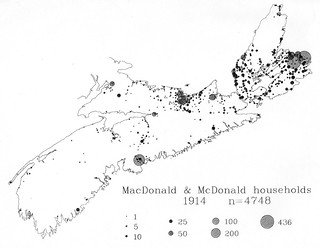
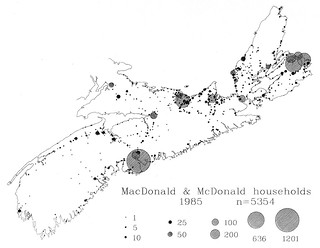
When I first arrived in Nova Scotia it was the telephone directory that captured my attention, when I noticed that many of the exchanges had clusters of surnames (Pubnico, for example, was 40% D'Entremonts; Saulnierville was mostly Saulniers, while adjacent Comeauville was mostly Comeaus, and so on). I started counting, and eventually made distribution maps of surnames ('patrihearths' are the noteworthy clumps of specific surnames), and in 1984 I bought a TI-Pro computer and plotter and started making maps of surnames and inferring internal migration processes. Thus:
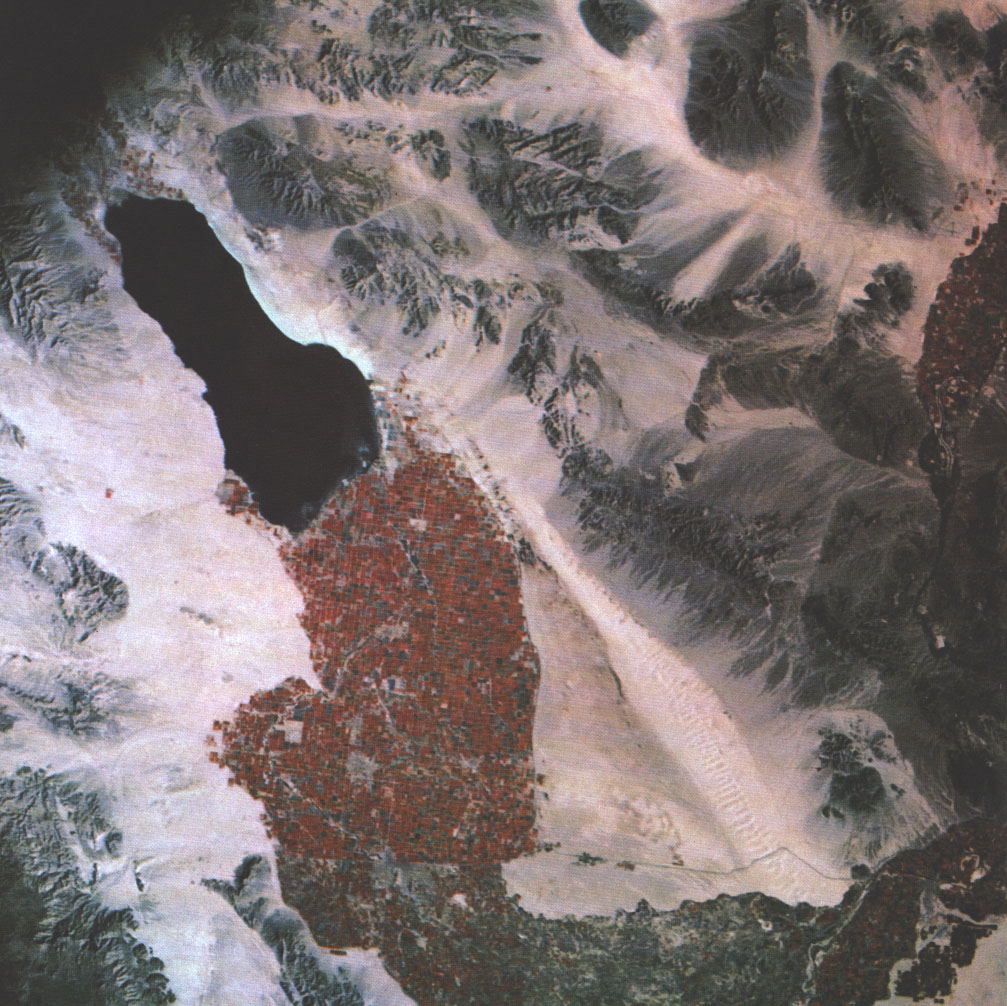
I taught Human Geography during most of the years I was at Acadia University (1973-1990), and made constant use of the 'numbers and distribution' framework. I also used a lot of remote sensing images, such as this one of California's Imperial Valley and Salton Sea (from Apollo 9, first published in NASA's Ecological Surveys From Space [1970]), for the complex stories they encode:
During a sabbatical at Stanford 1979-1980 I was drawn into historical demography of Hungary in the early years of the 20th century, when 'Greater Hungary' included large parts of today's Romania and parts of the Czech Republic and Slovakia, and when the Hungarians had a remarkable census bureau. I digitized large parts of the 1900 and 1910 census returns and made line-printer maps (this was before GIS) of variables like ethnicity, cause of death, agriculture...
During the Washington & Lee years (1992-2005) I became very involved with GIS as a means to display and analyze spatial data, and tried to interest faculty colleagues in various disciplines in those possibilities, without much success. I used GIS myself on all sorts of exploratory topics. Thus, twenty years ago (as a result of a Refernce question) I was exploring the geographical distribution of some toponyms: 'hollow', 'creek', 'run', 'brook', 'branch' and so on. (And NB Place Names in the United States for an interface to display maps of 30,000+ toponlyms in the US, and Places! to search for and display toponym prefixes and suffixes for many countries, and What syllables do German towns and villages end with? for a lovely display of kindred data.)
It's clear that fascination with spatial expressions of culture has been pretty much a constant for me for 50-odd years, though the direct involvement with such data has waxed and waned. I've always been interested in dialects and regionalisms in speech, and explored both written and recorded sources—Kurath's Linguistic Atlas of New England and the Bert & I recordings with equal gusto. Along the way I've accumulated a number of books on American dialects and other aspects of spatial distribution, and my ears and eyes are always tuned for more. Colin Woodard's American Nations: A History of the Eleven Rival Regional Cultures of North America is one of the fundamental documents in this general realm, though it doesn't have much to say directly about the dialects that accompany the various regional cultures.
I have just signed up for a subscription to the online form of the Dictionary of American Regional English (DARE).
Among the American Dialect resources on my shelves:
A Various Language: Perspectives on American Dialects Juanita V. Williamson and Virginia M. Burke (1971)New examples and displays of American dialect geography turn up frequently: a New York Times article on 'New York accent' and a a cross-country gallop are recent examples. And Amy Walker is always fun.https://www.amazon.com/American-Regional-Dialects-Word-Geography/dp/0472100769/ Craig M. Carver (1987)
American Talk: The Words and Ways of American Dialects Robert Hendrickson (1987)
Speaking American: How Y’all, Youse , and You Guys Talk: A Visual Guide Josh Katz (2016)