1.a. 1663-
Philosophy. The science or study of being; that branch of metaphysics concerned with the nature or essence of being or existence.1.b. 1855-
As a count noun: a theory or conception relating to the nature of being. Also in extended use.2. 1938-
Logic. Chiefly with reference to the work of Stanislaw Leśniewski (1886-1939): a system similar in scope to modern predicate logic, which attempts to interpret quantifiers without assuming that anything exists beyond written expressions.
S. Le&ssacute;niewski first developed this system of ontology in conjunction with the logical systems of mereology and protothetic. Cf. mereology n., protothetic n.
ontologic, adj. 1695-
= ontological, adj.
ontologist, n. 1727-
A student of or expert in ontology; a metaphysician.
ontologize, v. 1849-
intransitive. To apply or deal with ontology.
ontologism, n. 1850-
A mystical system based on the belief that God is...
Object-oriented ontology Wikipedia
...Hyperobjects (Morton)Timothy Morton became involved with object-oriented ontology after their ecological writings were favorably compared with the movement's ideas. In The Ecological Thought (2010), Morton introduced the concept of hyperobjects to describe objects that are so massively distributed in time and space as to transcend spatio-temporal specificities, such as global warming, styrofoam, and radioactive plutonium.[53] In their follow-up book, Hyperobjects: Philosophy and Ecology after the End of the World (2013),[54] Morton argued that the titular entities are defined by five key traits:
- Viscous: Hyperobjects adhere to any other object they touch, no matter how hard an object tries to resist. In this way, hyperobjects overrule ironic distance, meaning that the more an object tries to resist a hyperobject, the more glued to the hyperobject it becomes.[55]
- Molten: Hyperobjects are so massive that they refute the idea that spacetime is fixed, concrete, and consistent.[56]
- Nonlocal: Hyperobjects are massively distributed in time and space to the extent that their totality cannot be realized in any particular local manifestation. For example, global warming is a hyperobject that impacts meteorological conditions, such as tornado formation. According to Morton, though, objects do not feel global warming, but instead experience tornadoes as they cause damage in specific places. Thus, nonlocality describes the manner in which a hyperobject becomes more substantial than the local manifestations they produce.[57]
- Phased: Hyperobjects occupy a higher dimensional space than other entities can normally perceive. This means that hyperobjects appear to come and go in three-dimensional space, but would appear differently to an observer with a higher multidimensional view.[56]
- Interobjective: Hyperobjects are formed by relations between more than one object. Consequently, objects are only able to perceive the imprint, or "footprint," of a hyperobject upon other objects, revealed as information. For example, global warming is formed by interactions between the Sun, fossil fuels, and carbon dioxide, among other objects. Yet, global warming is made apparent through emissions levels, temperature changes, and ocean levels, making it seem as if global warming is a product of scientific models, rather than an object that predated its own measurement.[56]
According to Morton, hyperobjects not only become visible during an age of ecological crisis but alert humans to the ecological dilemmas defining the age in which they live.[58] Additionally, the existential capacity of hyperobjects to outlast a turn toward less materialistic cultural values, coupled with the threat many such objects pose toward organic matter, gives them a potential spiritual quality, in which their treatment by future societies may become indistinguishable from reverential care.[59]
Google AI Overview
Object-Oriented Ontology
(OOO) is a 21st-century philosophical movement rejecting human-centered views (anthropocentrism) by asserting that all entities—whether real, fictional, natural, or artificial—exist independently of human perception. OOO argues that objects have a "hidden" reality and agency, existing on equal footing in a "flat ontology".Key Principles of OOO
Independent Existence: Objects exist beyond human conception or observation, meaning a tree falling in a forest still makes sound regardless of whether anyone hears it.Flat Ontology: There is no hierarchy privileging humans; all things (e.g., quarks, people, fictional characters, or nations) have equal ontological status.
Objects are Inexhaustible: Objects cannot be reduced to their constituent parts (undermining) or to their relationships with other objects (overmining). They possess a "private life".
All Relations are Equal: Human relations with objects are not special; the interaction between a human and a hammer is structurally similar to the interaction between a hammer and a nail.
Origins and Proponents
Developed primarily by Graham Harman and rooted in Heideggerian philosophy, OOO is a subset of speculative realism. Other key figures include Timothy Morton, Ian Bogost, and Levi Bryant.Example of OOO
In an OOO view, a videogame is not just a construct of a programmer (human-centric) or pixels on a screen (materialist). It is an autonomous "object" that interacts with players, consoles, and electricity, possessing its own unique aesthetic and operational reality that is never fully exhausted by any single player's experience.Relevance
OOO is used in art, literature, and ecological studies to analyze how things exist and interact, particularly in contexts of environmental crises where human impact is not the only actor.
What is Object-Oriented Ontology? A definition for ordinary folk Ian Bogost
...Ontology is the philosophical study of existence. Object-oriented ontology ("OOO" for short) puts things at the center of this study. Its proponents contend that nothing has special status, but that everything exists equally—plumbers, DVD players, cotton, bonobos, sandstone, and Harry Potter, for example. In particular, OOO rejects the claims that human experience rests at the center of philosophy, and that things can be understood by how they appear to us. In place of science alone, OOO uses speculation to characterize how objects exist and interact.an update, alternate version::
Ontology is the philosophical study of existence. Object-oriented ontology ("OOO" for short) puts things at the center of this study. Its proponents contend that nothing has special status, but that everything exists equally—plumbers, cotton, bonobos, DVD players, and sandstone, for example. In contemporary thought, things are usually taken either as the aggregation of ever smaller bits (scientific naturalism) or as constructions of human behavior and society (social relativism). OOO steers a path between the two, drawing attention to things at all scales (from atoms to alpacas, bits to blinis), and pondering their nature and relations with one another as much with ourselves.
Object-Oriented Ontology: A New Theory of Everything Graham Harman (2018)
We humans tend to believe that things are only real in as much as we perceive them, an idea reinforced by modern philosophy, which privileges us as special, radically different in kind from all other objects. But as Graham Harman, one of the theory's leading exponents, shows, Object-Oriented Ontology (OOO) rejects the idea of human specialness: the world, he states, is clearly not the world as manifest to humans. "To think a reality beyond our thinking is not nonsense, but obligatory." At OOO's heart is the idea that objects—whether real, fictional, natural, artificial, human, or non-human—are mutually autonomous. This core idea has significance for nearly every field of inquiry which is concerned in some way with the systematic interaction of objects, and the degree to which individual objects resist full participation in such systems. In this brilliant new introduction, Graham Harman lays out OOO's history, ideas, and impact, taking in art and literature, politics and natural science along the way. From Sherlock Holmes, unicorns, and videogames to Dadaism, Voltaire, and string theory, this book will change the way you understand everything.
(Amazon blurb)
Ask yourself: what does your toaster want? How about your dog? Or the bacteria in your gut? What about the pixels on the screen you're reading off now—how is their day going? In other words, do things, animals, and other non-human entities experience their existence in a way that lies outside our own species-centric definition of consciousness? It's precisely this questions that the nascent philosophical movement known as Object-Oriented Ontology (arising from ontos, the Greek word for "being," and known to the cool kids as OOO) is attempting to answer or at least seriously pose, and they're setting certain segments of the art world on fire....In short, OOO (and its intertwined companion Speculative Realism) is dedicated to exploring the reality, agency, and "private lives" of nonhuman (and nonliving) entities—all of which it considers "objects"—coupled with a rejection of anthropocentric ways of thinking about and acting in the world.
...in contrast to the dominant strains of 20th-century phenomenology that claim things are only real insofar as they are sensible to a human subject, OOO asserts a radical and imaginative realism that not only claims that things do exist beyond the purview of human conception, but that this existence (defined by Harman as "nothing other than [the] confrontation of an experiencing real object with a sensual one") is almost entirely inaccessible to our understanding.
It's a brand of materialism that goes hand in hand with what you might call posthumanist egalitarianism, or panpsychism: none of the things you can name can be thought of as intrinsically less real, vital, or important than any other—an ecological viewpoint of existence that rejects any idea of human specialness as simple arrogance. As Harman writes, "The world is not the world as manifest to humans; to think a reality beyond our thinking is not nonsense, but obligatory."
This idea is closely linked to the OOO rejection of "correlationism," or the habit we humans have of thinking about things only in terms of the effects they have on us. For OOO adherents, this is a tragically limited worldview that at best precludes our ability to imagine the multiverse of beings, and at worst leads directly to the wanton environmental degradation we witness today. The world according to OOO is one full of beings acting on one another according to their own goals and caprices, motivations that cannot be kenned by others.
...Timothy Morton (who stands alongside Harmon as the best-known thinkers in the movement): "an artwork cannot be reduced to its parts or its materials, nor can it be reduced to its creator's life, nor to some other context, however defined ... Art is charisma, pouring out of anything whatsoever, whether we humans consider it to be alive or sentient or not." For Morton, the normative modes for thinking and talking about art ignore the agency (which he terms charisma) of the art object as well as its status as a thing that stands separate from (and equal to) all others. The charismatic pull he mentions is the art object acting on its viewers, a property he says all objects possess.
...What is object-oriented ontology, however? You might surmise that it's a return to the object qua object—a renewed focus on the composition, vitality, materiality, autonomy, wonder, and durability of objects large and small, near and far. In this sense, you could say that any discipline or practice is "object oriented," including not only art history and criticism but also architecture, graphic design, museum studies, archaeology, science and the philosophy of science, book history, literary criticism and rhetoric, and the culinary arts—indeed, any field of study whose subject is objects. This crude understanding of object-oriented ontology also applies to speculative realism,which may explain why both have become irresistibly appealing to the art world.But object-oriented ontology, as it happens, isn't all that. Instead, it is, well, an ontology—and, as such, involves a set of theses about All That Is. Let's dive in, surveying its three major tenets. First, everything is an object, including you and each of your thoughts. Second, and accordingly, no object relates to any other object, because the universe itself is devoid of all relation. Why is there no relation in the universe? It's because objects sever relations with every other object and withdraw into themselves to become self-subsisting, autonomous beings. It's also because relation is typically a human mode of apprehending, describing, and interacting with the world. Given that not every object is a human, though every human is an object, you can't have an object-oriented ontology if humans are at the center of it. Such an anthropocentric object-oriented ontology would be a contradiction in terms, because objects are not a means to our ends: They are meaningful whether or not we perceive them. Third—and finally—all objects are equal and, ontologically speaking, on the same plane. You, a speck of flea shit, an electric chair, and a solar flare are all equal objects.
...According to Harman, we can confidently claim that there are "a number of different kinds of relations . . . in the cosmos: ten of them, to be exact." Objects—be they sensual objects, real objects, sensual qualities, or real qualities—enter into relations, after all. These relations are assigned a variety of intriguing names for novelty's sake, such as fission, fusion, sincerity, allure, theory, and confrontation. And these latter three—allure, theory, and confrontation—are named "tensions" and are illustrated on the page by broken, squiggly lines that crisscross one another as they connect to the four poles of the sensual and the real like so many entangled Slinkys.
...Each object, no matter what it is, is abstracted in the same way. Each, that is, conforms to a template: All objects have insides and outsides, interiors and exteriors, depths and surfaces, and—especially—essences and accidents.
13ii26
I'm considering ontology as a case study in my developing lexicon —a term I've known for a long time but always been rather hazy about meaning and application (such that it's never been a part oof my lexicon, much less a Keyword). Does it show up in any of the Keywords collections I have, either in their indexes or as a free-standing entry? (see /ontology for a continuation)
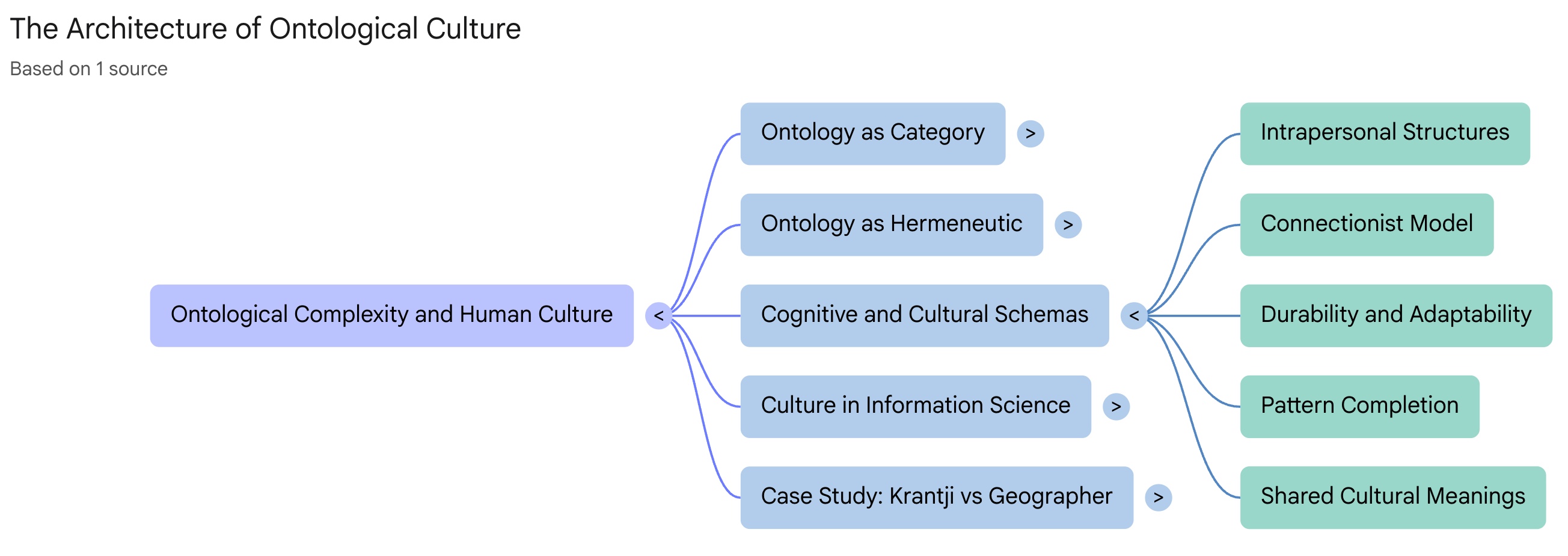
I've explored NolebookLM's possibilities re: ontology with two Notebooks, in the early days of figuring out how I might use the service, with some success:
The first document: Ontological Complexity and Human Culture David J Saab and Frederico Fonseca
and two days later, another Notebook using Ontology Is Just Another Word for Culture (a debate at University of Manchester, 2008)
15iii26
This from Mark Burgess enlightens the semantic territory of MYKeywords, and makes a much-needed link to the World Model unpacking:
> Avoiding the Ontology Trap: How biotech shows us how to link knowledge spaces Mark Burgess at Medium...How we group things together (or separate them) says a lot about how we think about problems. What we choose to see as similar or different is highly contextual, if not merely spurious, but when we try to make sense of something we are trying to justify those decisions. We sometimes refer to "namespaces" in IT to refer to independent "chapters" of a system, where different rules apply. In databases and programming, we create “tables” or “classes” of data, with a pretence of universal meaning. In books, we classify ideas by subject category, by fact or fiction, etc. But in knowledge graphs, we throw away a lot of those classifications and let everything float in a single space of ideas. There is both freedom and chaos in this that allows lateral thinking to join distinct areas...The vertebrate immune system is, in fact, a highly sophisticated and distributed system: a diverse battery of cell types forming a vast ecology of processes that is deviously complex. It isn't a solid lump of neural connections—it exists in a largely fluid state. It is a simple instance of what people are calling "agentic AI" today. Collectively, it has memory and enough discriminating chops to identify dangerous pathogens, then manufacture antidotes (even for substances that have never previously existed in the history of the planet), and bring us back to a state of "health". However, in spite of this apparent expertise, no single cell has any intelligence nor even a notion of what it's doing. It works, as the entire biosphere works, by the smallest of language models: recognition of patterns, supporting complex ecological interactions that seek out stable equilibria.
...The function of a knowledge graph, in such a process, is not to act as a database of memories, but to encapsulate many fragmentary episodic experiences in such a way as to allow us to make cross connections when they might occur. Yet, our familiar strategies for knowledge management are based on a taxonomic separation of concerns and the subdivision into authoritative hierarchies.
...The two culprits of classification are taxonomy and ontology. They are ultimately self-defeating attempts to regulate and legalize the boxes of our thought, and offer short term relief from the chaos of having too much to know—by basically fencing off the freedom to explore analogies and associations that give knowledge depth.
...The great conceit of a branching hierarchy representation of knowledge is that the world is a simple unfolding of ordered states. But we know that it isn’t. Whenever we come up with a rule that fits some exterior characteristic, it turns out to have an exception, because it is merely a spurious correlation—not a causal explanation.
...We can roughly divide the active elements of our experiences into three kinds of "happenings": events, things, and concepts (forming the convenient mnemonic "etc").
...one can say that biology is an application of linguistics to chemistry
...Knowledge management might not quite deserve the status that has been thrust upon it in recent times by hungry financial sponsors of "AI", but it is surely one of the most important topics for humanity to address. The information age has made that easier than at any time in history to forgo our own personal development, so we need to be ever more vigilant in approaching knowledge and how we use it.
A Physicist on Consciousness and Emergence Paul Austin Murphy at Medium
...One important distinction which has to me made here is between epistemic emergence and ontological emergence. (This distinction more or less captures the distinction made between weak emergence and strong emergence.) In basic terms, some systems are so complex that they display (or instantiate) properties which go beyond our present understanding.(quotes Trefil):
...The more sand grains you pile on, the more complex the web of forces becomes. Eventually, you add one more grain of sand and an avalanche flows down the side of the pile. In other words, the avalanche is a behavior that shows up only when the web of forces reaches a certain level of complexity. If you have to have a million grains of sand before you see an avalanche, you don’t get one-millionth of an avalanche in a single grain of sand... If we build a collection of neurons, adding one neuron at a time, the system will go through a series of discontinuous jumps, each jump corresponding to a new kind of emergent property — a new 'avalanche' — characteristic of its new level of complexity.
18iv26
Everyone Has an Ontology Now. Almost Nobody Has an Ontology Dr Nicolas Figay at Medium
Microsoft just announced Fabric IQ. At its core: an "Ontology item." Palantir has been selling its "Ontology" as the backbone of enterprise AI for years. SAP, Salesforce, AWS — each has a version of the same story.There is a pattern here worth naming.
The word “ontology” has escaped its technical meaning and become a marketing asset. It signals rigor, structure, shared understanding. It implies that the platform knows what your business means — not just what your data says. In the age of agentic AI, that is an enormously valuable claim.
The problem is that most of what is being sold under that label is something else: a governed property graph. A business glossary with relationship types. A typed schema with some constraints layered on top. These are not worthless — they are genuinely useful artefacts. But they are not ontologies in any formal sense, and the distinction matters enormously the moment you ask an AI agent to reason on top of them.
...An ontology, in the logical sense, provides a formal semantics — axioms, description logic, an explicit stance on the Open World Assumption. It distinguishes individuals from classes. It allows inference: from what you have asserted, a reasoner can derive what you have not explicitly stated. That derivation is bounded, decidable in defined fragments, and auditable.
None of the vendor “ontologies” I have examined commit to any of this. Microsoft's Fabric IQ ontology is bootstrapped from Power BI semantic models by business experts using no-code visual tools. Palantir's Ontology defines object types, link types, action types — a rich operational model, the most sophisticated of the vendor offerings — but with no description logic underneath, no inference, no formal commitment to an epistemological regime. What you get is a well-governed conceptual map. What you are promised is semantic reasoning. These are not the same thing.
...When an AI agent acts autonomously on the basis of a "semantic layer," the question that matters is: what guarantees does that layer actually provide? If the ontology is informal — if it is a business glossary with governance tooling — then the agent’s reasoning is only as good as the completeness and consistency of the model as manually constructed by domain experts. There is no inference. There is no formal constraint validation. There is no decidability. There is operational context, curated by humans, dressed in the language of logic.
That is not nothing. But it is not what is being claimed.