Barsetshire
21i26
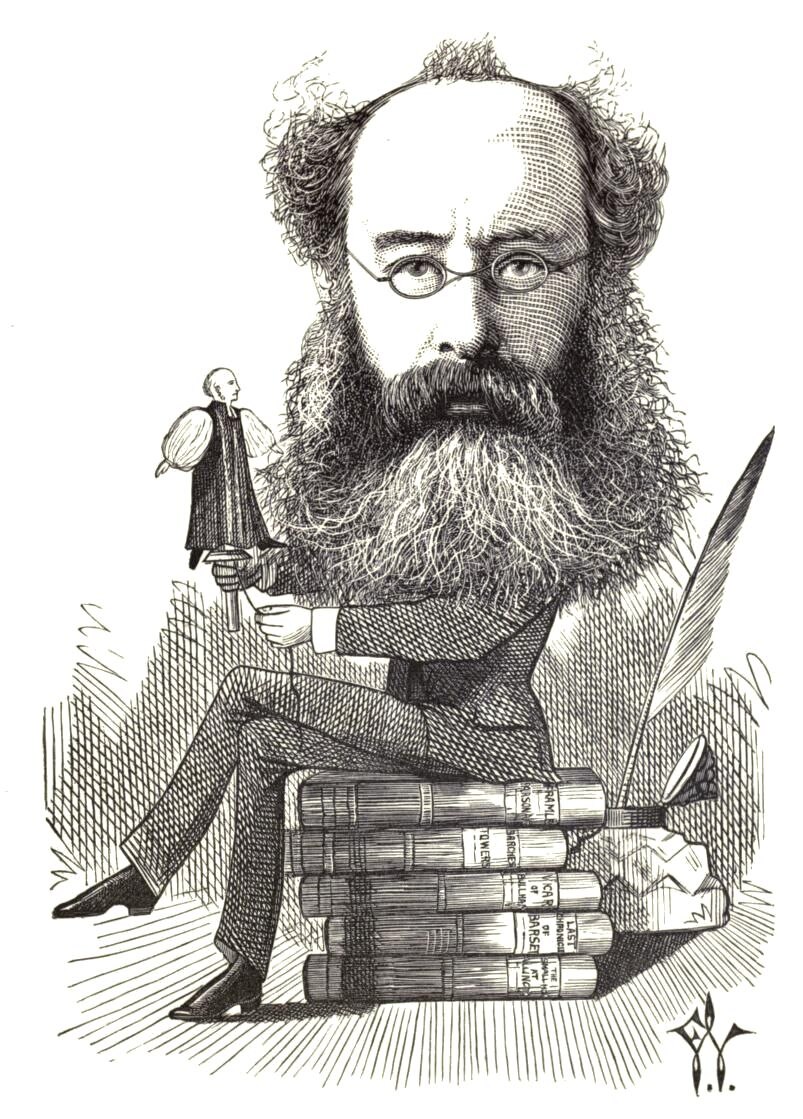
Anthony Trollope('s) ...grandfather was a parson; and it is in delineating
the phases of clerical life, from the bishop to the curate, that this popular writer excels.
Bishop Proudie, Archdeacon Grantley, the Rev. Obadiah Slope, Mr. Crawley of Hogglestock,
are creations of his genius that have their originals in life.
They are photographic portraits of men his readers know: nature clothed with the form of art:
and from this exquisite truthfulness they derive their interest.
(Wikisource)
Studies of a Biographer (Leslie Stephen)
...in this ancient novelist we see the society of the time, the squires and parsons and officials, and the women whom they courted, entirely unconscious of any approaching convulsions; imagining that their little social arrangements were to endure for ever; that their social conventions were the only ones conceivable; and, on the whole, mainly occupied in carrying on business in a humdrum way and sweetening life by flirtation with healthy and pretty young women without two ideas in their heads. Then they will look back to the early days of Queen Victoria as a delightful time, when it was possible to take things quietly, and a good, sound, sensible optimism was the prevalent state of mind. How far the estimate would be true is another question; but Trollope, as representing such an epoch, will supply a soothing if rather mild stimulant for the imagination, and it will be admitted that if he was not among the highest intellects of his benighted time, he was as sturdy, wholesome, and kindly a human being as could be desired.
❧ ❧ ❧ ❧ ❧
I'm not sure when I first encountered The Chronicles of Barsetshire, but I remember that Alice was reading Trollope ca. 1951-1952 at Blairhaven. Probably I read The Warden sometime in the mid-1970s, around the time I was reading Delderfield's oeuvre. I think I encountered the 1982 video sometime in the 1980s, and have watched it many times. It's accessible via YouTube, in 9 episodes:
Barchester Chronicles at YouTube (playlist of 9 episodes)
see also
IMDB Barchester Chronicles
The Barchester Chronicles Wikipedia
❧ ❧ ❧ ❧ ❧
A guide to the novels of Anthony Trollope, Part 1: The Chronicles of Barsetshire Exotic and irrational entertainment
...As so often in Trollope, though, debt, financial problems and issues of propriety loom over the characters and constrain their choices.
...The first two novels in the Chronicles of Barsetshire were adapted by BBC Television as The Barchester Chronicles (1982). The seven-episode series is superbly cast: especially fine are Donald Pleasance as the gentle Warden Harding, Alan Rickman as a sibilant and loathsomely snake-like Mr. Slope, Geraldine McEwan as the peremptory Mrs. Proudie, Clive Swift (later the hapless Richard Bucket in Keeping Up Appearances) as the hapless Bishop Proudie, Susan Hampshire (miscast in The Pallisers but perfect here) as Signora Madeline Neroni, and Barbara Flynn (later of Wives and Daughters (1999), He Knew He Was Right (2004), and Cranford (2007)) as Mary Bold, while Nigel Hawthorne entertainingly chews the scenery as Archdeacon Grantly. The one minor bit of miscasting is Derek New as Mr. Arabin, who seems a bit too buttoned-up (especially when he's standing next to Nigel Hawthorne). Alan Plater's wonderful script is both dramatically compelling and a model of faithfulness to the source; perhaps the only disappointment is in the handling of the garden party scene in Episode 6, which doesn't quite express all of the emotional nuances and dark humor of the novel (the scene is only one of the most brilliant set-pieces in all of Trollope).
❧ ❧ ❧ ❧ ❧
Barsetshire Wikipedia
Chronicles of Barsetshire Wikipedia
The Trollope Society
Search our directory of Trollope's novels and characters
Barsetshire in Pictures
The Barchester Chronicles
Maps of Barsetshire (USA branch)
Epilogue - Barsetshire via Selborne: Anthony Trollope's The Last Chronicle of Barset (1867) Amy M King
...The Epilogue returns us to Gilbert White's The Natural History of Selborne (1789) to illuminate the last novel in Anthony Trollope's The Last Chronicle of Barset (1867). We can better grasp Trollope's novel of a geographically bounded fictional reality by remembering the way White established reverent natural history as a local and bounded subject deep into the nineteenth-century. Trollope's Barsetshire Chronicles are likewise local and devoted to capturing an ecology: for Trollope the ecology is social, for White it is natural.
The Last Chronicle of Barset: Analysis of Major Characters EBSCO Research Starters
ANTHONY TROLLOPE'S BARSETSHIRE HEROES David Michael Mazurowski (1990 dissertation) (pdf)
...Every Barsetshire novel includes a variation on the not-quite-heroic young gentleman. Trollope, reacting against the Romantic hero and conventional heroes of Victorian popular fiction, creates young men who always strive for, yet fail to achieve, true heroism. With an ambitious Mark Robarts, an unthinking Lord Lufton, a flirtatious Johnny Eames, or a cowardly Adolphus Crosbie, Trollope exhibits the flaws which ruin the youth's quest for heroism.
❧ ❧ ❧ ❧ ❧
The Changing World of Anthony Trollope Robert M Polhemus (originally 1968)
Explore the transformative world of Anthony Trollope through Robert M. Polhemus's seminal study, The Changing World of Anthony Trollope. This work delves deep into Trollope's mastery as a chronicler of societal shifts and individual moral dilemmas. Polhemus intricately examines Trollope's best and most representative novels, such as the Barset and Palliser series, revealing the nuanced interplay between personal growth and historical currents. From the humor and poignancy of his characters to his exploration of the evolving Victorian mindset, Trollope emerges as both a mirror of his age and a commentator on the timeless challenges of adaptation and conscience.
With a focus on Trollope's unique ability to weave history, humor, and human emotion, Polhemus sheds light on the novelist's enduring relevance. Highlighting Trollope's celebration of the ordinary as extraordinary, the book captures his exploration of middle-class virtues and the often-overlooked complexities of everyday life. A must-read for lovers of Victorian literature, The Changing World of Anthony Trollope offers a fresh perspective on a literary giant whose works continue to resonate with modern audiences.
The Chronicler of Barsetshire: A Life of Anthony Trollope RH Super (1991)
Maps
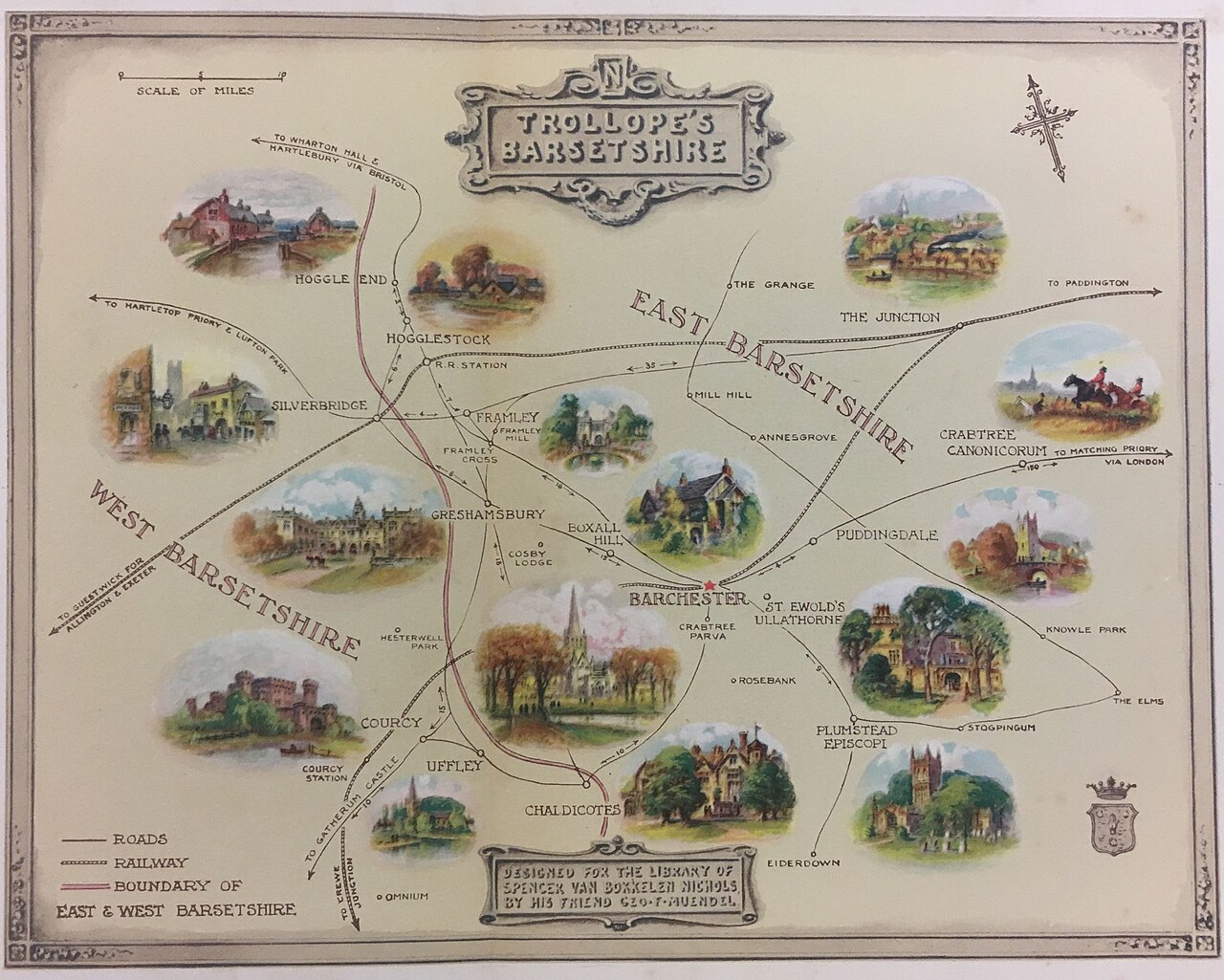
Barsetshire Map Trollope Society
Mapping Trollope; or Geographies of Power Ellen Moody
Mapmaking in Barsetshire Lance O. Tingay (1948) (pdf)
The Place-Names of Barsetshire William FH Nicolaisen Literary Onomastic Studies (1976) (pdf)
Complete Map Chronotopic Cartographies
Chronicles of Barsetshire full text of the six novels, via Wikisource
Doctor Thorne (full text)
from Dr. Thorne, the third in the series:
Greshams from time immemorial had been handsome. They were broad browed, blue eyed, fair haired, born with dimples in their chins, and that pleasant, aristocratic, dangerous curl of the upper lip which can equally express good humour or scorn. Young Frank was every inch a Gresham, and was the darling of his father's heart.
The De Courcys had never been plain. There was too much hauteur, too much pride, we may perhaps even fairly say, too much nobility in their gait and manners, and even in their faces, to allow of their being considered, plain; but they were not a race nurtured by Venus or Apollo. They were tall and thin, with high cheek-bones, high foreheads, and large, dignified, cold eyes. The De Courcy girls had all good hair; and, as they also possessed easy manners and powers of talking, they managed to pass in the world for beauties till they were absorbed in the matrimonial market, and the world at large cared no longer whether they were beauties or not. The Misses Gresham were made in the De Courcy mould, and were not on this account the less dear to their mother.
The Last Chronicle of Barset 1/5 YouTube audio
Cartoon portraits and biographical sketches of Anthony Trollope Wikisource
❧ ❧ ❧ ❧ ❧
See also the Barsetshire Series resumed Goodreads (Angela Thirkell carried on the series, 1933 ==> 1961 for 33 novels)