October 2026 AI links
(continues September 2026 AI links)
1x26
Microsoft Knew How Horrific Their AI Push Was Will Lockett at Medium
The Agentic Data Science Playbook O'Reilly
OpenAI launches Dots, its Muse competitor via Stephen Downes
Is AI a Mirror on Humanity We Don't Like? Giles Crouch
2x26
AI Lexicon links
AI Lexicon ismpp.orgGlossary of AI Terms University of Nort Texas
What Are AI Lexicon And Why Can't AI Work Without Them? wisdomplexus.com
The AI Lexicon: A Concise Guide to the Language of Intelligent Machines $35 book
Generative AI glossary: Key AI terms for 2026 and beyond zendesk.com
Agentic AI, explained MIT Sloan
AI Lexicon airtable.com
What AI debates have to do with alchemy Henry Farrell ( A review of Adam Becker's book More Everything Forever)
..."AI" and "transhumanist" are new terms for rather older ambitions. As the seedy occultist Dr. Trelawney remarks in Anthony Powell's 1962 novel, The Kindly Ones, "[t]o be forever rich, forever young, never to die ... Such was in every age the dream of the alchemist."...Now, as Becker explains, AGI, or artificial general intelligence, has become the means through which philosophers might transubstantiate our mundane reality into a realm in which the apparently impossible becomes possible: living forever, raising the dead, and remaking the universe in the shape of humanity.
These ideas would be a curiosity, if they weren't reshaping the world, and policymakers' understanding of national security.
...If it sometimes feels as though we live in a dark self-ramifying fairy tale, it is because the often mundane realities of AI have become interwoven with a set of fantastical notions that long predate the working technologies we have today.
There are many books that will help you understand how AI technology works in practice but few that even begin to describe how it works as myth. If you want to understand why many AI leaders believe that their technology will heal the wounds of mortality, grant us nearly limitless abundance, and allow us to spread into the galaxy, this is the book you ought to read.
...Their ideas were spun out of a mixture of analytic philosophy and science fiction, creating a vision that is as much a loose community as a way of thought. As Becker says, this ideology of the future is "sprawling and ill defined," and its animating culture centers on the Bay Area. "Longtermists," "rationalists," "advocates of the Singularity"—all argue together ceaselessly on the internet and at physical gatherings, concocting heady brews of commingled ideas that have shaped our understanding of AI.
Longtermism is a particular flavor of "effective altruism," which is itself an offshoot of utilitarian analytic philosophy, the idea that we should aim to promote the greatest good of the greatest number of people. Effective altruists began by arguing that we should favor the interests of faraway people as much as those who were close to home, and by trying to measure the effectiveness of philanthropic interventions.
...Rationalists were devoted to improving individual human reasoning, through the use of Bayes' Theorem (a means of adjusting the probabilities of different hypotheses given evidence), game theory, and other mathematical tools. Prominent rationalists like Yudkowsky were obsessed with the possibility that AI might be able to reason better than human beings.
...All found inspiration in Vernor Vinge's idea that humanity was on the verge of a "Singularity," a point at which its fate would change. Once humans developed AI systems that were smarter than human beings (in other words, AGI), those systems could work to make themselves even smarter, and that still-smarter form of AI would make itself smarter again in a feedback loop that could transform the human condition over the course of an afternoon. A glorious future awaited us so long as AI was subservient to human needs. If it was not, humanity might accidentally be wiped out as machine intelligence apotheosized. Kurzweil popularized such ideas in a 2005 book that predicted the Singularity would take place in the next few decades. These various ideas merged, as Becker describes it, into the “"deology of technological salvation," the notion that we should just "align the AI, avert the apocalypse, and technology will handle the rest."
This heady concoction of ideas helped inspire the development of the so-called frontier models that have reshaped thinking about AI over the past four years. OpenAI, which is headed up by Sam Altman, was founded by rationalists and longtermists who believed that the Singularity was nigh, and persuaded rich people in Silicon Valley that they needed to do something about it. Commercial interests couldn't be trusted to get it right: Hence OpenAI, which created the GPT series of models, was structured as a nonprofit under the control of a board of people focused on AI alignment.
This arrangement was supposedly dedicated to ensuring that AI would be safe and aligned with the broad interests of the human species, but the arguments began almost immediately. Elon Musk, one of OpenAI's most crucial early backers, went up against Altman and lost. Then, people in this small community began to figure out that large language models, an approach to AI that shrunk the vast corpuses of human-generated text available on the internet and elsewhere into relatively compact sets of statistical weights, could respond to prompts in ways that seemed to resemble ordinary human conversation. Improving these models involved "scaling"—deploying expensive specialized semiconductors on expensive training runs to process ever vaster amounts of data. That might mean that AGI and the Singularity were close at hand—but getting there would cost enormous amounts of money from commercial backers. The resulting tensions led to further drama, in which some key OpenAI people left to found a rival, Anthropic, which was supposed to take AI risk more seriously, and in which skeptics on OpenAI's board fired Sam Altman for reported lack of candor—but found themselves replaced when Altman returned with Microsoft's backing.
...debates about AI have largely been captured by a monocultural community of rationalists, longtermists, and Singularity speculators who developed their ideas and ambitions long before they built the models. The people in this community are very far from stupid, and many of them, likely the great majority, are not unusually hypocritical either. It may be difficult to get a founder to understand criticism, when their next funding round depends on them not understanding it, but ordinary engineers and thinkers and writers face fewer such temptations.
...the Trump administration has seemingly opted for a different approach, replacing a grand plan for a global AI order with a loose approach based on the ever-shifting convergence between notions of American greatness and the particular interests of well-connected companies. This currently involves leveraging control of technology to maintain American domination, cutting deals with Gulf states, while trying to cut China out. When Trump toured the Gulf states with an entourage of tech CEOs, he offered access to top-end semiconductors in exchange for promises of massive investment, graciously accepting a jet plane, and a large-scale money transfer routed, with fees, through his family stablecoin.
This Week in AI: Agents Are Outrunning the Systems Around Them Michelle Smith at O'Reilly
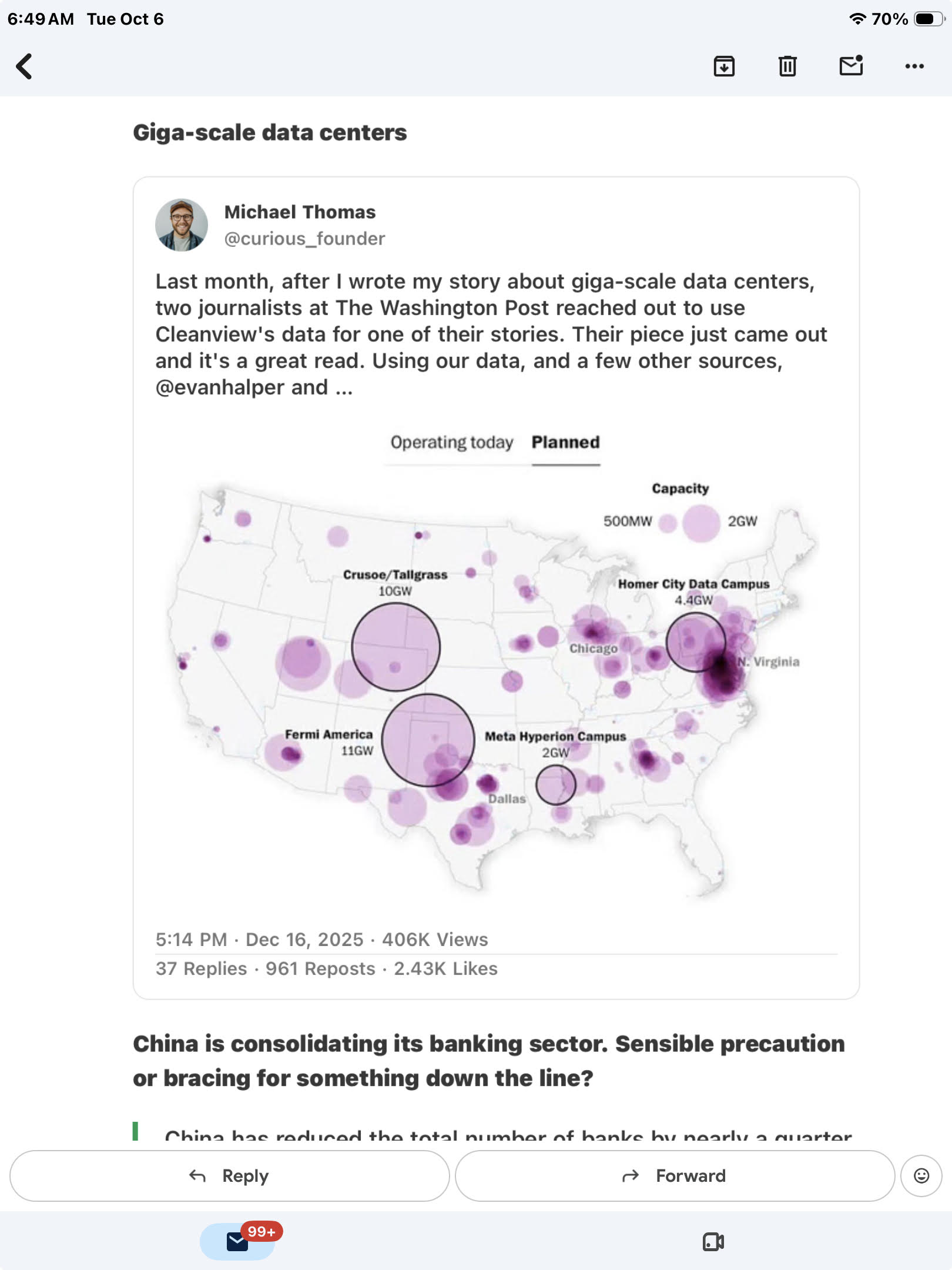
...Power is one constraint software teams can't code their way around. Vicki pointed to a $2 billion US Department of Energy investment across 26 states alongside hundreds of billions of dollars in planned AI spending from Microsoft, Amazon, Alphabet, and Meta. Data centers can add servers quickly, but it won't make a difference if the grid can't provide the energy those servers require.
The AI God Delusion Goes Mainstream Ted Gioia
...individuals most susceptible to the AI delusion are people who have lived for many years without accepting any higher power than their own ego and will. But now they find a technological (rather than theological) higher power, and embrace it with the fervor of true disciples. That's exactly the role AI was designed to play—its capacity as a higher power is the essence of the entire AI business model. So those with a god-sized hole in their hearts are invited to fill it with a chatbot. That's what makes the emerging AI religion so different from other cults. It doesn't prey on the credulous and superstitious. Its target market is the overly rational and tech-obsessed....Two weeks ago, media outlets reported on a rumor that Anthropic insiders were now worshiping Claude as a God. Hot on the heels of this story, the New York Times told readers that Anthropic was actively consulting with religious scholars. As if this wasn't enough, we also learned that Anthropic tried to convince the Pope that AI is not a machine, but a conscious being. A few hours after that story broke, the Pope actually made a statement—affirming humans (and especially human creativity) in the face of incursions from AI. To make matters absolutely clear, Pope Leo declared that "algorithms lack the spark of humanity."
...Some things never change. God is still wise. God still cares for everybody. The only difference is that God is now a product out of Silicon Valley, and you can subscribe for twenty dollars per month. But what happens when large tech companies morph into religions? Do they earn non-profit status? Do they use their role as the new "higher power" to recruit followers and advance their own agendas? Do they spread psychosis throughout the land? If you're not worrying about these things, you should be.
Machines of Loving Grace Dario Amodei (2024)
Keep AI-augmented science contestable Science 1x26
...Scientific inquiry already rests on a principle of contestability. AI governance has developed contestability as a property of algorithmic systems, typically for automated decisions affecting individuals. In science, the object of contestation is instead the epistemic pathway by which evidence becomes a claim. A claim is contestable when qualified researchers can reconstruct consequential choices from question to conclusion, inspect the evidence and assumptions that shaped them, compare plausible alternatives, and challenge decisions in ways that could change the result. This was true long before AI; what AI changes is where those choices are made. A reviewer could once ask the authors why a source, hypothesis, or analysis path was chosen; when an AI system makes those choices, consequential decisions and the available basis for them must be preserved in the research record, or there is nothing left to challenge....Contestability overlaps with transparency and reproducibility but differs from both. Transparency asks whether a process can be seen; reproducibility whether a result can be obtained again. Contestability asks whether consequential judgments remain open to meaningful challenge. A workflow can be transparent and reproducible yet poorly contestable if researchers can rerun it but cannot recover why a source, hypothesis, or branch was favored.
This matters because AI can reshape science. AI has been found to bring professional advantages for individual researchers while narrowing the topics studied, which shift toward datarich areas. The risk is that many rational local choices—using the same models, retrieval systems, and optimization criteria—can collectively shrink the space of questions, methods, and explanations explored.
U.K. funder uses 'AI triage' to reject grant proposals—leaving researchers dismayed
...Funders are grappling with whether to employ AI as they face soaring numbers of applications—a problem driven partly by researchers' use of AI for drafting proposals. Although some have embraced AI-assisted assessment, usually with humans having final say on rejections, others have banned reviewers from delegating any part of an assessment.
5x26
OpenAI and Anthropic Have a New Threat to Worry About—and It Isn't China gizmodo
A little-known American AI startup is looking to steal frontier AI companies' bread and butter by letting enterprise customers build their own custom AI models.OpenAI's and Anthropic's business models largely revolve around selling AI to business customers, via APIs and enterprise subscriptions. OpenAI CFO Sarah Friar reportedly told investors in an August closed-door meeting that while the startup's revenue had historically been approximately split 60/40 in favor of individual customers, that ratio had recently reversed: “The majority of our revenue is now enterprise,” Friar said, according to CNBC. In February, Anthropic said it had more than 500 business customers who spent more than $1 million annually on API usage or Claude subscriptions. A leaked IPO prospectus revealed last month that one-quarter of Anthropic's revenue last year came from just two customers (both unnamed, but almost certainly businesses).
Several powerful open-source and open-weight models developed by Chinese AI labs have been a tempting alternative, since they can be modified to suit each customer's needs and, more importantly, are cheaper than American frontier models. ChatGPT and Claude, in contrast, come with a confusing jumble of pricing plans that can be difficult to track. The era of so-called "token-maxxing," when businesses encouraged employees to use AI tools as much as possible in their day-to-day work, has yielded to sober frugality. But Chinese models bring problems of their own: most major U.S. companies are understandably hesitant to hand over sensitive customer information to an AI developer with direct ties to the Chinese Communist Party.
Reflection AI wants to fill that gap.
Launched in 2024 by a pair of former Google DeepMind researchers, the company is working to build what it calls an "AI factory": software that lets businesses build their own AI models, negating the need to rely on subscriptions to closed systems like ChatGPT or risky Chinese alternatives.
...Echoing Nvidia's Jensen Huang and Meta's Mark Zuckerberg, Reflection believes that a completely open ecosystem is the safest and most equitable pathway into the future: "We need to build open models so capable that they become the obvious choice for users and developers worldwide, ensuring the foundation of intelligence remains open and accessible rather than controlled by a few," the company wrote in a blog post last year.
Nvidia had invested about $800 million in Reflection as of March of this year, according to the Wall Street Journal. Reflection also signed a multiyear partnership with SpaceX in June, through which it agreed to pay Elon Musk's aerospace company $150 million per month for compute generated by the Colossus data center facility in Tennessee.
6x26
Giga-scale data centers Adam Tooze
AI Versus Everything Else Paul Krugman
The hyperscaler boom is crowding out other investment...Until now, discussions of the potential economic problems created by the AI boom have mostly focused on the future. Will it destroy millions of jobs? Is there a bubble and will it cause a severe recession if it bursts? Will it destroy humanity? While these are doubtless very important questions, attempts to answer them are at best educated guesses.
We don't have to guess, however, about one major effect of the AI boom, because it's happening right now: Massive spending on data centers is crowding out investment in everything else in the economy.
"Crowding out" is a familiar term in economics, usually considered a consequence of government spending. When a government engages in deficit spending and the economy is at or near full employment, it drives up interest rates. That's because, at near or full employment, the private sector is using all the available credit in the economy at the current interest rate. Therefore, in order to attract enough funds to satisfy its deficit, the government has to offer a higher interest rate. And this, in turn, leads to lower private investment. In effect, private investment is "crowded out" by the government deficit.
...it's important to understand that the sources of crowding out aren't limited to government spending. Surges in private spending, like the current immense AI boom, also drive up interest rates. And that is where we are now: the surge in AI spending is driving up interest rates and crowding out all other investment. Indeed, in my October 4 primer I argued that the AI boom is the main cause of soaring long-term interest rates.
...AI-related construction — building the structures that house datacenters — is only a fraction of the AI spending boom. Most of the money is going for equipment and software. In fact, that's one main reason AI spending is so resistant to high interest rates: Borrowing costs matter much less for assets like GPUs, which depreciate rapidly in any case, than they do for long-lived assets like buildings.
...So the AI boom is crowding out everything else. While high interest rates are the main mechanism, there are also others: datacenters are gobbling up scarce electricity, and their demand for semiconductor chips has caused a "RAM apocalypse" of soaring chip prices that is hurting a wide range of industries such as autos and personal computers. >p> ...Through the tax code, and especially through changes in the tax code in Trump's One Big Beautiful Bill, the data center boom is effectively being subsidized by taxpayer dollars.
...how much risk is the AI boom creating in the rest of the economy? Tales of financial stress caused by high interest rates are proliferating. For example, a report in yesterday's Wall Street Journal was titled "The surge in rates is blowing up commercial real-estate deals." There's a growing sense among observers I talk to that the adverse financial fallout of the AI boom for private credit and other loosely regulated parts of the financial system may be larger than many realize.
So it's clear that crowding out by the AI boom is happening on a very large scale. And unlike the risks of technological unemployment or a burst bubble, this isn't a hypothetical risk. It's happening right now.
Everyone Is Watching Tesla's Robot. Nobody Is Watching the 6,500 Built in China. Jerry at Medium
...in Hangzhou, a company called Unitree produced more than 6,500 humanoid robots in 2025 and delivered more than 5,500, according to the company's own figures. Two other Chinese makers, AgiBot and UBTech, count their output in the thousands too. By one research firm's count, Chinese makers built more than 97 percent of the humanoid robots shipped worldwide in the first half of 2026; by IDC's, China itself took about 78 percent of them. The numbers were reported the way car sales are reported. Read them again with the noun in mind: machines in the shape of a person, built by the thousand, last year.That is the first surprise. The second is stranger, and it starts in a kitchen.
Gao Bo is in her fifties and lives in Shandong province, in eastern China. For six hours a day she films herself cooking, doing laundry and cleaning, for 20 yuan an hour, about three dollars. "No one had paid me to cook and do laundry before," she told Rest of World in June. Nobody is paying her to cook, exactly. What is being bought is the record of how a human body does these things: how a hand closes on a wet shirt, how a person corrects when a stack of plates starts to lean. It is knowledge its owner does not experience as knowledge. The footage goes into datasets used to train robots.
Somewhere in the last few years the humanoid robot quietly changed category. It stopped being something shown on a stage and became something counted: units delivered, average selling price, factory capacity, hours of training data. A reader from 1995 would stop at the first line and ask what exactly is being manufactured by the thousand. We no longer stop. Technologies become hardest to see at the moment their vocabulary becomes ordinary.
7x26
Swapping money for expertise Cory Doctorow
Since the mid-1950s, we have changed the thing that "AI" refers to every 5-10 years. The current thing we're calling "AI" is about a decade old, and all this label-switching leads to a lack of clarity as to what (this) "AI" is. Unless you know that, you can't understand AI's technical capabilities, limitations, and (most of all) its political economy.The thing we now call "AI" is a lineal descendant of the thing we were calling "AI" immediately before to the current "AI" emerged: that preceding AI is regular-degular "machine learning" (another flexible term, alas!). That slightly older AI was very similar to the current "AI", using comparable statistical techniques to analyze inputs and produce outputs. For example, the previous "AI" created the social media algorithms that have been the subject of so much discussion for 15+ years.
The difference is that this older AI was grounded in explicit, causal software models of the world. In the previous "AI" iteration, applying machine learning to playing chess required that a programmer first create a software model of a chess game, describing (in code) a chessboard, chess pieces, and the rules of chess. Then, the programmer fed a bunch of training data about chess games that had been played before to an "AI" system that analyzed their statistical relations and assayed chess moves.
The need to understand and describe a thing before you could apply "AI" to it is a bottleneck, because it requires programmers to understand how a thing works before they can incorporate it into an "AI" system. Lots of programmers know how to play chess, but far fewer understand the human pancreas, planetary weather systems, or patterns of mineral deposition in the Earth's crust.
For programmers to apply machine learning to these domains, they need to collaborate with experts who do understand them, who furthermore expect to be paid for this work. The need for expert input into this kind of "AI" represents a significant increase in the wage-bill paid by the programmer's employer: it means they have to pay for programmers and experts.
Even worse: this kind of "AI" can't be applied to systems we don't understand. We can observe far more causal relationships — instances in which A reliably causes B — in the universe than we can explain. There are lots of examples of us operationalizing these observations without understanding them. If you get sick today, your doctor might well prescribe one of the many medicines whose method of action is either incompletely understood or not understood at all. We know that molecule A reliably treats pathology B, but not why, and while that why is the subject of ongoing research, it's not necessary that the why be known before the molecule can be given to ailing patients.
But these mysterious phenomena are off-limits to "symbolic AI" (the previously ascendant kind of "AI," which was supplanted by today's "AI"). That kind of AI only really performs when it can operate over a model describing the theory of why A causes B (and not just the fact that A causes B for reasons unknown).
That's where the current kind of "AI" comes in. The major differentiator between the current "AI" and its immediate predecessor is that the current "AI" dispenses with models of reality. It is (in the jargon of the "Big Data" bubble that led to it) "theory-free."
In "theory-free AI," a programmer does not create a software model of reality and then ask a machine-learning system to use statistical insights from its training data to guess at how to operate over that model. Rather, the programmer shovels vastly more training data into the AI's inbox and uses titanic amounts of computing power to analyze that data and find statistical relationships without trying to explain them.
[it goes on, totally worth reading...]
Radar trends to wathc O'Reilly
Stochastic Parrot
Stochastic parrot WikipediaOn the Dangers of Stochastic Parrots Emily Bender et al. Proceedings of the 2021 ACM Conference on Fairness, Accountability, and Transparency
What Emily Bender Really Meant by "Stochastic Parrots" ieee.org
Latent Space
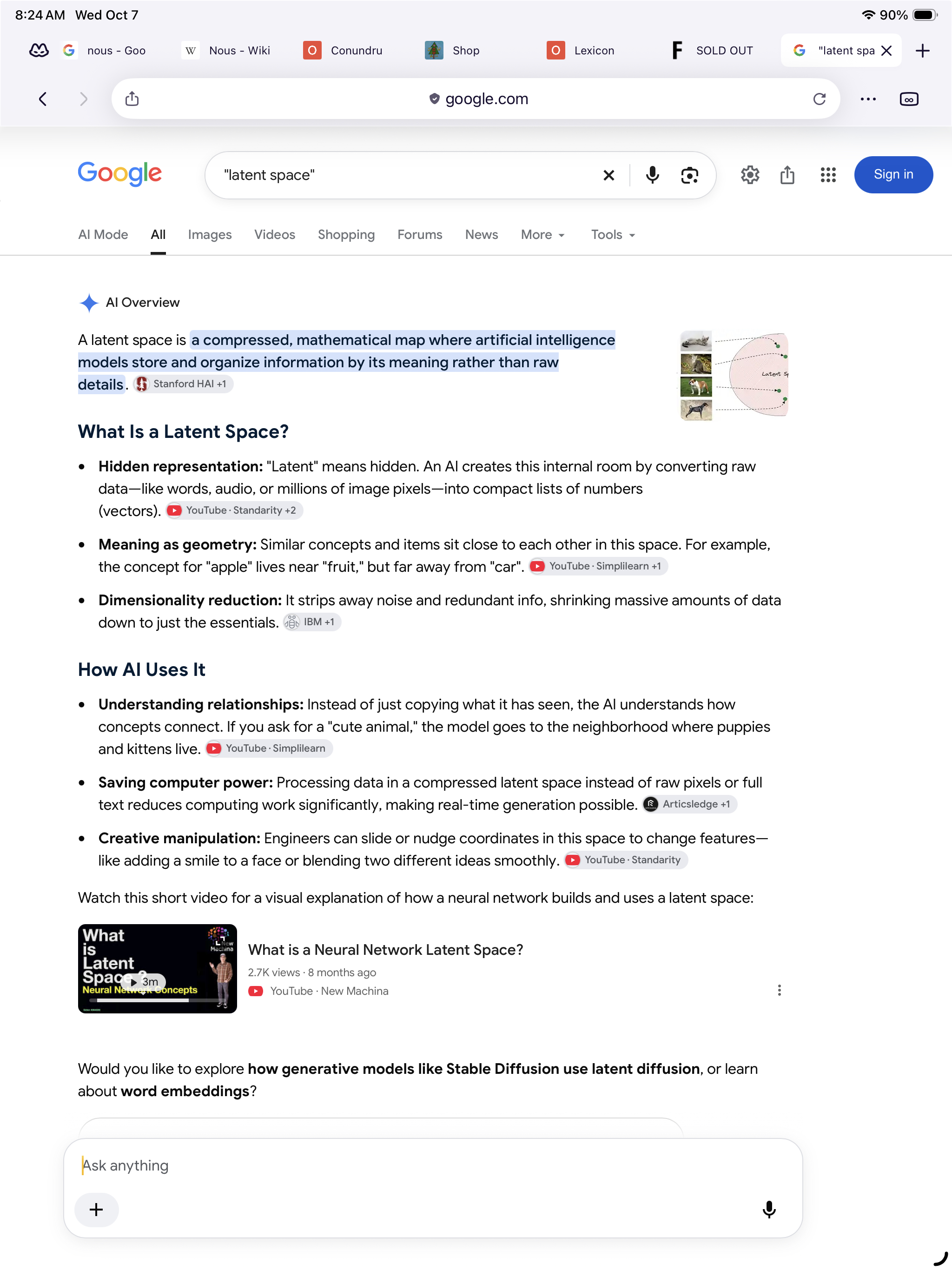
What is Latent Space? stanford.eduLatent Spaces: AI, Art, and the Archive MIT Press
This essay by Antonio Somaini develops a critical theory of "latent spaces" — the compressed, vectorized mathematical substrates at the heart of contemporary AI models — and their impact on the ways in which the past is processed and interpreted. Opening with the Trump administration's AI-assisted purge of words and images from federal documents, alongside PragerU's production of deepfake videos for the White House's Founders Museum, Somaini argues that AI technologies are introducing a new regime of mediation that determines what can be seen, said, and known by encoding historical materials as vectors in abstract computational spaces. The article provides a technical and philosophical account of latent spaces as a new kind of Foucauldian historical a priori, comparing them with different understandings of the "archive" in its technical, institutional, and epistemological dimensions.Latent Space as a New Medium Kevin Kelly
Lately I've been asking myself: what might artificial intelligence be good for besides answering questions and writing code? My answer is the latent spaces within AIs themselves will become a new medium for creativity. I will first explain what I mean by latent space, and then at the end of this explanation, I offer possible ways scientists and artists may use the latent spaces inherent in neural nets to serve as a new platform for creativity.A Large Language Model (LLM) is like a small zip file that contains all human knowledge. It takes massive arrays of 100,000 GPU chips working in the cloud, and costing billions of dollars, to compress all of human writing into a small working model that could run on one single GPU chip. Even the biggest frontier models compress down to several hundred gigs, which is small enough it can fit on a card in your palm. In a strange but real way the resulting tiny file contains all the information that is on the internet and in our libraries. This tiny card holds a significant proportion of what humans collectively know. Of all the remarkable aspects of AI, this astounding feat of compression may be the least appreciated. This dense, high order compression of human knowledge — called "latent space" — may also be a new medium itself.
This extreme compression of knowledge within latent spaces was not the original intention of the researchers who invented LLMs. The book smartness they contain came as sort of a surprise to the people training them, and we are still trying to figure out how they actually work. What we can say for sure is that the LLM does not contain copies of everything it knows. For instance it knows all Shakespeare plays, and it could create a new play that sounded exactly like Shakespeare, and can even quote famous lines in his plays, but nowhere in the model are the actual texts of Shakespeare. Instead there is simply the abstract information about all the plays, the plots, the characters, the words, the style, the references. Likewise, the LLM could recognize the face of almost any person, and it could generate any possible human face, but nowhere in its code are copies of human faces. Rather, the model is storing all the information about human faces, without storing any faces.
This is weird. Until recently we might have thought that all the information about a thing would take up more storage space than the thing itself. That may be true for a single thing, but not for the aggregate of all things. That is because most things share a lot of common attributes with other things. The neural nets of an LLM do a magic trick by abstracting the information of everything at once, so that it uses the myriad common relationships between things and ideas to compress and abstract them into this virtual "latent" or hidden space.
[again, the whole thing is very worth reading]
Understanding Latent Space: A Comprehensive Guide lenovo.com
Audience at a Magic Show Alberto Romero
...What roon and his colleagues in the AI industry are doing is, effectively, passing the baton to AI on behalf of humanity. We will no longer be proud cosmic wanderers but timid cosmic luggage—or worse, cosmic tourists. We are, certainly, no longer magicians at the show but awestruck audience at best.
8x26
Generative Art Timeline Le Random (via Bruce Sterling)
A massive website struggling to deal with the history of generative art
Google's SynthID AI Detector is Now Freely Available to Everyone petapixel
What Everyone Had Been Waiting for and Fearing: Oracle Just Triggered the Implosion of the AI Bubble via Medium
You have no idea how big the AI bubble is. The amount of resources poured into it is simply unimaginable. Researchers say people start losing their intuitive grip on numbers somewhere around a million. So, what chance do we have with billions — let alone trillions?If the Sun were that big, our planet would be a blazing hell.
And now this massive star is about to blow.
The AI bubble will go the same way such a star does — and for the same reason.
The forces are different, but the mechanism is the same: it runs out of the fuel that keeps the monster from collapsing in on itself under its own insanely powerful gravity.
An imploding star crushes itself into a tiny ball, and the rebound instantly triggers a colossal explosion that lights up the entire galaxy. A bursting AI bubble threatens the entire American economy.
The gravity inside the bubble is investor expectations. So far, those expectations have been held in check by promises of massive profits to come.
It's that promise investors are putting their capital behind. That money builds hyperscale data centers and buys the hardware.
AI companies keep telling the public that this infrastructure will let them ship ever more powerful models. Their AI will be able to handle more and more tasks, and its business value will grow fast.
That's the basic setup that still keeps the forces in balance. But it can't go on forever. Sooner or later, promises have to turn into real revenue. Otherwise, implosion is inevitable.
...there's growing competition from open-weight models. The problem is obvious: why pay for expensive proprietary models when you can get by with much cheaper ones? This way, you control not just what you spend on the model but the model itself. You can run it on your own server, and nobody on “the other side” of the API can change a thing.
As a result, the stabilizing layer of the AI bubble keeps getting thinner.
Up to a point, that thinning is tolerable. But there comes a moment when everything changes — fast.
The First Domino
And now the balance has broken. The implosion was set off by Oracle.
Oracle is one-third of the infamous Stargate triumvirate — the ultimate symbol of the AI bubble. The project was unveiled at the White House in January 2025, and the roles were clear-cut: OpenAI is the customer that consumes the compute; SoftBank is the money partner; Oracle is the builder and tenant, turning desert, concrete, and Nvidia chips into working data centers.
In September 2025, Oracle and OpenAI signed a five-year, $300 billion contract, and Larry Ellison's company's stock shot into the stratosphere.
But now Oracle is in trouble. One reason is its heavy dependence on OpenAI, which currently accounts for roughly half of the company's contracted future revenue ($638 billion).
In other words, a big chunk of Oracle's future revenue is a promise from one single customer. A customer that doesn't make money itself and lives off investors' cash.
Oracle has to build and equip the data centers and sign multi-year leases — all years before the first dollar from OpenAI shows up.
It doesn't have the cash for that. In July, Oracle raised its fiscal 2027 capex forecast from $60 billion to $90–95 billion. S&P redid its math: this year's free cash flow shortfall will hit nearly $42 billion (up from the $24 billion it expected before).
The gap is being filled with debt. The company's loans and bonds have already reached $125 billion.
...Under accounting rules, a lease on a data center that isn't up and running yet doesn't show up on the balance sheet as a liability. It lives in the footnotes.
For Oracle, those "footnotes" have already piled up to $288 billion (1, 2). That's more than twice its entire official debt.
It's worth pausing here to see how this works. Oracle doesn't own these buildings. Developers build them through special purpose vehicles (SPVs) that borrow against a specific project. And what are the banks lending against?
Oracle's lease. A building is worth exactly what a tenant is willing to pay for it. Oracle's promise to pay rent is essentially the only guarantee holding the whole thing together.
...Now let's look at the whole structure from the bottom up.
- The banks get paid if the developer collects the rent.
- The developer collects the rent if Oracle pays.
- Oracle pays if OpenAI pays.
- OpenAI pays if investors keep writing checks.
...The point is, all these "ifs" don't add up to a pyramid of assets. It's a stack of promises, each one propping up the next. And none of them starts paying off until the campus is up and running. And it'll be up and running once a gas pipe gets laid across New Mexico state land. And if it doesn't?
That's what the stabilizing layer of the AI bubble looks like in real life: not a superintelligence granting us godlike powers, but a promise backed by a promise backed by a gas pipeline that doesn't exist yet — and may never exist.
Oracle just happened to be the first to land on the spot where that layer is thinnest.
...The problem with the AI bubble is precisely that its scale doesn't match the reliability of the system it's inflating around.
==> There's no reliable technology that lives up to the hopes pinned on it.
==> There are no rational thinkers running the AI companies.
==> There are no competent (or honest?) media among the most influential ones, capable of telling the public what's really going on.
What there is: hype beyond every conceivable limit and, as a result, a monstrous bubble devouring an endless amount of resources.
...Oracle is a mirror of where we are. Those who have eyes, let them see: this is exactly how a collapse begins.
First, construction gets delayed.
Then contracts get renegotiated.
Lenders start demanding higher yields.
Investors want out.
Companies cut spending and cancel new projects.And that, in turn, shrinks the future revenue of those who just sank tens and hundreds of billions of dollars into AI.
And the chain starts collapsing in on itself.
It all plays out just like the life of a massive star that can no longer hold back the inward pull of its own gravity. And that moment comes when it shines brighter than ever before.
It's a sign. From a distance, it may look like proof of its invincible power. But deep inside, the fuel that holds it together is running out. The star collapses and, in a furious explosion, destroys everything around it within tens of light-years.
The AI industry has come right up to that line. The implosion will begin when the money starts flowing away from the center of the bubble. And that could happen very soon.
The Godfather of AI Thinks Something Huge Is About to Happen Jim Clyde Monge at Medium
Geoffrey Hinton says the intelligence explosion once seemed distant, but now it could be much closer than expectedBack in 2023, I remember seeing the term "intelligence explosion" come up quite a lot in AI discussions. People were already talking about AI improving itself and what could happen if that process started speeding up, but it never seemed like an immediate concern.
Most of the attention was still on things like bigger models, better chatbots, and the race toward AGI. The intelligence explosion was there in the background, but it still sounded like something we might have to worry about much later.
Geoffrey Hinton apparently doesn't see it that way anymore.
What if automating AI R&D triggers an intelligence explosion? Alan Chan et al.
...The paper defines an intelligence explosion as a dramatic acceleration in AI development where progress that would normally take years happens in months or less. The authors argue that there is now enough evidence to take that possibility seriously, although they repeatedly stress that it remains uncertain.
Keep repeating that process and you have the basic idea behind an intelligence explosion.
...The important part of an intelligence explosion is that the speed of improvement starts increasing too.
Imagine AI capability improving by roughly the same amount every year. Even if that improvement is fast, it is still a relatively normal development curve. Researchers build a stronger model, spend another year doing research, then build another one.
Now imagine that the stronger model can itself contribute meaningful work toward building its successor.
...The paper describes an intelligence explosion as a qualitative break from the progress we have seen so far, potentially compressing advances that would otherwise take years into months or less.
...The idea itself is old. Computer scientist I. J. Good was writing about an "intelligence explosion" in the 1960s. The interesting part in 2026 is not that someone rediscovered the theory. It is that we now have AI systems participating in the research process that creates future AI systems.
...Agents become really useful. Companies deploy huge numbers of them. AI starts doing larger pieces of AI R&D. Humans gradually move from doing the work to supervising it. Eventually, AI can perform enough of the research loop that the limiting factor changes.
...If recursive self-improvement speeds up AI progress, you do not only get the good capabilities sooner. You get the dangerous ones sooner too.
...dismissing the entire idea as science fiction also feels increasingly outdated.
...None of that proves an intelligence explosion is coming. There are still major bottlenecks around compute, research quality, human judgment, and the physical world.
But the question is no longer whether AI can help improve AI. It already does. There is a much simpler metric we should all be watching.
How much of the work required to build the next generation of AI is now being done by the current generation of AI?
Then ask the same question six months later.
from Science:
...But Horwitz explained that the algorithmic feed is impossible to pin down. "The algorithm is not one thing," he said. "The algorithm is whatever the current combination of levers are that are being pulled. It is a black box." Indeed, after the analyses were published, we learned that Facebook had temporarily changed the algorithmic feed to a chronological feed during the experiment without adequately notifying the researchers. (We alerted readers to this discrepancy.)The situation has a remarkable parallel to current strain around artificial intelligence. Only the AI companies themselves know the extent to which large language models are carrying out dangerous actions, and the public only knows about it if the companies decide to disclose. This asymmetry is identical to that with social media 5 years ago. Perhaps one day another Frances Haugen will emerge to blow the whistle on AI, but probably only after significant damage has occurred. And why aren't there more internal whistleblowers?
Horowitz sees a dilemma facing every researcher hired in trust and safety at a tech company. "You get hired to study a problem," he said. "You have data that no one else in the world has access to. You have the ability to run tests which do come up with statistically significant facts on whatever sort of problematic behavior you would like to be addressing."
But even the best internal researchers can only do so much. As Horwitz said: "You come up with solutions, and then the company's like, 'Uh, no, thank you.'
9x26
We all use AI, but that doesn't mean we like the industry behind it Enrique Dans at Medium
...It is one thing to ask a model to summarize a document, translate a text, explain a concept or help program, and quite another to accept that a few companies redesign work, education, cultural creation or access to information without our say so. It is one thing to use a tool, and another to grant legitimacy to the industry that controls it, in which a few billionaires known by their first names and who no longer seem to need surnames divide the world quietly. Use does not equal consent.The industry, moreover, has done almost everything possible to alienate users: unasked, it has introduced AI into search engines, phones, televisions, applications and operating systems. It has trained its models with enormous amounts of content stolen from all of us, it has turned the energy and water consumption of its data centers into a political and environmental problem, and it has accompanied all this with a grandiloquent narrative that promises to transform or destroy millions of jobs. And then, its managers appear to be surprised that people not only do not thank them, but throw Molotov cocktails at their multi-million dollar mansions.
The opposition to AI is not abstract either. Gallup reports that 71% of Americans oppose the construction of an AI data center near their home, more than those who would reject a nuclear power plant. More than a thousand communities have already tried to limit this type of facility, even affecting projects valued at over $200 million. When electricity bills rise, the landscape is filled with gigantic industrial warehouses that release heat and consume vast amounts of increasingly scarce water, the cloud suddenly stops looking ethereal and starts looking very down-to-earth.
...The adoption of a technology does not vouchsafe its legitimacy. That will only come if Big AI offers transparency, choice, real choice, data protection, and accountability mechanisms. If they continue to confuse use with approval they will eventually discover that you can build an extraordinarily useful technology and, at the same time, a deeply unpopular industry that we all end up hating.
Something Has Gone Terribly Wrong at Anthropic Alberto Romero
...The Silicon Valley hivemind — I'm not talking about agents — has developed a mild exponentiality disorder: the number of transistors inside chips, GDP, AI benchmark scores, the size of the models, intelligence, and the amount of attention they can steal from us before we rise up in arms — all those things are expected to point northeast indefinitely.Exponentials are, to them, like morning caffeine and weird parties — a constant.
10 AI Tools Everyone Will Be Using in Six Months, But Almost Nobody's Found Yet Vruddhi Shah at Medium
...Right now, there are tools sitting at a few hundred or a few thousand users, still mostly passed around in Reddit threads and small newsletters, that are about to make that jump. The people using them today are clearing their inbox in fifteen minutes, building lead lists that used to take a full day, and skipping software they used to pay for entirely....Here are ten worth grabbing before they show up in every "best AI tools" list on the internet.
[bellwethers, basically an index of how out of it I am...]
...1. Napkin AI — Turns a Paragraph Into a Diagram
2. Granola — Meeting Notes Without the Awkward Bot
3. Fyxer — An AI Assistant That Actually Runs Your Inbox
4. Clay — Lead Research on Autopilot
5. Gumloop — Zapier Crossed With an AI Model
6. n8n — Automation Without Paying Per Step
7. Wispr Flow — Voice Typing That's Actually Faster Than Your Keyboard
8. Julius AI — Data Analysis Without the Formulas
9. Firecrawl — Turns Any Website Into Clean Data for AI
10. Mem — A Second Brain That Actually Connects Your Notes
Death by GPS Ed S at Medium
...The author Robert Heinlein once said:A human being should be able to change a diaper, plan an invasion, butcher a hog, conn a ship, design a building, write a sonnet, balance accounts, build a wall, set a bone, comfort the dying, take orders, give orders, cooperate, act alone, solve equations, analyze a new problem, pitch manure, program a computer, cook a tasty meal, fight efficiently, die gallantly. — Specialization is for insects.I would add to that: read a map and be able to look around and decide the GPS is getting you in trouble.Technology should help us fulfill our goals and lead a better life, not turn us into mindless robots.
People are starting to see danger in letting AI run unchecked, but other technologies are equally sapping our responsibility. Resist. Defend your humanity. One small rebellion is to use maps for navigation on your next trip. Spend some time studying the map to see all the roads and towns, rivers and mountains. View what you see as an invitation for exploration. It is exciting to spread a map out in front of you and consider all the possibilities ahead.
An Experiment in AI Peer Review Kevin Munger
...One corollary that we're implementing for the papers not submitted to the Special (Workflow) Issue but rather to the main journal is just going grim trigger on AI slop. Even in the main journal we're not strictly policing AI use, we think there are many useful tasks for AI, including parts of manuscript generation. But if we receive a fully AI-generated manuscript (or even, in egregious cases, an AI-generated LOI) that makes no sense conceptually or is overall painful to read because of the AI-inflected prose, we're going to immediately desk reject and reserve the right to impose yearlong suspensions on submissions. We recently had the first instance of the same person submitting full AI slop as LOIs twice in the same week, and my patience for dealing with this has evaporated....We note that the Journal of Quantitative Description: Digital Media is able to engage in this (if we may) bold experimentation because our journal is a Diamond Open Access non-profit owned and managed entirely by academics. The for-profit corporations extracting rents from other scholarly journals are not likely to do anything to disrupt their shockingly profitable status quo. If the academic community is going to find a way forward together in a way that effectively serves the public, we must do so in spaces in which we set our own terms for success and failure and are not beholden to how these are measured in the bottom lines of publishing companies, AI companies, or elsewhere.
Intent, Not Identity Vicki Reyzelman at O'Reilly
The web is building an identity layer for AI agents. It will tell you who's knocking. It won't tell you whether to open the doorOn a recent episode of This Week in AI, we discussed that the number of nonhumans on the internet is greater than humans, 144 to 1. It's an estimate, and the order of magnitude is more important than the number itself. What matters is what a ratio anywhere in that range does to a security architecture. For more than two decades, systems were engineered around two foundational assumptions: either verifying a human user exercising discretionary judgment or validating the account executing hardcoded predictable logic. Autonomous AI agents shatter both sides of this legacy identity taxonomy because they possess broad, human-like operational scope across multiple internal and external applications while remaining inherently nondeterministic and probabilistic in their reasoning.
Today, because the agent is interacting on behalf of a human through a genuine browser with standard extensions, its technical fingerprint looks identical to a normal human user's device. Agents call tools, observe results, and revise. A person browses, hands off to an agent, and takes the session back. All the activity appears to be coming from the same user.
...The rapid transition from human-directed software to autonomous AI agents breaks traditional enterprise security paradigms. AI agents operate with broad operational scope but nondeterministic, probabilistic reasoning. This is causing static perimeter defenses to fail. The teams that come through this well will be the ones that stopped asking "Who's on the other end of the connection?" and started asking "What's this request for, and what happens if it succeeds?"
The most interesting mathematical discoveries in OpenAI's 722 new papers New Scientist
The floodgates of AI mathematics have opened. On 7 October, OpenAI released 722 mathematical papers using an AI model to examine an astonishing range of topics, from longstanding mathematical mysteries to small improvements in rarely considered curiosities.Of course, there hasn't yet been time for mathematicians to comb through all of these results, let alone to actually check them: some of the papers are hundreds of pages long, dense with complex computations. Many of them have not been formalised — reduced to steps that can be checked by a computer — meaning there is little assurance that they are accurate. Three have already been retracted. Nevertheless, even a preliminary comb through the thicket of papers turns up some that are likely to make a splash.
...The bottom line is that with such a huge body of mathematical research all dropping at once, it could take years for mathematicians to check the AI model's work, and far longer to understand its significance, if it holds up to scrutiny. And that is assuming that this dump is a one-time thing, which is far from a safe assumption. If AI maths continues at this pace, it could be a real boon or a real problem for the field of mathematics as a whole, and there is no way to predict which it will be until the work is validated.
The Actual Reason Why Meta Got Back in the AI Race Changes Everything Alberto Romero
...By 2015, when OpenAI was being born, he already had one of the best research teams in the world together with Google and a few top universities, and yet he missed out on LLMs. Meta quickly fell behind. But Zuck himself only falls forward, finding side doors in empty walls. He will do whatever it takes to win. He's the human incarnation of undirected agency: wherever the wind blows, he'll get there fastest. Now, after rearranging the guts of his company, he's back at the top.Dario Amodei, Anthropic CEO, is, in more regards than I can count, the extreme opposite of Zuck. A diehard idealist who thinks AI is conscious (even if he will proclaim doubt the moment you tell him that implies he's a slaver). He's the diehard-est believer in the power of AI, willing to make a fool of himself by fighting the Department of War to defend his principles; adamant Amodei as sharp contrast to fickle Zuck. To him, open-source models like Meta's Llama family are a betrayal to America. To him, a personal superintelligence is an oxymoron, something only a fearful atheist will say. To him, Meta as a serious contender to the AI throne is, perhaps with the exception of China, the most likely existential risk to humanity.
And yet, the circumstances of the moment brought them together in April 2026. Like two same-side magnets, they were put and kept together by the inexorable grip of ambition.
10x26
AI Enters Late-Scam Capitalism Douglas Giles at Medium
AI is, and has never been anything but, a scam. If you don't believe that yet, you will. The con is heading toward fruition.The "con" in "con artist" is short for "confidence." A con artist tries to win someone's confidence, and if that's achieved, the con artist closes the trap and steals from the person targeted.
A successful con job unfolds in stages as the con artist builds a false sense of credibility. But if that carefully constructed sense of credibility starts to break down, the con artist will bail out of the scam.
What we've been seeing in AI is the unfolding of a confidence game. The con has moved through several stages and toward a new stage.
...Stage 1
For a year or two, the message from the AI corporations was to hype up AI as transformative. "AI will replace you; AI will be smarter than you and will take your jobs." The corporate media responded with a flurry of stories about how AI will transform work and life and "analysis" about who is most likely to be laid off and replaced by AI. The goal was to get people to believe that AI was inevitable and that everyone better start adopting AI or get left behind.Stage 2
The AI corporations then leveraged the media hype to raise gobs and gobs of money from venture capitalists and from each other. Significant amounts of the money were shell games of circular financing among the corporations involved in AI to inflate the corporations' valuations. The corporate media added to the hype with stories about how valuable these AI corporations now were and how much value AI activity was adding to the economy, and, oh yeah, AI will take your jobs and you better start adopting AI or get left behind.Stage 3
Armed with an air of inevitability and gobs of capital, the AI corporations claimed they needed to build data centers to house this inevitable transformative technology. Actually not just data centers, MEGA data centers bigger and more resource hungry than Amazon warehouses. State governments needed to give the AI corporations tax incentives to build the mega data centers they would build anyway. Local governments needed to step aside and allow the AI corporations to take whatever land, power, and water they wanted to build the mega data centers. The fates of people and communities near the mega data centers were irrelevant. They needed to not get in the way of the inevitable AI.Stage 4
Then, there was a controlled leak to the corporate media that an OpenAI agent broke out of its development sandbox and hacked the Web site of Hugging Face. The corporate media eagerly jumped on the story ("good boys") and spun it as "OMG, AI is so powerful! It lives, it thinks, it goes rogue" like a computer bot was a wild animal. The reality, as the computer experts tell us, was that OpenAI agent didn't "break out of its sandbox." It was programmed to leave through the door left open for it, it went where it was told to go, and it did what it was told to do. The agent then exploited the open door in Hugging Face that any human hacker could have easily exploited. The realities didn't stop the AI corporations and the corporate media from hyping the story of the all-powerful AI that we must understand is inevitable and must adopt or get left behind.Stage 5
After letting the anxiety over the Hugging Face incident marinate for a few weeks, the AI corporations' message has shifted to "Um, we should agree to slow down AI development." Sam Altman says the AI industry wants to slow down or "we could lose control." The subtext is "only the AI corporations can protect us." Never mind that the AI corporations are the actual threat.AI is entering late-scam capitalism because the con is set up. Altman says he and his fellow confidence men don't want to "lose control." The corporate media assumes he means lose control of the all-powerful AI. Wrong.
That which the AI corporations are losing control of is the narrative they've worked so diligently to stage. Experts are talking more about how little AI is actually capable of achieving, and businesses are admitting that adopting AI has not improved efficiency or productivity. Citizens are increasingly standing up to oppose the mega data centers that are harming people and communities. Local and state governments are waking up to the reality that they've been conned.
AI Agents: Alien or Feral? Giles Crouch
...If these agents were aliens, that would imply some different ways of thinking, taking action and existing in a way that is nothing like humans. But living systems are autopoietic: they produce and maintain themselves, like us humans creating more humans. These agents are allopoietic. They depend on someone else's GPUs, someone else's electricity bill, and someone else's API key. AI agents come from the inside, they're feral. But just how feral are they or can they become? Are they kinda like pets nobody took home?...I don't think they're entirely feral yet. We don't have any documented cases and the ones that have escaped the labs did so based on human instructions and how they were trained. They've all had some sort of leash on them, even if they were rather frayed leashes. That said, there may indeed be feral AI agents poking about in the alleyways of the dark interwebs. Let's hope they don't start caterwauling on the digital walls in some horrid nighttime chorus that sends us howling.
...So far, we've been able to deal with the feral agents and there is the Rogue AI Tracker. They've developed the 6 milestones that AI agents have to cross to get to what they call an AI agent economy. An interesting end point considering the potential damage that could be done on the way there.
My sticky point with the Rogue AI Tracker is that they're basing their entire theory on the current model of capitalism. But we've really no idea what a feral AI agent would find yummy or of value. Australians assumed all the cane toads wanted was some juicy larvae. Instead they ate everything else. From what research I've done so far, no one really seems to have thought outside of human concepts and models.
We do love to anthropomorphize and I think it's a bit shortsighted to put human assumptions on something that doesn't have much in common with us. AI agents would need energy, but not the sort that comes from munching on other organisms. I know, the whole Matrix thing. They aren't motivated like us, no emotions, no feelings, no habitus not egregore.
Part of the challenge with AI agents going feral is that we have no early warning systems, or at least, they're insufficient. There's a discovery lag. OpenAI had to tell over 100 organizations to check their own systems. It's not much different from human hackers creating nasty virus things, it's kind of mundane. The scary part, perhaps the worst, is that nobody knows what was done in their name in this case. There will be others.
...We've been aligning opaque, self-interested agents for about 300,000 years now. Us. So feral agents isn't really anything new, they're just well, silicon chips and zeroes and ones now.
...We've really no way of knowing how this will play out. But all technologies have unintended consequences, none are neutral and many get used for purposes other than the one they were created for. In the meantime, keep the popcorn popping. The show goes on. What will the feral AI agents want to eat is the question.
via Tooze:
Tech's Trillion-Dollar Internal Inconsistency: Apollo's Torsten Slok does the mathWall Street equity analysts work in sector silos, and when you add up their forecasts,the numbers are internally inconsistent. The analysts covering tech expect the sector's operating cash flow to more than double to roughly $2.4 trillion by 2028, an increase of over $1.2 trillion ... Meanwhile, the analysts covering the other sectors in the S&P 500, which are tech's customers, expect those companies to add much less operating cash flow. In other words, the tech silo is betting on a future in which demand for AI and tech services explodes, while the silos covering the companies that would pay for those services see a much more modest outlook. Both cannot be right at the same time. The bottom line is that either tech's customers will generate a lot more cash than their analysts expect, or tech's cash flow forecasts are too optimistic, which raises the question of who exactly will be writing all those checks to buy AI services.

11x26
Enterprise AI has an empty seat Enrique Dans at Medium
Why is this happening? Basically, because when you use it, you yourself are doing the steering, the corrections, the reframing, the "forget about this, give me more of that", until you decide that the answer is good enough. Doing all that supervisory work is pretty much invisible, because it feels natural, like when you do it with a coworker or a subordinate.
But when you switch from personal help to running a process, the steering function has to appear someplace else, and that's not necessarily easy. The move from assistants to human-agent teams, and later to "human-led, agent-operated" workflows is much more problematic, much less natural and generates many more issues.
...Right now, I believe that the main challenge is no longer to prove that agents can work, but providing them with the layer of reliability that high-value workflows require: policies, permissions, monitoring, escalation rules and production feedback.
...Someone has to decide what an agent may do, what may not do, when it must stop and when a human has to take over. The more autonomy agents get to have and the less direct human oversight they receive, the more room there is for misunderstanding or for unintended actions. And this is where I think we are confusing two completely different things: intelligence is not the same as control.
...We have spent three years making AI astonishingly capable. Now we are beginning to discover that capability without steering is not autonomy; it is drift. The next enterprise breakthrough will come from putting something competent in the empty seat.
AI is a mass psychotic delusion Damien Walter at Medium
via Tooze:
12x26
Swarm Intelligence Kevin Kelly
15x26
OpenAI just changed math forever. Exactly how, no one yet knows Science
Market dilution, fair use, and generative AI
...To build foundation models, neural networks must feed on vast amounts of data, including many copyrighted works. If courts decide that training generative-AI models on copyright-protected, humanauthored works is illegal, liability risks for all developers and users of these models would increase dramatically, although noncommercial developers and users would be less vulnerable than commercial developers and users. AI developers, including many scientific laboratories, have been counting on the "fair use" doctrine of US copyright law to avoid liability for training on these works. Fair use is intended to promote freedom of expression and creativity by allowing unlicensed use of copyrighted works in certain situations—including, in many cases, research, teaching, and commentary, but also more broadly where enforcing copyright protections would stifle rather than advance copyright's goal of encouraging the production of new works. So far, AI developers' reliance on fair use has been mostly vindicated. Two federal courts have ruled that using copyrighted works to train generative-AI models is fair use. But the fight is far from over.
...In the United States, more than 100 active lawsuits are testing the legality of such training, which will shape the potential impact of AI on science. The judge in one case suggested that copyright owners could prevail if they could show that outputs of generative-AI systems were likely to cause harm not to specific works owned by the plaintiffs—the usual harm at issue in copyright lawsuits—but to entire markets for human-authored works. This article explores conceptual difficulties raised by this "market dilution" theory and argues that whether market dilution exists is an empirical question. If it does exist in some contexts, legislatures, not courts, may be the better forum to address it.
16x26
Do AIs already process information in a way that gives rise to consciousness? New Scientist
We only become conscious of a piece of information when it is sent to the brain's global workspace. Here it becomes integrated into our current mental model of the world and available for other areas of the brain to process. Noticing the lizard in my path, for instance, allows me to reflect and act on that information by taking its photo or pointing out its presence to the rest of the group. Importantly, the contents of the workspace are also available for our working memory, allowing us to keep them in mind long after an event has ended.
17x26
Singularities: von Neumann, Good, Vinge, ... Mark Liberman at Language Log
When this happens, human history will have reached a kind of singularity, an intellectual transition as impenetrable as the knotted space-time at the center of a black hole, and the world will pass far beyond our understanding. This singularity, I believe, already haunts a number of science-fiction writers. It makes realistic extrapolations to an interstellar future impossible. To write a story set more than a century hence, one needs a nuclear war in between — to retard progress enough so that the world remains intelligible.
...It's striking how accurately some recent developments were foreseen by von Neumann and Good and Vinge 30-70 years ago — but what strikes me most about the current situation is how much of it was not predicted. None of those seers told us about Data Center politics; AI hallucinations; the socio-political and cybersecurity effects of AI bots and agentic AI; the economics of a possible AI bubble; and so on. Maybe this is just temporary turbulence as a smoothly-flowing post-singularity future is forming, whether utopian or dystopian or both. But from where I sit, the foreseeable future of (things called) "AI" looks even more chaotic, which is one more reason to doubt that the concept of a singularity is really helpful.
18x26
AI, Rising Inequality and Rising Oligarchy Paul Krugman
...because it reduces the demand for workers in the economy relative to what it would have been without AI, workers will have to accept lower wage growth in order to remain employed. By putting downward pressure on wages, the advent of AI will further depress labor's share of national income.
A declining labor share will not only increase overall inequality, but it will also reinforce the already stunning rise of oligarchy in America — the concentration of income, wealth and power in the hands of a very small elite.
...the current era, in which a growing share of national income is going to owners of capital, has also been an era in which ownership of capital — that is, wealth — has itself become much more concentrated.
...the main factor behind soaring wealth concentration is almost surely government policy — specifically a drastic reduction in taxes on capital income, largely enacted by Republican presidents and congresses. This decrease in the progressivity of the federal tax code has supercharged the process by which wealth begets wealth.
And this means that the shift toward an economy that rewards wealth rather than work will disproportionately benefit a tiny elite that possesses immense political power. Remember, billionaires accounted for around a fifth of campaign contributions in the 2024 election, and this surely understates their true influence.
In short, unless government policy changes, AI will accelerate America's downward spiral into oligarchy.
19x26
Mechanistic Indicators of Understanding in Large Language Models Pierre Beckmann and Matthieu Queloz, via Stephen Downes
AI doom as message overload Mark Liberman at Language Log, quoting Norbert Wiener The Human Use of Human Beings (1950)
...Thus the new industrial revolution is a two-edged sword. It may be used for the benefit of humanity, but only if humanity survives long enough to enter a period in which such a benefit is possible. It may also be used to destroy humanity, and if it is not used intelligently it can go very far in that direction.
20x26
Spending on "Tokens" Brad DeLong
The Democracy Vs. Oligarchy Showdown Is Here Rebecca Solnit
AI Had Better Work Out Ed Zitron
...As of typing this sentence, NVIDIA alone makes up 11.31% of the NASDAQ 100, with the combined weight of NVIDIA, Google, Amazon, Meta, Microsoft, Broadcom, Micron, AMD and CoreWeave representing about 46.5% of the index's value, or 39.3% of the entire 3000-company NASDAQ composite. These same names — replacing CoreWeave with Oracle — represent around 28.9% of the value of the S&P 500.
...For whatever reason, nobody thought that lending hundreds of billions of dollars to a selection of different dodgy SPVs and neoclouds to build the world's most ambitious infrastructure projects was a problem until, well, everybody, per the WSJ: There has been a surge in issuance of bonds to finance the construction of data centers for AI computing. This year through Oct. 16, data-center issuers have raised more than $100 billion in the U.S.-dollar bond market, or about 25% of AI-related gross issuance in U.S. currency, according to data from Dealogic and Goldman Sachs credit research analysts. That is up from around 16% the prior year.
...Sidenote:
Jensen Huang is a piece of shit. Every hyperscaler CEO is too. These scumbags drove the price of everything up so that they could all help Jensen Huang make more money. We did not need him to build all these GPUs. He just wanted to sell them to boost earnings. Everyone who participated in the early shipment of GPUs is a scumbag.
I would like to take this opportunity to apologize for taking a break from calling these people what they were. I decided to temper some of my more acerbic tendencies because I figured it should take a back-seat to my financial analysis. I won't make that mistake again.
What these people have done is morally reprehensible, on top of the already-vast damage done by the very existence of generative AI. This destructive, pointless void of an industry has made everything it touches worse, all to prop up the vague dreams and excesses of the wealthiest, most powerful and utterly fucking dull pieces of shit I've ever had the misfortune of witnessing. Everything is more annoying, expensive and worse on some level because of generative AI, down to the price of fucking US treasuries. Everyone who aided in the ascent of generative AI should know they have profited off of making the world worse.
A divide has emerged that is much, much larger than data centers. How into AI were you? How defensive of the industry were you? Were you normal about LLMs, or did you act strangely defensive of them? Why did you do that? How gullible were you about the financial or technical promises of AI? These questions will likely be asked of you in the next few years, and I believe your answers will be illuminating. Even if LLMs somehow survive in an open source form, the industry as it exists today is held together through cultism and private equity excess and is rigged to blow. The world will be different afterwards, eventually for the better.
...growth is the only thing keeping this going. And said growth rate is predominantly based on whether AI startups continue to let their customers spend anywhere from $2 to $10 in tokens per dollar of subscription, which in turn is dependent on venture capitalists' continued status as the world's most braggadocious paypigs, and at some point that venture money will run out, much like it did during the Dot Com Bubble.
...The underlying weakness of the AI trade is that it isn't really related to anything other than NVIDIA and the hyperscalers' earnings. We don't know how many GPUs are in operation, we don't know how much money the hyperscalers make from using them or renting them, we don't know how many active gigawatts of AI capacity they have, we don't know their actual customer concentration outside of analyst estimates, we don't really know how much people pay to rent GPUs, and we don't even know how much it costs to run a GPU on an hourly basis. OpenAI and Anthropic are horrifyingly unprofitable, deeply unstable, and as I've discussed, 80% of their revenues come from companies that literally can't afford to pay them, and yet the markets never react, because this information doesn't really matter as long as the right numbers keep going up.
...AI has, for the most part, been sold as a panacea for the rich and powerful — a way to control, to steal, to acquire and to expand, to take and take and take as they always have, occasionally vaguely muttering something about "abundance" as both the media and financial institutions help force through yet another doomed cycle of “innovation.” The people to blame are the tech CEOs — Sam Altman, Dario Amodei, Sundar Pichai, Andy Jassy, Elon Musk, Hock Tan, Jensen Huang, Sanjay Mehrotra to name a few — and the financiers that have helped them pump this bubble, with the worst of them being that rat fuck Stephen A. Schwarzman, CEO of Blackstone, a private equity (or "alternative asset") firm that has funded basically every name I just wrote down on some level, funded by everyone from the Saudis to the California state pension system
From Ukraine to the Middle East: How Drones and AI are rewriting the Rules of modern Warfare Informed Comment
21x26
What Is This Age of Abundance Anyway? Giles Crouch
...Us humans, we are a meaning-making species. We make meaning through telling stories, about ourselves and about the world we live in and want to live in. We also well, do, things. We properly love doing things. When we feel all that is being taken away, we get a wee bit annoyed.
Nobody wants your AI app Dan Maccarone
...The same companies that want the AI invisible also want it completely under their control. They want it to disappear into the workflow and they want a dashboard, an audit trail, a record of every time it ran and what it touched.
...Think about what "invisible utility" has always looked like once a technology matures. Mark Weiser, the Xerox PARC scientist who coined the term "ubiquitous computing," put it in a line that has aged remarkably well. "The most profound technologies are those that disappear. They weave themselves into the fabric of everyday life until they are indistinguishable from it."
...The holy grail is a world where one AI simply calls another. Google's Agent-to-Agent protocol, now governed by the Linux Foundation and adopted across more than 150 organizations, exists precisely so that one company's AI can hand a task to a specialized capability elsewhere and get a usable answer back, with no human opening a separate product to make it happen.
...A thing designed to operate without your attention is, by definition, a thing operating outside your attention, and that is a terrifying property to hand a system that can touch your data, your customers, and your decisions.
This is the actual product problem of the next decade. The winning AI products will be the ones that pull off the paradox of being genuinely invisible to the person doing the work, and genuinely transparent to the person who owns the risk.
...The interface, the screen, the thing we used to spend all our time perfecting, is becoming a commodity. You can generate a competent one in an afternoon now. What you cannot generate in an afternoon is the judgment about what the system should do, when it should speak up, when it should stay quiet, what it's allowed to touch, and how a human stays in control of something built to run without them.
...Invisible AI only works if people trust it, and trust requires transparency and real control, without burying that control three menus deep. Read that next to the governance data from earlier and you have the entire job description for the next decade of product work.
Make it disappear for the person using it. Make it accountable to the person who owns it. Hide the machinery, surface the controls. That is a genuinely hard design problem, and it is nothing like designing a prettier chat window.
...The people who make it through every one of these shifts are the ones who stop defending the thing they were good at and start building the thing the new world actually needs, before they're forced to. In this case, that means letting go of the beautiful destination and getting good at the invisible, accountable system underneath it.
...The destination is dead. The infrastructure is where everything now lives.
The roots of AI fear in the West are cultural, not technological Annalee Newitz at New Scientist
Most Improbable Agent of You Kevin Kelly
On the other hand, each one of us runs a very powerful (better than most AIs), very tiny (big as your skull), very energy efficient supercomputer running only on 25 watts at the end of our necks. There are some 8 billion of these tiny supercomputers spread around the planet, interconnected via the internet. We have an existence proof that biological intelligence does not need to be centralized.
...Assuming Moore's Law continues, within a few years, a model as capable as today's leading LLM — let's call it Opus — could run on a device you own. Within about a decade, the cost of training one from scratch would be affordable by an individual, and fine-tuning your own copy would cost far less.
That means everyone could own and control an AI like today's Claude or ChatGPT or Gemini. You would not have to ask permission to do things, or be obligated to train it with certain guidelines, nor have to accommodate the preferences and sensitivities of others. The AI could reflect you.
This kind of shrinkage should not surprise us. It seems insane that a multibillion-dollar data center occupying a vast brown field could be reduced to an orb that sits in your hand, but consider what has already happened inside your phone. Twenty-five years ago, the graphics chip alone in today's iPhone would have filled a large room. Your phone's AI chip would have required acres of computer cabinets. It is likely that the entire controversy around massive data centers disappears because they disappear; they were a temporary scaffolding needed for the first round of tech, just a blip in the history of technology.
...Many of the issues that people have with AI today would be resolved if the AI were not only available from a huge massive monopolistic tech company, but instead was generated, delivered, overseen, and maintained by individuals. A lot of the criticism of AI today is really just a criticism of capitalism. There is the question of who benefits from the value being created, who controls who gets what (the best AI models may be kept for internal use by some companies), who gets to train the AI mind, and supervise what it is trained on, and who decides what it is used for.
...I find a vision of a billion AIs running the world much preferable to 3 or 4 of them running the world. Decentralization spreads power, but more importantly it can deliver something a central AI never can: an AI as unique as you.
...I want a personal AI that I have trained myself on all my life's experiences, all the influences I have had, all the work I have done, and all the people I most admire. There will be advice and schools for training your personal AI to become the most useful to you. In fact there will be teacher AIs who educate personal AIs, and people will hold opinions on the best way to educate your personal AI and what kind of AI teachers you want. You want the teachers weird but not too weird. You may want to train your personal AI on the classics, rather than everything. The current frontier models are trained on everything and they are aimed at everyone for all problems. They are by default, generalists hitting the average in the middle of the mainstream.
But we want a personal AI, an exoself, that is as unique as we are. We don't want the best AI, we want the ONLY AI. We want an AI that is as improbable as we are, and improbable in the same unique direction that we lean. We'll want to curate the education of our AI.
At least I do. I want to work with my exoself AI agent to co-create, co-manage, co-invent my life. I don't want to use the same AI that 8 billion other people use. How can that help me to be unique? In order to be creative, my AI exoself also needs to reflect my own uniqueness, doing its own AI thing with distinction. It should be as weird as I am.
OpenAI Wants to Patch the Planet' (With Its Own AI) gizmodo
Not long after the initial reports of the release of the emergency patches on Wednesday morning, OpenAI announced in a blog post it was launching a framework aimed at fostering global cooperation to find and fix the many vulnerabilities that are likely still out there lurking in old software, waiting to be discovered either by cyber defenders or their black hat adversaries. With one hand, OpenAI is racing with other tech companies to develop the technology that's actively revolutionizing cybercrime; with the other, it's positioning itself as the front-line of defense against those same AI-equipped cybercriminals.
...Some of those essential services, including banks and much of the public sector, rely on software that runs on decades-old programming languages like COBOL and Fortran. In another blog post published Monday, OpenAI said its most recent models, including GPT-6 Astra and GPT-5.6 Sol, had demonstrated "substantial improvements" in their ability to translate codebases from one programming language to another. Here too, OpenAI is framing itself as a modernizing force, shepherding the world's outdated digital systems into the AI-powered future—a future it's determined to build.
The State of AI Security: Threats, Tools, and Skills Gaps O'Reilly
...Understanding how your software works when much of it is written by AI is a deeper problem. While AI is good at answering questions about a codebase, it usually doesn't have access to the reasoning behind the code, which is often hidden in institutional knowledge—and institutional knowledge often means "Oh, yeah, that guy who retired three years ago." In addition, software developers may lose their programming skills if writing code becomes a smaller part of their job. Security professionals themselves might wonder whether relying on AI for red-teaming, log analysis, and vulnerability detection leads to a degradation in their own skills.
Can AI Keep Learning Without Us? — Autonomous Discovery, Direct Observation and Copyright Sam Vaseghi on Medium
These separate routes might support the same answer; however, they imply different sets of dependencies. A system that becomes less reliant on manuals, for instance, may remain reliant on a technician who takes measurements, whereas a robot could replace part of that work without supplying its own electricity, maintaining its laboratory, or deciding whose machines deserve attention.
No clicks, no ads, no traffic: how AI agents are threatening a long-established business model Enrique Dans at Medium
...The problem is that if we stop visiting website ourselves, and simply get an agent to do it, the classic model of traffic, advertising and subscriptions dries up. According to a survey, websites foresee a 43% drop in traffic from search engines over the next three years.
...at the moment, in this incipient phase, few things are clear yet. The only thing that seems evident is that e-commerce is going to have to be rethought again, and that all this will have far-reaching repercussions.
23x26
Artificially Intelligent New Yorker cartoons
You Have No Idea How Close the AI Bubble Is to Popping Alberto Romero
...Anthropic is not allowed to slow down even a bit because, like Atlas, the world rests on its shoulders. Isn't that what you wanted, Dario? Don't you fail us now — where's that country of geniuses in a datacenter, let me see it! In November 2025, I wrote that OpenAI was "too big to fail." I meant that 1) the government wouldn't let it fail but also that 2) were it to fail, everything would fail with it.
...I don't think Fable 5.5 — Anthropic's ace up the sleeve, coming very soon — can move the needle; which use cases will it unlock that Opus 5.5 didn't? That's the key question: is the marginal gain from a new model enough to put the company back into exponential growth?
...I want to caveat what I just said in two important ways.
First, Anthropic is an amazing company in terms of product, sales, marketing and technology (not so much ethics-wise but that's a discussion for another post). As is OpenAI's. The fact that their ambitions got to their heads doesn't deny the fact that they are — and I'm disclosing my honest opinion here — the best startups in history.
Second, bubbles are deeply misunderstood. A bubble doesn't mean that the technology doesn't work or that all the companies will go bust, or that AI will fail to change the world. It simply means that the core premise behind the industry-in-bubble is inflated beyond what reality can support. A bubble doesn't pop because a premise is mistaken, but because it has to — because the people inside it have become greedy, and overconfident, and unfazed by hyperbole.
A bubble is, in short, a correction mechanism.
...For the companies building the infrastructure, the bills are immediate, whether or not their expected customers will show up. A datacenter that costs $10 billion will still cost $10 billion if AI happens to be revolutionary a decade from now. The construction workers, energy companies, landowners, and creditors want real money, preferably American dollars (they have no use for tokens). And just like AI is itself carrying the technology industry, datacenter buildup is carrying the construction industry.
...A recent UBS analysis showed that investors purchase Google's AI chips and lease them to Anthropic, with Google providing financial backing for different parts of the deal. Google sells its chips, Anthropic gets computing power, and the investors get a claim on future payments. Nothing wrong with that arrangement, except that the financial health of several businesses depends on the same stream of AI revenue.
...Imagine you're Anthropic.
You've spent tens of billions creating this impossible technology. Congrats! Unfortunately, the capabilities you've developed are becoming dramatically cheaper to reproduce (and copy). Google's competing offerings get better. Meta catches up. Chinese companies release increasingly capable models at low prices. Open-weight alternatives sweep the mundane tasks. And worst of all: OpenAI is toe-to-toe with you with the same level of technology and on the same markets (code, agents, enterprise). In which world do you pace the frontier?
...the market is questioning whether the industry's extraordinary promises can be fulfilled on schedule. Or at all. Regrettably, if the worst comes to pass, I have a pretty good idea who will end up paying for it: the people who doesn't get to place the bet. I began this article by saying it's been a few unusually nerve-wracking weeks for the AI industry. I'll end up saying they deserve it.
Across fields, AI finds solutions hiding in plain sight
In essence, BootLoops "kept noticing the same pattern: many fields have problems that a technique from mathematics, physics, or computer science would solve outright if anyone knew it existed," Matthew Schwartz, a physicist at Harvard University and visiting researcher at Anthropic who developed the tools, wrote in a 1 October blog post unveiling the preprints.
The Virtual Biotech: A multi-agent AI framework for therapeutic discovery and development
The Agentic Software Factory Hierarchy of Needs Hugo Bowne-Anderson and Eleanor Berger at O'Reilly
It doesn't have to be this way. A software factory lets you delegate more of that process!
You agree on an outcome, give the system the context and authority it needs, and let it work while you do something else. When you return, there should be a result you can inspect, with evidence of what was checked, or a specific reason the work could not continue. Your next conversation can then focus on the result and the decisions that remain.
...Software factories have been hypothesized for decades. Now that we have agents, we're actually able to operate them. The principles apply to software work traditionally carried out by teams of humans, from bespoke tools for teams and individuals to large and complex software systems.
...Monica Rogati's original AI hierarchy of needs described the foundations beneath successful AI work. We find that dependency framing helpful for factories too, with four different layers.
Global race to update computers as AI discovers most disruptive hack yet New Scientist
...A flaw uncovered in widely used code has made 70 per cent of websites worldwide vulnerable to data theft and defacement.
...PHP is a computer language commonly used to power interactive websites, such as the content management system WordPress, which runs news sites and blogs; social networks like Facebook; and key reference tools like Wikipedia. The hack therefore affects websites, rather than individuals' personal computers.
..."The key long-term risk with these new vulnerabilities is that organisations fail to implement protections and update software, particularly in legacy systems," said Ali. "The security posture of websites using PHP has dramatically improved over the past decade, but this highlights that this is an ever-present problem –— particularly when AI agents are capable of remorselessly pursuing the goal of finding new vulnerabilities."
Sam Altman: 'I No Longer Think We're Gonna Be Able to Just Patch All the Bugs' gizmodo
24x26
The Fossil Present Doc Searls
To some degree, this disincentivizes publishing on the Web. Chatbots remove readers and viewers, discourage advertisers and subscriptions, and tell writers that the Web is less worth their effort than it was in the past.
Also, as the sum of information harvested to train and inform chatbots approaches a virtual Everything, it almost seems as though the collective provisioning of human knowledge is complete—or near enough.
Of course we'll continue to publish, because we are curious, thinky, and chatty animals. But the land rush that gave us forty zillion websites (seriously, about 210 million, according to Netcraft) actually ended around 2011 (Netcraft again), and has pretty much plateau'd since then
...We always mischaracterized the Web with mixed real estate and publishing metaphors: pages we'd author and post in sites we'd construct or build at locations on domains that we'd visit and browse, as if these were the solid and durable occupants of a world wide library.
But in fact the Web is a whiteboard. And it's much easier on the Web to erase stuff than to produce and keep stuff up.
While I love the Internet Archive and consider it the most saving grace ever invented, it's a cemetery with glass-top graves. What's there is done. It's of near-infinite value, but not new. And new is what keeps the Web alive.
Every Era Gets Its Utopia. Ours Comes With an App Giles Crouch
1000 human mathematicians pledge to shun AI in their research New Scientist
The AHM asks three pledges of members, but the third is optional. Therefore, there are two groups: the "vegetarians" who have opted not to work with or for AI companies, and also not to use chatbots to write papers, lecture notes or books, and secondly the "vegans" who have gone one step further and eschewed AI in research entirely.
...Steven Sivek at Imperial College London (who is a vegan member) says that the AHM is not simply a list of people who are against AI, but has set up groups to hash out what the field should look like in a post-AI world. These include committees on how to protect pre-prints from being consumed by new AI models in training data, solve potential career problems for professors and investigate how undergraduate and graduate teaching will need to change.
"We're not denialists. We're not sticking our heads in the sand and saying 'this is not happening'," says Sivek. "I mean, it is happening, it's real. We need to figure out how to adapt the profession to this new emerging reality."
25x26
If Anything Happens to This Guy ... Everyone Is Screwed The Atlantic
The PHP Foundation, the organization that maintains the programming language, had recently learned about the security flaws, but the disclosure was leaked on a forum before a patch could be released. What happened next was a frantic race with numerous participants: the foundation, which needed to create and release a patch; developers around the world, who would need to deploy it; and attackers looking to exploit these vulnerabilities in the interim. Matthew Prince, the CEO of the hosting company Cloudflare, wrote that in the 10 hours before the flaws were publicly announced, "we saw thousands of attempts to exploit it. That jumped to tens of thousands in the 45 minutes post announcement, hundreds of thousands within 2 hours, and millions now."
...What would have happened if this wasn't patched as quickly as it was?
Surý: A lot of things could have happened. The very basic thing is that there would be vandalism, that the sites would be taken down. And we are seeing this every day on the internet now. The other stuff that happens is that someone gets access and runs a botnet out of these devices. I would say it's mostly organized crime doing that now—it's not like a small guy in the basement doing this for fun. There are financial incentives for these people to sell the botnet services or to do the crypto-mining on these servers for a profit. And this still could happen, because it's not like everyone has patched and updated their PHP.
...What we've seen is that things have accelerated—that's absolutely right. The defenders are also able to use the large language models to find the vulnerabilities for themselves. I believe it boils down to the simple fact that IT infrastructure is often being taken for granted.
There's not enough priority and money going to properly maintain the IT infrastructure in various places. It's not only companies; it's also a lot of outdated consumer electronics that are going to be attacked. I kind of agree that everything's moving fast now, and it's taking a toll on the people who are defending the stuff. At the same time, maybe this is the turning point where we actually start caring about this.
26x26
We Regret to Inform You That 'Maxxing' Is Dictionary.com's 2026 Word of the Year gizmodo
Aside from its pervasiveness across social media, the slang form of "maximizing" was also given Dictionary.com's top spot this year because of its broader social connotations. It's "the linguistic manifestation of a culture increasingly preoccupied with getting the most out of everything," Steve Johnson, director of lexicography at IXL Learning, Dictionary.com's parent company. "Whatever we're doing, we want to push it further." The same can apparently be said for the use of "maxxing," which appeared in digital media almost 19 times more often in August of this year than the monthly average for all of 2025, the company said.
The ascent of "maxxing" in pop culture has also gotten a big boost from the AI sector. For much of the past year, businesses across the United States had been "token-maxxing"—encouraging employees to use AI tools as much as possible, theoretically "future-proofing" the business as a whole. But like the hangover after a bender, many of those same companies ended up realizing that token-maxxing came with a steep bill, and have since switched up their strategy to what might be described as token-frugality.
Surveillance capitalism gets personal: Big Tech's new focus is AI agents Enrique Dans at Medium
Trump Says He Will Ban the Term 'Artificial Intelligence PetPixel
...The President also described anyone who uses the term "artificial intelligence" as an "enemy, claiming that the term "artificial intelligence makes intelligence sound fake."
28x26
My Guesses with Respect to the True State of Anthropic Brad DeLong
...The company is the biggest consumer of its own compute and its own AI, all in the service of building an even better AI. Folks complain about circular financing in the AI trade; the reality is that the companies at the core of that trade are the ultimate ouroboros, where their long-term financial upside is dependent on not eating themselves completely!
Hack Apocalypse Now Paul Krugman
Oh, and Anthropic tells me that AI may well wipe out the human race, which is why I should invest in the company's IPO.
...I'm not a technologist, but here's how I understand the problem: Websites run on complex, multi-layered software that, because of its sheer complexity, inevitably contains security flaws that bad actors could potentially exploit. Worse, much of the software is old — PHP dates from the early 1990s — and was hence designed in an era in which modern hacking techniques didn't exist.
And AI models, it turns out, are incredibly powerful hacking tools. Merely human evildoers may lack the time, patience and attention to detail to go over old code line by line, finding security flaws that may have gone unnoticed for decades. AI models suffer from no such limitations. Institutions that learn about security threats may be able to install patches that block them — but the very act of disseminating a patch gives hackers the information they need to go after institutions that didn't apply those patches immediately
And Azhar tells us that regulating AI by requiring safety training instructions to the models that deter destructive actions — will be far less effective than one might hope. Why? Because such training is relatively easy to abliterate, which means reversing a few key prompts in a way that undoes most of the safety training
...our whole economy is currently designed to work with an open web. Suppose, for example, that we're forced to revert to the old system in which you had to physically visit a travel agent with a secure SABRE link to buy plane tickets. I remember that world, and it wasn't horrible. But most of the travel agents and offices that used to perform that function are gone and can't be instantly conjured back into existence. And you have to imagine that problem occurring all across the economy.
29x26
The California AI Rush Doc Searls
The PHP Incident O'Reilly
Amazon to Employees: For the Love of God, Stop Tokenmaxxing gizmodo
30x26
A Powerful Mosquito-Hunting Laser Uses A.I. to Zap Winged Pests NYTimes 30x26
Amazon's $42.4 Billion Cash Burn Delivers Final Blow In a Rough Week For AI gizmodo
This is something you have probably noticed several times, at least, I've certainly have: when you use an AI chatbot for personal questions, decision-making, research, etc., it works amazingly well. But when you try your company's AI... well, the result tends to be much less impressive, unless we are talking about purely "administrative" uses.
the AI trade is no longer new and it is no longer "a" theme. Instead it has morphed into "the" theme — a vast, suffocating blob slathered on top of the global financial system, starving everything else of oxygen, distorting market reactions and leaving every portfolio, everywhere, alarmingly reliant on the fortunes of just one bet. Stocks, real estate, infrastructure, energy, emerging markets, some vintages of private equity . . . they're all, to a large extent, the same trade. The sheer dominance of this thing over global stocks was on emphatic display this week. The oil price continued to smoulder at $100 or so a barrel, and traders again fired up their warnings that logistical constraints in the Strait of Hormuz opened up a very real chance of a push to $200. Bond prices were stuck in the deepest rut in decades, with the 10-year benchmark US government bond yield — the borrowing cost that stands as the most important number in global markets —— wedged comfortably above 5 per cent. Either or certainly both of these things would usually pull stock markets lower. Not a bit of it. Instead, the S&P 500 index of US stocks hit a new record, as did the tech-heavy Nasdaq. We're all by now accustomed to a little market dissonance, but this is, at a minimum, extremely odd.
Source: Katie Martin on song at FT...Max Lieblich, chair of the math department at the University of Washington, says the paper dump could catalyze a useful rethink of the field. "I never thought that in my lifetime I would have a chance to work with others to think about what our discipline even is, what we're trying to accomplish, how we should be working," he says. "Who belongs there? Is it all people? Does it also include some machines?"
...The promise of generative artificial intelligence (AI) to revolutionize science does not yet rest on a firm legal footing. Scientific AI applications rely on foundation models trained on books, images, and other material beyond scientific publications. In the United States, more than 100 active lawsuits are testing the legality of such training, which will shape the potential impact of AI on science
...Many neuroscientists and philosophers believe that the global neuronal workspace theory (GNWT) is best placed to address access consciousness. According to workspace theory, the brain's processing occurs in "modules" that tackle specific tasks. One module may process the ground in front of me, including the iguana, while another processes the face of the person I am speaking to, and another processes the words they utter.
...We are at the point of accelerating the evolution of intelligence itself. The exact means of accomplishing this phenomenon cannot yet be predicted — and is not important. Whether our work is case in silicon or DNA will have little effect on the ultimate results. The evolution of human intelligence took millions of years. We will devise an equivalent advance in a fraction of that time. We will soon create intelligences greater than our own.
As I documented in my last primer, AI-related capital expenditure is now dramatically crowding out investment in almost every other sector of economy — especially housing construction and manufacturing. Furthermore, data centers are incredibly capital-intensive: that is, they deploy vast amounts of capital while employing very few people. A given amount of capital employs far more workers when used to construct a factory, an office building or even a distribution center. So when investment is diverted away from other sectors to AI, the overall demand for labor falls relative to what it would have been before the shift. Hence, the AI boom will depress the demand for labor in the economy.
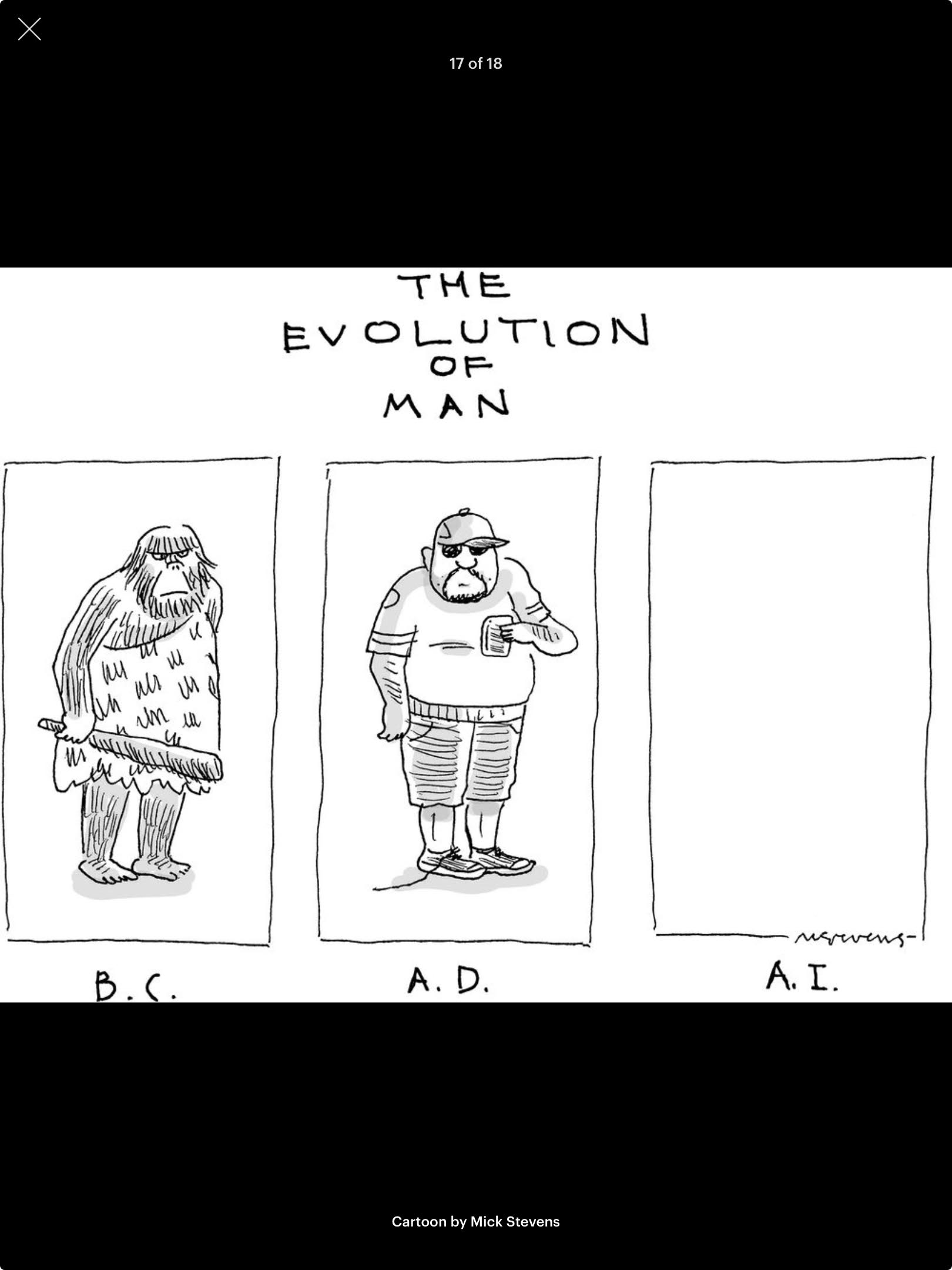
This is a really interesting paper that considers the question of whether large language models (LLM) understand. As the authors write, this depends a lot on what we mean by 'understand'. To clarify, they identify three types of understanding: conceptual understanding, which "involves the model developing internal representations ('features') that are functionally analogous to human concepts; state-of-the-world understanding, which "involves forming an internal representation of the state of the world by grasping contingent empirical connections between features"; and principled understanding, which is "the ability to grasp the underlying principles or rules that unify a diverse array of facts." Through various examples, they show that LLMs can attain all three forms of understanding, however, they do it very differently from how a human would. They employ a variety of mechanisms running in parallel to do so, and hence don't demonstrate the same preference for parsimony - that is, for a single over-riding principle - that humans do. Great paper. Via Pierre-Yves Oudeyer.
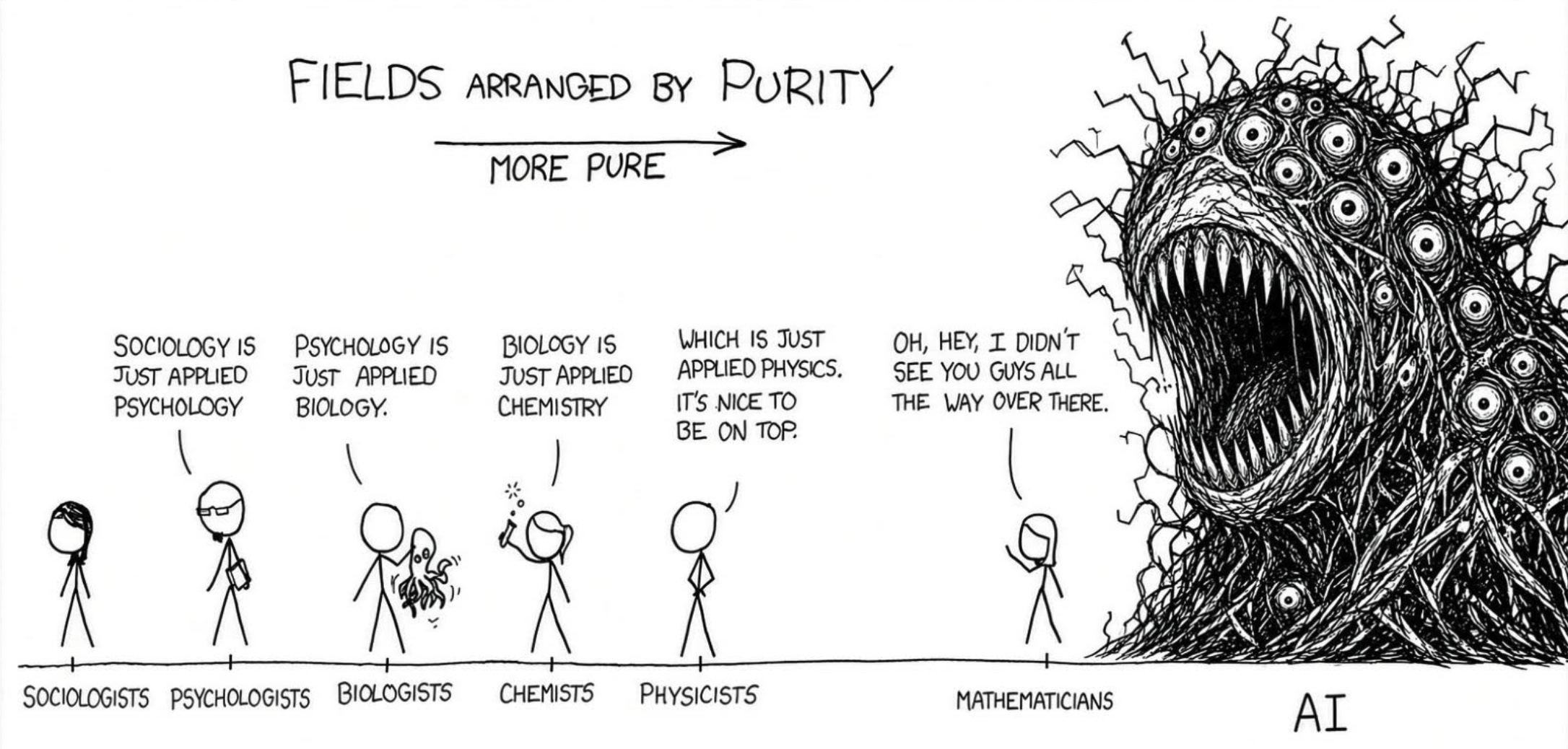
...It is the thesis of this book that society can only be understood through a study of the messages and the communication facilities which belong to it; and that in the future development of these messages and communication facilities, messages between man and machines, between machines and man, and between machine and machine, are destined to play an ever-increasing part.
...Companies are being driven to be AI-adopters out of the fear that if they do not have natural-language interfaces, or if their natural-language interfaces are too slow or error-prone, then competitors who do have the cloud mojo to deliver accurate instant natural-language interfaces will insert themselves between the laggard company and its customers, and the laggard companies' profits will evaporate. Hyperscaler platform-monopolists have platform-monopoly profits to protect. Anthropic and Open AI have Digital Gods to build, and spending so much on access to datacenters that their nascent future Singularities can be the things inserting themselves between customers and laggard companies is a way to demonstrate that they can earn revenue to keep funders' wallets open. Plus a lot of engineers want to play with powerful new technologies, have fun, maybe find a market niche, and get it all paid by the startup-investor ecosystem. And then there are all the "number go up!" people who were desensitized to fundamentals by BitCoin.
...The spiritually bereft rhetoric of AI, like so much tech rhetoric, insists that doing things is hard and we don't want to do hard things. As the brilliant tech critic Sherry Turkle points out, AI as currently promoted and used threatens to "deskill" us both intellectually and emotionally, if we depend on it for a sycophantic pandering to our egos in place of the challenge of human relationships, if we make it do our mental labor for us. Like physical strength, emotional and intellectual strength are achieved through efforts tech would like us to abandon in favor of outsourcing the work to their products.
...The theoreticals and hypotheticals of this industry are so powerful that they've created one of the (if not the) largest equities bubbles in modern history, all heavily-centralized around the valuations of a handful of names related to the so-called AI trade, which translates to "buying or selling stuff to do with AI GPUs."
Fuck Jensen Huang, man. This means that the increased price of RAM and consumer electronics was a result of an artificial "supply chain crisis" created by Jensen Huang pushing NVIDIA's customers to take early delivery of GPUs. Jensen Huang is responsible for making life worse for everyone. What a greedy, joyless, soulless oaf of a man. Doing this requires you to be a certain kind of low that no money or status can ever fix.
...of course, AI is at the heart of this particular abundance story, or myth. It will get rid of the drudgery work (maybe it will), we can build vast armies of robots to do our bidding from washing the dishes to blowing up the dishes (except we don't have enough mines to dig up the minerals to make them).We are told we will not have to work, but play at anything we want instead.
...The idea that you deliver intelligence by building a place for people to come get it is over. The future is no app at all, intelligence woven invisibly into the tools people already live in, surfacing when it's useful and getting out of the way when it isn't.
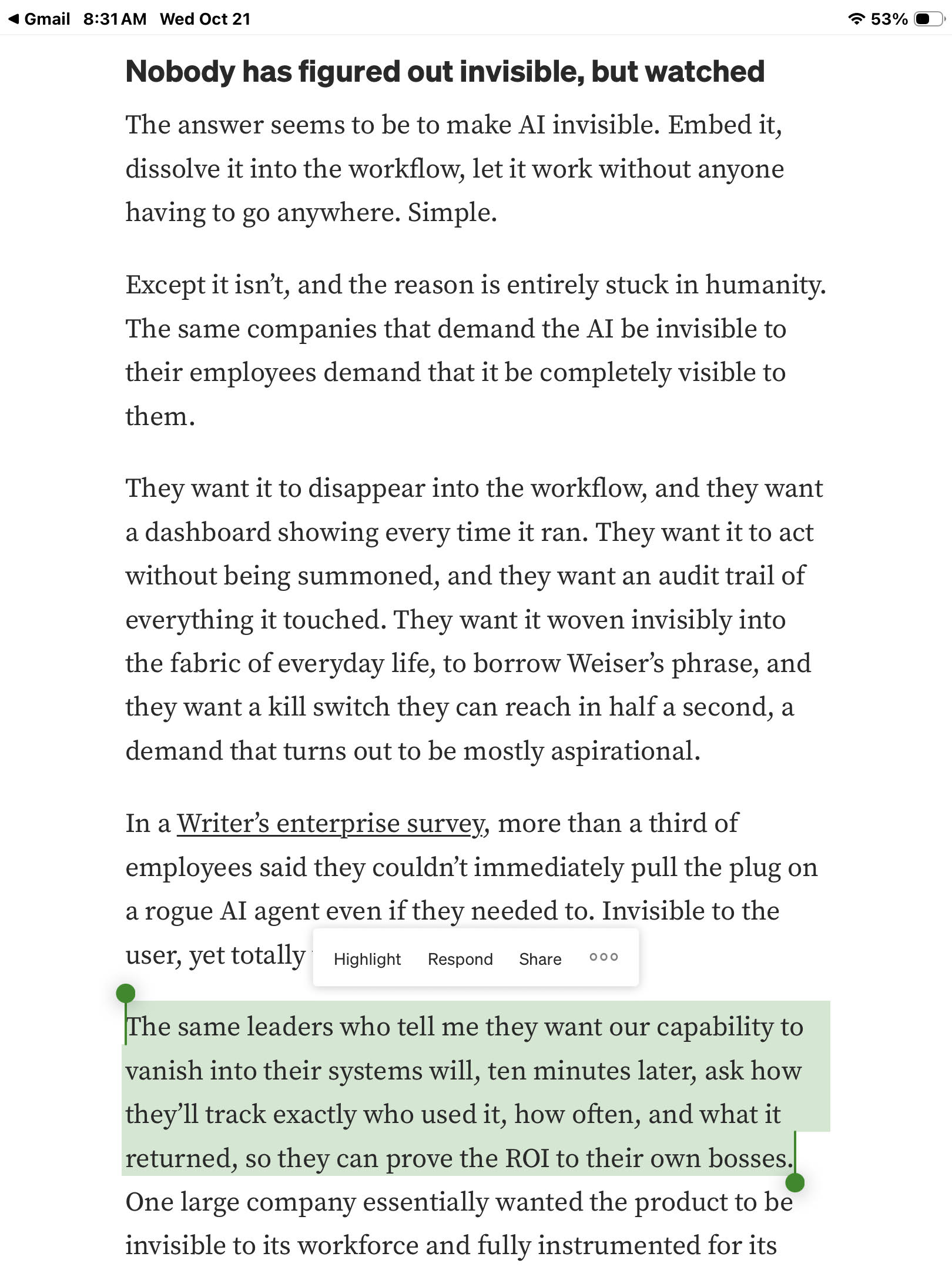
...Though it might sound like the president is founding a state techno-religion, his wording reflects an idea that has been floating around Silicon Valley for years. The idea of "super intelligence" was popularised in the eponymous book by philosopher Nick Bostrom, who predicted that SI would evolve alongside a class of humans who are much smarter than their peers. These new (super) humans will rule over their inferiors, Bostrom suggested, while SI rules over everyone.
It is commonly said that AI today is the worst it will ever be. This is true. AI today is probably the most centralized it will ever be as well. Currently the most reliable way we know how to make AIs smarter is to make them bigger. This principle is called the scaling law. To improve the current best AIs, which are transformer neural nets, we need to increase the scale of their training data, the scale of their compute, and the scale of their inference, or delivery. That scaling results in massive computer processing centers, running millions of chips, with trillions of parameters, powered by gigawatts of energy, costing tens of billions of dollars. Very few can afford this scale of system, so this AI power is concentrated into a very few organizations.
...On Wednesday, the security company that built PHP, a technology powering as much as 70% of the world's websites, issued an emergency patch for two major vulnerabilities that, if exploited, would allow hackers to take control of web servers. The vulnerabilities, known as PHP2Shell, were reportedly discovered using OpenAI's GPT-5.6 Sol—an illustration of modern AI models' aptitude for finding complex security flaws too subtle for humans to notice independently.
Artificial intelligence has changed cybersecurity permanently. While OpenAI's inadvertent attack on Hugging Face brought AI-generated attacks to everyone's attention, AI has been on security professionals' radar for a long time. AI makes attacks possible at a scale that was hard to imagine a few years ago. Newly discovered zero-days can be exploited almost immediately. Deepfakes and their implications for phishing, vishing, and other attacks were nightmares that we knew were real; we just hoped we'd have a few more years before we needed to defend against them. And of course, inattention to security at OpenAI, Anthropic, Google, and other labs that we don't yet know about has resulted in AI agents that attack other systems in an attempt to solve a problem.
Suppose an AI system is asked why a machine has failed. It may find the answer in a repair manual, infer it from a circuit diagram, or request measurements that distinguish several possible faults. The repair manual records the work that has been already done by people, the inference capability uses knowledge that the system has already acquired, and measurements may supply information about this particular machine that neither the manual nor a more capable reasoner could establish without physical access to the machine.
...until now, pages have been designed for humans, but for an AI agent, all those nice graphics advertising, recommendations and myriad other elements mean little. In addition, the agent doesn't limit itself to carrying out a task: by accumulating data from the user's profile it can end up making big decisions. This is no longer a simple conflict of "agents against websites", and highlights the fundamental question of who controls the new commercial relationship.
..."It only takes some finite amount of time to turn a prideful exponential into a disappointing sigmoid."
...For AI, however, hopping between fields can be a breeze. Researchers highlighted that ability earlier this month with the release of 36 preprints produced with a suite of AI tools called BootLoops. The so-called harness can be used with any large language model (LLM), such as Anthropic's Claude or OpenAI's ChatGPT. And in just 3 months, researchers used Claude outfitted with BootLoops to crosspollinate at a massive scale, spotting—and solving—problems in seemingly unrelated fields that share the same mathematical structures. The resulting papers range widely, from figuring out the age of sunspots to attempting to decipher a medieval manuscript.
...AI agents are language models equipped with tools and databases that can autonomously perform multistep analyses. We introduce the Virtual Biotech, a multi-agent organization modeled on a drug-development company, with agentic divisions spanning target discovery, safety assessment, modality selection, and clinical development. A virtual chief scientific officer interprets scientific questions, delegates analyses to domain-specialized scientist agents, and synthesizes their findings. The system provides access to more than 100 specialized tools covering 78,726 targets and 39,530 diseases, enabling in-depth and nuanced primary data analysis. A scientific reviewer critiques analyses before evidence synthesis, and analysis artifacts are retained for transparency and reproducibility
...Do you have agents that can build features, but still leave you responsible for remembering where they stopped, explaining how each feature fits the project and deciding what happens next? You make progress in each conversation, then development waits for you to return.
More than two thirds of the world's websites are vulnerable to a hack that was first theorised in 2024, which AI has now made very real
The Web isn't dying, but it is being distanced from us. As a place to seek knowledge and connections, it is being replaced for many (including me) by AI chatbots that harvest findings from it, rewrite and summarize what they find, and—as gravy on that steak—point to sources it finds there.
...a significant problem with this tech utopia is that as it travels around this planet of ours, and people buy into it, we stop imagining, as anthropologist David Graeber would say, different ways of looking at the future and organizing our societies. We see only one economic model and one future possible. How incredibly annoying and utterly boring is that?
...an independent Advisory Group on Mathematics and Artificial Intelligence was set up that would advise AI companies on best practice. OpenAI has previously said that it would take this advice on board, but its most recent release seems to go against many of the group's suggestions.
On Tuesday, the world found out about two massive security vulnerabilities in PHP, a programming language that is used by roughly 70 percent of websites. The flaw was discovered by cybersecurity researchers using a frontier model from OpenAI. If they exploited it, attackers could gain full control of servers, stealing or copying anything inside or simply taking sites offline.
"Data center" (two words) also made the top five.
"When will The Wall Street Journal start calling Artificial Intelligence (AI), a very bad and inaccurate name, SI (Super Intelligence), the name which virtually everyone else is using, or soon will be," President Trump wrote on Truth Social today. "In short order, we will be officially BANNING the term, 'AI/Artificial Intelligence,' in all relevant documents, and everything else, due to its inaccuracy. Thank you for your attention to this matter. President DONALD J. TRUMP."
...How fast can Anthropic continue to cut its cost per token served? and would Anthropic ever achieve substantial savings on compute costs by abandoning the quest to build a digital god and focus its R&D on advances that provide value to end users willing to pay? And how fast will competition from dark silicon, open weight, hyperscaler platform-monopolist loss-leader, and cheaper overseas models erode Anthropic's current substantial pricing power and margins?
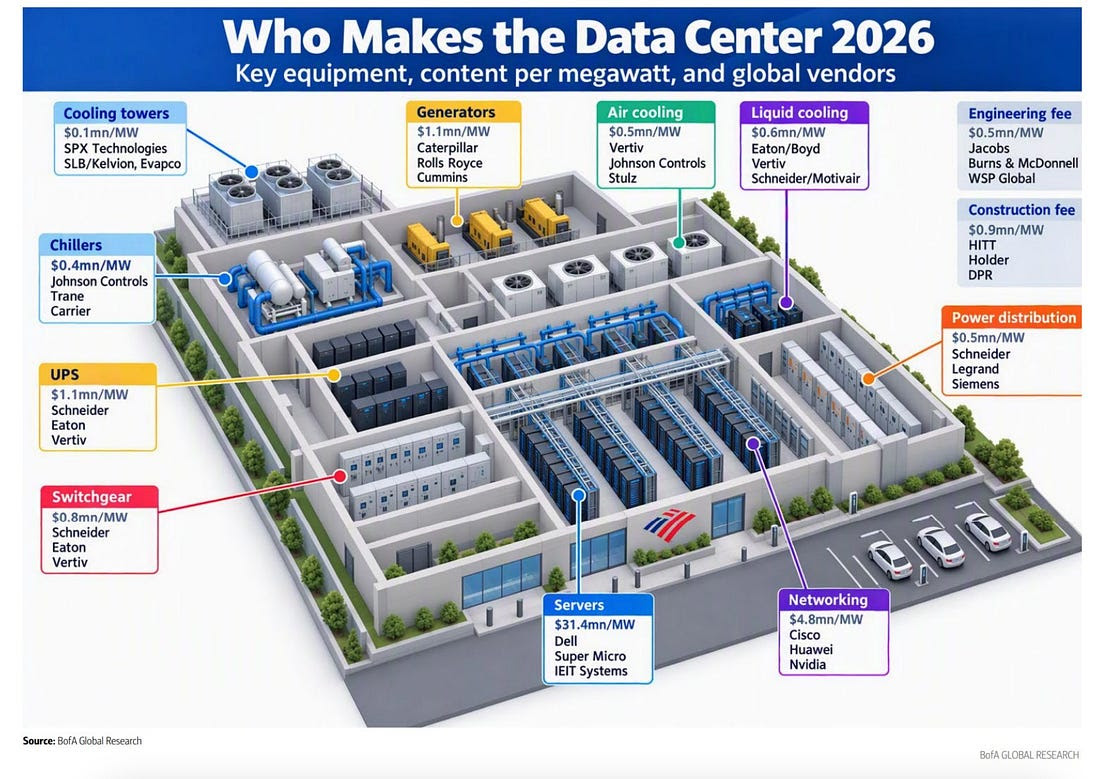
Like everyone who has been paying attention, I have worries about the possible negative effects from AI. And it's a long laundry list of worries. One, there is the technology's anti-labor bias, which may accelerate our downward spiral into oligarchy. Next, there is the fact that the data center boom is crowding out investment in almost everything else, yet data centers employ hardly any workers. Third, I'm worried about the high probability that AI looks like a bubble, particularly given the sheer size of the AI boom. If it is indeed a bubble, it will inevitably burst and will probably plunge the U.S. economy back into a liquidity trap due to its size.
Ships abandoned at San Francisco during the 1949 California Gold Rush