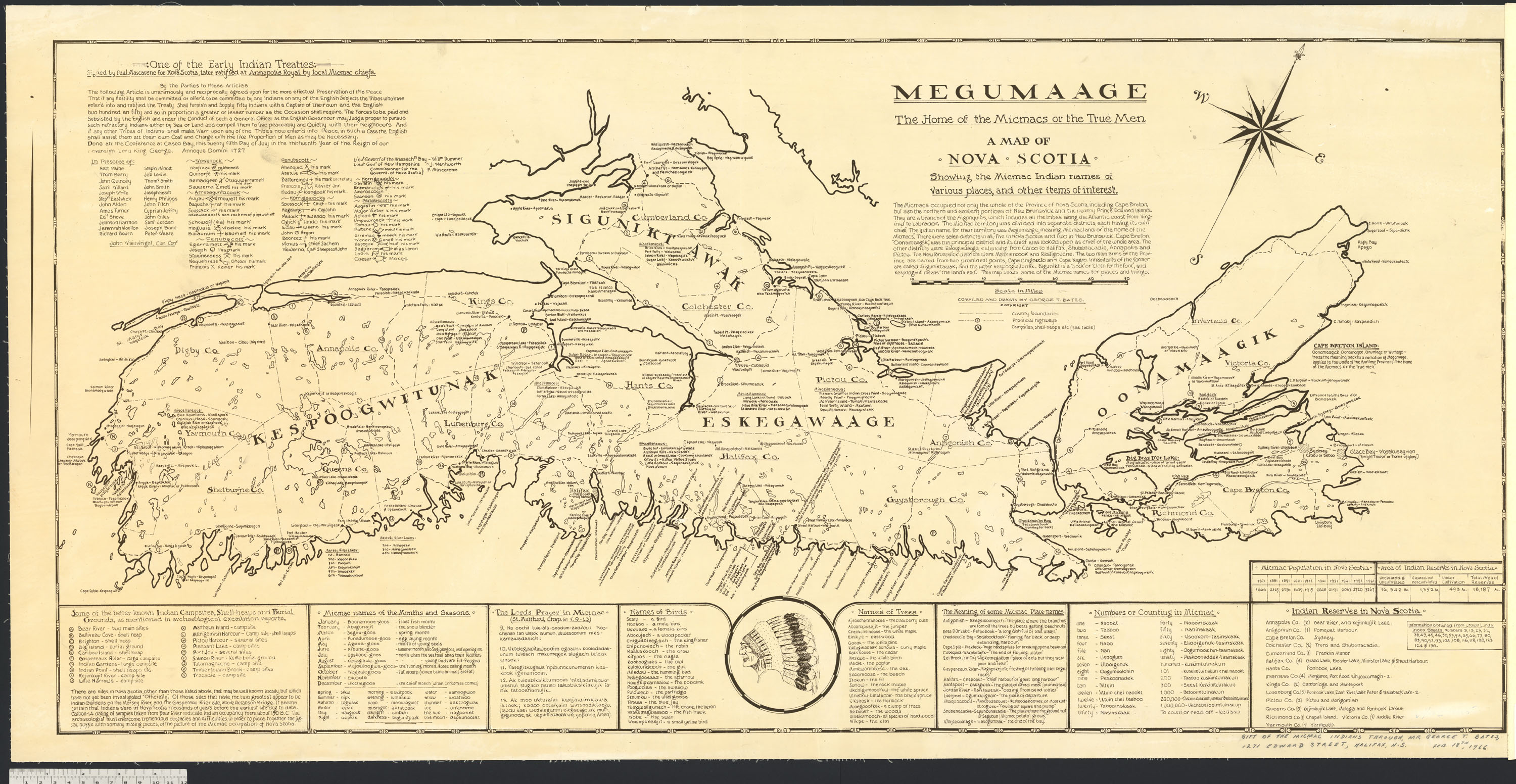
A map of Nova Scotia, showing the Micmac Indian names of various places and other items of interest
Mi'kmaq atlas reveals secrets behind Nova Scotia place names CBC (19x15)
Nova Scotia Place Names Thomas J Brown (1932)
Place-Names and Places of Nova Scotia C Bruce Fergusson (1967)
Mi'kma'ki Wikipedia
Mi'kmaq Wikipedia
...As of 2023, there are 66,748 Mi'kmaq people in the region;
this includes 25,182 members in the more recently formed Qalipu First Nation in Newfoundland.[6][7]
According to the Canadian 2021 census, 9,245 people claim to speak Mi'kmawi'simk, an Eastern Algonquian language....Mi'kmaq (singular: Mi'kmaw) comes from the word ni'kmaq meaning "my friends". There exist various spelling conventions resulting in forms like Mi'gmaq (sing.: Mi'gmaw) and Míkmaq (sing.: Mígmaw). The singular form (Mi'kmaw) is also used as the adjectival form, as seen in "Mi'kmaw Nation".[14] Alternatively, Mi'kmaq use the terms L'nu (plural: L'nuk, meaning "the people") to describe themselves.
...In the chapter "Late Prehistory of the East Coast" in the Smithsonian's 1978 Handbook of North American Indians, archaeologist Dean Snow says that the fairly deep linguistic split between the Mi'kmaq and the Eastern Algonquians to the southwest suggests the Mi'kmaq developed an independent prehistoric cultural sequence in their territory. It emphasized maritime orientation, as the area had relatively few major river systems.[85]: 69 In the chapter "Early Indian-European Contact" in the 1978 Handbook, ethnologist T. J. Brasser, described how pre-contact small semi-nomadic bands of a few patrilineally related families who lived in a climate unfavorable for agriculture, had subsisted on fishing and hunting. Developed leadership did not extend beyond hunting parties.[86]: 78 In the same 1978 Handbook, anthropologist Philip Bock described the annual cycle of seasonal movement of pre-contact Mi'kmaq. Bock wrote that the Mi'kmaq had lived in dispersed interior winter camps and larger coastal communities during the summer. The spawning runs of March began their movement to converge on smelt spawning streams. They next harvested spawning herring, gathered waterfowl eggs, and hunted geese. By May, the seashore offered abundant cod and shellfish, and coastal breezes brought relief from the biting black flies, deer flies, midges, and mosquitoes of the interior. Autumn frost killed the biting insects during the September harvest of spawning American eels. Smaller groups would disperse into the interior where they hunted moose and caribou.[87][88] The most important animal hunted by the Mi'kmaq was the moose, which was used in every part: the meat for food, the skin for clothing, tendons and sinew for cordage, and bones for carving and tools. Other animals hunted/trapped included deer, bears, rabbits, beavers, and porcupines.
Braser described the first contact between the Mi'kmaq and early European fishermen.[86]: 79–80 These fishermen salted their catch at sea and sailed directly home with it, but they set up camps ashore as early as 1520 for dry-curing cod. During the second half of the century, dry curing became the preferred preservation method.[86]: 79–80 Brasser said that trading furs for European trade goods had changed Mi'kmaq social perspectives. Desire for trade goods encouraged the men to devote a larger portion of the year away from the coast, trapping in the interior. Trapping non-migratory animals, such as beaver, increased awareness of territoriality. Trader preferences for good harbors resulted in greater numbers of Mi'kmaq gathering in fewer summer rendezvous locations. This in turn encouraged their establishing larger bands, led by the ablest trade negotiators.
...Silas Tertius Rand in 1849 help found the Mi'kmaq Missionary Society, a full-time Mi'kmaq mission. Basing his work in Hantsport, Nova Scotia, where he lived from 1853 until his death in 1889, he travelled widely among Mi'kmaq communities, spreading the Christian faith, learning the language, and recording examples of the Mi'kmaq oral tradition. Rand produced scriptural translations in Mi'kmaq and Maliseet, compiled a Mi'kmaq dictionary and collected numerous legends, and through his published work, was the first to introduce the stories of Glooscap to the wider world. The mission was dissolved in 1870. After a long period of disagreement with the Baptist church, he eventually returned to the church in 1885.
...The Mi'kmaq practice of playing ice hockey appeared in recorded colonial histories from as early as the 18th century. Since the nineteenth century, the Mi'kmaq were credited with inventing the ice hockey stick.[105]: 60 The oldest known hockey stick was made between 1852 and 1856. Recently, it was sold for US$2.2 million. The stick was carved by Mi'kmaq from Nova Scotia, who made it from hornbeam, also known as ironwood.
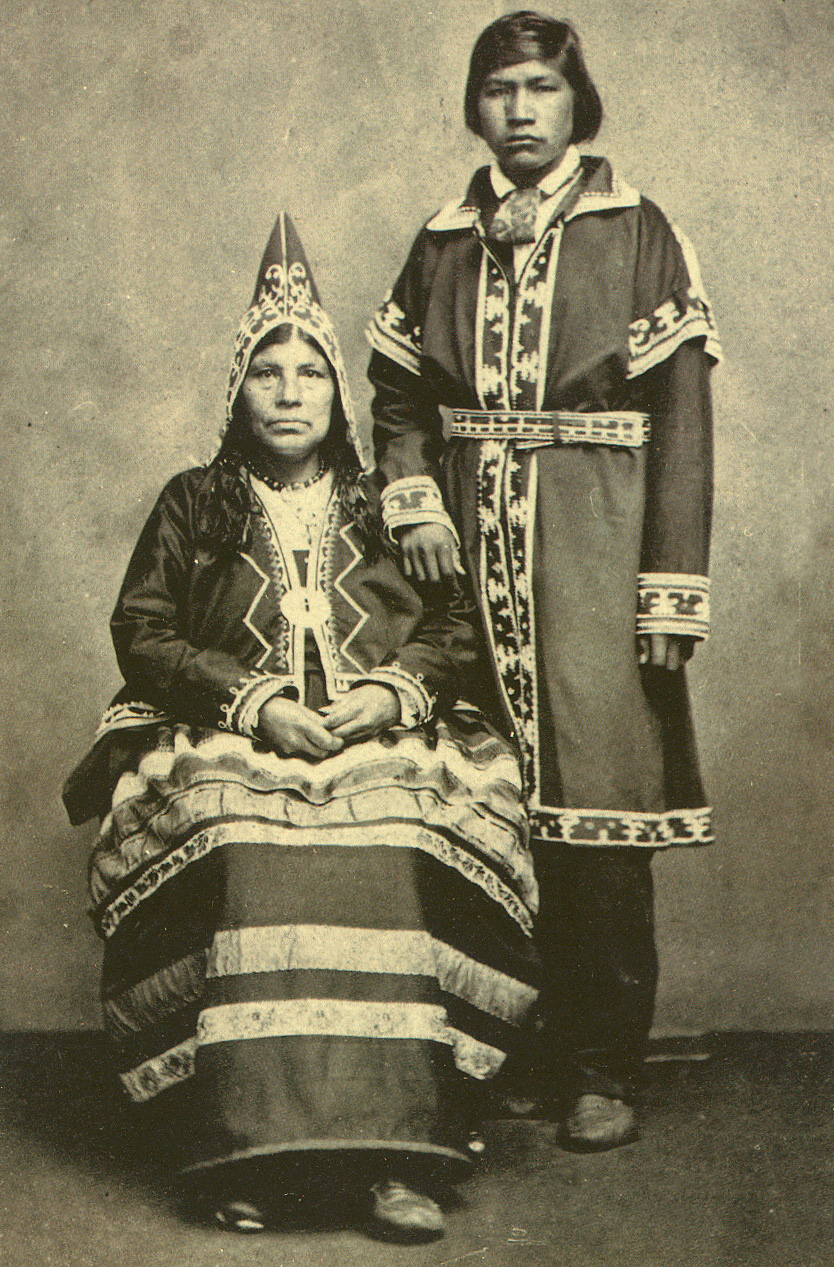
Public Domain, https://commons.wikimedia.org/w/index.php?curid=1220354
Mi'kmaw hieroglyphs (Wikipedia)
Pre-contact fish weirs: a case study from Southwestern Nova Scotia Roger J Lewis (2006) MA thesis, Memorial University of Newfoundland
Mi'kmaq Portraits Collection Nova Scotia Museum