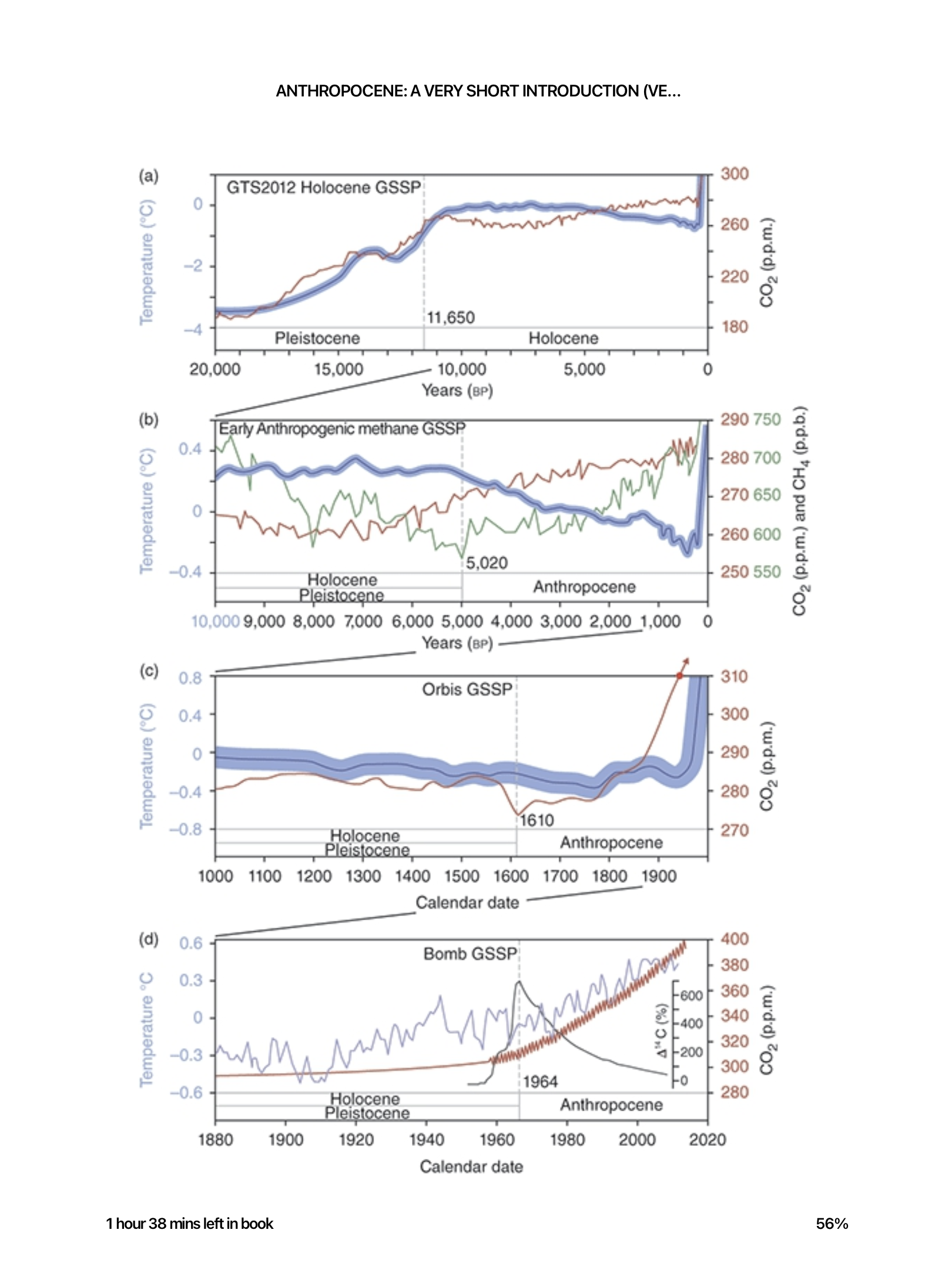
of the Anthropocene
As I understand the ambit of the discipline of Archaeology, most concern and research and writing is engaged with Homo sapiens before the Anthropocene (which I imagine as the unfolding process of the last 500 years or so, though other chronologies have been proposed). My attention as an anthropologist has mostly been directed to human activities in the last 250 years, in which the technologies we rely upon have come to have global-system consequences.
The question of how to think about the social evolution that has accompanied the Anthropocene is wide open, and probably has not much to do with the discourse of 'social evolutionary theory' as carried on in archaeological and prehistoric literatures.
6vii26
in energetic terms, we manage other life forms and harvest their transductions of solar energy.
30vii26
Anthropocene Wikipedia
The Anthropocene Project theanthropocene.org
Anthropocene anthroencyclopedia.com
The Age of Humans: Evolutionary Perspectives on the Anthropocene Smithsonian
The Concept of the Anthropocene Yadvinder Malhi1 Annual Review of Environment and Resources (2017)
...This article reviews the proliferation of literature surrounding this concept. It explores the origins and history of the concept, as well as the arguments surrounding its geological formalization and starting date ranging from the Pleistocene to the twentieth century. It examines perspectives and critiques of the concept from the Earth system sciences, ecological and geological sciences, and social sciences and human- ities, exploring its role as a cultural zeitgeist and ideological provocation.
The Anthropocene is functionally and stratigraphically distinct from the Holocene Colin N Waters et al. Science 8i2016
Humans are altering the planet, including long-term global geologic processes, at an increasing rate. Any formal recognition of an Anthropocene epoch in the geological time scale hinges on whether humans have changed the Earth system sufficiently to produce a stratigraphic signature in sediments and ice that is distinct from that of the Holocene epoch. Proposals for marking the start of the Anthropocene include an "early Anthropocene" beginning with the spread of agriculture and deforestation; the Columbian Exchange of Old World and New World species; the Industrial Revolution at ˜1800 CE; and the mid-20th century "Great Acceleration" of population growth and industrialization.
The End of Nature Bill McKibben (2014)