Merriam-Webster:
Two Related, Yet Distinct, Meanings of Theory
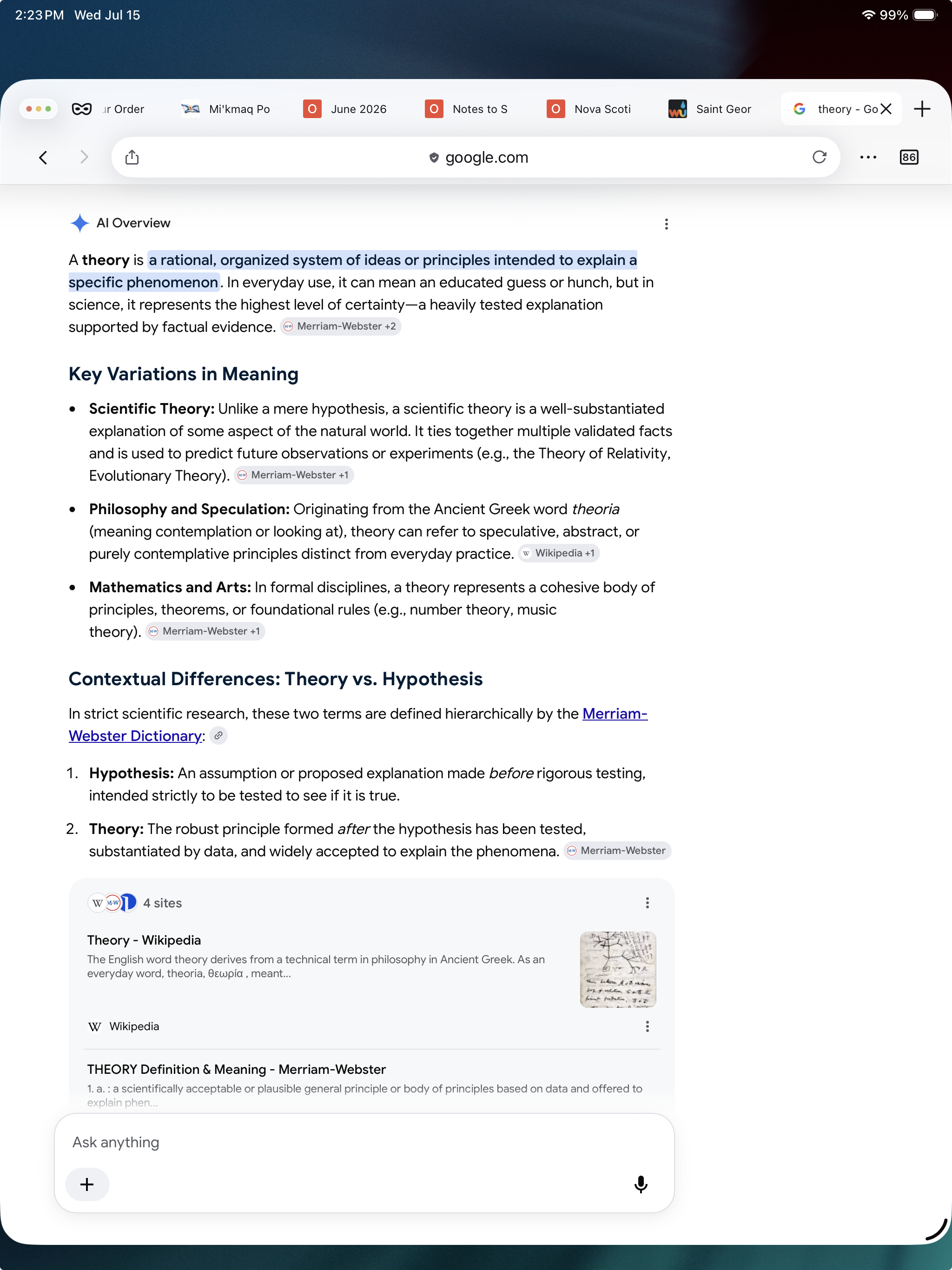
There are many shades of meaning to the word theory. Most of these are used without difficulty, and we understand, based on the context in which they are found, what the intended meaning is. For instance, when we speak of music theory we understand it to be in reference to the underlying principles of the composition of music, and not in reference to some speculation about those principles. However, there are two senses of theory which are sometimes troublesome. These are the senses which are defined as "a plausible or scientifically acceptable general principle or body of principles offered to explain phenomena" and "an unproven assumption; conjecture." The second of these is occasionally misapplied in cases where the former is meant, as when a particular scientific theory is derided as "just a theory," implying that it is no more than speculation or conjecture. One may certainly disagree with scientists regarding their theories, but it is an inaccurate interpretation of language to regard their use of the word as implying a tentative hypothesis; the scientific use of theory is quite different than the speculative use of the word.
What is theory? University of Warwick
Theory is never going to be a straightforward term to use as it gathers together many different assumptions about epistemology, methodology and indeed the purpose of doing social research. To complicate matters there are a host of further terms, for example modelling, conceptualising, analysing indeed theorising, that cover at least some of the things that 'theory' does. However attempts to define theory frequently refer to:
- the search for cause and effect explanation as within, for example, large data sets. Here the contribution of theory might be to develop the explanatory framework that supports reported statistical association.
- the modelling of outcomes. A model may lay out the factors that influence a certain outcome and while generated in particular circumstances they may be seen as generalisable. For example Piketty (2014) has a theory of capital and inequality which can be expressed as a general rule that wealth (r) grows faster than economic output (g) all things being equal.
- what if scenarios: for example Rawls introduces a theory of justice based on reasoning what would happen if everyone were to decide principles of justice behind a veil of ignorance - an ideal state in which no one knows in advance what their place in society will be. According to Rawls, these conditions will lead to principles that are fair to all.
- ethnographic description: for example Geertz's famous thick description of cock fighting in Bali. The key here is that all observation is theory laded. This kind of theorisation often aims at establishing a social phenomenon inviting others to look for a similar phenomenon in other contexts.
...Swenberg (2015) suggests that there is a distinction between theorising and theory. This draws a useful distinction between theory about the practice of research and theory regarding bodies of evidence which throw light on social behaviour. In discussing Swenberg, Krause (2016) suggests that modes of theorizing include:
- interpreting major figures
- applying existing concepts to new observations
- linking a new fact or observation to an existential issue or a historical trend
- developing new concepts in dialogue with observations and previous concepts
- joining concepts to a testable hypothesis about a causal relationship between them.
This helps us to see that the work of understanding a key concept within a particular discipline, in some fields something that takes second place to the accumulation of empircial evidence, is an important kind of theoretical contribution.
...In our interviews we often found that theory involved an attempt to abstract something from the data (a model, a rich description or conceptual category) which allowed for understanding social phenomena in more generalisable or at least more relatable way. Theory, at least for some, connected local findings to the problems of a discipline and staked a claim for general significance. Further, theory seems concerned with explanation. This did not necessarily mean cause and effect explanation it could as easily be explanations of actions and consequences of actions.
Theory-theory Wikipedia
...which made me wonder about Metatheory Wikipedia
Metatheory sciencedirect.com
...Background concepts are sometimes called frameworks, but more generally they are termed metatheoretical or metatheories. They transcend (i.e., "meta") theories in the sense that they define the context within which theoretical concepts are constructed. Thus, metatheories ground theories....The primary function of metatheories—including metamethods—is to provide a rich coherent source of concepts, out of which theories and methods emerge. As a part of this function, a metatheory provides the meaning context for specific theoretical concepts. For example, "structure" may have a physical meaning in the context of one metatheory, and may refer to a pattern, a form, or an organization in another. Metatheory also provides latent conceptual resources that assist in the advancement of theory. And metatheory provides guidelines that assist in avoiding conceptual confusions and, consequently, assist in avoiding what may ultimately be unproductive ideas and unproductive methods.
Theories are about the empirical phenomena in a specific scientific area of interest, and methods are the procedures employed in the empirical analysis of these phenomena. In contrast, metatheories and metamethods are about the theories and methods themselves, respectively. More specifically, a metatheory is a coherent set of rules, principles, or a narrative, that both describes and prescribes what is acceptable and unacceptable, meaningful and meaningless, as theory—the means of conceptual exploration of any scientific domain. A metamethod is also a set of rules, principles, or a narrative, but these rules describe and prescribe the nature of acceptable methods—the means of observational exploration—in a scientific discipline.
Metatheory Encyclopedia of Communication Theory
...Every theory is based on certain assumptions about the nature of theory and about fundamental aspects of the phenomena or subject matter theorized. Most often these metatheoretical assumptions are implicit, meaning they are not explicitly articulated within the theory itself. The purpose of metatheory is to explicitly articulate and critique the metatheoretical assumptions that underlie theories and to articulate normative metatheoretical principles to guide the creation and assessment of theories....1. Ontology: Assumptions about existence such as the nature of the human individual and how we relate to the world around us. For example, some theories assume that human behavior is determined by external causes, while others assume that individuals freely choose how to act. Theories also disagree about whether communication phenomena exist objectively, independent of our theories, or whether those phenomena exist only as socially interpreted, in which case the communication phenomena we study do not exist independently of our theories but are shaped to some extent by the theories we use to interpret them.
2. Epistemology: Assumptions about knowledge such as what it means to know something and how knowledge claims can be validated. Some theories assume that theoretical claims can be supported only by empirical observation, while others assume that theoretical claims can be based on conceptual analysis and rational argument, and still others assume that theories are interpretations of the world that cannot be proven with much certainty, if at all.
3. Praxeology: Assumptions about the practice of theory such as how a theory should be structured and presented and factors that determine a theory's relevance and originality. Theories are always written for particular audiences—intellectual communities in which it is conventionally expected that theories should address certain issues, cite certain precedents (usually previous theories in the same tradition), and be written in certain ways (e.g., using verbal arguments, formal systems of propositions, or mathematical formulas).
4. Axiology: Assumptions about the values that a theory should reflect or how a theory should contribute to society. In the empirical scientific tradition, it is generally assumed that the best way for science to contribute to society is by providing carefully tested, objective, value-free theoretical knowledge. In contrast, normative, value-based theorizing is explicitly intended to evaluate and influence communication practices.
An introduction to metatheories, theories, and models Bates (pdf)
...Metatheory can be seen as the philosophy behind the theory, the fundamental set of ideas about how phenomena of interest in a particular field should be thought about and researched ...The concept of a metatheory has a lot of overlap with the term "paradigm," which was given its modern understanding in science by Thomas Kuhn (1996). In the terms used here, Kuhn considered a paradigm to be the metatheory, the theory, the methodology, and the ethos, all combined, of a discipline or specialty....Theory... can be thought of as the entire body of generalizations and principles developed for a field ...A theory is a system of assumptions, principles, and relationships posited to explain a specified set of phenomena.
...Models ...are a kind of proto-theory, a tentative proposed set of relationships, which can then be tested for validity. Developing a model can often help in working through one's thinking about a subject of interest. Indeed, there is not always a sharp dividing line between a model and a theory about the same phenomenon.
Meta-theories of Human Development baylor.edu
...Meta-theories (or world views or paradigms) of human development are sets of assumptions people hold about the nature of humans and the meaning of development— what it looks like, how it happens, what causes it. These assumptions are important because everyone has them, including researchers, but they are often implicit, meaning we are not always consciously aware of them.
Theory and Metatheory in the Nature of Information: Review and Thematic Analysis Luke Tredinnick mdpi.com (2025)
these two illustrate the stretch-to-fit of 'metatheory':
Introducing The New Story of Wholeness appliedmetatheory.org
...IAM is committed to cutting-edge research across four major vectors:
- The Metacrisis
What is the nature of the interconnected social, ecological, ethical, epistemic, and existential challenges of our time—AKA "the metacrisis"?
- Worldviews
What are worldviews and how do their frameworks of meaning and value transform in response to civilizational steering problems?
- Integrative Metatheory
What sort of Big Picture philosophy lies at the heart of the Integrative Worldview currently emerging to transcend the limits of our prior meaning-making structures?
- Social Impact
How can we apply the insights from integrative thinking to the complex challenges we face today, and what new institutions can we incubate to address these systemic problems for human flourishing?By advancing our understanding in these key domains and operationalizing their insights, we endeavor to help catalyze the sort of liberatory transformations needed for a society of human flourishing in the 21st century.
Investing in Metatheory Andrew Chen and Jonathan Lai at Andreessen Horowitz (2022)
From Shakespeare to the Beatles, and Star Wars to Fortnite, every generation has a set of entertainment properties that define its culture and shared universe of stories. As we look to the coming decade, we believe the next major creative franchise will be built from the bottom up through games and web3 primitives.As the most interactive and social form of media, games are masterclasses at building universes of shared stories. The best games today are thousand hour experiences where players experience epic adventures spanning years, build lasting friendships, and contribute meaningfully to a shared universe populated by many others. At scale, these games are next-generation social networks and cultural powerhouses
in the context of archaeology:
Middle-range theory (archaeology) Wikipedia
Mapping the field of cultural evolutionary theory and methods in archaeology using bibliometric methods David N. Matzig et al. nature.com (2023)
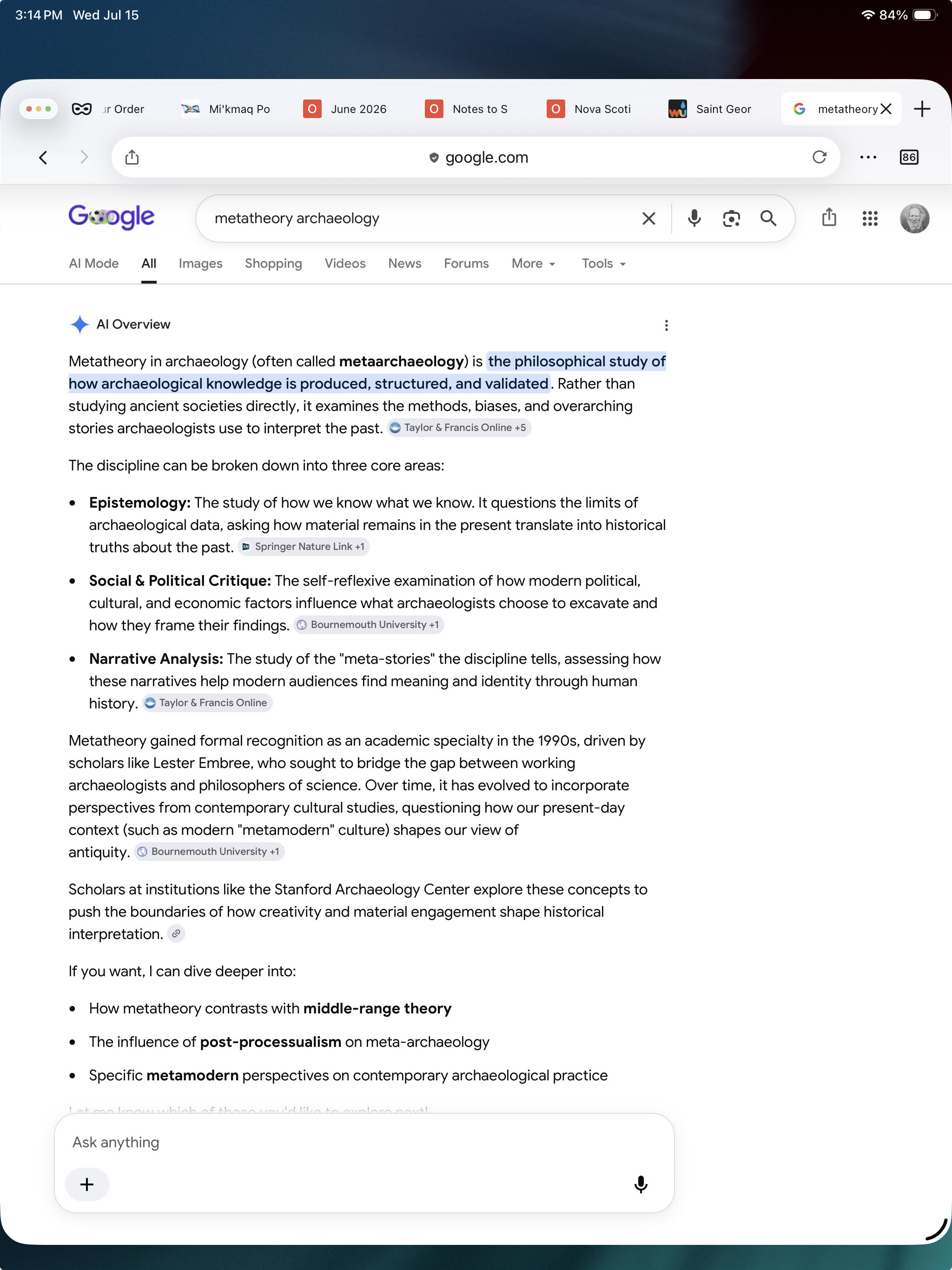
Meta-stories of archaeology Cornelius Holtorf (2010)
meta-archaeology archaeolog.stanford.edu
Metaarchaeology: Reflections by Archaeologists and Philosophers (1992)
❧ ❧ ❧ ❧ ❧ 21vii26
A piece in the latest Harper's: "Textual Deviants" by Emily Eakin, from her just-published The Frenchmen: Or, My Life in Theory
(from the Introduction)
...It was a heady time. Years later, after the fixation on theory had subsided, and its critics had moved on to other targets, a wise professor summed up what had transpired: "A bunch of people threatening all kinds of subversion by means that couldn't possibly produce it, and a bunch on the other side taking them at their word and waging cultural war. Not comedy, not tragedy, more like farce, but farce with consequences. Careers made and ruined, departments torn apart, writing programs turned into sensitivity seminars, political witch hunts, public opprobrium, ignorant media attacks, the whole ball of wax."...For more than two decades, through the pitched battles of the 1980s "canon wars" over which books were essential to a college education, theory, an eclectic body of philosophical writings by a handful of middle-aged Frenchmen (for better or worse, most of the theorists were both French and male) held sway on campuses and, more remarkably, in the American imagination where it loomed almost comically large. "Students in our best universities do not believe in anything, and those universities are doing nothing about it," declared Bloom in 1982, sounding the alarm in an essay that laid the groundwork for his subsequent bestseller, The Closing of the American Mind. "The heads of the young are stuffed with a jargon derived from the despair of European thinkers, gaily repackaged for American consumption."
...American students and scholars flocked in droves to theory, perceiving in its recondite abstractions a thrilling new way of understanding the world—even, some believed, of changing it. And in many respects they were right: The Frenchmen challenged some of our most fundamental assumptions, from our beliefs about power, truth, and the individual to reality itself. At the center of their concerns was language.
...The French philosophers who followed in Sartre's wake dedicated much of their careers to showing how they believed language actually worked: molding our thoughts and behavior, constraining and compelling us, tripping us up and deluding us—in a word, creating us. And not just us, but the world too, everything we liked to imagine was out there, beyond us. In the new dispensation, there was little room for physical existence. Non, the Frenchmen said, language is all there is. Or, more precisely, it's what matters: What we know about the world is inseparable from our discourse about it.
...The Frenchmen, it turns out, are crucial for understanding the world we inhabit today, one that in decisive ways they bequeathed to us. Their influence ran deep, permanently altering how we think not only about bedrock philosophical ideas but about the role of language in shaping those beliefs and everything else.
...Their aim was to enlighten us about language's very real and powerful, if mostly invisible, effects. By showing, through rigorous close readings of literary and philosophical texts, how language operates as an inescapable force, shot through with ideology, and in which intention and meaning often fail to coincide, they taught us to be deeply wary consumers of signs. We have learned the Frenchmen's lessons for both good and ill. In the wake of their teachings, we no longer regard language as innocent or natural, a mirror reflecting the world as it is or even necessarily our thoughts as we think them. The theorists instructed that no single person, institution, or state power can fully control the narrative about our world; language is far too unstable, too self-aware, too contradictory for that. And where no one can claim jurisdiction over meaning, interpretations inevitably proliferate—multiplying, diverging, competing. >p> ...Their aim was to enlighten us about language's very real and powerful, if mostly invisible, effects. By showing, through rigorous close readings of literary and philosophical texts, how language operates as an inescapable force, shot through with ideology, and in which intention and meaning often fail to coincide, they taught us to be deeply wary consumers of signs.
Social Theory and Archaeology MICHAEL SHANKS AND CHRISTOPHER TILLEY (1988)
THEORETICAL ARCHAEOLOGY: A PRELIMINARY AND CONVENTIONAL OUTLINETheory has been an important issue in archaeology since the 1960s and has taken the form of a contentious field of polemical manoeuvring within the discipline and between archaeology and other social sciences. In his essay, 'Archaeology: the loss of innocence' (1973), David Clarke, a seminal figure in British theoretical archaeology, specified different aspects of theory. He distinguished a theory of concepts from a theory of information and a theory of reasoning, terming these respectively archaeological metaphysics, epistemology and archaeological logic and explanation. For Clarke these three aspects are overlain and permeated by a series of other levels of archaeological theory; these are steps in archaeological interpretation. Predepositional and depositional theory considers the relationships between activities, social patterning, and environmental factors and the traces deposited in the archaeological record. Postdepositional theory considers what happens to the deposited traces: processes such as destruction, erosion and disturbance. Retrieval theory is predomi-nantly a theory of the sampling of the surviving deposited traces in excavation and fieldwork. Analytical theory is concerned with retrieved information and its processing; interpretative theory considers how the traces relate to their ancient social and environmental sources which are not now open to direct observation and experience.