August 2026 general links
(continues July 2026 links)
1viii26
Let's eat badly: Irrationality and its Other William Davies at LRB
review of Irrationality: A History of the Dark Side of Reason Justin E.H. Smith
...ever since the dawn of market research and advertising in the late 19th century, there has been a commercial interest in understanding what determines individual choices, as distinct from what economists or moral philosophers think should determine them....Where orthodox economists explain behaviour on the basis of rational choice, assuming that each of us is a finely tuned calculator weighing the costs and benefits of every decision, the 'nudgers' are always on the look-out for anomalies, situations in which we habitually do things with harmful consequences: eating badly, neglecting to recycle, or failing to save for retirement.
...The extent to which we are predictably irrational is conditioned by how much of our behaviour the predictor is privy to. And since the launch of the iPhone and the lift-off of Facebook in 2007, the quantity of human irrationality available to be scrutinised and exploited has grown exponentially.
...It has become something of an orthodoxy in these circles that our behaviour is rarely governed by rational self-interest, but is swayed by norms, habits, instincts and emotions.
...maybe Jeff Bezos, the founder of Amazon (presently earning $75,000 every thirty seconds), with his global network of household sensors and consumer tracking, is the real rationalist now. But if Silicon Valley (not, say, the university) is now the seat of objectivity and reason, that puts rationality out of sight and out of mind for the vast majority of us.
...The new dominance of such giant technology platforms as Facebook and Google represents a distinctive threat to the status of reason in society. These are businesses that make money by collecting data about our behaviour, then exploiting the intelligence that results: what Shoshana Zuboff refers to as 'surveillance capitalism'. But as we know from controversies over 'fake news' circulating on Facebook and extreme content on YouTube, the platforms have no interest in establishing norms of behaviour, only in maximising engagement with the platforms themselves. As far as Mark Zuckerberg's business interests are concerned, it doesn't matter how absurd, stupid, dangerous or mendacious a post is, just so long as it takes place on Facebook.
...Nudgers, like Bentham, see rationality as a habit in which to be trained by a benevolent government in order to steer us towards health and happiness. My preference for a Big Mac may one day be conditioned out of me altogether. Platform giants, by contrast, regard rationality as their intellectual property, the product of a calculation going on in secret. If they can discern the underlying mathematical logic of society, they have no intention of disclosing it. Neither of these attitudes to rationality is politically attractive. The problem lies with behaviourism itself, and its assumption that human freedom is programmed and programmable: ‘rationality' is in the eye of the all-seeing observer, not a property of conscious action at all. In this conception of reason there is no place — and crucially no time — for thinking, reflection or deliberation: each of us is reduced to a node in a network, bombarded by stimuli to which we can react only as automatons. Behaviourism flips rationalism into irrationalism. Surveillance capital treats the global population as if it were a vast zoo, spotting patterns of behaviour that the specimens themselves will never know about. Once democracy and public argument are premised on the logic of the platform, it simply doesn't matter what anyone says or does, so long as they remain engaged and engaging. President Trump is the symptom of a society that treats rationality as a property of machines, and not people.
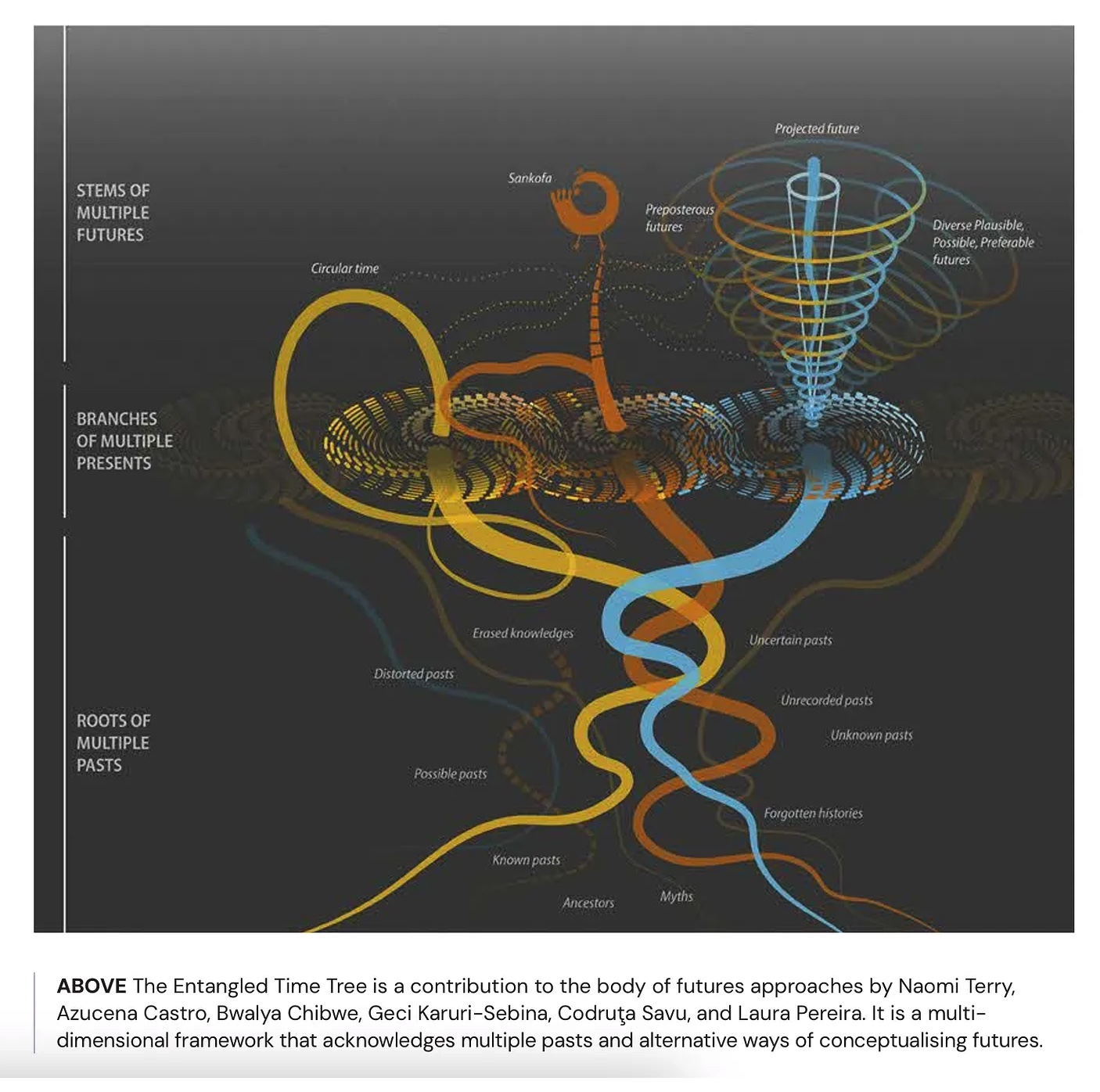
the entangled time tree Adam Tooze
...Given this vast and lucrative psycho-industrial complex, you might think that the human mind could hold few surprises for business and policy elites. It has become something of an orthodoxy in these circles that our behaviour is rarely governed by rational self-interest, but is swayed by norms, habits, instincts and emotions. Yet when such irrational forces, combined with techniques of psychological experimentation and influence of the sort used by nudgers on social media platforms, disrupted the democratic arena in 2016, it was as if Dionysus himself had hurtled dancing into the room. Irrationality is predictable, maybe, but not to the point of putting Donald Trump in the White House. The myopia of the nudgers is in their assumption that irrationality is a ‘behaviour' like any other, which can be tracked and controlled — that is, rationalised. It's true that the relation between rationality and irrationality is ultimately one of power: which part of society (or the self) is able to boss the other?But Trump's election demonstrated the naivety of assuming that in the end reason will always come out on top. Perhaps with sufficient surveillance, the logic of our present madness can be divined; maybe Jeff Bezos, the founder of Amazon (presently earning $75,000 every thirty seconds), with his global network of household sensors and consumer tracking, is the real rationalist now. But if Silicon Valley (not, say, the university) is now the seat of objectivity and reason, that puts rationality out of sight and out of mind for the vast majority of us. The anxiety provoked by the use of Facebook to influence elections isn't so much that the platform is all-powerful, but that we have no way of knowing what its true capabilities are. Paranoia is the rational response to a system whose rules and goals are shrouded in secrecy. …
Contrary to the comforting myths of Enlightenment, irrationality is no longer peripheral to science or liberal democracy, but appears swirling around in their core. ...
This is the nub of the crisis that we're in. It can't be that irrationality is simply bad or dispensable: every society — indeed every psyche — must find a place for it, in the arts, in sleep or on the analyst's couch. The colonial Enlightenment fantasy was that unreason was external to the white European male; the digital-behaviourist fantasy is that unreason is external to the algorithm. One crucial difference is that, as the standard of reason shifts from white, male, European minds to the machines of Silicon Valley, our society no longer demands that white men provide a model of rational behaviour. Hence President Trump.
Thinking About Tomorrow Center for Strategic Futures, Singapore
...The Entangled Time Tree challenges the common mental framework of linear time and simple causality. Inspired by a baobab plant, the diagram envisions time as an interconnected tangle of stems, branches, and roots, where multiple strands of each exist. Moreover, the roots, branches, and stems flow into each other, indicating how the past, present, and future are constantly influencing and reshaping one another.
The diagram makes other points:
World Scientists' Warning to Humanity: A Third Notice Eric Lee at Medium
text (pdf)
2viii26
Universal Consciousness Andy Ilachinski
'Portrait of a Man' (Possibly Matteo di Sebastiano di Bernandino Gozzadini) and 'Portrait of a. Woman' (Possibly Ginevra d'Antonio Lupuari Gozzadini) —Maestro delle Storie del Pane (Attributed) Alejandro Orradre at Medium
In My Life as a Visiting Lecturer I Meet Various and Sundry People or, Another Way to Think of This, Here Are All the Novels I Never Wrote and You Are Welcome to Them Anne Carson at LRB
3viii26
Global Human Population Has Surpassed Earth's Sustainable Carrying Capacity Eric Lee at Medium
...The idea is that if all humans reduce their population to ‘x', become Master Gardeners who use regenerative agricultural practices (or 'organic', permacultural'...) with no fossil fuel inputs, and properly farm all of Earth's resources (all terra firma and aquatic resources to maximally feed humans), then Earth can support some 'x' number of humans.In the 1960s systems ecologist H.T. Odum was guessing 500 million was a maximum human population (but didn't publish). David Pimentel (distinguished professor of entomology and agricultural sciences at Cornell University) guessed 600 million. One ecologist emailed some 60 of his colleagues to ask what their best guess of how many humans Earth could sustainably support was, but did not publish (low was 50 million, high 2 billion, mean about 1 billion). Oh, but Dave King, small ball expert, informs President Trump that Earth can support at least 1 trillion prosperous people.
...The context for all numbers is the presupposition that Earth, the Planet of the Humans, can be managed by modern humans to maximize their numbers within limits they agree to. In some 4 billion years, no species has done so, but modern humans (with technology and ideology) can turn Earth in a Trantor-like planet if they want to (and those who currently live within limits self-select out of the future, to be replaced by Anthropocene enthusiasts who exceed limits habitually). Humans are not mere animals. We modern humans are denormalized domesticants, humans of NIMH, who will create the future we want and deserve.
Oh, but the opinions of usually clothed apes doesn't determine Earth's carrying capacity, nor that a serially invasive species can run Earth's biosystem to maximally benefit them for as long as they want to until they decide to leave Earth as astronomical expansionists to spread throughout the Milky Way Galaxy (first of trillions) to turn all the planets for the taking into more humans.
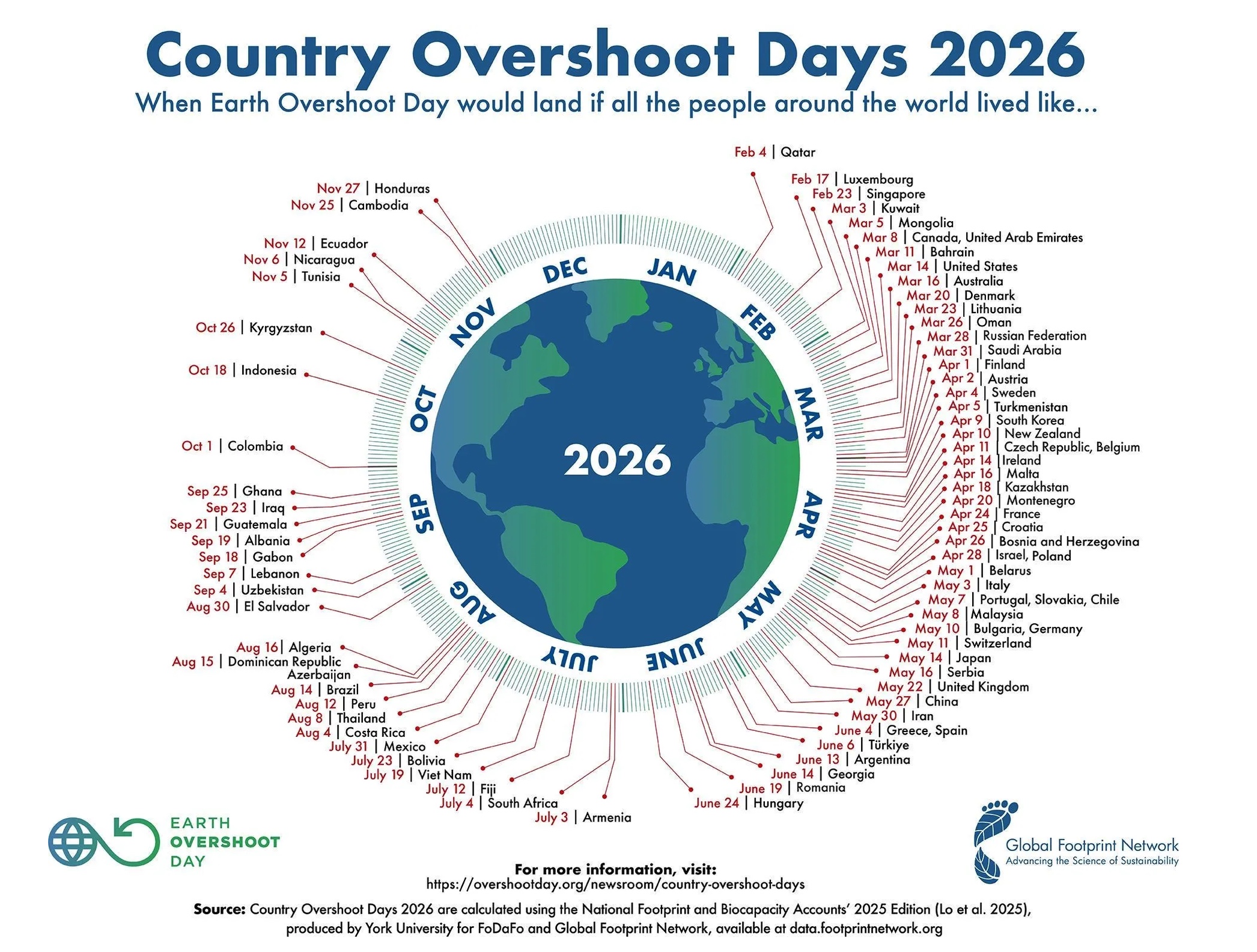
88 Prompts for Long Term Thinking Kevin Kelly
1 Our aim is to improve the present by remembering the future.2 Our religion is change.
3 We promote tools and systems that manage the resources of change.
4 Over time, the process of change itself changes, compounding change.
5 We are making the world safe for continuous compounding change.
6 The system that best manages compounded change is civilization.
7 We favor tools that operate upon civilization.
8 Civilization is long-term thinking; Long-term thinking is civilization.
9 We promote long-term thinking instead of long-term planning.
...
13 The best choices today are those that lead to a greater number of choices in the future.
14 We seek those possibilities that increase future possibilities for all.
15 Individually we are better off with expanding possibilities for everyone.
16 Civilization is the process of creating the maximum number of opportunities that work for the maximum number of people.
...
41 Thinking about the future is a way to think about the systems.
42 Focus not on the outcomes, but on the processes that produce outcomes.
...
62 We'd like to improve the ways of being accountable to posterity.
...
67 This present moment used to be the unimaginable future.
68 The future is purchased by the present.
69 We have more obligation to the future than the past.
70 The tyranny of the present can only be offset by possible futures.
71 The future is no more free of the past than the present is.
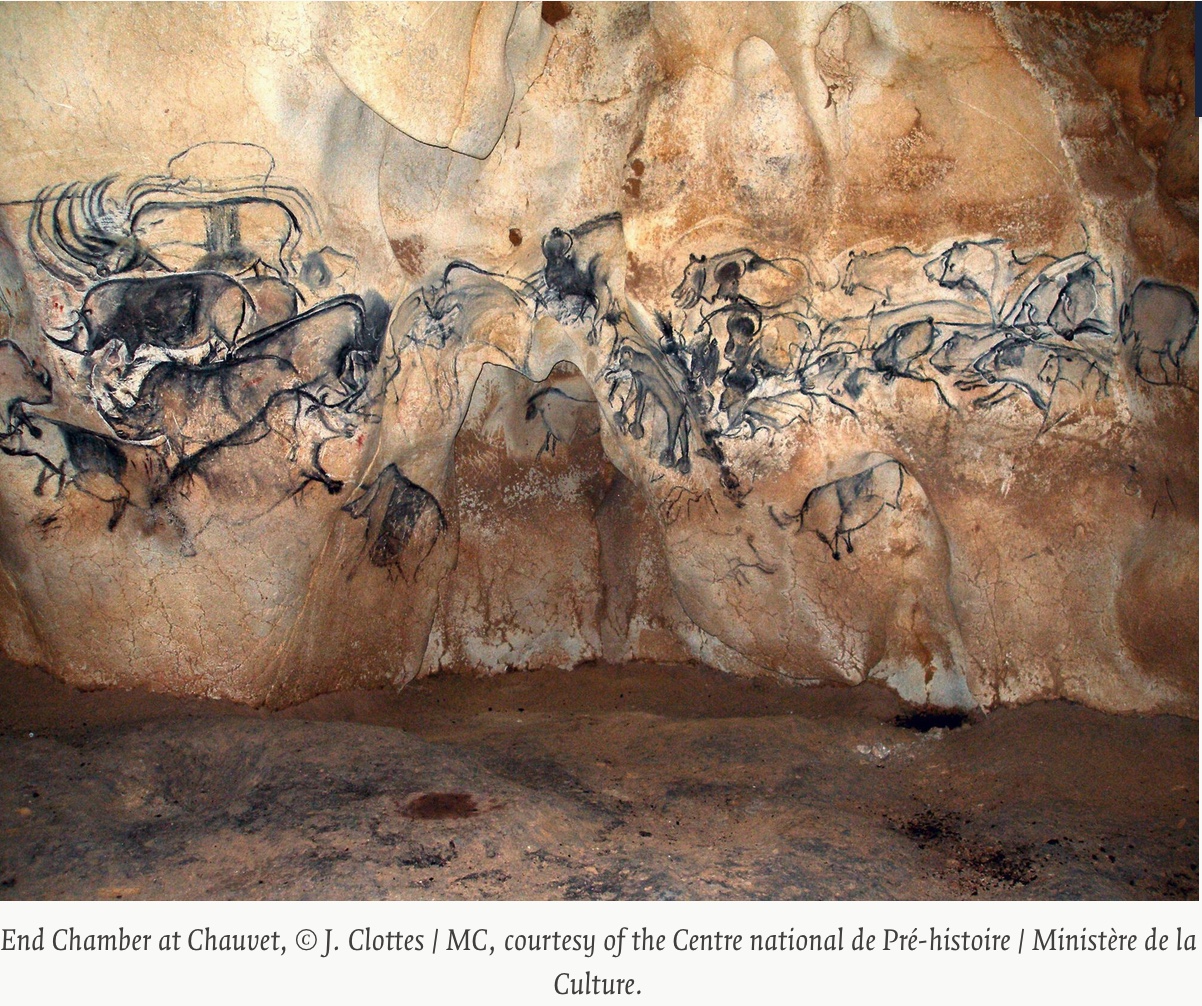
Night Visitors T.J. Clark on the Chauvet cave paintings at LRB
...At Chauvet, depiction was already what picturing had become. Look at the way the artists have organised the meeting of the line of beasts with the cleft in the cave wall – the little cave within a cave, which doubles in the illusion as a hilltop or defile. Look at the difference of pace and depth and solidity of the group – the procession – before and after. The overall being-together of shapes and objects and intervals between them, and their arrangement within some kind of spatial surrounding: that seems to be what these artists most wanted to capture.
Umberto Eco
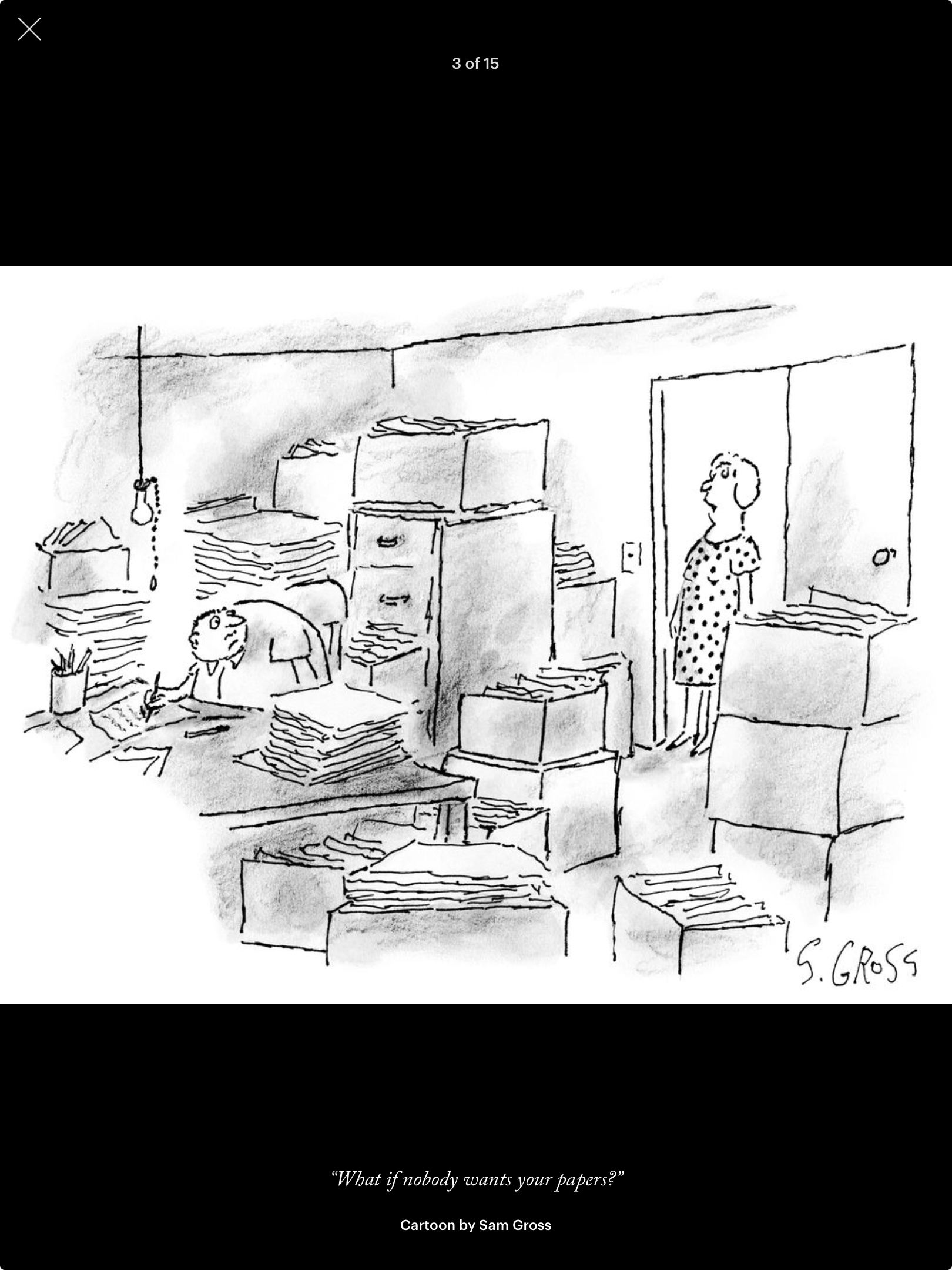
Umberto Eco and the nature of the home library reddit...The library should contain as much of what you do not know as your financial means, mortgage rates, and the currently tight real-estate market allows you to put there. You will accumulate more knowledge and more books as you grow older, and the growing number of unread books on the shelves will look at you menacingly. Indeed, the more you know, the larger the rows of unread books.The Antilibrary: The Hidden Value of Unread Books fs.blog
...It is foolish to think that you have to read all the books you buy, as it is foolish to criticize those who buy more books than they will ever be able to read. It would be like saying that you should use all the cutlery or glasses or screwdrivers or drill bits you bought before buying new ones....If, for example, we consider books as medicine, we understand that it is good to have many at home rather than a few: when you want to feel better, then you go to the 'medicine closet' and choose a book. Not a random one, but the right book for that moment. That's why you should always have a nutrition choice!Those who buy only one book, read only that one and then get rid of it. They simply apply the consumer mentality to books, that is, they consider them a consumer product, a good. Those who love books know that a book is anything but a commodity.
Umberto Eco: A Library of the World (Amazon video)
The Oldest Map of Grand-Pré? Jonathan Fowler
...In June of 1760, Charles Morris drew what may be the oldest properly surveyed large scale plan of Grand-Pré, or at least part of it. His focus was the place the French inhabitants had called Vieux Logis, the area near the landing on the Gaspereau River at the eastern end of the Grand-Pré Marsh. It may be presumed that some of Acadian Grand-Pré's founders disembarked hereabouts in the 1680s. It was also from this landing that their children and grandchildren were sent away. Now Charles Morris selected the hillside overlooking the landing as the best location for the town plot, or nucleus, of the planned settlement of Horton Township.
4viii26
How to Finally Sync Your Fitbit Data to Apple Health lifehacker
The Grasshopper and the "Lusory Attitude" Essential for Playing the Game of Life Marginalian
Post-American compute for a post-American Internet Cory Doctorow
...Big Tech is key to Trump's pogroms. Without Oracle's databases, Microsoft's administrative tools, Amazon's cloud, and Google's location data, ICE would be frozen in place. Big Tech is the source of Americans' risk from authoritarian oppression. That means that Americans cannot rely on Big Tech to protect them from that authoritarianism.And yet, after decades of regulatory forbearance and lax antitrust enforcement, Big Tech has forced nearly all its rivals out of business. Who can compete with companies that use Irish domicile to evade taxation and US domicile to evade privacy law?
5viii26
Pronoia or reverse paranoid delusion: A brief exploration into a conspiracy in your favour S Jesus et al (2021)
Cynicism and Naïveté in the Summer of a Thousand Fires Rebecca Solnit
...A lot of the cynicism about climate is cynicism about human nature. The simplest response to that is that there is no one human nature: we are a malleable species, much shaped by the beliefs and values of the society we're from, and the same society, even the same family, can produce wildly varying specimens of humanity. Renee Good going out on a cold January morning to try to protect her immigrant neighbors represents human nature; so does the ICE agent who shot her. Recent noodling around online led me to learn that fashion designer Christian Dior's sister Catherine Dior was a hero of the French Resistance, but their niece was a neo-Nazi. Even the same family can produce wildly different versions of humanity
6viii26
Eternal Sloptember Cory Doctorow
...when it comes to Mark Zuckerberg, I'm increasingly convinced that he didn't acquire his worldview through the self-inflicted brain damage of his long exposure to the back-end of a vast social media system. I think the causal arrow points in the other direction: I think that Zuck founded Facebook because he doesn't really believe that other people are truly real, at least not as real as he is....If Zuck thought other people are as real as he is, he wouldn't spy on them in ways he himself could never tolerate. He certainly wouldn't pay fancy white-shoe lawyers to steal their land out from under them. At heart, Zuck is a billionaire solipsist to beat all other examples of the form — a billionaire social media solipsist who sees others as manipulable collections of statistical abstractions, and not as people at all
...Once you realize that Zuck doesn't really think other people exist, "the metaverse" starts to make a lot more sense. Why would Zuck light $61b on fire in a bet that we will all stand still while he converts us and everyone we love into legless, sexless, low-polygon, heavily surveilled cartoon characters that he imprisons in a virtual world he stole from a 25 year old satirical dystopian cyberpunk novel? It's easy to understand if we're all non-player characters — if that's true, then the metaverse is surely our native habitat.
...Zuck and people like him call themselves "high agency," a disgusting bit of jargon meant to denote someone who has real interiority, wishes and desires (as opposed to the rest of us, who do as we're told and stay where we're put). Zuck's "agency" isn't higher than yours or mine. The difference between him and us is that he doesn't think we're really real, and we know that he's really a monster.
El Cid of the Left? Abdul El Sayed, Victor in Michigan Primary, Faces Racism over his Name Juan Cole
aaaaaa… Robert Mazzocco on Any Warhol (NYRB)(1969)
...The auto-destructive sculpture of Tinguely, the defecation iconography of Robert Whitman or Sam Goodman, Paradise Now and its coup d'état: a "liberated" water ballet ("Are we gonna talk about Bolivia, or are you here just to look at our big dicks?")... What has been happening in Warhol has been happening, to lesser or greater degrees, throughout the Sixties. A power vacuum exists in culture today, frequently filled with self-congratulatory innovations, demagogic somersaults, ponderous theorizing—the evangelical "new sensibility," the bridging of the gulf between art and life. It's an historical problem. "Why must I think," asks Mann's Leverkuhn in Doctor Faustus, "that all the methods and conventions of art today are good for parody only?" Leverkuhn approaches the question with anguish. The most Warhol (and how many others?) seems able to do is snigger.
The Data Center Debate Rages. Will It Change the Course of History? John Battelle
...Until we can see the monster, we tend to ignore the monster. With their massive appetites for energy, land, capital, and water, data centers have become tangible manifestations of Big Tech's otherwise incorporeal impact on society. Data centers give the monster a body, a tractable container through which to air out a dog's breakfast of grievances against not only the tech industry, but also the corporations, politicians, and financiers profiting from its concentrated power.
"Melt Up"? Mark Liberman at Language Log
...since the semantics of phrasal verbs is at best quasi-compositional.
Every country was wrong on the State Department's map of Africa boingboing
30-odd metaphors from Ross Macdonald Stan Carey
Google Maps Has Launched 'Agentic Food Ordering,' but Don't Get Too Excited lifehacker
There's now a $69 pair of shoes designed only for using the toilet boingboing
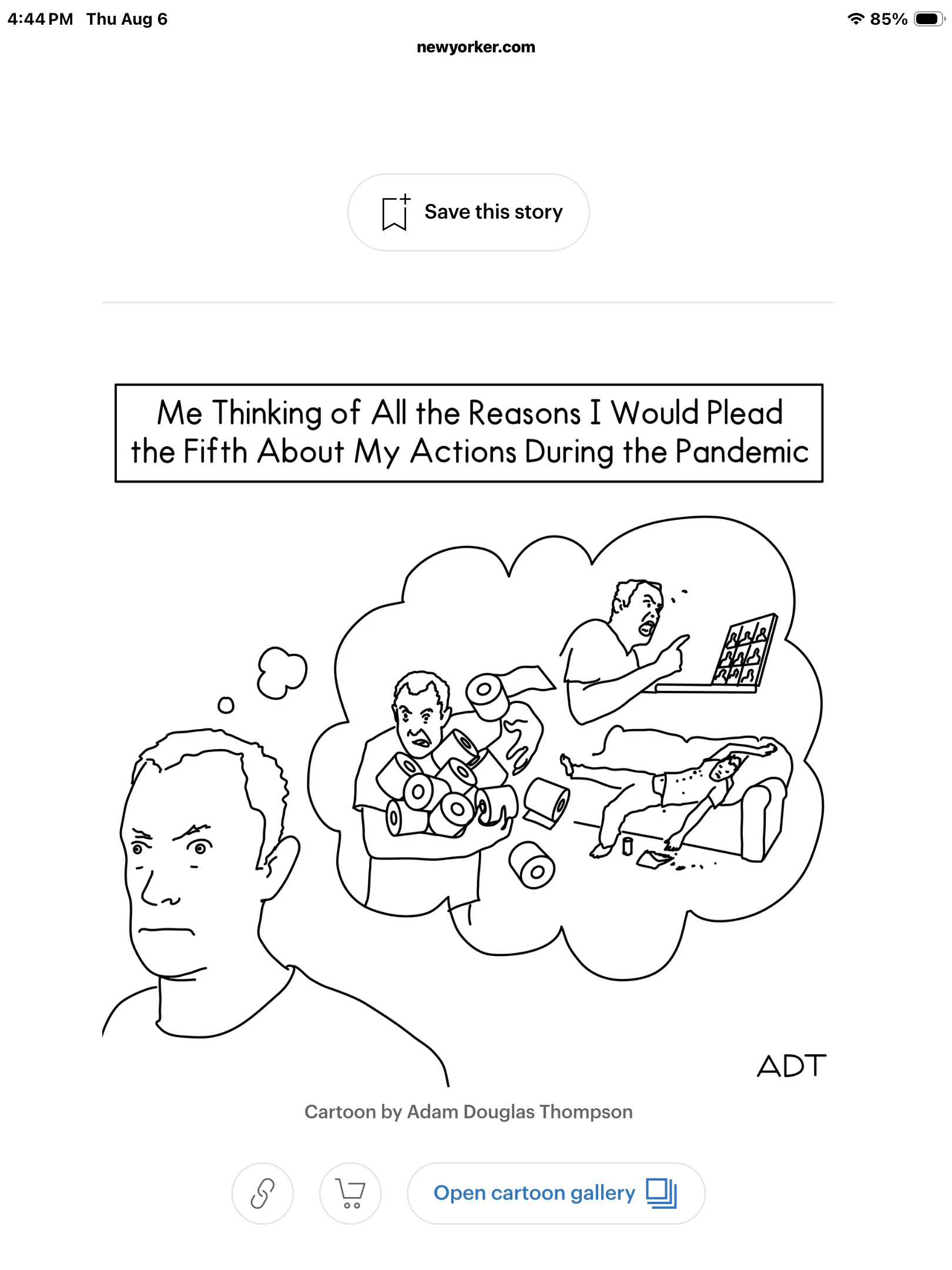
The Internet of Stuff Doc Searls
We now have an internet of stuff, at the heart of which are the distribution and fulfillment centers that have been replacing farmland and former broadcast transmitter sites near highways and airports everywhere.
7viii26
Science Friday
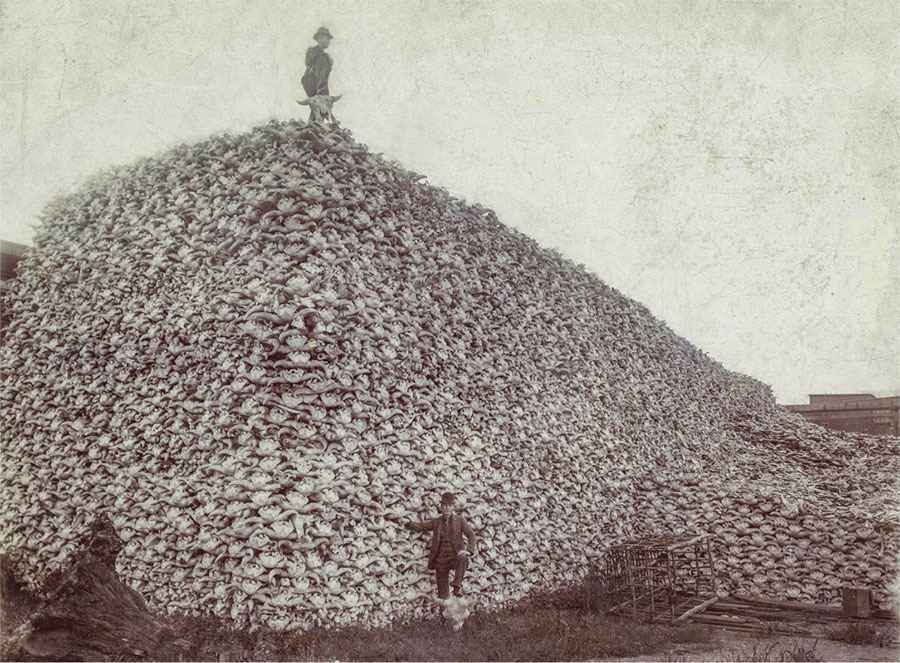
NASA's PUNCH punches up space weather forecasts...The intensity of a geomagnetic storm depends partly on the orientation of the magnetic field embedded in the plasma. If that field's orientation is aligned with Earth's field, Upton says, the storm's effects will be far milder than if they're opposed. Where things stand today, "We don't really have that information until 30 to 40 minutes before it hits," Singer says. But by sensing both visible light and its polarization, PUNCH can capture the front of an approaching CME in 3D, allowing researchers to model the strength and orientation of the front's magnetic field hours before impact....Most Indigenous groups held—and still hold—buffalo as sacred, considering them the beating heart of the land. Lakota Sioux writer and spiritual leader John Fire Lame Deer wrote in 1972 that the "buffalo was part of us, his flesh and blood being absorbed by us until it became our own flesh and blood. Our clothing, our tipis, everything we needed for life came from the buffalo's body. It was hard to say where the animal ended and the man began."That's in part why Europeans set out to exterminate the beasts. The animals sustained the tribes U.S. and Canadian governments wanted to subjugate or eliminate, and the herds occupied territory coveted by ranchers, railroads, and farmers. Beginning in the 1860s, hunters rode the newly laid rails out into the plains and shot just about every bison they spotted. By 1890, when the smoke from their Sharps rifles had cleared, hunters had slaughtered all but about 500 scattered bison
There were already indications of a systematic evolutionary relationship between primates' expanded neocortex and visual specializations. Living primate species with a larger neocortex and brain for their body size have more convergent orbits (bony eye sockets), larger optic nerves, more neurons in subcortical visual nuclei, and relatively expanded cortical visual areas. These differences are concentrated in visual pathways that support high-acuity color vision
A harrowing tour of Earth's sacrificial lands (James Crawford The Vanishing Earth reviewed)
...chapters 2 through 5 are entitled respectively "Rock," "Metal," "Sand," and "Water." These four chapters are grouped together into a part entitled "Sacrifice," in reference to the 1970s notion that human civilization needs to set aside sacrifice regions for its uses. Crawford's narratives in these chapters take the reader to the Bone Valley in Florida, the heart of the US phosphate industry for fertilizers; to the salt flats of Chile's Atacama Desert, where lithium is produced by evaporating brine; to the melt-shorelands of Greenland, where sand is mined; and finally to arid lands including the province of Almeria in southeastern Spain, which boasts the world's largest concentration of arid commercial plastic greenhouses filled with crops that consume huge amounts of water.Curb plastic pollution at its source
...Global plastic production has more than doubled since 2000 to roughly 460 million tonnes per year, about half of it destined for single-use products (1). After accounting for reprocessing losses, only about 9% of plastic waste is ultimately recycled, whereas nearly half is landfilled, about a fifth is incinerated, and the rest is mismanaged or leaks into ecosystems (1, 2). As governments negotiate a legally binding global plastics treaty (3, 4), they should recognize that recycling alone cannot solve plastic pollution and prioritize reducing production and reusing materials.The recycled plastic cycle is structurally inefficient. Contamination, mixed polymers, and degradation during reprocessing divert much of the collected plastic back to disposal, and reported rates are inflated by accounting that blends waste collected, sorted, and transformed into new material (1). Recycled plastics still supply only a small share of feedstock, leaving virgin fossil-based plastics dominant (1, 2). Plastics also account for about 3.4% of global greenhouse gas emissions, mostly from production (1), and the global recycling rate is projected to reach only about 17% by 2060 (5), far too low to offset rising plastic waste (6).
A central role for dietary sugars in human evolution
...Before cooking made starch easily digestible, the sugars in fruit and honey provided glucose, the brain's preferred fuel. Modeling suggests that sugars provided >25% of dietary energy, fulfilling obligatory glucose demand. Pounding and cooking released glucose specifically, not merely energy. The evolution of a bigger brain is therefore a story of carbohydrate foods as much as animal foods: from sweet sugars to cooked starch, from chewing to processing, and from wadging to advanced nutrient extraction.
What China Wants and Why Thomas Pueyo at Medium
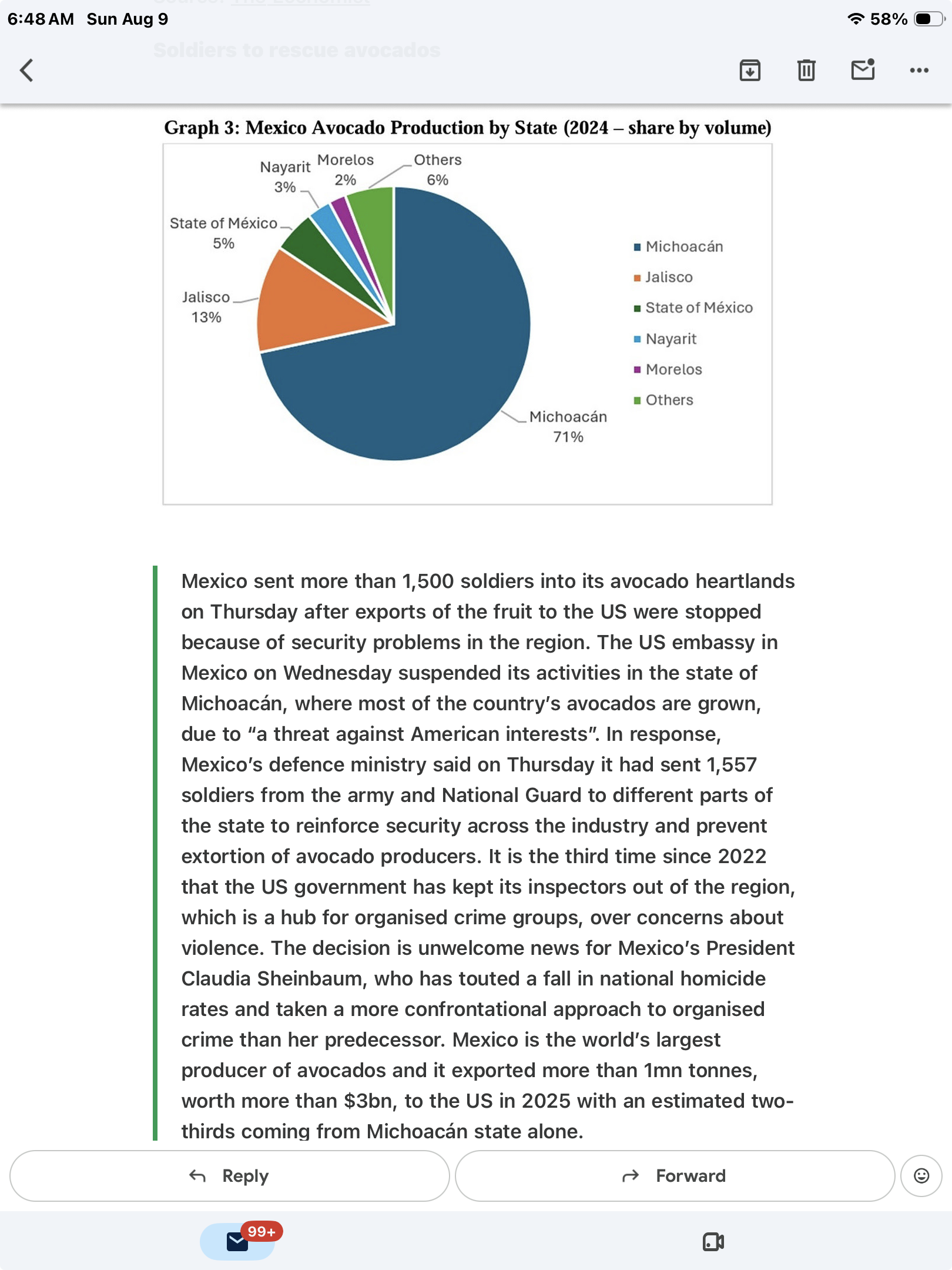
...The Hu Line: 94% of China's population lives on 43% of its land, east of that line.
9viii26
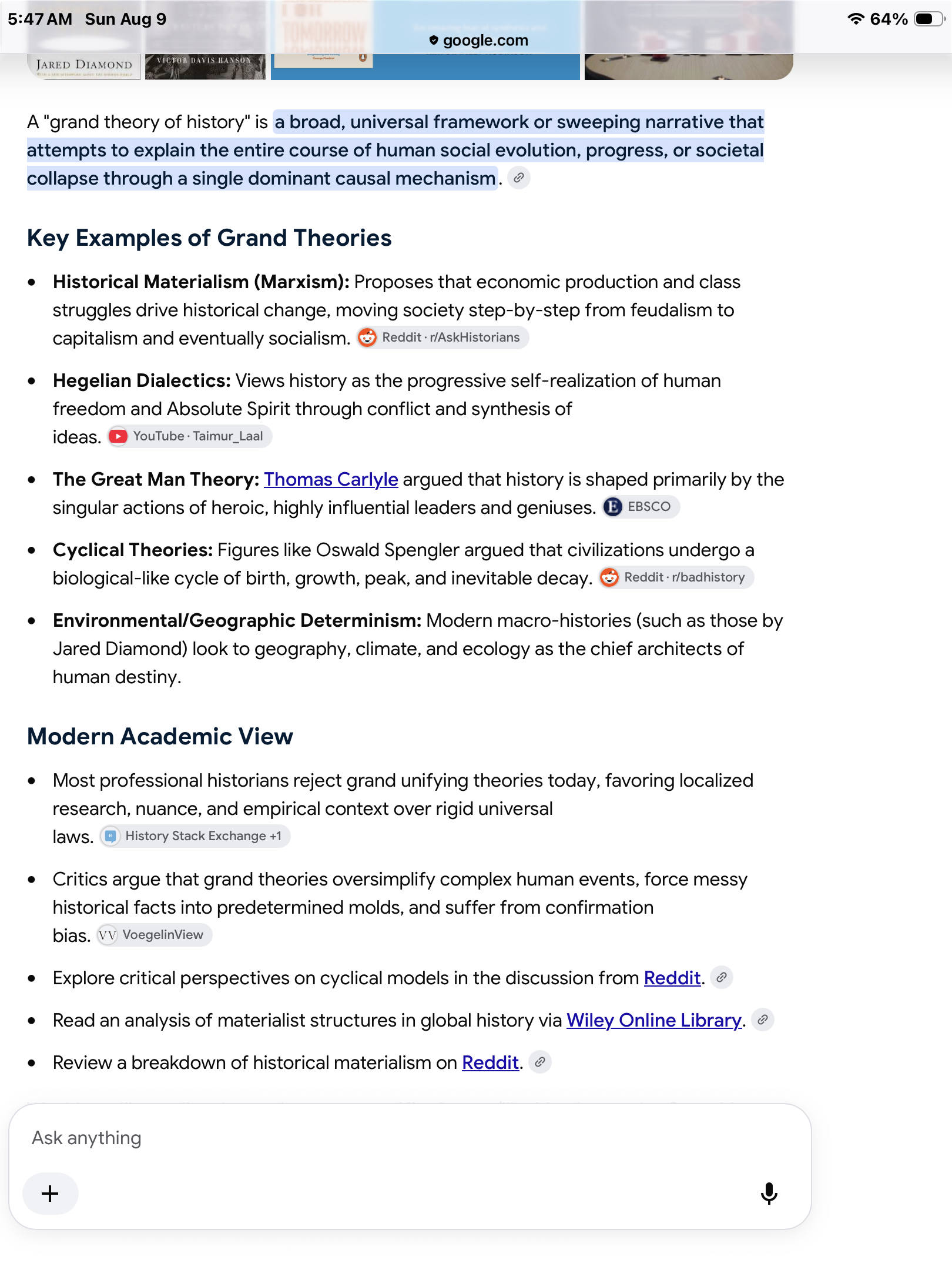
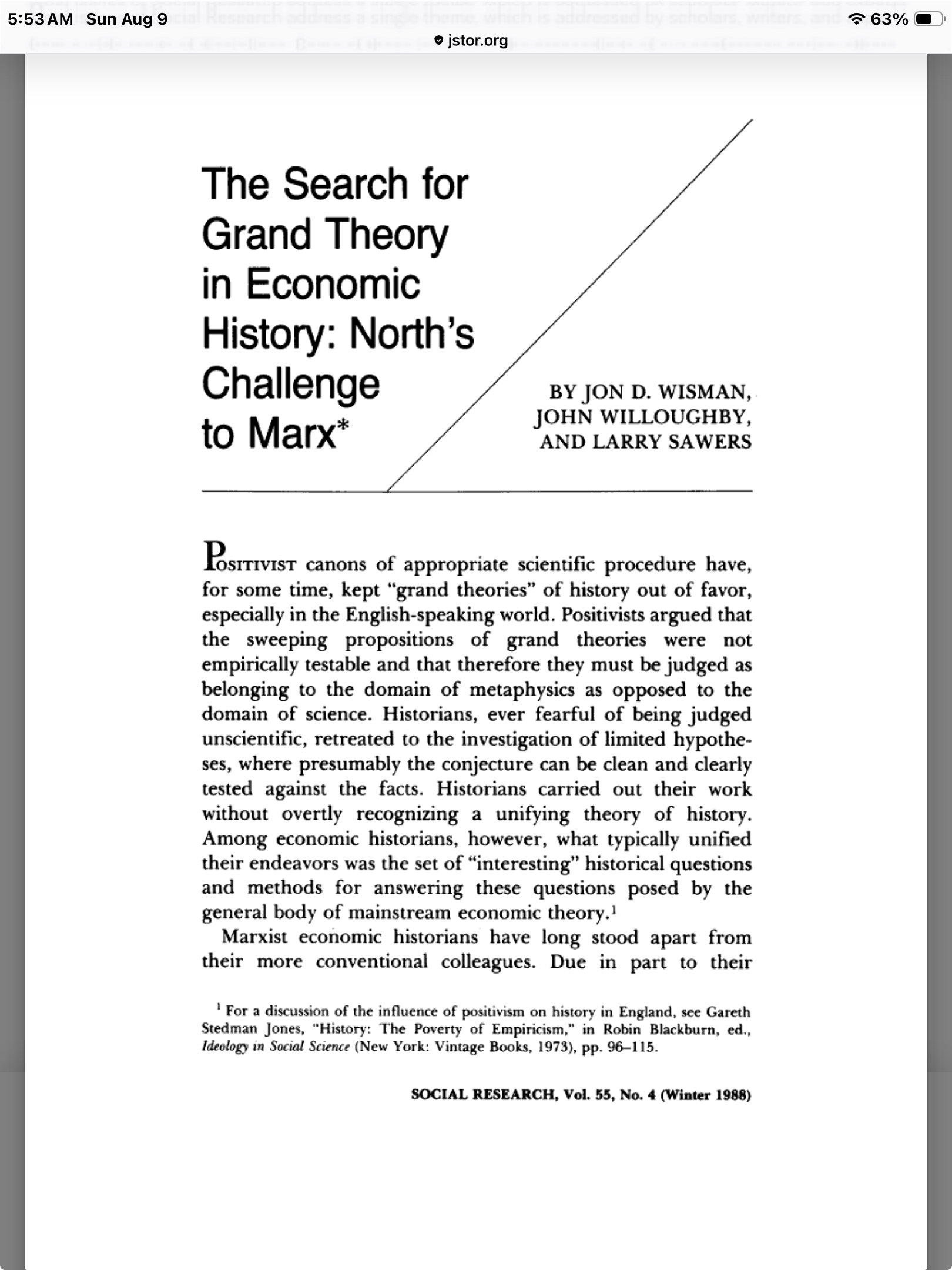
Grand Theories of History and Popular Historical Discourse One Last Sketch (2012)
History as weather: A fractal theory of history for Ian Morris, Jared Diamond and CGP Grey Metaphor Hacker (2021)
The Web and the New Reality Doc Searls (a repost of a 1995 post)
...The import of the Internet is so obvious and extreme that it actually defies valuation: witness the stock market, which values Netscape so far above that company's real assets and earnings that its P/E ratio verges on the infinite.Whatever we're driving toward, it is very different from anchoring certainties that have grounded us for generations, if not for the duration of our species. It seems we are on the cusp of a new and radically different reality. Let's call it Reality 2.0.
The label has a millenial quality, and a technical one as well. If Reality 2.0 is Reality 2.000, this month we're in Reality 1.995.12.
10viii26
LRB translation articles (html)
Mapping the Hollowing of the United States maps mania
US Population Growth Atlas, an interactive map showing how the populations of every US county and state have changed between 1980 and 2025.
The bureaucratic AI arms-race is mutually assured destruction Cory Doctorow
...an interactive map of the world throughout history, created by people like you and dedicated to the public domain.
11viii26
The Wisdom of Water: Alan Watts on the Ocean and the Meaning of Life Marginalian
Trump and American Enshittification Hobbledehoy
You feel it and see it, everywhere, like an ambient, grating sensation that everything is worse, and getting more so by the day.Your airline seat is narrower than it was ten years ago, and you paid extra for it. Your insurance company denied the claim through a system designed so that appealing it takes more days than the cancer patient has left without treatment. Your groceries come in a smaller box at a higher price. The brand you love was bought out by private equity and cheapened, a logo stuck on something made in a Chinese slave factory.
The app that used to just work now wants a subscription. The doctor gets four minutes. The customer service line is a machine that says it understands, then hangs up. The hotel charges a resort fee for a resort that doesn't exist. Every institution you interact with has quietly discovered that it can degrade the thing it sells you and lose almost nothing, because where exactly are you going to go?
The Future, Made in China The New Yorker
...For a long time, China looked west for visions of the future. These days, it favors its own. The Chinese car company BYD recently surpassed Tesla as the world's largest maker of electric vehicles. A popular clip shows Tesla's C.E.O., Elon Musk, being asked in 2011 about competition from BYD, which was then known mainly for a boxy, undersized sedan; Musk laughed and said, "Have you seen their car?" Fifteen years later, China has more than a hundred automakers, competing for customers with such extravagant features as in-car karaoke, mechanical foot massagers, and video headlights that can project drive-in movies.
Karine Polwart performs "James Hutton and The Restless Earth" Hobbledehoy
12viii26
John asks Aki for breakfast suggestions in Boston
maps mania
Model collapse Cory Doctorow
Temperature Zero for Culture: Why Everything Is Starting to Look the Same Lauren Leek
Iraq between Occupation and Sovereignty, as US Troops Depart Alex Poppe at Informed Comment
Our Wars on Each Other and our War on the Planet Tom Engelhardt at Informed Comment
US War on Iran Is Devastating for Women Who Want Life and Freedom Truthdig at Informed Comment
3 Ways To a Picture-Perfect Process AND Product with the Studio Habits of Mind via Stephen Downes
The Rise of the Measles-Industrial Complex Paul Krugman
Why do I call it a "right-wing turn"? Because declining support for childhood vaccines is entirely a Republican phenomenon. Gallup has some striking charts on this. One tracks belief that it's extremely important for parents to get their children vaccinated — a belief that has plunged over the past decade, but only among Republicans
...Why is this happening? Anti-vaccine sentiment is a lot like climate change denial. In both cases, to understand the politics one must do two things. First, follow the money: look at which interest groups benefit financially from misinformation, and why those groups have power. Second, follow the culture war: ask why this particular misinformation resonates with the prejudices and grievances of a segment of the population.
At first sight, the monetary interests behind anti-vax politics are less obvious than the fossil-fuel interests backing climate denial. After all, nobody benefits directly when children get measles.
Peddling quack medicine is, however, a highly profitable business. And it's a business deeply enmeshed with the right-wing media ecosystem: Ads for dietary supplements with no proven medical benefits and other forms of snake oil have for decades been a key revenue source for right-wing talk radio, conspiracy-theory websites, and more. So there is a longstanding connection between hucksters touting fake cures and hard-right politics. Some observers were startled to see Dr. Mehmet Oz — who has touted, among other things, the health wonders of bovine colostrum — named by Trump as administrator for Medicare and Medicaid, a job for which he has no relevant qualifications. But given the underlying monetary and political incentives, Oz's appointment is no surprise.
Why are right-wing audiences receptive to the lies of the snake oil industry along with agitprop against vaccines? To understand such gullibility, we have to address the culture war part of this debacle.
The modern right is a deeply anti-intellectual, anti-science, anti-expertise movement that is highly receptive to conspiracy theories. And like RFK Jr during his recent interview with CNN's Dana Bash, when confronted with scientific facts it flies into a sputtering rage. So the snake oil industry targets its marketing to the kind of person who listens to the rants of right-wing influencers, gets their news from Newsmax, and finds common cause with the neo-Nazi posters on X. By framing their false claims as "The Medical Miracles that the Elites Don't Want You to Know About", the snake oil hucksters create a receptive audience for conspiracy theories that malign actual medical miracles like vaccines.
Unfortunately, Covid greatly boosted anti-vaccine forces. The witch hunt against Anthony Fauci shows how strong a hold anti-medical-science conspiracy theories now have on the Republican Party. This was not, to be clear, because medical science failed. In fact, the clear negative correlation across the United States between rates of Covid vaccination and Covid deaths was an object lesson in how effective vaccines can be. But those Americans already inclined to believe that the elites are out to get them, already hostile to any notion of collective action for the common good, reacted to vaccine mandates with rage. And their rage quickly generalized beyond preventive measures against Covid to preventive measures against all diseases — including measles.
China's Polar Silk Road Adam Tooze
...China is now the world's great oil power: Forget OPEC. The Chinese Communist Party calls the shots
THE IRAN war has caused the largest supply shock in petroleum history. Yet even when fighting was most intense, oil prices never reached the $150 a barrel many analysts had predicted at the start of the conflict. For this, thank a few governments. Soon after Iranian munitions made the Strait of Hormuz unpassable, trapping 14m barrels a day (b/d) of crude inside the Gulf, petro-monarchs in Abu Dhabi and Riyadh directed an extra 5m b/d through pipes bypassing the conduit. Ministers in Washington and Tokyo released a record 2m b/d of emergency stocks; state-led rationing in poorer countries shaved off a chunk of demand. But disaster would still have struck without decisions quietly taken in another capital: Beijing. Between February and June, China slashed its crude imports by half, or 5.5m b/d—enough, experts reckon, to have shaved $30 or more off Brent, the global benchmark. That is more than half of the worldwide decline during the covid-19 lockdowns, when global demand collapsed by 9m b/d. And in contrast to the pandemic, when the world economy slid into recession, China's GDP has chugged along just fine. It has not been buying less foreign crude because its economy is suffering.
13viii26
"Basically pleasant bureaucrat" vs. "Sexy murder poet"
A is for Airtight Categories, B for Blanket Statements, C for Cherrypicking... Rebecca Solnit
...We live in a time where people are more isolated then ever from the kind of private, personal engagement where you can wonder, doubt, improvise, or just admit you don't know, and where many of us are instead more than ever in the para-public sphere of social media where you perform for an audience of casual acquaintances and strangers who may savage you if you get anything wrong or even seem weak or uncertain or uncommitted. This requires a performance of confidence and certainty that is seen as powerful even when it's also uninformed or oversimplified. I think of it as "you're naked without an opinion," in that lots of people there seem to think they need to have an opinion on everything and the old assumption that you have to have the facts first has faded.
...Ideas matter. How we tell the story matters. How good we are at recognizing our own habits of mind, frameworks, assumptions, biases and those of the most powerful storytellers in our society is how good we are at navigating our personal and collective path toward the truth and our aspirations. This is cultural work, the cultural work that shapes our world, because culture underlies politics the way topsoil underlies crops. Understanding the culture, the frameworks, the stories is essential to all the political work we do.
Stewart Brand put his 1997 BBC architecture series online for free
Greatest science books: Gödel, Escher, Bach: a daunting but captivating look at consciousness New Scientist
CROSSPOST: SCOTT AARONSON (2013): Against John Searle's Analogy of an Apparently Chinese-Understanding Room Brad DeLong
The Lost Vocabulary of Whaling Orion Magazine
14viii26
Science Friday
Most force-carrying particles largely ignore one another. For example, photons convey the electromagnetic force but do not readily interact because they have no electric charge. In contrast, gluons possess a charge for the strong nuclear force, so they attract one another mightily and can bind together, according to quantum chromodynamics (QCD), the theory describing the force. The challenge is that glueballs can mix with ordinary particles made of quarks and antiquarks. Instead of appearing as entirely new particles, they may be hybrids, with both quark and gluon components.
The scales of strain on sharks
...Humans operate as apex consumers in the oceans through fishing (11), but that capability, and the species that people depend on, often have complex and varied cultural and oceanographic contexts. Understanding the current state of natural systems requires an understanding of their histories. That is, the past can be a key to understanding the present
A boost for chemical vaccination against malaria
The phase-shifting architecture of chromosomes
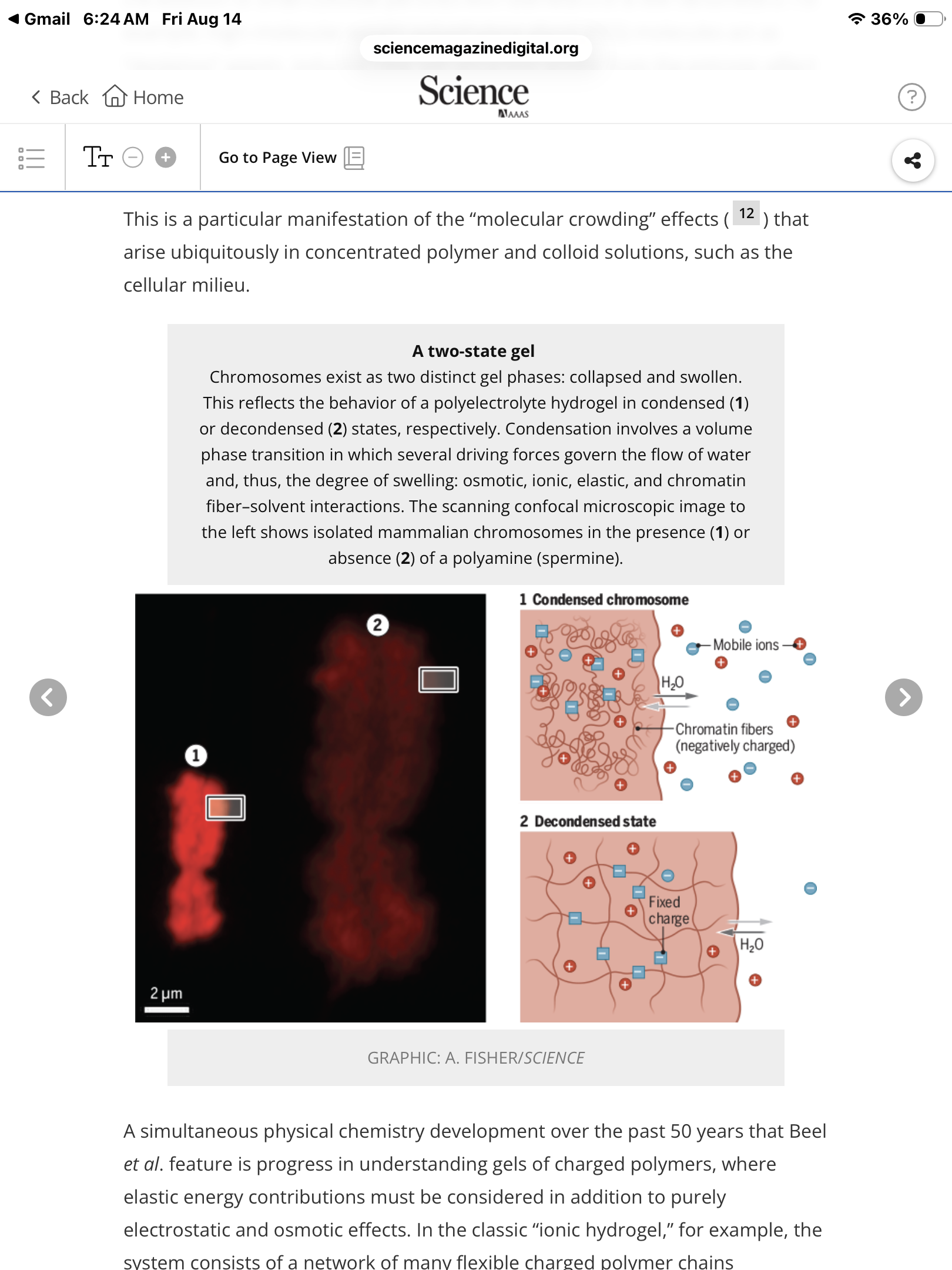
...A simultaneous physical chemistry development over the past 50 years that Beel et al. feature is progress in understanding gels of charged polymers, where elastic energy contributions must be considered in addition to purely electrostatic and osmotic effects. In the classic "ionic hydrogel," for example, the system consists of a network of many flexible charged polymer chains connected by physical (e.g., divalent counterion) or chemical linkers, and well-developed theory (13, 14) accounts for the bulk-phase first-order condensation transition that it undergoes as a function of concentration, temperature, or ionic strength. A chromosome, on the other hand, is a single, inches-long anionic polymer molecule (DNA) organized by millions of cationic histone octamers into 10-nm and associated 30-nm fibers, the effective length of which is substantially decreased (and the width, increased) by millions of "loop-extruding" condensin and cohesin proteins, forming the thick iconic chromatid arms visible by optical microscopy (see the figure). As argued by Beel et al., each of these single-DNA but many-component, noncovalently linked network structures achieves thermodynamic osmotic equilibrium in the same way as does a bulk ionic hydrogel. More explicitly, its structure (volume fraction, the degree of swelling) is determined by minimization of a free energy that includes corresponding osmotic, ionic, elasticity, and demixing (polymer-solvent interaction) contributions.
The eukaryote chromosome, a two-state system with interconversion by a volume phase transition (Beel et al.)
Inside the world of aspiring octopus farmers
...Schweid's ethnography of the cooperative farming initiative around O. maya in Sisal, Mexico, is a fascinating part of the book. He contributes voluntary labor to the farm, joining with local women to place 40,000 pats of paste made from crab, squid, and vitamins on trays to feed baby octopuses. In this way, readers glimpse beyond the corporate forces that have pushed octopus aquaculture globally— most famously seafood giant Nueva Pescanova in Spain—to see people investing in the future economic health of their communities.
However, the story of O. maya is also one of loss and failure. Schweid describes "a tranquil environment for the expectant mothers" in the cooperative's tanks. However, data logged by the company showing mortality across a dozen years at that facility in excess of 52%, largely due to octopus cannibalism, has led to a push by Mexican lawmakers to ban octopus farming altogether (2).
As Schweid explains, the goals of octopus aquaculture vary according to location and culture. In Mexico, the hope is to sell octopuses to the country's upscale restaurants and thus pull people out of poverty; in Japan, it is to reduce octopus imports; and in Spain, it is to revolutionize the global market for elite diners. Despite keen interest around the world, no farmed octopuses have yet reached the market. Even Nueva Pescanova has now failed in its goals for octopus aquaculture; in July 2026 the company withdrew its plans for an industrial-scale facility in Spain, citing changes in technical, business, and regulatory requirements it could not meet. (I believe it is highly likely that yearslong pressure on the corporation from international activists about harms to octopus welfare and to the environment played a role in the decision as well.)
Hidden costs of China's straw-burning ban
Equity in pathogen genomic surveillance
False reporting undermines the integrity of supply chain sustainability initiatives re: Cote d'Ivoire cocoa production
...Because agroforestry actions by multiple buyers are scattered, overlaps are not systematically reported at the subnational level, and monitoring data are not disclosed, it is generally not possible to assess how changes in the implementation of VSS affect false reporting. Our partnership with a cocoa trader enabled us to study this issue. We adapted the partner's monitoring data collection protocol for the shade tree planting program and embedded a preregistered randomized controlled trial in the program's field verification process. To minimize interference with other programs (including potential PES projects), the monitoring data were available only to the researchers. As part of the baseline data collection and before the beginning of the shade tree planting program, all cocoa farmers in the target villages were incentivized to report how many shade trees were planted in their cocoa fields by offering them a lottery, administered by the same cooperative agents later conducting field verification visits, and using electronic forms. The lottery procedures, the winning probability, and the prizes were stated up front in village meetings. A total of 3654 cocoa farmers participated in the lottery in the 85 villages. If the farmer won the lottery, they were rewarded with a machete or boots, but only if the self-reported outcomes matched the result of field verification visits, no matter the number of trees reported. This mechanism removes incentives to over-or underreport and instead rewards accurate reporting (SM section S3.2 documents a successful manipulation check). A total of 407 farmers won the lottery, and half were randomly allocated to the treatment group. We obtained field visit results for all 407 farms. They were, on average, 2.64 ha (SD = 1.94 ha) large and contained, on average, 20 trees (SD = 27 trees) planted from seedlings, according to farmers, and 26 trees (SD = 28 trees), according to field agents.
...The question is, why is Trump doing this? To understand what is happening, we need to put Monday's executive order in the context of the general right-wing turn against vaccines, and against science in general.
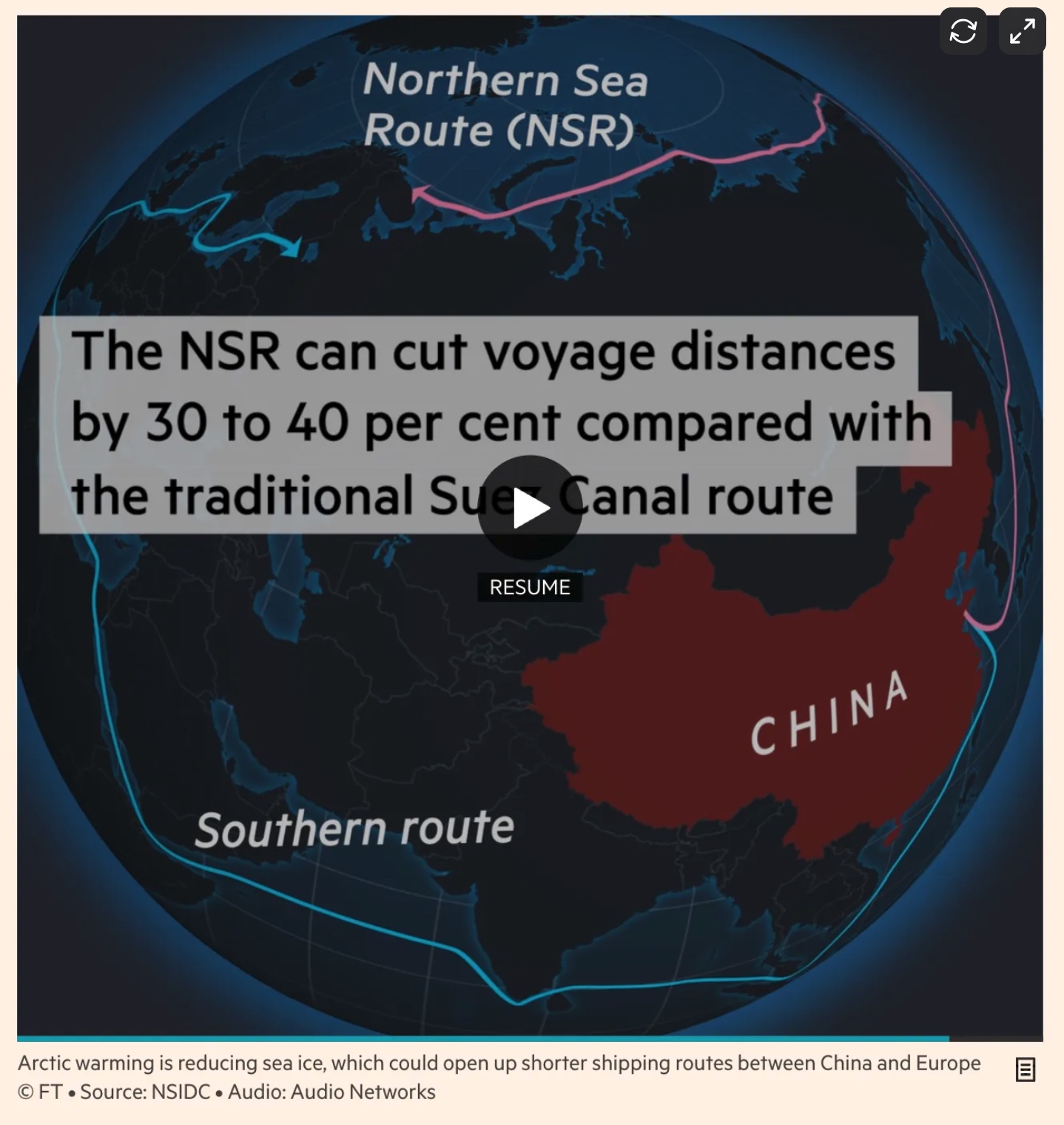
...For China, the Northern Sea Route to markets in the West is far shorter than a route by way of the Suez Canal
This paper examines the strategic use of language in contemporary artificial intelligence (AI) discourse, focusing on the widespread adoption of metaphorical or colloquial terms like "hallucination", "chain-of-thought", "introspection", "language model", "alignment", and "agent". We argue that many such terms exhibit strategic polysemy: they sustain multiple interpretations simultaneously, combining narrow technical definitions with broader anthropomorphic or common-sense associations. In contemporary AI research and deployment contexts, this semantic flexibility produces significant institutional and discursive effects, shaping how AI systems are understood by researchers, policymakers, funders, and the public. To analyse this phenomenon, we introduce the concept of glosslighting: the practice of using technically redefined terms to evoke intuitive—often anthropomorphic or misleading—associations while preserving plausible deniability through restricted technical definitions. Glosslighting enables actors to benefit from the persuasive force of familiar language while maintaining the ability to retreat to narrower definitions when challenged. We argue that this practice contributes to AI hype cycles, facilitates the mobilisation of investment and institutional support, and influences public and policy perceptions of AI systems, while often deflecting epistemic and ethical scrutiny. By examining the linguistic dynamics of glosslighting and strategic polysemy, the paper highlights how language itself functions as a sociotechnical mechanism shaping the development and governance of AI.
...the discomfort with temporal uncertainty that manifests as false certainty about the future has, I've come to realize, an equivalent in the unease about ambiguity, complexity, contradiction, and opacity that manifests as the urge to stuff reality into airtight categories. Categories are inevitable—language itself is a collection of categories—but their leakiness and limits should be recognized... Categories too often become where thought goes to die. That is, there's a widespread tendency to act as if once something has been categorized, no further consideration is required.
...See, consciousness has this weird dual property that, on the one hand, it's arguably the most mysterious thing we know about, and on the other hand, not only are we directly aware of it, but in some sense it's the only thing we're directly aware of. You know, cogito ergo sum and all that. So, to give an example, I might be mistaken about my shirt being blue –—I might be hallucinating or whatever — but I really can't be mistaken about my perceiving it as blue. (Or if I can, then we get an infinite regress.)...
Physicists find strong evidence for elusive 'glueball'
...Matter is like a Russian doll. Molecules are made of atoms, atoms of electrons and nuclei, and nuclei of protons and neutrons. Protons and neutrons, in turn, consist of quarks held together by a swarm of gluons. A glueball would be different: a particle whose mass comes almost entirely from gluons bound to one another, with little or no quark content.
...changes that have taken place within the past century. Paradoxically, even though global fisheries yield increased by more than 30 million tons in the period 1970–2022 (7), a huge portion (35%) of those fish populations are overfished (8). Commercial capture increased in many regions across the world's oceans during the first half of the 20th century, but there have also been substantial declines and collapses as stocks have become depleted (9, 10)
...Malaria is one of the world's most devastating infectious diseases, causing an estimated >600,000 deaths yearly, particularly in children up to 5 years old. Two vaccines that became available in the past few years partially protect children against infection with Plasmodium, the malaria parasite. However, a need remains to increase vaccine efficacy and expand it to other groups of people at risk (1). Plasmodium sporozoites infect the mammalian host's liver without causing malaria symptoms, before developing into symptomatic mature merozoites that infect red blood cells. Whole-sporozoite vaccines use sporozoites that have been irradiated or genetically modified before immunization to arrest their liver development or drugs that act on liver-or early-blood-stage parasites to prevent the onset of symptomatic blood-stage infection
...proton carries a conserved baryon number of one. In the conventional valence quark model, it consists of three quarks, each carrying one-third of this number. As the proton moves through space and time, its baryon number (its identity) moves with it. This flow is governed by quantum chromodynamics, a theory that describes the strong interaction between quarks and the gluons that pass back and forth between quarks to bind them. However, in a high-energy collision, a proton may break apart into quarks and gluons that crash into each other, transferring massive amounts of energy and momentum. Consequently, its baryon number can appear far from the initial path of the proton. In this scenario, what causes the baryon number to move? In the valence quark model, movement of the baryon number is tied to the electric charge and flavor (an intrinsic property that defines type of quarks) of the valence quarks (see the figure). An alternative hypothesis is the baryon junction model in which three "strands" of gluons bind quarks at a common point, forming a structure known as the baryon junction (4, 5). Here, the baryon number does not require following the motion of valence quarks. Instead, its movement may be associated with the overall organization of the gluon field that binds the quarks together. Thus, transport of the proton's identity depends not only on its quark content but also on the structure of the gluon field (6). For decades, the baryon junction hypothesis has been rarely tested. In most experiments, valence quarks and baryon number moved together, making it difficult to determine which component (quark or gluon) carries the baryon number.
As biologist and Nobel laureate Francois Jacob famously observed, "The dream of every cell is to become two cells."; And because the cell is the indivisible unit of all living things, this dream can arguably be considered the driving force for life. On the cellular level, the dream is fulfilled by the process of cell division (mitosis), and on the molecular level, it is fulfilled by the replication of chromosomal DNA molecules and their organization into compacted X-shaped pairs followed by their separation into daughter cells
...How to grow octopuses in bulk to adulthood remains a key challenge that vexes would-be aquaculturists. The common octopus (Octopus vulgaris) from the Atlantic and the Mediterranean goes through a paralarval period of drifting in the water, and this planktonic stage brings with it incredibly high mortality. By contrast, the O. maya species in Mexico does not drift but instead becomes benthic rapidly, settling to feed on the seafloor, and is easier to grow in captivity.
...In China, the world's largest producer of crop straw (2), local governments implemented strict straw-burning bans in 2013 to reduce its environmental and social harms (3). Between 2013 and 2022, annual agricultural fire spots across 19 Chinese provinces decreased by more than 80% (4). However, the apparent success of the bans does not take into account the costs borne by already disadvantaged farmers.
When a disease outbreak occurs, sequencing the responsible pathogen and posting its genome to a public database facilitates research into diagnostic tests and vaccines. However, the benefits of sharing genomic data quickly and widely are not equally shared. Many outbreaks begin in lower-income countries (1), where health workers and scientists collect samples and generate sequences that are then used by well-resourced institutions to create proprietary tests, therapeutics, and patents (2). When there is little return for sharing data, countries may decide to share less [as Indonesia did in 2006 (3)], making the equity problem a security problem as well. Member states of the World Health Organization (WHO) adopted the Pandemic Agreement in 2025 (4), and they are now negotiating an annex called Pathogen Access and Benefit Sharing (PABS) (5). The current terms of the annex will help in emergencies but overlook the steps required to establish enduring equitable practices.
...Although producers' main incentive is to maintain market access by complying with buyers' rules, cooperatives and traders also benefit from showing compliance because it can ensure stable supply and good relations with supplying communities. Traders and manufacturers can also benefit at the brand level from the appearance that their supply chain programs are functioning well. This structural conflict of interest creates fertile ground for false reporting that benefits at least one of the agents involved (either the data collector alone or the data collector and the beneficiary). This false reporting may be a form of collusion when the agent and producer collaborate on the misinformation.
...Memories leave lasting physical changes at the synaptic level. Although stable, larger spines are thought to support memory, the high turnover of dendritic spines and the drifting of neuronal representations after memory formation suggest alternative possibilities. To elucidate the structural trace underlying memory retention, we used a mouse model of artificial hibernation. During hibernation, hippocampal neurons exhibited a substantial reduction in their activity and an extensive elimination of dendritic spines and synapses. Despite these changes, their memory and associated hippocampal neuronal representations remained intact.
The eukaryote chromosome, a two-state system with interconversion by a volume phase transition (Beel et al.)
Forest canopy decline under elevated CO2 during the Paleocene-Eocene Thermal Maximum
Uncertainty remains regarding the impact of rapid anthropogenic warming on forest ecosystem structure, biodiversity, and function. As an analog, we reconstruct forest canopy density and compositional change in Wyoming, USA, through the Paleocene-Eocene thermal Maximum (PETM), an interval of abrupt carbon increase and warming ˜56 million years ago....Anthropogenic enrichment of atmospheric CO2 (pCO2) has driven increasing global “greenness,” measured as leaf area index [(LAI); foliage area (m2)/area of ground (m2)] since 1982 (1). Around 2000, this pattern reversed across ˜90% of Earth's vegetated surface, particularly at mid-to low latitudes (45°N to 30°S), indicating that the benefits of pCO2 fertilization for primary productivity are being outpaced by heat and drought stress from increasing air temperature (2). As a result, vegetation carbon storage is declining and could lead to a net loss of above ground live carbon of up to 20% by 2100 (3). However, the long-term ecological consequences of sustained greenhouse warming for forest structure and carbon storage remain poorly constrained, limiting our ability to predict how modern forests may respond over millennial timescales.
Bison Restoration Efforts and Grazing Rights Hinge on One Question: Are Bison Wildlife?
The FDA says you can't wash Cyclospora from your lettuce boingboing
Proto-Elamite in the Iranian Context languagehat
15viii26
365 Geospatial Papers Milan Janosov
Mapping All Our Yesterdays maps mania
Popova:
The great paradox is that we are aflame with aliveness only as we burn through the atmosphere of now, and yet our lives are the story we constellate from the signals of bygone experience across the sky of time.To be truly alive is to inhabit the moment not as a future memory of experience, not as a projection of the past, but as a meteor of actuality.
16viii26
As a long-time fan of Italian design, I have to... ...admire these Milanese runway-models who are so aggressively chic that they really look like they would assassinate men, eat the flesh of men, and then chew on the dry bones of men. Bruce Sterling
Trump reinvents the Portuguese Empire with Plan to make Hormuz US Territory Juan Cole
Calculated Deception: How Israel uses Diplomacy to buy Time for Gaza's Destruction Informed Comment
A History of the Lottery: Winners, Numbers, Powerball, & United States Britannica
Lottery Wikipedia
Barbie, Dolly, rebarbative, phenobarbital sesquiotic
17viii26
Shots and Misses Doc Searls
...a meteor impact crater in Utah's Canyonlands National Park. It's called Upheaval Dome, because that's what geologists thought it was before it became clear that it wasn't
Are You An Anarchist? The Answer May Surprise You! David Graeber (2009)
The New Anarchists David Graeber (2002)
N is for Nuts Timothy Burke
...("Nut" is also a semantically live word in general in English, when you consider the variety of other things it can mean—testicles, insanity or mania, a difficult problem, a dominant hand in poker, a derisive interjection.)
Iraq Kuwait via Adam Tooze
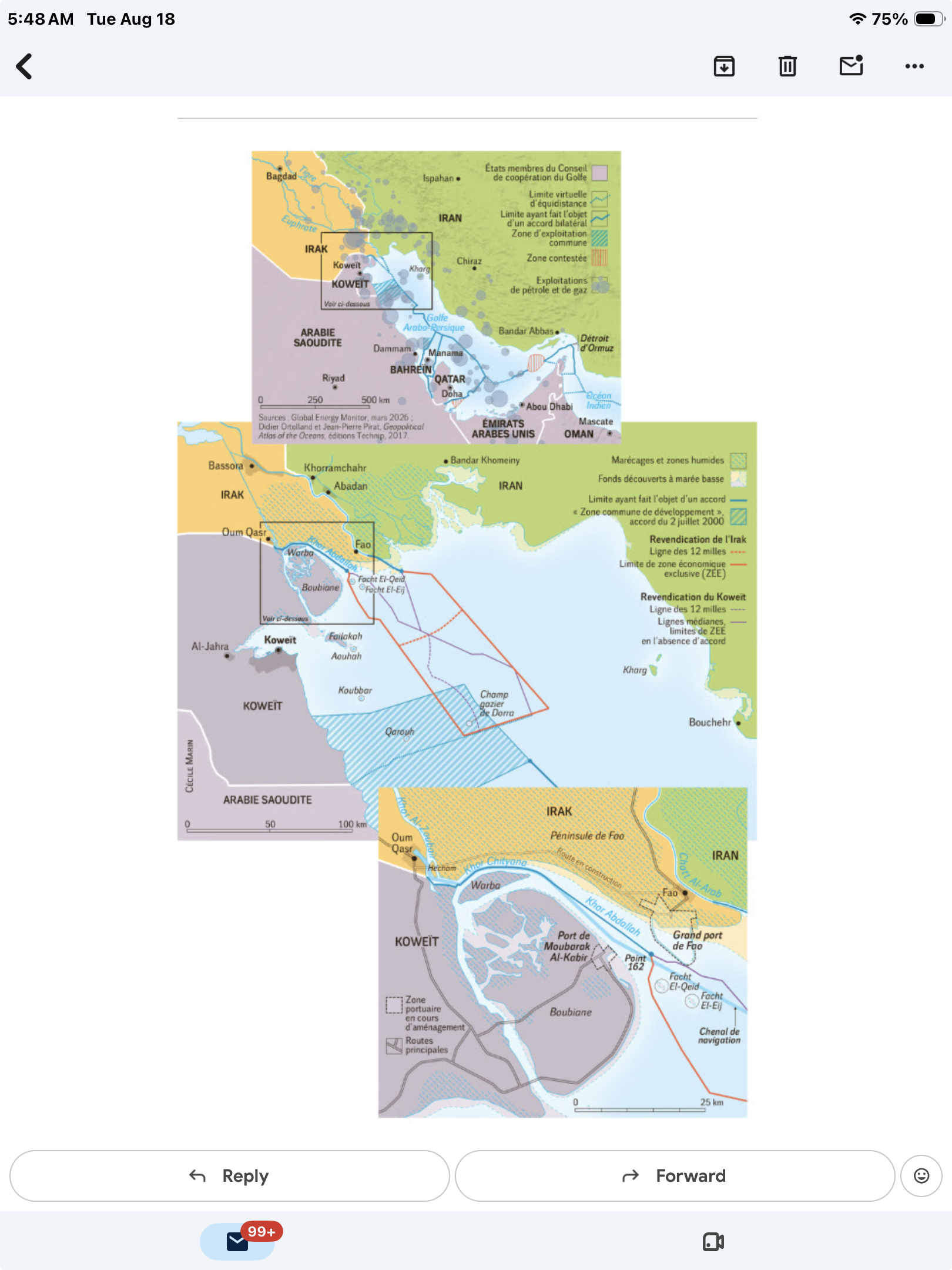
18viii26
THC in cannabis may reduce nightmares in people with PTSD New Scientist
We Need To Talk Kevin Munger
...the media theorist Walter J. Ong, who spoke of the emergence of a secondary orality'. And Ong deserves his flowers; his careful work about the psychodynamics of orality and literacy catalogued the multitudinous and profound ways in which our previous media regime constructed the humans that took part in it, and how those humans are being replaced by new kinds of humans as the media regime changes. It's difficult to imagine reading through this well-researched text and not coming away convinced by his argument.
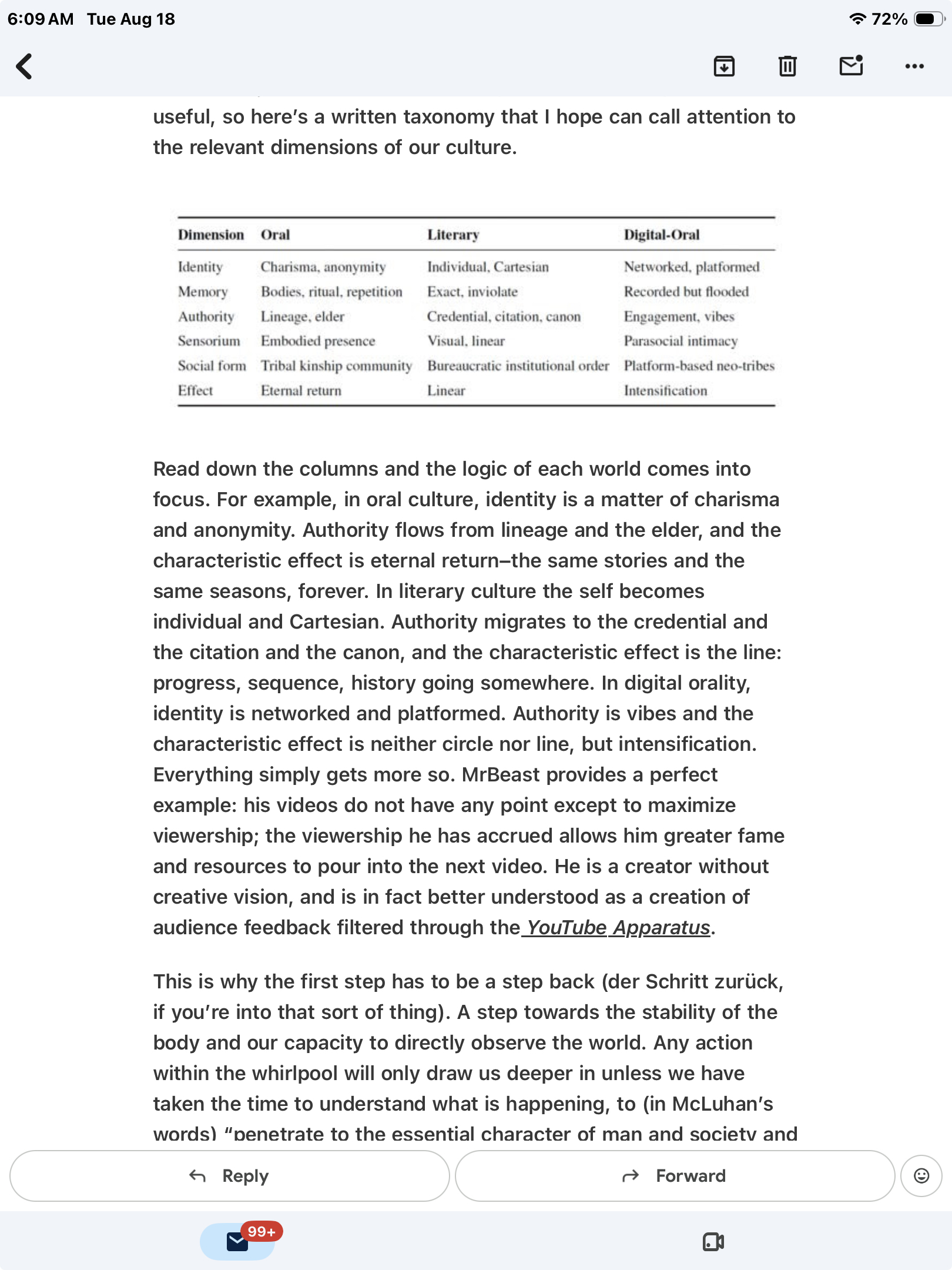
The Passing of the Decisive Moment Michael Alford at Medium
...The Decisive Moment” is perfect to describe HCB's photography. It's more on point than his original French title for the book, Images à la Sauvette, which roughly translates as "photography on the sly," or "furtive photography," or "images on the run." Images à la sauvette is accurate as a description of how HCB took his pictures, but it doesn't describe his results.
Surveillance vs guillotines Cory Doctorow
...the alleged heroes of the market system — the entrepreneurs who found and manage the firms that increase public prosperity — are doomed to play second fiddle to the mere plumbers of money, people who "contribute" by accumulating....Piketty shows that this holds true across markets and nations and eras: all other things being equal, the market system produces a class of hereditary aristocrats who command the world's capital and direct its deployment, despite never having done anything. The market's most lavish rewards do not go to its most productive participants, but rather, to those participants who have the good fortune to emerge from the luckiest of orifices.
Epictetus Ran a Better Productivity System Than Any App You've Bought JA Westenberg
...Epictetus focused on three things: your judgments, your desires, and your decisions; in particular, he emphasized choosing what to pursue, what to turn down, what to keep, and what to cut out completely.Everything outside that circle is neither your circus nor your monkeys.
Everyone else's actions, opinions, ideas, annoyances, traumas, outrages, and emotional dysregulation don't actually need to concern you at all. Neither do the various algorithms you can't reshape or the markets you can neither predict nor control, or the emails someone else marked urgent based on their needs and their deadlines. None of these things belong to you, and it's not your job to try to own them.
The Stoics called this the dichotomy of control; the YouTube philosopher squad might call it a lifehack. I call it a damn good way to avoid going insane while still getting through a to-do list.
Back from Bali: A 12-Point Meditation On Our Moment Otto Scharmer at Medium
...We live in a time of Rupture, Fracture, and Absencing. A time of rupture, as Mark Carney put it at Davos earlier this year, not transition. A time of fracture, not fragmentation. And a time of absencing, not just presencing. We see different versions of these patterns pretty much everywhere... The three patterns — anomie, atomie, atrophy — are not three separate problems; they result from one and the same source: the erosion of social soil. Beneath the clash of logics lies something deeper. Social soil, i.e., the quality of our awareness and relationships, can be degraded in multiple ways. The fracture of our relationships results in loneliness (atomie). The fracture of our inner values results in loss of meaning (anomie). And the fracture of both results in the loss of our creative capacity (atrophy). All three deepen the fracture of our consciousness, moving us backwards (or locking us in) inside the boundaries of an ego-centric awareness. And that is the loop: the fracture feeds back into the very soil from which it grows.
...Soil Functions As A Membrane. The soil of our planet functions as a breathing membrane between atmosphere and lithosphere. A membrane is semi-permeable, partially open, partially closed. It's the quality of that earth soil (or of that breathing membrane) that allows the biosphere to emerge and flourish.
Likewise, the social soil functions as a breathing membrane that allows the social sphere to emerge and flourish. But what actually is that middle sphere, that breathing membrane, in the case of the social soil? It's human attention. Shared human attention. The quality of our shared human attention allows the social sphere to emerge and flourish.
As my Japanese colleague Professor Masato Homma, who is one of the participants in the IDEAS Asia Pacific journey, explained to me last week: if that membrane is too closed, we experience loss of connection (atomie). If that membrane is too open, we experience loss of inner substance (anomie). And if that membrane loses the capacity to breathe between both, we experience loss of agency (atrophy)
Model Collapse Cory Doctorow
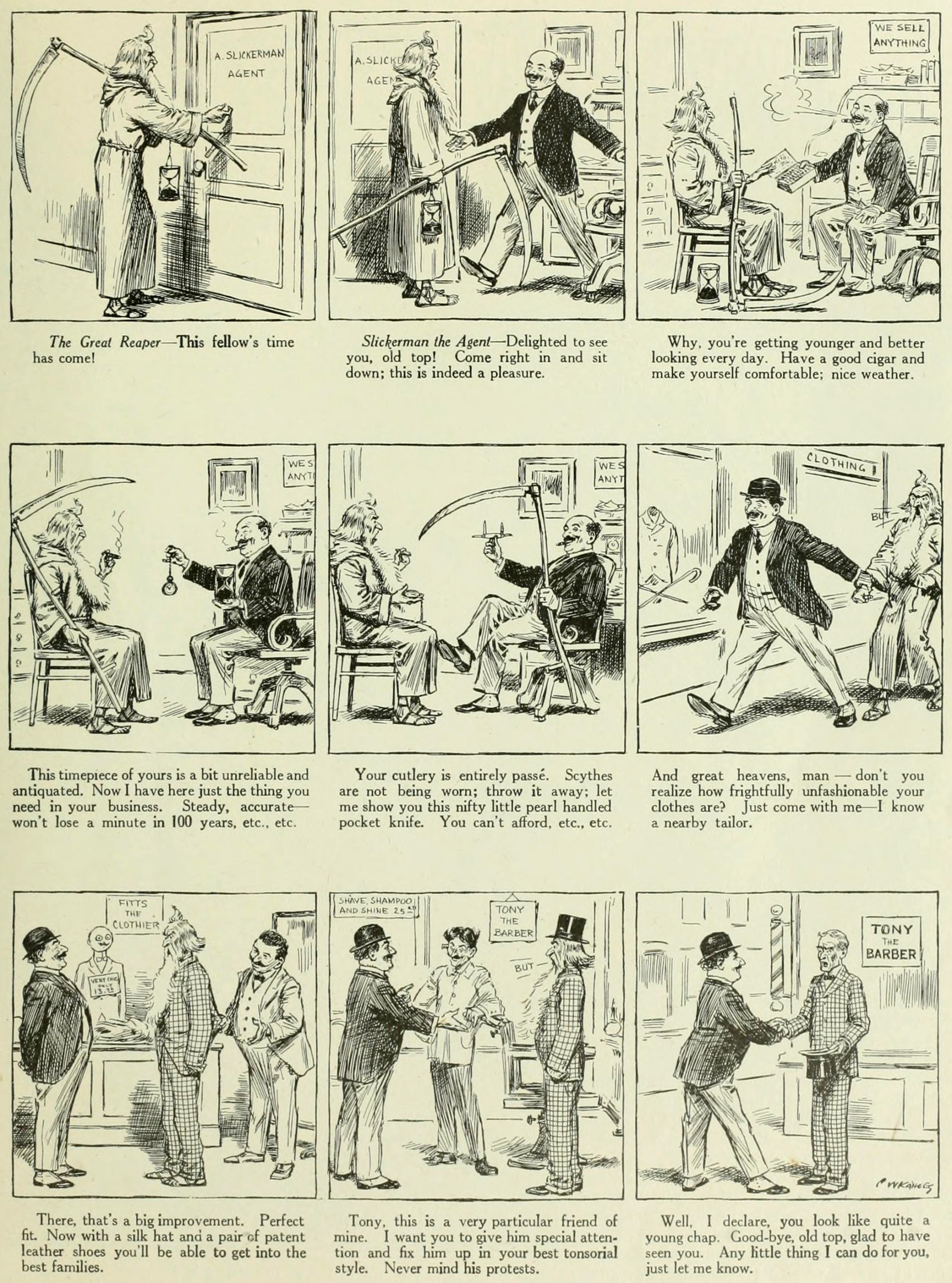
rabbithole: type a word, fall in via Stephen Downes
Dickovers, baggravation and botiquette: 18 new words to describe our tech hellscape Guardian
Secondary Source People languagehat
(quotes David Hollingshead)For many years, I've held a pet theory that cultural consumers can be grouped into two broad categories: Primary Source People and Secondary Source People. The former are the book lovers, cinephiles, archive perusers, and history buffs who grew to love their areas of study because of the specific objects that constitute the field: the two women I overheard whispering about how they wanted to fuck Adam Bede, in one of my undergrad classes; the student of mine who disclosed that he loved The House of Mirth because "something similar happened to me recently" (????); or the guy who collects swords as a way into understanding the medieval period are examples of this type. You've certainly met these people or been taught by them; they are often motivated by personal attachments to specific works, and my hunch is that they represent the majority of those who care about art today.Secondary Source People are different; they become obsessed with the discourse about the objects being studied. Professional critics, "theory bros" (gender neutral), Letterboxd reviewers who primarily read other Letterboxd reviews, the weirdly combative people in your seminars who know all about the different scholarly camps on a topic—this group prioritizes the conversations, contexts, and conflicts surrounding the works above and beyond the works themselves. Secondary Source People are the main contingent both producing and consuming academic writing. For them, the question of a text's beauty or capacity to immerse is less important than how its ideas expand or contract as we engage with them.
I can see the attraction of this distinction, but I think that as stated it feeds into the ever-popular tendency to divide humanity up into mutually exclusive groups: there's this kind of people (our kind, the good kind) and that kind (their kind, the bad kind). Note that he doesn't say, as I would if I took it into my head to make use of the distinction, that most of us, especially scholars, are a mix of both, with each surfacing and taking control at different times and in different situations. No, there are Primary Source People and Secondary Source People, and never the twain shall meet; he, claiming membership in the second group, presents the first as simple-minded and laughable (“the two women I overheard whispering about how they wanted to fuck Adam Bede”) — serious people like himself prioritize “the conversations, contexts, and conflicts surrounding the works above and beyond the works themselves.” I think the latter characterization is true of a lot of people, notably academics, and I think it's a big problem. Once upon a time, literary scholars took it for granted that literature (alias "primary sources") was a vital element of humanity, and the job of scholars was to explain it and bring out its various excellences — "the good and the beautiful," as they used to say. This led to a lot of silliness (the biographical fallacy, Walter Pater's ecstasies), but it also brought to light a great deal of useful information about textual interconnections, linguistic details, real-world referents, and the like. The 20th-century reaction against it took various forms, starting with the structuralists ("what's important is the system of relations between elements") and winding up in Theory (Derrida, Althusser, & Co.), with an ever-increasing elevation of the critic/scholar above the mere author (who, it turned out, didn't exist anyway) and the kind of contempt for the lay Primary Source reader that we see in evidence here.
19viii26
The ordinariness of evil Cory Doctorow
...AI is mostly a novelty, a heavily subsidized toy that produces little more than distraction. Where AI does produce value, that value is comparable to a plug-in, a new feature for your word processor or image/sound/video-editing package that might help you do your job somewhat better, or it might not.That doesn't make AI useless, it just makes it a normal technology: useful for some, useless for others, capable of being abused and likely to waste a lot of time when used unwisely
...This is a civilizational act of Magic Underpants Gnomery, and every day that it goes on is a day when more economic, climate and political costs of AI are imposed on all of us. Scientific journals, open source repositories and even science fiction magazines are being overwhelmed by slop, whose perpetrators and apologists insist that soon, AI will realize its potential and the slop will be transformed into gold.
That's why AI bosses are so committed to talking up AI's destructive potential: because destructive potential is nonetheless potential. The moment we stop believing in that potential is the moment that we stop supplying AI companies with bales of cash to shovel into their money-furnaces so that they can afford to sell hundred dollar bills for a dollar each to Elon Musk cultists who want to generate child porn and pictures of Sonic the Hedgehog with giant boobs.
AI does have destructive potential. It has the potential to destroy the productive economy when an AI salesman convinces your boss to fire you and replace you with chatbots that can't do your job
...Treating AI as unexceptional is the best way to halt the destructive march of AI companies and their impact on jobs, the climate and the economy. But treating AI as unexceptional requires that we stop talking about AI as if it were exceptionally evil. Yes, some people who use AI experience severe mental problems, but that's not because AI is a Lovecraftian horror that destroys your brain and your capacity for rational thought if you use it. It's not a basilisk. AI is like a carny ride that triggers cardiac events in riders who never knew they had a problem because they never experienced those particular g-stresses –— it's not something that induces vulnerability, it's something that triggers vulnerability
Demiurge Wikipedia
Maurice Merleau-Ponty (1908-1961) Wikipedia
Maurice Merleau-Ponty Stanford Encyclopedia of Philosophy Archive
Merleau-Ponty's Encounter with Saussure's Linguistics: Misreading, Reinterpretation or Prolongation? Anna Petronella FOULTIER (2013) (pdf)
The Diacritical Nature of Meaning: Merleau-Ponty With Saussure Emmanuel Alloa (2013)
The News: The Chessmen of Uranus Timothy Burke
Speaking really broadly, empires are defined by a relationship between a core, peripheries and outer frontiers. The core region or territory can move around somewhat. The Western Roman Empire shifted its administrative core from Rome to Ravenna in its last century of existence, and the Roman Empire as a whole effectively relocated its overall core to Constantinople before that. Niani may have been the nominal capital of the Mali Empire but the big metropolitan cities of the central Niger like Timbuktu and Gao defined its core, which then carried over into the Songhay Empire afterwards.The core, in any event, is a conceptually different space than the peripheries. Power and wealth flow inwards towards the core and are then dispersed from there in various ways throughout the core and into the peripheries. Laws and rules, social formations and structures, forms of personhood and access, customs and languages, all operate differently in the core. Empires don't have to be exclusive or monocultural in their cores—many of them in history have been cosmopolitan, inclusive, or heterogenous at their heart.
The peripheries, on the other hand, shift and fluctuate all the time. Frequently, they do not have precise boundaries. Their relationship to the imperial core may be defined by arbitrary violence, brutal exploitation, persistent contempt. Or it may be contractual, business-like and constrained to the paying of tribute and mandatory alignment with the empire's larger military and political objectives. A periphery may be a perpetual battleground between regional hegemons that changes hands frequently, it may be a sparsely inhabited region valued for its provision of a single extractable resource, or it may be a centralized state ruled by a client elite who treasure their relationship to the empire and the benefits that relationship provides.
If you want to diagnose the health of an empire, and its likely futures, you look to its peripheries. The rulers of the core, whatever the nature of their rule, see their peripheries as the wellspring of opportunity and the portent of danger. Pretenders and challengers who lose the game of thrones go out into the peripheries to try and earn another throw of the dice.
Manifold
Manifold WikipediaWhat Is a Manifold? Quanta Magazine
Reddit:
palordrolap 4y agoEtymologically, the word "manifold" is a Germanic counterpart to the Latinate "multiple". They're not strictly cognate in the linguistic sense, but their derivations mean exactly the same thing.
That the meanings have drifted a bit, or been co-opted for different concepts shouldn't really blind us to that.
A manifold has multiple things about it. Dimensions. Layers. Abstract interconnected concepts. Possibly all three.
Subjective selection, super-attractors, and the origins of the cultural manifold via PubMed
Husserl's Notion of Manifold Carlo Ierna's Blog
Eric Wolf, Europe and the People Without History (Rediscovered) livinganthropologically.com
The central assertion of this book is that the world of humankind constitutes a manifold, a totality of interconnected processes, and inquiries that disassemble this totality into bits and then fail to reassemble it falsify reality.A Homage to Eric R. Wolf's Europe and the People Without History Alex Sager
20viii26
Psychedelic Visions Andy Ilachinski, quoting Fitz Hugh Ludlow (1836 - 1870) The Hasheesh Eater
...It is this process of symbolization which, in certain hasheesh states, gives every tree and house, every pebble and leaf, every footprint, feature, and gesture, a significance beyond mere matter or form, which possesses an inconceivable force of tortures or of happiness....Perhaps one of the most difficult things to convey to a mind not in the hashish delirium, by the symbols which there teach the manner of its process, or by any others, is the interchange of senses. The soul is sometimes plainly perceived to be but one in its own sensorium, while the body is understood to be all that so variously modifies impressions as to make them in the one instance smell, in another taste, another sight, and thus on, ad finem. Thus the hashish-eater knows what it is to be burned by salt fire, to smell colours, to see sounds, and, much more frequently, to see feelings.
Fragments Christopher Hobson
quotes Arendt (1975):>br>...n retrospect it looks as though there existed no such grand schemes but "only" the firm resolve to do away with any law, constitutional or not, that stood in the way of shifting designs inspired by greed and vindictiveness rather than by the drive for total power or any coherent political program. In other words, it is as though a bunch of con men, rather untalented mafiosi, had succeeded in appropriating to themselves the government "of the mightiest power on earth."
World may warm by 25 per cent more than current projections suggest Michael Le Page at New Scientist
Paul Simon's Graceland' Turns 40. I Wish I Hadn't Researched It The Complex Backstory of a Masterpiece James Geuzebroek at Medium
...I learned some rather disturbing things about the making of this album.No, I am not talking about the controversy around Simon travelling to South Africa during Apartheid, in defiance of the United Nations-backed cultural boycott. Nor am I talking about the accusations of cultural appropriation that have dogged the album. Both have been thoroughly covered, and I don't feel particularly qualified to chime in on either.
...This excellent Ringer article by Steven Hyden, a warts-and-all tribute to Paul Simon, does a nice job of outlining the complexities of the man's legacy. Of Graceland, it says: "an impossible album not to love until you learn its back story. Then it becomes impossible to love without caveats."
...The whole story raises questions about where creativity comes from, and what belongs to whom. When musicians get together in a studio and build a song through improvisation, who owns the bass line, the guitar riff, the groove that suddenly makes everything click? At what point does a musician stop being a collaborator and become a songwriter? There are no easy answers.
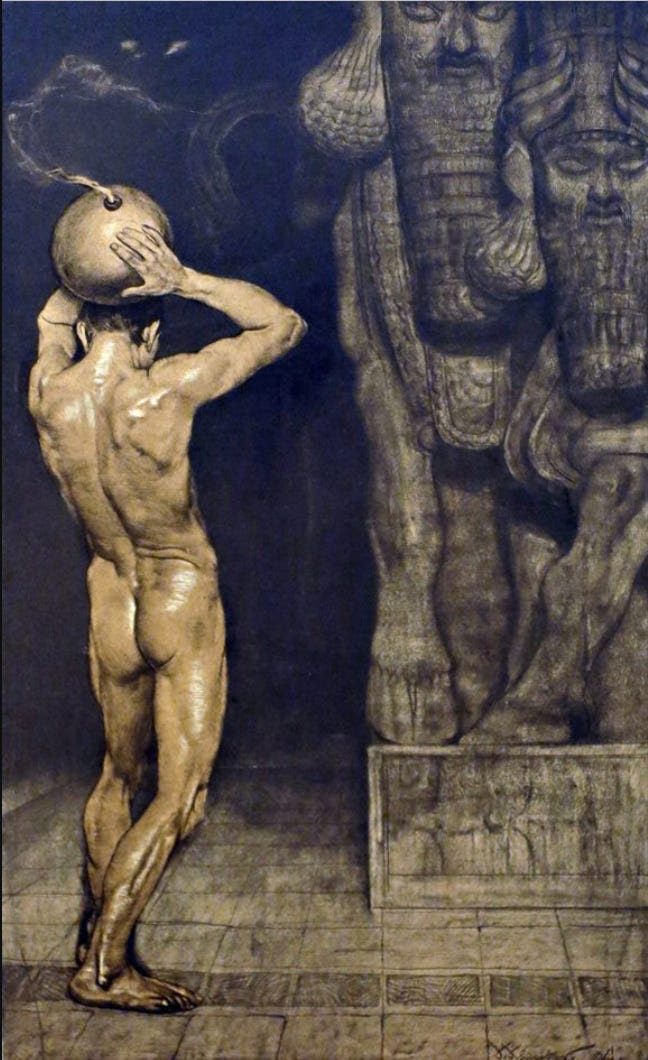
SWEET THINGS, Part 3: Cane Syrup #2 Home Made David S Shields
Medieval Europe was battered with 16 catastrophic floods in just 2 years Julia Vaz at Science 18viii26
In the town of Göttingen, Germany, sits a small parish of stone and red brick. Inscribed on a cross within, a son mourns the loss of his father, Hermann, who drowned in a flood in 1342. Known as the Magdalene flood, the deadly deluge was one of the greatest natural disasters to hit Europe in the past 1000 years.Despite the devastation, historical records of the flood are scarce. The inscription on the Göttingen cross is the only known text to name a victim. Now, after years of scrubbing archives, researchers are painting a much more complete, and even more devastating, picture of catastrophic weather from this era. In a study published this month in Nature, scientists report evidence of about 16 cascading floods that wreaked havoc across Europe between late 1341 and 1343—the largest number of back-to-back flooding events documented in the past 700 years.
"This is a massive cycle of floods," says Ellen Arnold, an environmental historian at Ohio State University who was not involved in the study. "It's like taking the last five extreme flood events over the last 20 years and having them all happen within 2 years."
The cascading floods would have been particularly devastating for medieval Europe. Many towns and villages relied heavily on rivers for transportation, trade, and water-powered mills. The deluges would have drowned thousands, while many more perished from resulting food shortages and diseases. Buildings and homes were destroyed, and roads were washed out. "It damages the core metabolism of cities," Arnold says. And if that wasn't bad enough, these events were closely followed by the arrival of the Black Death, a devastating plague that killed millions in Europe.
...a period of climatic transition that brought about the start of the Little Ice Age, which was marked by extreme weather with an increase in high-intensity cyclones, volcanic eruptions, and changes in Arctic sea ice. All those conditions could have led to the series of intense floods
Academia: Go Into Plasticity Timothy Burke
...Robbins' thought is that what current agentic AI lack is “phase”, which in turn denies them the semantic plasticity that is a basic part of how we as individuals relate to language and to representation through an accumulating and irreversible history. Robbins uses the example of how the phrase "Fuck you, asshole" changes if you've seen the film Terminator 2 such that you can say it to a friend if the friend has also seen the movie, as long as you're careful to say it like Ah-nuld does in the movie. There are a lot of examples. My daughter and I were bemoaning how the innocent variety of things that the word “goon” meant is being destroyed by the virulent spread of the new meaning of "gooner", but that semantic destruction is only happening to people who are online too much (as the two of us are).Even before generative AI, the kinds of agent-based approaches I was thinking about (inexpertly) almost two decades ago required topography, meaning a confined environment that gave their rulesets something to act on and within. Some experts, like John Holland, were working to make agent-based systems have history, in a sense—that was the whole point of “genetic algorithms” and of machine learning. There was a fitness criteria, the agents that met it best in one cycle were kept and others discarded, the cycle began again, and so on.
So as I understand it, Robbins is suggesting that to have "phase" is to have a confined linear topography of time just as agents have an "environment" that is quasi-spatial, and with it, they would have some kind of semantic plasticity that was persistent. Tasks would be undertaken differently after some kind of rupture or shift derived from a previous experience. Interaction histories would be conserved and continuously processed rather than constantly destroyed by each new training cycle and versioning. And that this, suggests Hollins, would create the possibility of persistent relations between agents. And perhaps? between agents and users.
21viii26
The Resilience of Uncertainty: How to Hold the Universe in You Marginalian
Touch and pain shape what brain imaging sees Adiya Rakymzhan and Laura D. Lewis at Science
Much of what is known about the spatial organization of cognitive and sensory function in the human brain comes not from recording neurons directly but from imaging signals from blood vessels. For example, functional magnetic resonance imaging (fMRI) infers neural activity in the brain from local changes in blood oxygenation. Neurons send signals to nearby vessels to dilate, delivering oxygen and glucose to fuel neuronal activity. This neurovascular coupling is often treated as a faithful, modality-independent translator of neural signals into an imaging readout.
Bricolage origins and evolution Thomas Aston at Medium
...the official origins of the word bricolage come from anthropologist Claude Lévi-Strauss in The Savage Mind. The word is derived from the French verb bricoler ("to tinker") and linked to the term bricoleur which means 'a jack-of-all-trades.' In essence, it refers to the reuse a heterogeneous repertoire of available materials to solve new problemsIn art, bricolage refers to the construction, or creation, of an artwork from what materials are available or can be found. It generally emerged as part of post-modern art practice, finding expression in surrealism, dada, cubism and most notably in assemblage art. Formally, it was said to have emerged from Pablo Picasso's cubism, but most explicitly found expression in German Dadaist artist Kurt Schwitters' collage, or Merz, technique of scavenging scrap materials (see below). The term Merz itself was borrowed from the suffix of the German word for commerce: Kommerz.
...So, in art, there's a sense of retrieval, borrowing, repurposing, re-configuring and re-signifying everyday found objects into an artistic setting.
...In qualitative research, Norman Denzin and Egon Lincoln referred to the qualitative researcher as a bricoleur or "quilt maker" who borrows from many different disciplines, perspectives, theories, or methods, working between and within competing and overlapping paradigms and perspectives and the result is a ‘"set of fluid, interconnected images and representations." It speaks to a kind of "eclectic methodological pluralism," as Robert Chambers put it. We can see here a slightly different form of skilled worker in this image. Not hobbyist gentleman or handyman jack-of-all-trades out in public life, but a domestic quilt maker. Perhaps what Denzin and Lincoln best convey here is a disposition of open-mindedness, pluralism, and dialogue.
...There are multiple different words for bricolage, but I think it doesn't really matter which we use. Mosaics, jigsaws, tapestries, patchworks, quilts, montages, collages, combines, assemblages are all variations of a similar theme and are functional equivalents. All of these are metaphors to refer to how diverse elements fit together to create a multi-perspectival and multi-coloured whole. They merely have slightly different organisational schemas. It is not that one media or mode is always superior to one another. It depends on the context which is the most appropriate organisational schema. Sometimes a fixed mosaic tile doesn't fit.
...It is also worth acknowledging that there is almost always a mixture of purposeful design and contextual improvisation. There is also a clear need for integration and for that integration to be coherent. And perhaps finally, there seems to be some need for legibility (or transparency). Creative and flexible integration all sounds lovely, but it's not always that easy to achieve.
Bricolage — a systematic review, conceptualization, and research agenda in Sara Mateus & Soumodip Sarkar Entrepreneurship & Regional Development (2023) (full text)