Discourse Wikipedia
Discourse etymonline
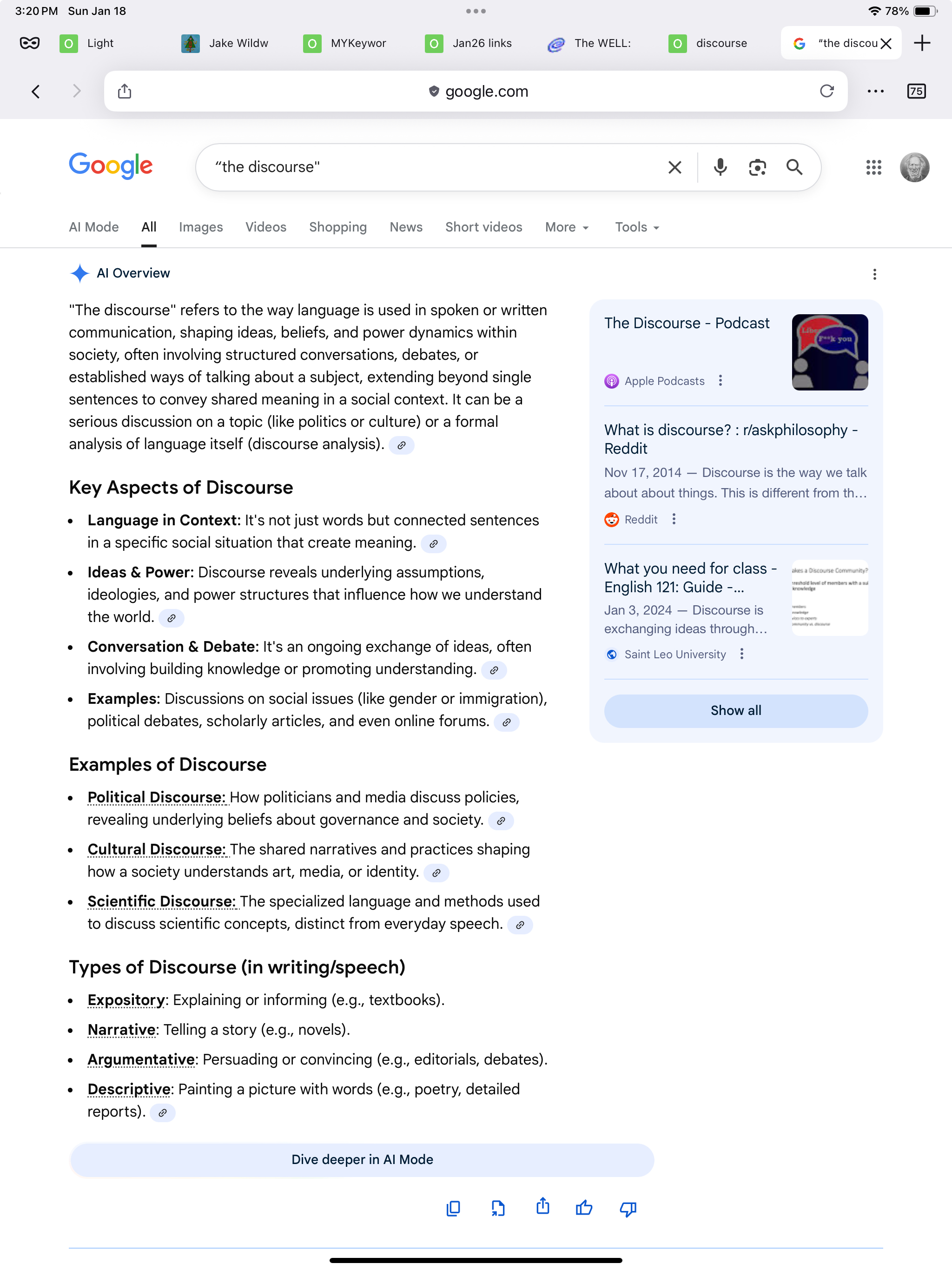
What is Discourse — Definition, Types, and Examples studiobinder (2020)
...a comprehensive term that encompasses various forms of communication beyond just spoken or written expression...Discourse involves many moving parts, all working together to create effective communication. These components include language, context, participants, and goals. Each component contributes to the overall meaning and effectiveness of discourse.
...Discourse is typically categorized into four main types: [Narrative, Descriptive, Expository, Argumentative]
...Discourse analysis is the study of language as it is used in communication. It involves examining the structure, context, and use of language to understand its meaning and effects
People talk incessantly, and once there's writing, they live in and around the symbols that convey meaning and messages and information (and that goes back at least as far as the first cuneiform of Sumerian times. There are conversations within the speech community, which we can label as discourse. Sez Foucault
...any practice by which individuals imbue reality with meaning ...a system of thought, knowledge or communication that constructs our world experience...Discourse analysis, in sociopolitical, social, and cultural context, attends to the state of play in intellectual exchange, which is the process of refining the information in a common ground (the set of propositions that the interlocutors have agreed to treat as true)
18i26
This morning's incoming included a post by Doc Searls quoting Joan Westerberg, which led me to her The Discourse is a Distributed Denial-of-Service Attack, an especially cogent piece of writing, My lengthy extracts are here and below are some especially trenchant excerpts:
...the botnet is the discourse itself ...our collective attention...The discourse takes the most important problem of our time and converts it into an infinite series of tribal skirmishes, each of which generates heat and engagement while bringing us no closer to answering any of the actual hard questions.
The discourse doesn't help us think about things. It helps us perform thinking about things, which is a different activity entirely.
...The feed is infinite, and every slot in the feed is optimized to make you feel something strongly enough that you'll engage with it. Outrage works, and so does fear. Disgust works, and righteousness really fucking works. Nuance and careful reasoning don't work at all, because by the time you've finished a thought that begins with "Well, it's complicated..." someone else has already posted a much simpler take that makes people feel validated, and the algorithm has moved on.
The discourse is great at generating positions. It's terrible at generating understanding. In fact, it actively undermines understanding. Understanding involves sitting with difficulty and ambiguity, while the discourse rewards confidence and clarity. Understanding involves admitting what you don't know, while the discourse punishes uncertainty as weakness. Understanding involves engaging with the best version of opposing views, while the discourse treats opposition as either stupidity or malice.
...When many ideas compete for limited attention, the ideas that are best at capturing attention win, and those that aren't good at it die out. This creates selection pressure toward attention-grabbing content, which tends to be extreme, emotional, simple, tribal, and visceral. The ideas that survive aren't the most true or useful. They're the most viral.
And virality, it turns out, has almost nothing to do with truth or usefulness.
...the discourse hates expertise. Or rather, it puts experts in an impossible position. To engage with the discourse, an expert has to compress their nuanced understanding into takes that can compete with the confident nonsense being spouted by random accounts with anime avatars. This compression loses most of what makes expertise valuable in the first place.
...Experts withdraw from public discourse because it's frustrating and unrewarding, which leaves the field to confident non-experts and degrades the quality of public understanding, which makes it even harder for experts to engage productively when they do try to participate. The result is an environment that's actively hostile to expertise while claiming to value science and evidence.
...In computer science, there's a concept called the halting problem: the impossibility of writing a program that can determine, for any arbitrary program and input, whether that program will eventually halt or run forever. Alan Turing proved in 1936 that no such algorithm can exist. The halting problem is undecidable.
The discourse has something like a collective halting problem. Every controversy generates commentary, and that commentary generates meta-commentary. Where does it stop? When is a topic resolved? When can we move on? There's no algorithm for this. The discourse doesn't halt. It just continues until something newer and shinier captures our attention, at which point the old controversy doesn't get resolved so much as abandoned. The underlying issues remain, waiting to resurface the next time something triggers them.
...The discourse isn't a process that converges on truth over time. It's a holding pattern. We circle endlessly without ever landing.
...Find some topic you care about. Just one. Resist the temptation to have takes on everything else. Let the discourse rage without you while you spend weeks or months actually understanding something. Read books about it, not takes. Talk to experts, not pundits. Follow the evidence where it leads, even when it's uncomfortable. Change your mind when you find you were wrong. And when you finally have something to say, something you've actually earned through careful thought rather than absorbed from the tribal zeitgeist, say it clearly and then step back.
Reading Joan Westenberg surfaced the conundrum of the definite article 'The' (The Algorithm, The Culture, The Imagination, The Landscape, The Lexicon, The Narrative, The Zeitgeist, etc.) which seems to mark a general concept, and to suggest an abstraction, a diffuse and disembodied force in which one swims. 'The Algorithm' has a different salience and flavor and reach than 'an algorithm', which is in essence a set of steps.
I searched the word book shelves for other explications of discourse, several of which seem useful enough to transcribe:
from Neologisms: New words since 1960 Jonathon Green (1991):...(1977) a mode of systematic representation of the world, what Marx called 'consciousness' and what Michel Foucault has termed the systems of linguistic representation through which power sustains itself. The discourse is used to order and arrange an otherwise random world, and in so doing exert one's mastery over it. On a more general level this bedrock term of structuralist criticism is a synonym for the way we see a given topic, discipline, or just a way of talking about things (76)from New Keywords: A Revised Vocabulary of Culture and Society Tony Bennett et al. (2005)
...meaning something like the fact of organized language as a set of social relations of knowledge (91)...in linguistics to the analysis of utterances at a level higher than that of the sentence, and by extension to the rhetorical dimensions of language (92)
...['discourse'] has also become so widely and often so glibly used as to have lost much of its precise meaning (93)
Both Cambridge Encyclopedia of Language and Cambridge Encyclopedia of the English Language have whole sections (as yet unplumbed) on 'Discourse'
OED (see more detail)
1. c1400- The process or faculty of reasoning; reasoned argument or thought; reason, rationality.2.a. 1532-1683 The thread of an argument; a line of reasoning; a reasoned argument. Obsolete.
3.a. 1533- A more or less formal treatment of a subject, in speech or writing, in which it is considered or discussed at length; a treatise, dissertation, homily, or the like; a disquisition.
3.b. 1546- A narrative or account of a particular subject. Now rare.
4.a. 1545- The action or process of communicating thought by means of the spoken word; interchange of words; conversation, talk. Also: the words exchanged by this means; speech. In later use also: the written representation of this; communication in written form.
...
7. 1931- The body of statements, analysis, opinions, etc., relating to a particular domain of intellectual or social activity, esp. as characterized by recurring themes, concepts, or values; (also) the set of shared beliefs, values, etc., implied or expressed by this. Frequently with of or modifying word.
8. 1951- Linguistics. A connected series of utterances by which meaning is communicated, esp. one forming a unit for analysis; spoken or written communication regarded as consisting of such utterances.
Compounds and derived words:
discourse, v. 1546-
intransitive. Frequently with of, on, upon. To…discoursory, adj. 1581-1604
= discoursive, adj.love discourse, n. 1591-
discoursative, adj. 1604-68
Rational, reasonable; susceptible to rational…table discourse, n. 1611-
Discourse or conversation at table, table talk…discourseless, adj. 1620-1857
Having no rational capability; unreasoning.by-discourse, n. 1660-
tavern-discourse, n. 1660-
discourse analysis, n. 1952-
A method of analysing the structure of texts or utterances longer than one sentence, taking into account both their linguistic content and their sociolinguistic context; analysis performed using this method.free indirect discourse, n. 1953- A manner of presenting the thoughts or utterances…
discourse analyst, n. 1958-
A person who engages in discourse analysis.metadiscourse, n. 1960-
Any discourse which is concerned with or alludes to other discourses. Also: a general or universal discourse which sets the parameters within which other discourses are employed.discoursal, adj. 1967-
Of or relating to discourse or a discourse (see…discourse marker, n. 1967-
A word or phrase whose function is to organize discourse into segments and situate a clause, sentence, etc., within a larger context.discourse theory, n. 1969-
A theoretical approach which uses discourse…discourse community, n. 1972-
A group of people sharing a common and distinct mode of communication or discourse, esp. within a particular domain of intellectual or social activity.